Quick Answer
Italian opera vocabulary gives you the language to follow a performance, read a program, and react naturally in the theatre. Learn core terms such as aria, libretto, overture, bravo, and bis, plus the cultural rules behind them.
Italian opera vocabulary includes musical terms such as aria /ˈa.rja/, libretto /liˈbret.to/, and ouverture /u.verˈtyr/, plus audience words such as bravo /ˈbra.vo/ and bis /bis/. Learn these terms and you can follow an Italian program, understand what happens onstage, and respond with confidence at a performance, whether you are at La Scala or watching opera in a film.
Italian is spoken by roughly 67 million people worldwide, according to Ethnologue's 27th edition. Yet opera has carried Italian far beyond Italy: terms such as soprano /soˈpra.no/, tempo /ˈtɛm.po/, and finale /fiˈna.le/ are standard in music around the world.
Opera is not simply music sung in Italian. It is a theatrical tradition shaped by regional theatres, social rituals, literary language, and strong audience participation. For a broader foundation in the language before your first performance, review these practical Italian greetings.
| English | Italian | Pronunciation | Note |
|---|---|---|---|
| Opera | opera | OH-peh-rah | A staged drama primarily sung rather than spoken. |
| Aria | aria | AH-ree-ah | A solo piece that develops a character's feelings. |
| Libretto | libretto | lee-BRET-toh | The opera's text and dramatic script. |
| Act | atto | AHT-toh | A major division of an opera. |
| Scene | scena | SHEH-nah | A smaller dramatic division within an act. |
| Overture | sinfonia | seen-foh-NEE-ah | Often an instrumental opening, depending on the work. |
| Orchestra | orchestra | or-KEH-strah | The instrumental ensemble, usually below the stage. |
| Conductor | direttore | dee-ret-TOH-reh | The musical leader, also called maestro. |
| Singer | cantante | kan-TAHN-teh | A general word for a vocal performer. |
| Rehearsal | prova | PROH-vah | Can refer to a musical, staging, or dress rehearsal. |
| Applause | applauso | ahp-PLOW-zoh | Audience clapping after a number or at the curtain call. |
| Encore | bis | bees | Literally 'again'; a request for a repeat performance. |
| Curtain call | chiamata alla ribalta | kyah-MAH-tah AHL-lah ree-BAHL-tah | The performers return to receive applause. |
| Premiere | prima | PREE-mah | Short for prima rappresentazione, the first performance. |
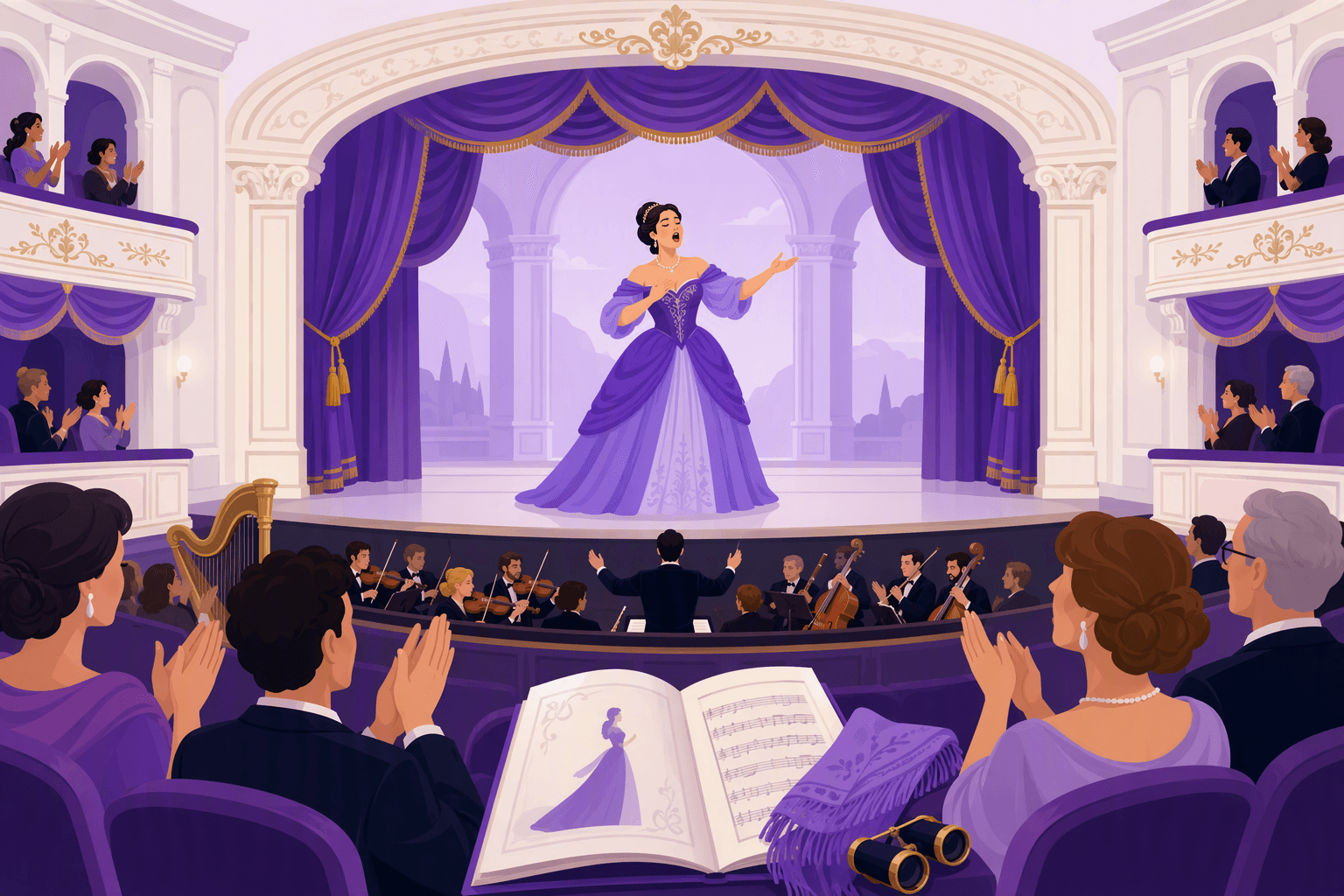
Why Italian became opera's shared language
The first works commonly described as opera emerged in late sixteenth-century Florence, where artists and intellectuals experimented with setting dramatic speech to music. The genre developed rapidly in Italian courts and public theatres, then spread throughout Europe.
Italian remained central because composers, singers, publishers, and theatres circulated its repertory across borders. A German, French, Russian, or English audience could encounter instructions such as allegro /alˈle.ɡro/, andante /anˈdan.te/, and pianissimo /pjaˈnis.si.mo/ without needing to speak Italian conversationally.
Treccani's entry on opera lirica /ˈɔ.pe.ra ˈli.ri.ka/ traces how the genre became a defining form of Italian musical theatre. That legacy is audible in the language itself: many opera terms describe not only technical form but a dramatic action or emotional state.
Music historian Philip Gossett, in Divas and Scholars: Performing Italian Opera, emphasizes that a score is not the whole event. Performance traditions, singer choices, editions, stage conventions, and audience expectations all shape what listeners actually experience.
The words you will see in an opera program
An Italian theatre program may look formal, but its core vocabulary becomes familiar quickly. These labels tell you where you are in the story and who is responsible for the production.
Opera
Opera /ˈɔ.pe.ra/ literally means work. In everyday Italian, it can refer to a work of art, a construction project, or an achievement, but in a theatre context it means a sung dramatic work.
You may see opera seria /ˈɔ.pe.ra ˈsɛr.ja/, serious opera, or opera buffa /ˈɔ.pe.ra ˈbuf.fa/, comic opera. These are historical categories, not strict promises about whether a modern production will feel solemn or funny.
Libretto
The libretto /liˈbret.to/ is the text of the opera: dialogue, lyrics, scene directions, and dramatic structure. The word literally means little book.
A librettista /li.bretˈtis.ta/ writes or adapts that text. In Italian opera, the librettist matters enormously because the relationship between words and music drives character, pacing, and emotional contrast.
For instance, Lorenzo Da Ponte wrote libretti for several Mozart operas, while Arrigo Boito collaborated with Giuseppe Verdi. Their work is not an accessory to the music: it supplies the drama the music intensifies.
Atto
An atto /ˈat.to/ is an act. A program might announce atto primo /ˈat.to ˈpri.mo/, first act, followed by intervallo /in.terˈval.lo/, an interval.
Many nineteenth-century operas have two, three, or four acts. A long atto /ˈat.to/ may contain several scenes, choruses, ensembles, and solo numbers without a break.
Scena
A scena /ˈʃe.na/ is a scene, often defined by a change in setting, dramatic focus, or characters onstage. In vocal writing, it can also name an extended solo sequence that moves through several musical moods.
Do not confuse scena /ˈʃe.na/ with a physical stage. The stage itself is palcoscenico /pal.koˈʃe.ni.ko/, a useful word when reading theatre directions.
Prima
A prima /ˈpri.ma/ means first. In opera, it commonly abbreviates prima rappresentazione /ˈpri.ma rap.pre.zen.taˈtsjo.ne/, the first performance of a production or a new work.
The opening night can be a major social and cultural event, particularly at historic theatres. Teatro alla Scala's archives document how premieres and season openings became closely connected with Milanese public life and artistic debate.
The people and voices onstage
Opera voice categories are practical labels, not personality types. They describe a singer's approximate range, weight, color, and the roles they are typically prepared to perform.
Soprano
A soprano /soˈpra.no/ is generally the highest standard adult female voice. Many famous heroines, including Violetta in Verdi's La traviata /la tra.vjaˈta/, are written for soprano.
Within that broad label, specialists may use terms such as soprano lirico /soˈpra.no ˈli.ri.ko/ or soprano drammatico /soˈpra.no dramˈma.ti.ko/. These indicate different vocal qualities and repertory needs.
Mezzosoprano
A mezzosoprano /ˌmɛd.dzo.soˈpra.no/ usually has a lower and darker range than a soprano. It is often shortened to mezzo /ˈmɛd.dzo/ in rehearsal talk.
Mezzo roles include mothers, rivals, confidantes, seductive figures, and some young male characters. The latter tradition is called a ruolo en travesti /ˈrwɔ.lo en tra.veˈsti/, a role in disguise, though the French phrase is commonly used internationally.
Tenore
A tenore /teˈno.re/ is a high adult male voice and often the romantic lead in nineteenth-century Italian opera. A tenore /teˈno.re/ must combine height, power, flexibility, and sustained dramatic expression.
The Italian do di petto /do di ˈpet.to/, literally chest C, refers to the famous high C sung with a powerful full voice. It has become a symbol of virtuosic tenor singing, even though not every tenor role requires it.
Baritono
A baritono /bariˈto.no/ sits between tenor and bass. Baritone roles frequently include fathers, political rivals, villains, friends, and complex authority figures.
Verdi wrote especially rich roles for baritono /bariˈto.no/, including Rigoletto and Simon Boccanegra. In these parts, vocal color is tied closely to moral and emotional ambiguity.
Basso
A basso /ˈbas.so/ is the lowest standard adult male voice. A basso profondo /ˈbas.so პროˈfon.do/ has an especially deep, resonant sound.
Bass roles may be comic, frightening, noble, religious, or paternal. The category is not automatically serious: Gioachino Rossini wrote dazzling comic music for basses as well.
🌍 Voice labels are not ranking systems
A soprano /soˈpra.no/ is not inherently better than a mezzosoprano /ˌmɛd.dzo.soˈpra.no/, and a tenore /teˈno.re/ is not automatically the lead. Opera casting depends on repertoire, dramatic character, vocal health, style, and the acoustic demands of a specific theatre.
Musical vocabulary that unlocks the drama
Italian opera often alternates between moments that advance the plot and moments that pause it to explore feeling. Recognizing this pattern makes even a subtitled performance easier to follow.
Aria
An aria /ˈa.rja/ is a solo number, usually centered on one character. It may reveal love, fear, determination, grief, jealousy, or a decision that changes the plot.
A famous aria /ˈa.rja/ can feel like a self-contained song, but it belongs to a larger dramatic arc. Watch what happens immediately before and after it: the emotional context explains why the character sings rather than simply speaks.
Recitativo
Recitativo /re.tʃi.taˈti.vo/ is speech-like singing that moves the action forward. It may be accompanied sparsely by keyboard and cello, or supported by the full orchestra.
In earlier Italian opera, recitativo secco /re.tʃi.taˈti.vo ˈsek.ko/ used light accompaniment, while recitativo accompagnato /re.tʃi.taˈti.vo ak.kom.paɲˈɲa.to/ used the orchestra for heightened dramatic moments.
Duetto
A duetto /duˈet.to/ is a piece for two singers. It can be romantic, argumentative, comic, conspiratorial, or all of these in sequence.
Italian opera loves musical disagreement. Two characters may sing different words, rhythms, and emotions simultaneously, then unite in the same melody when the drama reaches a turning point.
Coro
A coro /ˈkɔ.ro/ is the chorus. In Verdi especially, the coro /ˈkɔ.ro/ can represent citizens, prisoners, soldiers, priests, partygoers, or a whole community under pressure.
The coro /ˈkɔ.ro/ is often a dramatic force rather than background decoration. Verdi's Va, pensiero /va penˈsjɛ.ro/ from Nabucco /naˈbuk.ko/ became associated with Italian national feeling during the nineteenth century.
Finale
A finale /fiˈna.le/ is the ending of an act or the whole opera. A large finale /fiˈna.le/ may build from a conversation into a multi-character ensemble, with the orchestra accelerating the tension.
This is one reason opera can feel overwhelming in the best way: several characters experience different crises at the same time, while the music lets you hear their conflict together.
For more everyday Italian music and emotion vocabulary, see our guide to Italian music words and Italian emotion words.
How to react like an informed audience member
Opera audiences are often quieter than cinema audiences during the performance, but they can be highly expressive at the right moments. The rules are simple: listen closely, follow the performers' timing, and never interrupt the music.
Bravo
Bravo /ˈbra.vo/ means well done when addressing one man. For one woman, say brava /ˈbra.va/. For several people, use bravi /ˈbra.vi/ for a mixed group or masculine group, and brave /ˈbra.ve/ for an all-women group.
International audiences often call bravo /ˈbra.vo/ regardless of the singer's gender. Italians will understand it, but choosing brava /ˈbra.va/ after an exceptional female solo is a thoughtful detail.
Bis
Bis /bis/ means again. Calling bis /bis/ after a celebrated aria asks for an encore.
Do not expect it at every performance. Modern staging, orchestra schedules, and conductors' artistic choices can make an encore impractical, even when the audience is enthusiastic.
Maestro
Maestro /maˈɛs.tro/ is a respectful title for a master musician, especially a conductor or distinguished composer. You may hear it used for the direttore d'orchestra /di.retˈto.re dorˈkɛs.tra/, the conductor.
Use it carefully outside the theatre. Calling every Italian musician maestro /maˈɛs.tro/ can sound overly theatrical, but in an opera setting it is entirely natural.
🌍 Applause has its own timing
Clapping after a major aria /ˈa.rja/ is normal in Italian opera culture, particularly when a singer finishes a famous or difficult passage. Do not applaud during the number. If you are uncertain, wait for experienced audience members and join them after the final chord.
Opera etiquette in an Italian theatre
Arrive early enough to find your seat before the lights go down. Historic theatres can have narrow corridors, steep balconies, and small seats, especially in upper-level sections.
A palco /ˈpal.ko/ is a private box, while platea /plaˈtɛ.a/ usually refers to the main floor seating. The upper galleries may be called loggione /lodˈdʒo.ne/ or loggione /lodˈdʒo.ne/ seating, depending on the theatre's local terminology.
At La Scala, the loggione /lodˈdʒo.ne/ has a reputation for informed and demanding listeners. This is not a myth of Italian opera: audiences have historically expressed strong approval and, at times, disapproval, making the theatre a live public forum rather than a silent museum.
Avoid talking, unwrapping food, or checking a bright phone screen during the music. If you need to leave, wait for applause or an interval unless there is an emergency.
When the evening ends, arrivederci /ar.ri.veˈder.tʃi/ is a natural goodbye. If you attended with someone special and the performance moved you, Italian has no shortage of expressive language beyond the stage, including the phrases in our guide to saying I love you in Italian.
Learn opera words through scenes, not isolated lists
Opera vocabulary sticks when you connect it to a real scene. Watch a short clip with Italian subtitles, identify whether you are hearing an aria /ˈa.rja/, duetto /duˈet.to/, or recitativo /re.tʃi.taˈti.vo/, then repeat one line with the singer's rhythm.
Mary Ann Smart's Waiting for Verdi examines how nineteenth-century Italian opera audiences experienced music as public culture, not merely private listening. That remains useful for learners: opera language is social, physical, and tied to the moment of performance.
Start with a familiar story, use subtitles in your strongest language, then replay key passages with Italian subtitles. The goal is not to understand every poetic line immediately. It is to notice recurring words, recognize dramatic patterns, and hear how Italian vowels carry emotion through melody.
Frequently Asked Questions
What are the most important Italian opera words to know?
Why do audiences say bravo at the opera?
Can I clap after an aria in Italy?
What does bis mean at an Italian opera performance?
Do I need to speak Italian to enjoy opera in Italy?
Sources & References
- Treccani, Enciclopedia dell'Italiano: Opera lirica, accessed 2026
- Teatro alla Scala, Archivio Storico and theatre history resources, accessed 2026
- Fondazione Rossini, Gioachino Rossini resources and critical editions, accessed 2026
- Philip Gossett, Divas and Scholars: Performing Italian Opera, University of Chicago Press
- Ethnologue, Italian, 27th edition, 2024
Start learning with Wordy
Watch real movie clips and build your vocabulary as you go. Free to download.


