Quick Answer
The most essential Italian emotion words are felice (happy), triste (sad), arrabbiato (angry), spaventato (scared), sorpreso (surprised), and disgustato (disgusted). Italian also has untranslatable emotion words like magone (a lump in your throat from deep emotion), struggimento (intense longing), and sprezzatura (studied nonchalance) that have no direct English equivalent.
The most important Italian emotion words to learn first are felice (happy), triste (sad), arrabbiato (angry), spaventato (scared), sorpreso (surprised), and disgustato (disgusted). Italian emotion vocabulary goes far beyond simple translations, though. The language includes untranslatable words like magone, struggimento, and sprezzatura that reveal how deeply feelings are woven into Italian culture and identity.
With approximately 68 million native speakers according to Ethnologue's 2024 data and an additional 17 million second-language speakers, Italian is the language of opera, poetry, and passionate expression. Psychologist Paul Ekman's foundational research identified six universal emotions recognized across all human cultures, and Italian has distinct, expressive vocabulary for each one, plus dozens of culturally specific feelings that English simply cannot capture in a single word.
"Languages differ not only in how they label emotions but in which emotional distinctions they treat as fundamental. Italian, like other Romance languages, preserves a lexical richness around states of longing, tenderness, and social grace that Germanic languages have largely collapsed or left unnamed."
(Anna Wierzbicka, Emotions Across Languages and Cultures, Cambridge University Press)
This guide covers 40+ Italian emotion words organized by category, with pronunciation, grammar notes, uniquely Italian concepts, and the cultural context that brings this vocabulary to life.

Quick Reference: Essential Italian Emotions
| English | Italian | Pronunciation | Note |
|---|---|---|---|
| Happy | Felice | feh-LEE-cheh | 2-form: felice/felici |
| Sad | Triste | TREE-steh | 2-form: triste/tristi |
| Angry | Arrabbiato | ahr-rahb-BYAH-toh | 4-form: -o/-a/-i/-e |
| Scared | Spaventato | spah-vehn-TAH-toh | 4-form: -o/-a/-i/-e |
| Surprised | Sorpreso | sohr-PREH-zoh | 4-form: -o/-a/-i/-e |
| Disgusted | Disgustato | dee-zgoo-STAH-toh | 4-form: -o/-a/-i/-e |
| In love | Innamorato | een-nah-moh-RAH-toh | 4-form: -o/-a/-i/-e |
| Worried | Preoccupato | preh-ohk-koo-PAH-toh | 4-form: -o/-a/-i/-e |
| Calm | Tranquillo | trahn-KWEEL-loh | 4-form: -o/-a/-i/-e |
| Tired | Stanco | STAHN-koh | 4-form: -o/-a/-i/-e |
💡 Two-Form vs. Four-Form Emotion Adjectives
Check the Note column above. Adjectives ending in -e (like felice, triste) are two-form: they stay the same in masculine and feminine singular and only change in the plural (felici, tristi). Adjectives ending in -o (like arrabbiato, spaventato) are four-form and change for both gender and number. This distinction is essential for sounding natural.
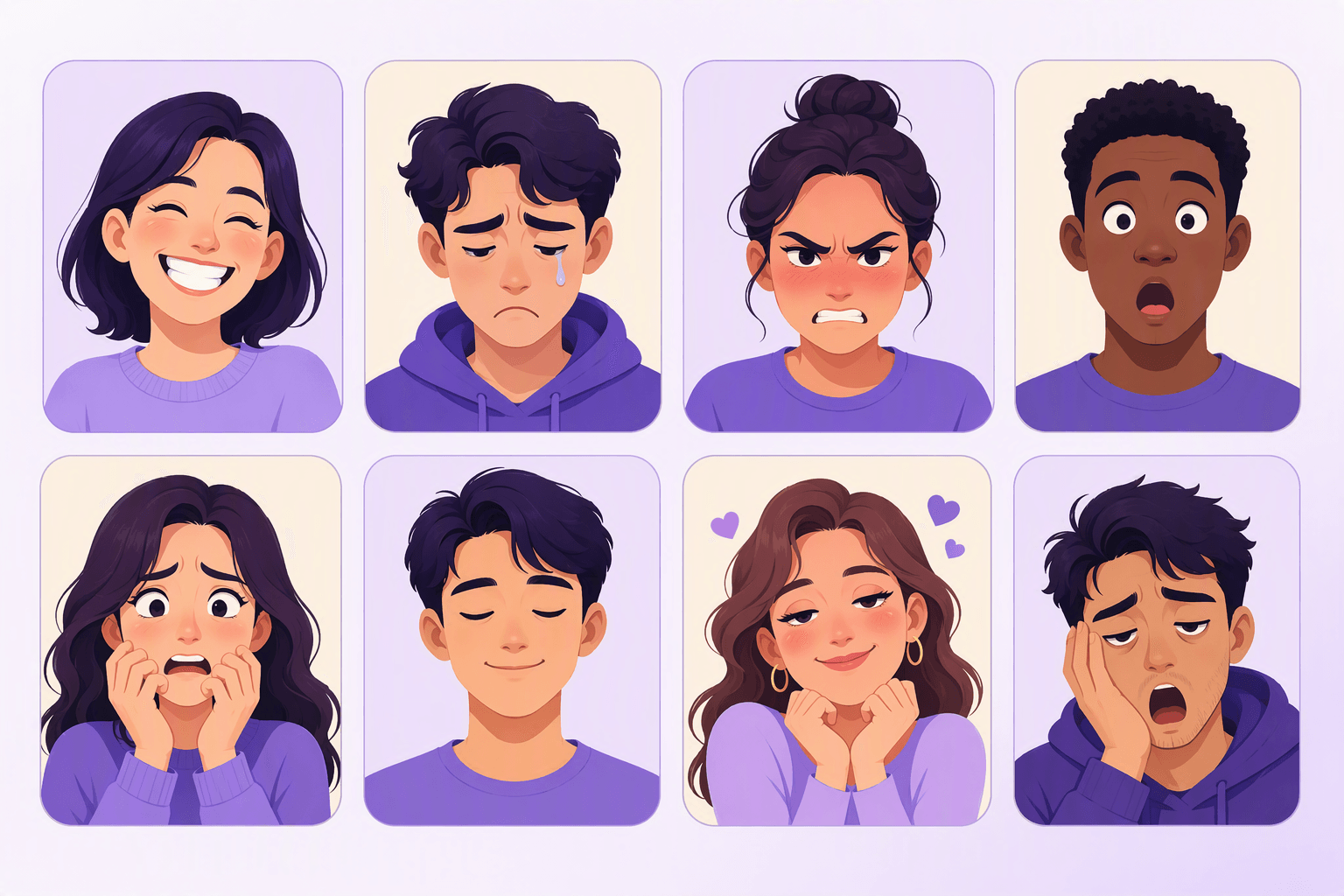
Basic Emotions
Ekman's six universal emotions each have a clear Italian equivalent. These are the foundation of emotional expression in the language.
Felice
| English | Italian | Pronunciation | Note |
|---|---|---|---|
| Happy | Felice | feh-LEE-cheh | Sono felice (I'm happy) |
| Content / Pleased | Contento | kohn-TEHN-toh | 4-form; slightly less intense than felice |
| Sad | Triste | TREE-steh | Sono triste (I'm sad) |
| Angry | Arrabbiato | ahr-rahb-BYAH-toh | Sono arrabbiata (fem.) |
| Scared / Afraid | Spaventato | spah-vehn-TAH-toh | Also: ho paura (I have fear) |
| Surprised | Sorpreso | sohr-PREH-zoh | Sono rimasto sorpreso (I was surprised) |
| Disgusted | Disgustato | dee-zgoo-STAH-toh | Che schifo! = How disgusting! |
Felice and contento both translate to "happy" but carry different weights. Felice implies a deeper, more lasting happiness, closer to "joyful" or "blissful." Contento is lighter, more situational: Sono contento del risultato (I'm pleased with the result). In daily conversation, Italians use contento more frequently for everyday satisfaction and reserve felice for genuine joy.
Triste
Triste is a two-form adjective: triste in the singular (both masculine and feminine), tristi in the plural. Italian often intensifies sadness through the absolute superlative: tristissimo/tristissima (extremely sad). The word comes from Latin tristis and shares its root with the English musical term triste, used to mark a melancholy passage.
Arrabbiato
Arrabbiato follows the standard four-form pattern: arrabbiato/arrabbiata/arrabbiati/arrabbiate. It is also the name of a famous pasta sauce, pasta all'arrabbiata (pasta in the angry style), named for its fiery chili heat. The superlative arrabbiatissimo (absolutely furious) is a common spoken form that packs five syllables of Italian fury into a single word.
Positive Emotions
Italian has a particularly rich vocabulary for positive feelings, reflecting the culture's emphasis on joy, gratitude, and personal satisfaction.
Entusiasta
| English | Italian | Pronunciation | Note |
|---|---|---|---|
| Enthusiastic / Excited | Entusiasta | ehn-too-ZYAH-stah | Invariable: -a for all genders |
| Grateful | Grato | GRAH-toh | 4-form: grato/grata/grati/grate |
| Proud | Orgoglioso | ohr-goh-LYOH-zoh | 4-form: -o/-a/-i/-e |
| Serene / Peaceful | Sereno | seh-REH-noh | 4-form; also means clear (sky) |
| Satisfied | Soddisfatto | sohd-dee-SFAH-toh | 4-form: -o/-a/-i/-e |
| Hopeful | Speranzoso | speh-rahn-TSOH-zoh | 4-form: -o/-a/-i/-e |
| Relieved | Sollevato | sohl-leh-VAH-toh | 4-form: -o/-a/-i/-e |
| Moved / Touched | Commosso | kohm-MOHS-soh | 4-form; deeply emotional |
Entusiasta is a common trap for learners: it ends in -a for all genders in the singular (sono entusiasta whether you are male or female). The plural forms split: entusiasti (masculine), entusiaste (feminine). This irregular pattern also applies to ottimista (optimistic) and pessimista (pessimistic).
Commosso deserves special attention. It describes being emotionally moved to the point of visible tears, something Italians consider beautiful, not embarrassing. An Italian father might be described as commosso at his daughter's wedding, a singer as commossa during a standing ovation. The word captures a cultural openness to visible emotion that English "moved" or "touched" only partially conveys.
Negative Emotions
Ansioso
| English | Italian | Pronunciation | Note |
|---|---|---|---|
| Anxious | Ansioso | ahn-SYOH-zoh | 4-form: -o/-a/-i/-e |
| Frustrated | Frustrato | froo-STRAH-toh | 4-form: -o/-a/-i/-e |
| Jealous | Geloso | jeh-LOH-zoh | 4-form: -o/-a/-i/-e |
| Lonely | Solo | SOH-loh | 4-form: solo/sola/soli/sole |
| Ashamed | Vergognoso | vehr-goh-NYOH-zoh | Also: ho vergogna (I have shame) |
| Nervous | Nervoso | nehr-VOH-zoh | 4-form: -o/-a/-i/-e |
| Disappointed | Deluso | deh-LOO-zoh | 4-form: -o/-a/-i/-e |
| Bored | Annoiato | ahn-noh-YAH-toh | 4-form: -o/-a/-i/-e |
| Envious | Invidioso | een-vee-DYOH-zoh | 4-form: -o/-a/-i/-e |
Geloso and invidioso are often confused by learners, but Italians draw a clear distinction. Geloso is jealousy: the fear of losing something (or someone) you already have. Invidioso is envy: wanting something someone else possesses. An Italian might say È geloso della sua ragazza (He's jealous about his girlfriend) but È invidioso del suo successo (He's envious of his success). Mixing these up will draw a quick correction from native speakers.
Vergognoso works as an adjective, but Italians more naturally express shame with the noun construction: Ho vergogna (I have shame) rather than Sono vergognoso. This pattern (avere + noun instead of essere + adjective) is a key grammatical feature of Italian emotion vocabulary (more on this below).
Uniquely Italian Emotions
These words have no direct English equivalent. They represent emotional concepts so embedded in Italian culture that other languages borrow them untranslated.
Magone
| English | Italian | Pronunciation | Note |
|---|---|---|---|
| Lump in throat (from emotion) | Magone | mah-GOH-neh | Avere il magone; no English equivalent |
| Intense longing / yearning | Struggimento | stroo-jee-MEHN-toh | From struggere (to consume) |
| Studied nonchalance | Sprezzatura | spret-tsah-TOO-rah | Coined by Castiglione, 1528 |
| Sweet doing nothing | Dolce far niente | DOHL-cheh far NYEHN-teh | A celebrated Italian lifestyle ideal |
| Making a good impression | Bella figura | BEL-lah fee-GOO-rah | Social/emotional concept, not just appearance |
Magone is perhaps the most emotionally precise untranslatable Italian word. It describes that physical lump in your throat when emotion overwhelms you, not necessarily sadness, but any intense feeling. Hearing a beautiful aria, watching your child graduate, returning to a childhood home after years away: all might produce il magone. Italians say Ho il magone (I have the magone), treating it as something that arrives and takes hold of you physically. The Treccani dictionary traces the word to a dialectal term originally meaning the gizzard of a bird, metaphorically extended to the tight sensation in the throat.
Struggimento
Struggimento comes from the verb struggere (to melt, to consume) and describes an intense, almost painful longing for a lost love, a distant homeland, or an idealized past. It is the emotion behind countless Italian opera arias, the feeling Puccini's characters embody when they sing of love beyond reach. Where English might need a full phrase ("a consuming, bittersweet yearning"), Italian captures it in a single word.
Sprezzatura
Sprezzatura was coined by Baldassare Castiglione in Il Cortegiano (The Book of the Courtier, 1528) to describe the Renaissance ideal of making difficult things appear effortless. It is not merely "coolness" or "nonchalance"; it carries the specific nuance of deliberate practice concealed behind apparent ease. A well-dressed Italian who looks as though he simply threw on whatever was nearby is performing sprezzatura. The concept has been adopted into English fashion and design vocabulary precisely because no native English word captures the same meaning.
Dolce far niente
Dolce far niente (the sweetness of doing nothing) is not laziness; it is a philosophy. It describes the deliberate pleasure of having no obligations and savoring that freedom. This phrase appears in Italian literature as far back as the 18th century and was popularized internationally by the film Eat, Pray, Love. In Italian daily life, the long Sunday lunch, the slow afternoon espresso, the evening passeggiata: these all embody dolce far niente.
Bella figura
Bella figura (literally "beautiful figure") goes far beyond physical appearance. It is the Italian social and emotional imperative to present yourself well in all contexts: dressing appropriately, behaving graciously, being generous, never embarrassing yourself or others. Its opposite, brutta figura (ugly figure), is one of the most dreaded social outcomes in Italian culture. The Accademia della Crusca notes that fare bella figura (to make a good impression) is among the most frequently used idiomatic expressions in contemporary Italian.
Italian Hand Gestures and Emotions
🌍 Gestures Amplify the Vocabulary
Italian is famous for its hand gestures, and emotional expression relies on them heavily. A few essential gesture-emotion pairings: the "pinched fingers" gesture (fingertips together, hand bouncing upward) can express frustration, disbelief, or "what do you want?"; touching the cheek and rotating the hand means "delicious" or "beautiful" (positive emotion); flicking fingers under the chin means "I don't care" (indifference, defiance). Research by linguist Isabella Poggi at Roma Tre University has catalogued over 250 distinct Italian gestures, many of which are inseparable from the emotional words they accompany. Learning the vocabulary without the gestures gives you only half the picture.
Grammar: Essere vs. Avere With Emotions
One of the most important patterns in Italian emotion vocabulary is the split between essere (to be) + adjective and avere (to have) + noun. English uses "to be" for nearly all emotions, but Italian distributes them across both verbs.
Essere + adjective (the emotion as a state you are in):
| Italian | English |
|---|---|
| Sono felice | I am happy |
| Sei triste | You are sad |
| È arrabbiata | She is angry |
| Siamo sorpresi | We are surprised |
| Sono innamorato | I am in love |
Avere + noun (the emotion as something you have):
| Italian | Literal Translation | English Meaning |
|---|---|---|
| Ho paura | I have fear | I'm scared |
| Ho vergogna | I have shame | I'm ashamed |
| Ho nostalgia | I have nostalgia | I miss (something) |
| Ho il magone | I have the lump-in-throat | I'm choked up |
| Ho ansia | I have anxiety | I'm anxious |
⚠️ Do Not Mix These Constructions
You cannot say sono paura (I am fear) or ho triste (I have sad). The essere/avere split is fixed for each emotion and must be memorized. A useful rule of thumb: if the Italian emotion word is an adjective (ending in -o/-a/-e), use essere. If it is a noun, use avere. When in doubt, the Treccani dictionary marks each word's grammatical category.
Intensifying Emotions: Superlatives and Augmentatives
Italian speakers rarely settle for a plain adjective when they can intensify it. The absolute superlative suffix -issimo/-issima/-issimi/-issime is used constantly with emotion words:
| Base Form | Superlative | Meaning |
|---|---|---|
| Felice | Felicissimo/a | Extremely happy |
| Triste | Tristissimo/a | Extremely sad |
| Arrabbiato | Arrabbiatissimo/a | Absolutely furious |
| Stanco | Stanchissimo/a | Utterly exhausted |
| Contento | Contentissimo/a | Overjoyed |
| Nervoso | Nervosissimo/a | Extremely nervous |
These superlative forms are not bookish or exaggerated in Italian. They are standard spoken language. An Italian will say Sono felicissima! where an English speaker might say "I'm so happy!" The -issimo suffix is one of the most productive and distinctive features of Italian and gives the language much of its expressive musicality.
Italian also borrows emotion vocabulary from the world of opera and classical music, where Italian terms are the global standard. Words like furioso (furious), appassionato (passionate), doloroso (painful/sorrowful), and agitato (agitated) appear as musical tempo and expression markings worldwide, a testament to how central emotional expression is to the Italian language.
Practice Emotions With Real Italian Content
Emotion vocabulary comes alive in context, whether in a heated argument in an Italian film, a declaration of love in an opera, or the quiet sadness of a Ferrante novel. Italian cinema and television are particularly rich in emotional expression, from the raw passion of neorealist classics to contemporary drama.
Wordy lets you practice Italian emotion words in real context by watching Italian content with interactive subtitles. When arrabbiato, felice, or innamorato appears in dialogue, tap it to see its gender forms, pronunciation, and usage. Hearing native speakers express emotions naturally, with the gestures, intonation, and intensity that textbooks cannot capture, is the fastest path to fluency.
Explore our blog for more Italian vocabulary guides, or check out the best movies to learn Italian for viewing recommendations that bring this emotional vocabulary to life.
Frequently Asked Questions
What are the basic emotions in Italian?
Do Italian emotion adjectives change for gender?
What is magone in Italian?
What does sprezzatura mean?
What is the difference between essere and avere with Italian emotions?
How do Italians express strong emotions with word endings?
Sources & References
- Accademia della Crusca, Vocabolario degli Accademici della Crusca
- Ekman, P., Basic Emotions, in Handbook of Cognition and Emotion (Wiley)
- Wierzbicka, A., Emotions Across Languages and Cultures (Cambridge University Press)
- Treccani, Enciclopedia e Vocabolario online
- Ethnologue: Languages of the World, 27th edition (2024)
Start learning with Wordy
Watch real movie clips and build your vocabulary as you go. Free to download.


