Italian Slang Words and Expressions: 20+ Essential Phrases Italians Actually Use
Quick Answer
The most essential Italian slang word is 'Figo/a' (FEE-goh), meaning 'cool' or 'awesome.' But Italian slang is deeply regional. Romans say 'Daje!' (let's go!), Milanese say 'Bella lì' (nice one), and Neapolitans say 'Uè!' (hey!). The universal expression 'Boh!' (I don't know / who cares) with an exaggerated shoulder shrug might be the most Italian thing you'll ever learn.
Why Italian Slang Is Unlike Any Other
Italian slang is not one system; it is twenty. Every major city, from Rome to Milan to Naples, has developed its own distinct informal vocabulary shaped by centuries of regional dialect. Understanding these expressions is the difference between textbook Italian and the language Italians actually speak.
Italian is spoken by approximately 85 million people worldwide, according to Ethnologue's 2024 data. But within Italy's 20 regions, linguistic diversity is staggering. The Accademia della Crusca, Italy's oldest linguistic institution (founded in 1583), has documented how regional dialects continuously feed new slang into standard Italian.
"Italian slang is the living bridge between the old dialects and modern standard Italian. Each generation reinvents the language, but the regional roots remain visible."
(Tullio De Mauro, La storia linguistica dell'Italia unita, Laterza)
This guide covers 20+ essential Italian slang expressions organized by category: universal expressions everyone uses, everyday casual slang, regional expressions from Rome, Milan, and Naples, and youth slang you will hear on social media. Each includes pronunciation, examples, and the cultural context you need to use them naturally.
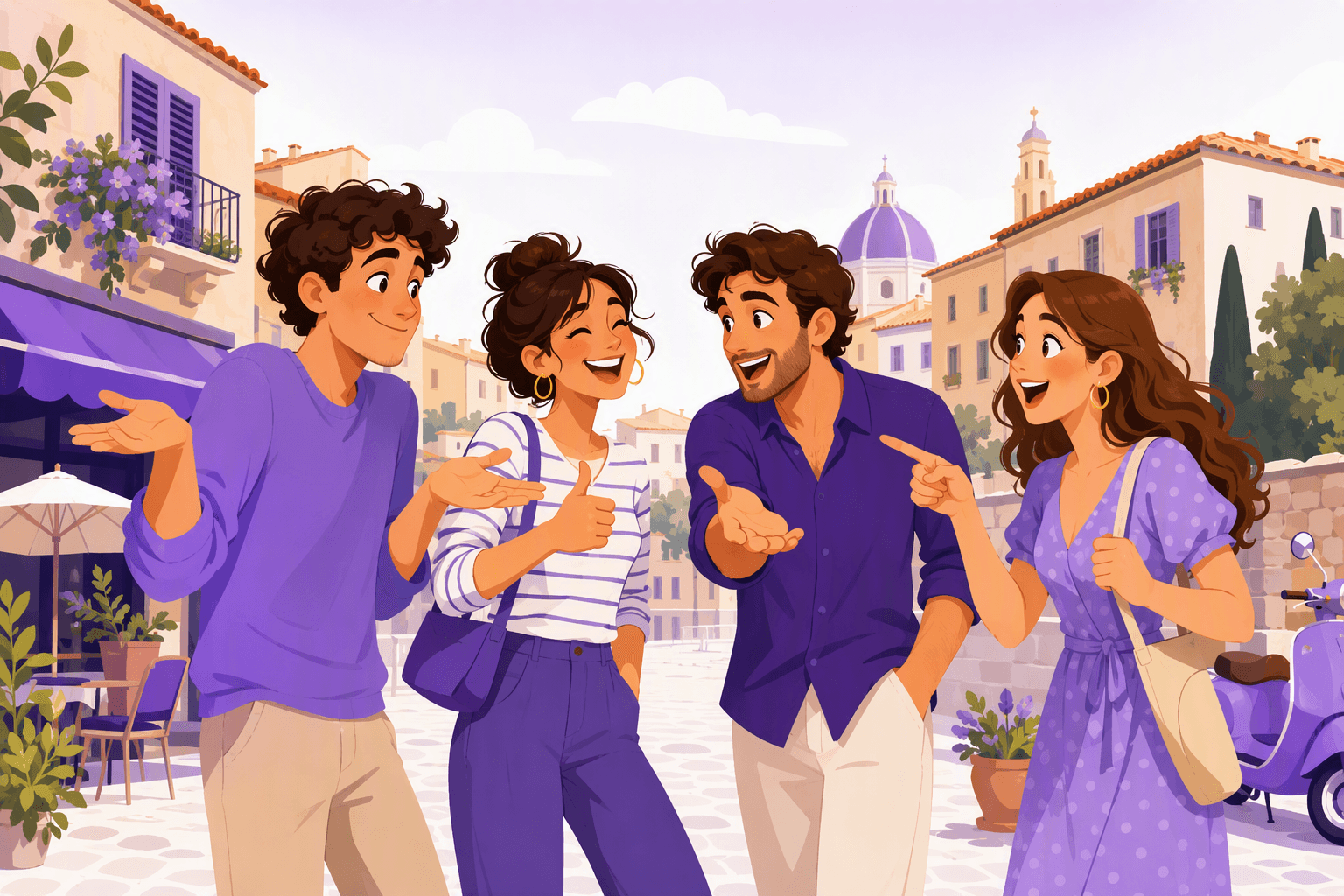
Quick Reference: Italian Slang at a Glance
| English | Italian | Pronunciation | Formality |
|---|---|---|---|
| Cool / Awesome | Figo/a | FEE-goh / FEE-gah | slang |
| How awesome! | Che figata! | keh fee-GAH-tah | slang |
| I don't know / Who knows | Boh! | BOH | casual |
| If only! / I wish! | Magari! | mah-GAH-ree | casual |
| Come on! / Let's go! | Dai! | DAH-ee | casual |
| Dude / Mate | Tipo/a | TEE-poh / TEE-pah | slang |
| To hang out | Beccarsi | behk-KAR-see | slang |
| Broke (no money) | Al verde | ahl VEHR-deh | casual |
| To freak out | Andare fuori di testa | ahn-DAH-reh FWOH-ree dee TEHS-tah | slang |
| Wasted / Hammered | Sbronzo/a | ZBRON-tsoh / ZBRON-tsah | slang |
| Let's go! (Rome) | Daje! | DAH-yeh | slang |
| Would you look at that! (Rome) | Anvedi! | ahn-VEH-dee | slang |
| Not at all (Rome) | Mica | MEE-kah | casual |
| Nice one! (Milan) | Bella lì | BEHL-lah LEE | slang |
| Hey! (Naples) | Uè! | oo-EH | slang |
| Stunning (youth) | Spettacolare | speht-tah-koh-LAH-reh | casual |
| To ghost someone | Ghostare | goh-STAH-reh | slang |
| To chill | Chillare | cheel-LAH-reh | slang |
Universal Italian Slang
These expressions are understood and used across all of Italy, regardless of region. They form the core of informal Italian and you will hear them dozens of times per day in any Italian city.
Figo/a
/FEE-goh / FEE-gah/
Literal meaning: Fig (the fruit)
“Quella macchina è troppo figa!”
That car is so cool!
Italy's most versatile slang adjective. Can describe anything cool, attractive, or impressive. Etymologically traced from 'fico' (fig). Treccani documents its evolution from fruit to slang across the 20th century.
Figo is the Swiss Army knife of Italian slang. A person, a car, a restaurant, a movie, a pair of shoes: anything impressive can be figo. The word follows standard Italian gender agreement: figo for masculine, figa for feminine. Note that figa can also be vulgar in some contexts (referring to female anatomy), so context and tone matter.
The exclamation Che figata! (keh fee-GAH-tah), literally "what a fig-ness!", is the standard way to express that something is awesome. You will hear it constantly among Italians under 50.
Boh!
/BOH/
Literal meaning: (none, pure interjection)
“Dove vuoi mangiare stasera?, Boh!”
Where do you want to eat tonight?, I dunno!
Always accompanied by a shoulder shrug with open palms. Zanichelli's dictionary lists it as one of the most frequently used Italian interjections. Used by all ages, all regions, all social classes.
Boh might be the single most Italian sound in existence. It expresses uncertainty, indifference, or a cheerful refusal to commit. The word has no real etymology; it is pure sound, pure gesture, pure Italian. According to Zanichelli's Lo Zingarelli, it entered standard dictionaries in the mid-20th century, though Italians had been shrugging and saying it for much longer.
The key is the delivery: rounded lips, one sharp syllable, shoulders up, palms open. Without the gesture, it is only half a Boh.
🌍 The Gesture Is Part of the Word
In Italian communication, hand gestures are not decoration; they carry meaning. Boh! without the shoulder shrug is incomplete. Research from the University of Rome has shown that Italian speakers process gesture and speech as a single communicative unit, not separate channels.
Magari!
/mah-GAH-ree/
Literal meaning: From Greek 'makári' (blessed/fortunate)
“Vuoi venire in vacanza con noi? (Magari!”
Do you want to come on holiday with us?) I wish! / That would be amazing!
One of the most untranslatable Italian words. Can mean 'if only!,' 'I wish!,' 'hopefully!,' or even 'maybe/perhaps.' The meaning depends entirely on context and intonation.
Magari is the word that Italian learners fall in love with and then struggle to use correctly. It packs at least three English translations into one word. Treccani traces it to the Greek makári (blessed, fortunate), which evolved through Southern Italian dialects into mainstream Italian.
As a standalone exclamation (Magari!), it expresses a passionate wish. In a sentence (Magari domani piove, maybe it'll rain tomorrow), it functions as "perhaps." This dual nature makes it distinctly Italian, a word that can express both intense desire and casual uncertainty.
Dai!
/DAH-ee/
Literal meaning: You give (imperative of 'dare')
“Dai, andiamo! Siamo già in ritardo.”
Come on, let's go! We're already late.
Used across all of Italy. Can express encouragement ('Dai, ce la puoi fare!', Come on, you can do it!), impatience ('Dai, sbrigati!', Come on, hurry up!), or disbelief ('Ma dai!', No way!).
Dai is technically the second-person imperative of dare (to give), but in slang usage it has nothing to do with giving. It functions as an all-purpose intensifier. The variant Ma dai! (mah DAH-ee) shifts the meaning toward disbelief or surprise, similar to "No way!" or "Get out of here!" in English.
Everyday Casual Slang
These expressions are part of daily informal conversation. They are not regional; Italians across the country use them in casual settings.
Tipo/a
/TEE-poh/
Literal meaning: Type / Kind
“C'era questo tipo che parlava al telefono fortissimo.”
There was this dude who was talking on the phone super loud.
Used exactly like 'dude,' 'guy,' or 'like' in English. Among younger speakers, 'tipo' also functions as a filler word: 'Era, tipo, bellissimo' (It was, like, beautiful).
Tipo has two slang lives. As a noun, it means "dude" or "guy" (quel tipo, that guy). As a filler word, it functions exactly like the English "like": younger Italians insert it into sentences the way American English speakers use "like" or British speakers use "sort of."
Beccarsi
/behk-KAR-see/
Literal meaning: To peck (like a bird)
“Ci becchiamo al bar alle otto?”
Shall we meet up at the bar at eight?
Standard informal way to say 'to meet up' or 'to hang out.' From 'beccare' (to peck), the image is of birds finding each other. Used across Italy by all ages in casual speech.
When Italians make plans with friends, they si beccano. The standard verb incontrarsi (to meet) sounds too formal for casual plans. Beccarsi fills the gap perfectly: informal, warm, and widely understood.
Al verde
/ahl VEHR-deh/
Literal meaning: At the green
“Non posso uscire stasera, sono al verde.”
I can't go out tonight, I'm broke.
One of Italy's oldest slang expressions. The Accademia della Crusca traces it to medieval candle auctions, when the candle burned down to the green base, time (and money) was up.
The etymology of al verde is genuinely fascinating. The Accademia della Crusca explains that in medieval Italy, candles used at auctions had green-painted bases. When the flame reached the green, the auction was over: you had run out of time, and metaphorically, out of money. Six centuries later, Italians still say sono al verde when their wallet is empty.
Sbronzo/a
/ZBRON-tsoh / ZBRON-tsah/
Literal meaning: (uncertain, possibly onomatopoeic)
“Marco era completamente sbronzo alla festa ieri sera.”
Marco was completely hammered at the party last night.
The standard informal word for 'drunk.' Less vulgar than English equivalents. The verb form 'sbronzarsi' (to get drunk) is equally common. Alternatives include 'brillo' (tipsy) and 'ubriaco fradicio' (soaking drunk).
Italian has a nuanced vocabulary for levels of intoxication. Brillo (BREEL-loh) means pleasantly tipsy. Sbronzo means properly drunk. Ubriaco fradicio (oo-bree-AH-koh FRAH-dee-choh, soaking drunk) is the extreme. Knowing the right word for the right level is a mark of fluency.
Andare fuori di testa
/ahn-DAH-reh FWOH-ree dee TEHS-tah/
Literal meaning: To go outside of one's head
“Sto andando fuori di testa con questo esame.”
I'm going crazy with this exam.
Can express stress ('I'm losing my mind'), enthusiasm ('I'm going crazy for this song'), or actual anger ('He went ballistic'). Context determines which meaning applies.
This expression works across a wide emotional range. A student stressed about exams is andando fuori di testa. A fan obsessed with a new song is andando fuori di testa. Someone furious about a parking ticket is andando fuori di testa. The versatility mirrors similar expressions in English, but with more dramatic Italian flair.
Regional Slang: Rome, Milan, and Naples
Italian regional slang (gergo regionale) is where the language gets truly interesting. Each major city has expressions that locals use daily but that sound foreign even to Italians from other regions.
⚠️ Use Regional Slang With Awareness
Using Roman slang in Milan or Neapolitan expressions in Turin can sound jarring or comical. If you are not sure which region you are in linguistically, stick to the universal slang in the previous section.
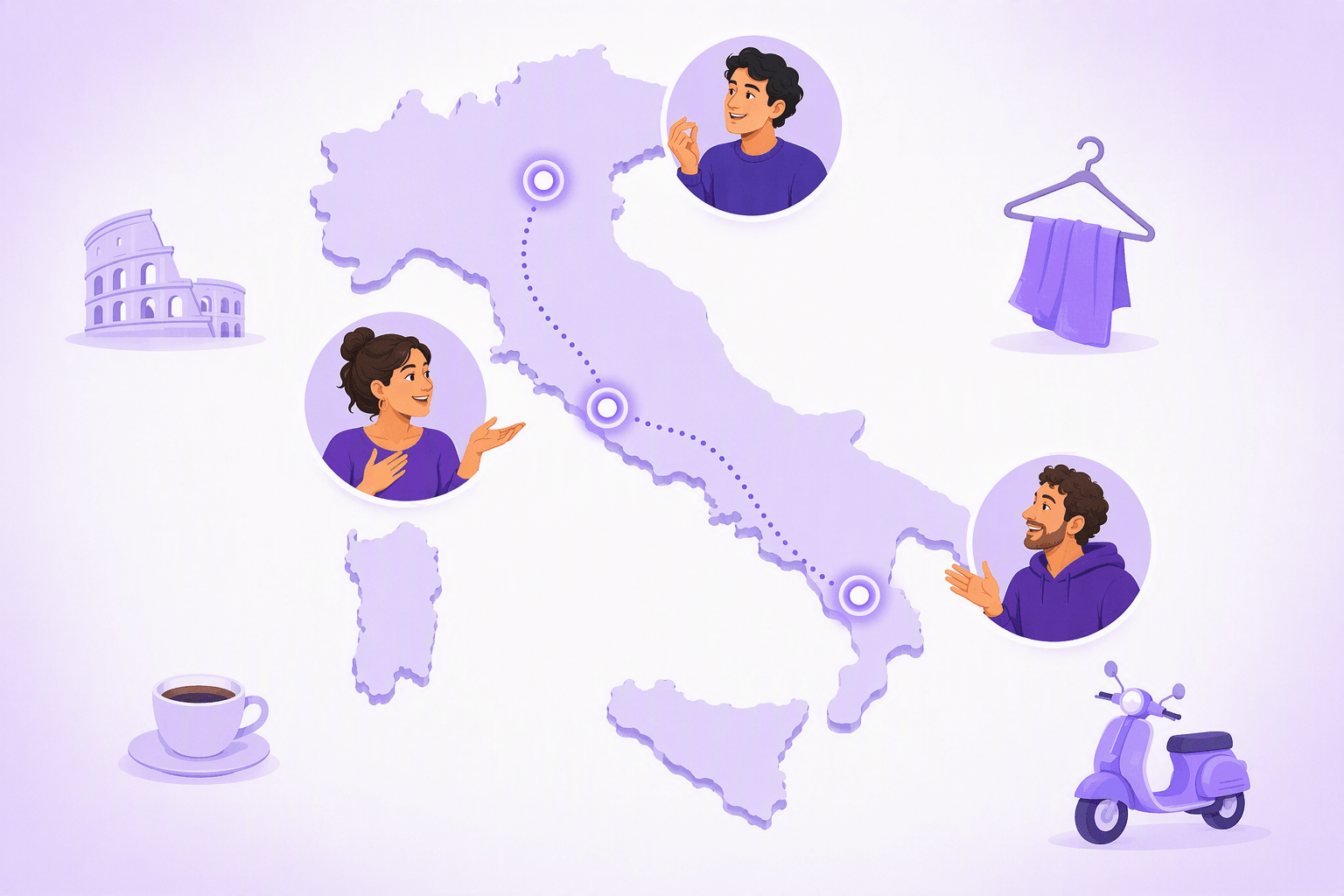
Roman Slang (Romanesco)
Rome's slang, called romanesco, has gained national recognition through Italian cinema and television, from Federico Fellini to modern series like Suburra.
Daje!
/DAH-yeh/
Literal meaning: Roman pronunciation of 'dai' (come on)
“Daje, Roma! Forza!”
Let's go, Roma! Come on!
Rome's signature expression. Originally a romanesco pronunciation of 'dai,' it has become a cultural symbol. Football fans scream it at the Stadio Olimpico, friends use it as encouragement, and it appears on t-shirts and bumper stickers across Rome.
Daje is to Rome what "Forza" is to Italy as a whole: an all-purpose battle cry. It became internationally famous through AS Roma football culture but is used in every conceivable context: encouraging a friend, expressing excitement, or pushing through a difficult task.
Anvedi!
/ahn-VEH-dee/
Literal meaning: Roman contraction of 'and you see' (e vedi)
“Anvedi che macchina! È una Ferrari!”
Would you look at that car! It's a Ferrari!
Pure romanesco. Expresses surprise, admiration, or disbelief at something you're seeing. Often accompanied by a pointed finger or head nod toward the object of attention.
Anvedi is a contraction that only makes sense in Roman dialect. It compresses the phrase e vedi (and look/see) into a single exclamation of surprise. Using it outside of Rome will immediately mark you as either Roman or someone who has spent serious time in the capital.
Mica
/MEE-kah/
Literal meaning: Crumb (from Latin 'mica')
“Non è mica male questo ristorante!”
This restaurant isn't bad at all!
While 'mica' exists in standard Italian, Romans use it far more frequently and emphatically. It reinforces negation: 'non è mica facile' (it's not easy at all). It can also ask rhetorical questions: 'Mica vorrai andare?' (You don't actually want to go, do you?).
Mica exists in standard Italian grammar, but Romans have adopted it as a signature intensifier. Where standard Italian might use per niente (not at all), a Roman reaches for mica. Treccani traces the word to the Latin mica (crumb), the idea being "not even a crumb" of truth to something.
Milanese Slang
Milan's slang reflects the city's position as Italy's business and fashion capital: faster, more cosmopolitan, and heavily influenced by English.
Bella lì
/BEHL-lah LEE/
Literal meaning: Beautiful there
“Ho passato l'esame!, Bella lì!”
I passed the exam!, Nice one!
Milanese expression of approval or satisfaction. Functions like the English 'nice one,' 'sorted,' or 'sweet.' Compact and efficient, very Milanese.
Bella lì captures Milan's linguistic personality: efficient, approving, and not overly emotional. Where a Roman might give you a dramatic Daje! with gesticulating arms, a Milanese nods and says Bella lì. Job done. Moving on.
Neapolitan Slang
Naples' slang is inseparable from Neapolitan dialect (napoletano), which UNESCO classifies as a separate language. Many Neapolitan slang words have crossed into mainstream Italian.
Uè!
/oo-EH/
Literal meaning: (interjection, hey!)
“Uè, Gianni! Dove stai andando?”
Hey, Gianni! Where are you going?
Naples' signature greeting-call. Loud, warm, and unmistakably Southern. Can be friendly or confrontational depending on volume and context. Famously featured in countless Neapolitan songs and films.
Uè is the sound of Naples: loud, direct, and impossible to ignore. It can be a warm greeting shouted across a piazza or a sharp attention-getter in a crowded market. The length of the vowel and the volume determine the emotion: a short, cheerful Uè! is a greeting; a drawn-out, loud Uèèè! is a warning.
Youth Slang and Social Media
Italian youth slang (gergo giovanile) evolves rapidly, heavily influenced by English, social media, and music. The Accademia della Crusca publishes regular reports on these linguistic shifts, noting that approximately 30% of new Italian youth slang borrows directly from English.
Spettacolare
/speht-tah-koh-LAH-reh/
Literal meaning: Spectacular
“Il concerto ieri sera è stato spettacolare!”
The concert last night was spectacular!
Not technically slang (it's a standard Italian adjective), but used with much higher frequency in casual youth speech as an all-purpose positive. Functions like 'amazing' or 'incredible' in English.
While spettacolare exists in formal Italian, younger speakers have adopted it as their go-to superlative, similar to how English speakers overuse "amazing." It has largely replaced older intensifiers like fantastico and meraviglioso in casual youth conversation.
Ghostare
/goh-STAH-reh/
Literal meaning: To ghost (English borrowing)
“Mi ha ghostato dopo il secondo appuntamento.”
He/she ghosted me after the second date.
Direct borrowing from English 'to ghost,' adapted with Italian verb conjugation (-are ending). Part of a wave of English borrowings in Italian dating and social media vocabulary.
Italian does what it has always done with foreign words: absorbs them and conjugates them. Ghost becomes ghostare, following the standard -are verb pattern. You can conjugate it fully: io ghosto, tu ghosti, lui/lei ghosta. The Crusca has noted this pattern of "Italianizing" English verbs as one of the defining features of contemporary Italian slang.
Chillare
/cheel-LAH-reh/
Literal meaning: To chill (English borrowing)
“Stasera chilliamo a casa mia?”
Tonight, shall we chill at my place?
Another English-to-Italian verb adaptation. Used primarily by Italians under 30. Older Italians might say 'rilassarsi' (to relax) instead.
Chillare perfectly illustrates the generational divide in Italian slang. Ask an Italian grandmother what chillare means and she will stare at you blankly. Ask a 20-year-old and they will use it three times in the next sentence.
Regional Slang Comparison
The same basic concept can be expressed completely differently depending on where you are in Italy:
| Concept | Rome | Milan | Naples | Standard Italian |
|---|---|---|---|---|
| Cool / Awesome | Figo / Forte | Figo / Bella lì | Bellillo | Bello / Fantastico |
| Come on! | Daje! | Dai! | Jamm! | Dai! / Andiamo! |
| Hey! | Aò! | Ehi! | Uè! | Ehi! |
| Look at that! | Anvedi! | Guarda! | Uè, guarda! | Guarda! |
| Dude / Guy | Er tipo | Il tipo | 'O guaglione | Il ragazzo |
| No way! | Ma che stai a dì? | Ma va! | Ma che dici? | Ma davvero? |
🌍 Italy's Linguistic Diversity
Italy was unified only in 1861, and for centuries each region functioned as a separate state with its own language. According to Ethnologue, Italy has 34 living languages, not dialects, but distinct languages. This history explains why regional slang differences are so dramatic compared to countries with longer linguistic unity.
How to Sound Natural Using Italian Slang
Using slang correctly is about more than vocabulary; it is about rhythm, gesture, and context. Here are practical guidelines.
| Do | Don't |
|---|---|
| Start with universal slang (Boh, Dai, Figo) | Mix regional slang from different cities |
| Match the energy of the person you're speaking with | Use slang in formal or professional settings |
| Pair expressions with appropriate gestures | Overuse slang to seem "cool", Italians notice |
| Listen to how locals use expressions before copying | Assume slang from Rome works in Milan |
💡 The 'Listen First' Rule
Before using any regional slang, spend a day simply listening. Italian slang depends heavily on intonation and gesture. The same word with different delivery can mean something completely different. Dai! with a smile is encouragement. Dai! with a glare is frustration.
Learn Italian Slang Through Movies and TV
Reading about slang gives you vocabulary, but hearing it in context is what makes it stick. Italian cinema is one of the best resources for natural, region-specific slang. Roman slang fills every scene of Suburra and Romanzo Criminale. Neapolitan dialect drives Gomorra and L'Amica Geniale. For pan-Italian youth slang, contemporary comedies like Perfetti Sconosciuti are perfect.
Wordy lets you watch Italian movies and shows with interactive subtitles. Tap any slang expression to see its meaning, pronunciation, and regional context in real time. Instead of memorizing lists, you absorb slang from real conversations with authentic intonation.
For more Italian content, explore our blog for guides including the best movies to learn Italian. You can also visit our Italian learning page to start practicing with real Italian media today.
Frequently Asked Questions
What is the most common Italian slang word?
What does 'Boh' mean in Italian?
What does 'Magari' mean in Italian?
Is Italian slang the same across Italy?
What does 'Dai' or 'Daje' mean in Italian?
Sources & References
- Treccani, Vocabolario della lingua italiana online (treccani.it)
- Zanichelli, Lo Zingarelli: Vocabolario della lingua italiana, 2024 edition
- Eble, C., Slang and Sociability: In-Group Language Among College Students (University of North Carolina Press)
- Ethnologue: Languages of the World, 27th edition, Italian language entry (2024)
- Accademia della Crusca, Consulenza linguistica: Il gergo giovanile
Start learning with Wordy
Watch real movie clips and build your vocabulary as you go. Free to download.


