Quick Answer
Italian is the national language of Italy, San Marino, and Vatican City, and one of Switzerland's four national languages. It is also spoken in border communities, historic diaspora communities, and Italian-descended families worldwide, with major regional differences in accent, vocabulary, and local languages.
Italian is spoken primarily in Italy, Switzerland, San Marino, and Vatican City, but its real map is much broader than four national borders. Standard Italian, italiano /itaˈljaːno/, connects roughly 65 million native speakers worldwide, while regional accents, local languages, and diaspora communities make Italian sound noticeably different from Milan to Sicily, from Swiss Ticino to Argentina.
If you are learning Italian, this is good news: the standard language taught in courses, films, news, and books will serve you across every Italian-speaking region. The key is learning to recognize variation without assuming that one accent or one local word is the only correct version. Start with the foundations in our Italian language overview, then use this guide to understand the people and places behind the language.
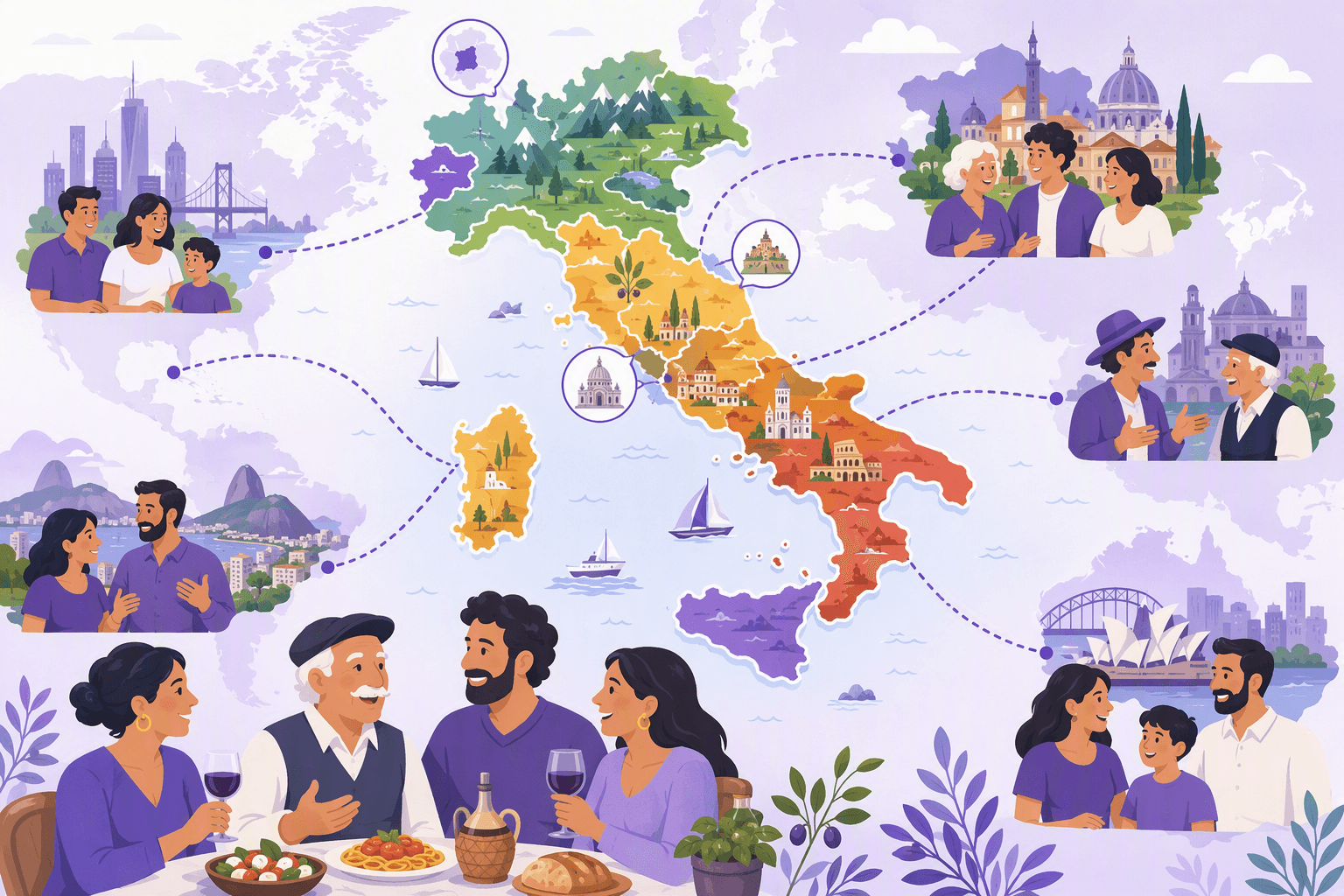
Where Italian is officially spoken
Italian has official status in four sovereign states. Italy is, by far, the largest Italian-speaking country, but Switzerland gives Italian a distinct place in a multilingual national system.
| Place | Status of Italian | What learners should know |
|---|---|---|
| Italy | National official language | The main home of standard Italian and many regional varieties |
| Switzerland | One of four national languages | Italian is strongest in Ticino and southern Graubünden |
| San Marino | Official language | Standard Italian is used in public life |
| Vatican City | Official working language alongside Latin in many contexts | Italian is the daily language of administration and local life |
| Slovenia | Protected minority language in some coastal municipalities | Used alongside Slovene in designated bilingual areas |
| Croatia | Protected minority language in parts of Istria | Present in Italian minority communities and bilingual signage |
Italy has a population of almost 59 million people, and Italian is the language of national education, broadcasting, government, and public life. Yet this does not mean every conversation sounds like a textbook audio track.
Ethnologue identifies Italian as one of the world's major languages by first-language speakers. Its global reach also reflects emigration from Italy during the late nineteenth and twentieth centuries, particularly to the Americas and Australia.
Italy: one country, many ways of sounding Italian
Modern standard Italian developed historically from the Tuscan literary tradition, particularly the prestige associated with Florence. Writers such as Dante Alighieri, Petrarch, and Boccaccio gave Tuscan enormous cultural authority, but Italy did not become a unified state until 1861.
For generations after unification, many Italians used a local speech variety at home and encountered standard Italian mainly through school, military service, newspapers, and later television. Tullio De Mauro's work on Italy's linguistic history explains why national Italian spread alongside, rather than simply replacing, local varieties.
Today, standard Italian is widely shared. Still, regional speech remains a living social signal: it can suggest where someone grew up, their family background, and how formal or relaxed the setting is.
Northern Italy
Northern Italian accents are often associated with shorter, more clipped vowel patterns and speech rhythms that can feel brisk to learners. Cities such as Milan, Turin, Bologna, Venice, and Genoa all have recognizable local features.
In Lombardy, the local language family includes Lombard varieties, while Veneto has Venetian varieties. These are often casually called dialetti /djaˈletti/, meaning local dialects, but they should not be dismissed as careless or incorrect Italian.
Many northern regional languages have long independent histories and distinctive vocabulary. A speaker may use standard Italian at work, then switch into local speech with grandparents, friends, or neighbors.
Central Italy and Tuscany
Tuscany has special symbolic status because Florentine-based Italian became the model for the written standard. That does not mean people in Florence speak exactly like grammar books.
Tuscan speech has its own famous sound patterns. In everyday conversation, some consonants, especially /k/, /t/, and /p/ between vowels, may be softened. This can make local speech sound airy or aspirated to learners.
Rome also has a highly recognizable urban variety known as romanesco /romaˈnesko/. You may hear it in Italian comedy, crime dramas, and films set in the capital. It often carries a direct, humorous, streetwise cultural identity.
Southern Italy
Southern Italian speech is extremely diverse. Campania, Puglia, Calabria, Basilicata, and Sicily each contain many local varieties, some of which differ sharply even between nearby towns.
Neapolitan, napoletano /napoleˈtaːno/, has a major cultural presence through theatre, music, and cinema. Sicilian, siciliano /sitʃiˈljaːno/, also has a deep literary and oral tradition. Both are commonly described as Italian dialects in everyday speech, though linguists often treat them as distinct Romance languages or language systems.
For a learner, the practical point is simple: a local-language conversation can be much harder than regional Italian. Do not panic if you understand an Italian TV presenter but miss a fast exchange between relatives in a southern family drama.
Sardinia
Sardinia is one of the most linguistically distinctive parts of Italy. Sardinian, sardo /ˈsardo/, is often classified as a separate Romance language rather than a dialect of Italian.
Italian remains essential for school, public administration, national media, and communication with visitors. But Sardinian varieties continue to carry cultural importance, particularly in family life, music, local politics, and traditions.
The existence of Sardinian is a useful reminder that Italy is not linguistically uniform. Alberto A. Sobrero's sociolinguistic research emphasizes that Italian identity includes a spectrum of regional and social varieties, not a single fixed way of speaking.
🌍 Standard Italian is not the only authentic Italian
A regional accent does not mean someone speaks incorrect Italian. Standard Italian is the shared national variety, while regional Italian and local languages express place, family history, and identity. Learn the standard first, then treat variation as listening practice rather than as a mistake.
Italian in Switzerland
Switzerland is the second most important Italian-speaking country in Europe. Italian is one of the country's four national languages, alongside German, French, and Romansh.
The Italian-speaking heartland is Ticino, Ticino /tiˈtʃiːno/, a canton south of the Alps bordering Italy. Italian is also used in southern parts of the canton of Graubünden, especially in the valleys of Bregaglia, Mesolcina, and Poschiavo.
According to the Swiss Federal Statistical Office, about 8 percent of Switzerland's resident population reports Italian as a main language. That share represents hundreds of thousands of people, though Italian's national role is larger than the number alone suggests because it is used in federal communication and institutions.
Swiss Italian is not a separate language. A visitor from Rome can speak standard Italian with a shopkeeper in Lugano without needing a different grammar book. The differences are mostly lexical, institutional, and phonetic.
For example, a Swiss resident may encounter Italian terms connected to Swiss public life, schools, transport, and federal administration that are less common in Italy. In informal settings, local Lombard varieties may also appear.
Why Swiss Italian matters to learners
Swiss television, radio, schools, and public life offer high-quality Italian exposure in a multilingual context. It is also a useful reminder that Italian belongs to more than one national identity.
If you watch Italian-language media from Switzerland, expect clear standard speech in news programming, plus local vocabulary and a regional accent. This is excellent listening practice once you can follow mainstream Italian content.
San Marino and Vatican City
San Marino is a small independent republic completely surrounded by Italy. Italian is its official language, and its public institutions operate in standard Italian.
Vatican City is even smaller, but Italian has enormous practical importance there. Latin has formal and ceremonial significance in the Catholic Church, while Italian is the everyday language used by residents, staff, visitors, shops, and much of the administration.
Neither place requires a separate version of Italian for learners. What changes is cultural context: San Marino has its own republican institutions, while Vatican Italian is shaped by religion, international visitors, and the language of church administration.
Italian minority communities on the Adriatic
Italian has recognized minority-language status in parts of Slovenia and Croatia, especially around the northern Adriatic and Istrian peninsula. Bilingual signs, schools, cultural organizations, and local institutions preserve Italian in these communities.
In Slovenian coastal municipalities such as Koper, known in Italian as Capodistria /kapodiˈstrja/, Italian can appear alongside Slovene. In Croatia, the Italian national minority has a historic presence in Istria, Istria /ˈistrja/.
These communities are not simply extensions of modern Italy. Their linguistic history comes from centuries of Adriatic trade, shifting borders, mixed populations, and changing political rule. The Council of Europe's minority-language framework recognizes why legal protection matters in such settings.
Italian beyond Europe: diaspora communities
Italian migration created long-lasting communities across the world. Argentina, Brazil, the United States, Canada, Australia, Uruguay, Venezuela, and South Africa all received substantial numbers of Italian migrants.
Argentina is especially important in the popular imagination of Italian migration. Italian immigration influenced Argentine Spanish pronunciation, food culture, surnames, gestures, and expressions. The connection is visible in the intonation of Buenos Aires Spanish, although Argentine Spanish is not Italian.
In the United States and Canada, Italian heritage remains strongly visible in family names, neighbourhood institutions, festivals, Catholic parishes, and food traditions. Language transmission varies greatly by generation.
A grandparent may speak a southern regional variety, a parent may use mostly English, Portuguese, Spanish, or French, and a younger family member may be learning standard Italian at school. This is why an Italian heritage speaker may know emotionally important words without feeling confident in formal Italian.
🌍 Diaspora Italian can preserve older forms
Italian spoken in migrant families may preserve vocabulary, pronunciations, or regional expressions that have changed in Italy. A heritage speaker is not speaking badly when their family Italian differs from a textbook. They may be carrying a record of a particular town and migration period.
Standard Italian, regional Italian, and local languages
Learners often hear three labels used as if they mean the same thing. They do not.
Standard Italian is the common language used in school, newspapers, national television, formal writing, and communication across regions. It is the best starting point for every learner.
Regional Italian is standard Italian shaped by a local accent, rhythm, grammar tendency, or vocabulary. Someone may be speaking fully understandable Italian while sounding distinctly Roman, Milanese, or Sicilian.
Local languages and dialects are community varieties that may differ substantially from standard Italian. The Italian word dialetto /djaˈletto/ is culturally useful, but it is not always a precise linguistic category.
This distinction matters in films. A historical drama, a crime series, or a family comedy may shift between standard Italian and local speech to show class, intimacy, conflict, or regional identity. For more ways to turn this variation into listening practice, see our guide to learning Italian through movies.
What regional variation means in real conversations
You do not need to memorize every regional word before visiting Italy. You need a reliable standard base and the confidence to ask for clarification.
A greeting such as ciao /ˈtʃaːo/ works throughout Italy in informal contexts, while buongiorno /bwondʒorno/ is safer with strangers, staff, and older people. Our guide to saying hello in Italian explains the formality choices in detail.
You may hear a local version of a familiar word, a different name for a food, or a sentence with unfamiliar rhythm. Usually, the conversation can switch back to standard Italian when needed.
For example, a person may say parli più lentamente, per favore? /ˈparli pju lentaˈmente per faˈvore/, meaning please speak more slowly. This is a normal communication strategy, not an admission of failure.
💡 Use regional media strategically
Watch one scene first with Italian subtitles, then replay it without subtitles. Note whether the challenge is vocabulary, speed, accent, or a local language. This turns confusion into a specific skill to practise.
Food, identity, and regional vocabulary
Food is one of the fastest ways to encounter regional Italian culture. A dish that seems universal abroad may have a very specific regional history at home.
In Rome, pasta dishes such as carbonara /karboˈnaːra/ are tied to local identity. In Bologna, ragù /raˈɡu/ has a particular meaning that differs from many international menu versions. In Naples, pizza is connected to local craft traditions and vocabulary.
Regional food words can trigger strong opinions because they often represent family memory, not just ingredients. Before ordering or cooking, read our guide to Italian food culture for the social rules around meals, coffee, and restaurant timing.
The same principle applies to gestures and tone. Italian communication is not one uniform performance. A gesture common in one family or city may be less familiar elsewhere, and stereotypes about Italians being universally loud or expressive flatten real regional and personal differences.
How to learn Italian that works across regions
Learn standard Italian first, because it is your bridge across Italy, Switzerland, San Marino, Vatican City, and diaspora settings. Focus on frequent vocabulary, high-value verbs, listening practice, and polite interaction.
Then add regional exposure through films, interviews, music, sports commentary, and travel videos. Label the source region when you save a phrase, rather than treating every new word as universally Italian.
When you meet a regional expression, ask whether it is local, informal, or broadly understood. That question shows genuine interest without pretending you already know the answer.
Finally, remember that language variation is not an obstacle to overcome once. It is evidence that Italian is alive in many places. Learn the shared standard, listen closely to local voices, and enjoy the fact that every region adds another layer to the language.
Frequently Asked Questions
What countries have Italian as an official language?
Do all Italians speak the same Italian?
Is Swiss Italian the same as Italian spoken in Italy?
What is the difference between Italian dialects and regional languages?
Where outside Europe is Italian still spoken?
Sources & References
- Ethnologue, Italian, 27th edition, 2024
- Swiss Federal Statistical Office, Languages, Religions and Culture, accessed 2026
- Treccani, Lingua italiana and Dialetti italiani, accessed 2026
- Accademia della Crusca, Resources on Italian language variation, accessed 2026
- European Charter for Regional or Minority Languages, Council of Europe, accessed 2026
Start learning with Wordy
Watch real movie clips and build your vocabulary as you go. Free to download.


