Quick Answer
Italian cognates are words that look or sound similar to English because both languages inherited large amounts of vocabulary from Latin and French. Learning them gives English speakers a fast vocabulary boost, but you must also recognize false friends whose familiar spelling hides a different meaning.
Italian cognates are one of the quickest ways for English speakers to begin understanding Italian: words such as nazione /natˈtsjoːne/ and nation, importante /imporˈtante/ and important, or possibile /posˈsiːbile/ and possible share historical roots and closely related meanings. They give you a major head start, but they work best when you learn their Italian pronunciation, gender, and real-life context instead of assuming that familiar spelling means identical use.
Italian has roughly 68 million speakers worldwide according to Ethnologue's 27th edition. It is the national language of Italy, San Marino, and Vatican City, and it is also an official language in parts of Switzerland. For English speakers, its large Latin-based vocabulary creates an unusually visible bridge into the language.
That bridge is real, but it has limits. A word may resemble English while using a different ending, stress pattern, or meaning. This guide shows you how to recognize reliable Italian cognates, avoid expensive false-friend mistakes, and turn familiar-looking words into vocabulary you can actually use.
If you are starting from zero, pair these words with Italian greetings for everyday situations. Cognates help you understand more quickly, while greetings give you immediately usable conversation tools.
| English | Italian | Pronunciation | Note |
|---|---|---|---|
| active | attivo | aht-TEE-voh | IPA: /atˈtiːvo/. Feminine form: attiva. |
| bank | banca | BAHN-kah | IPA: /ˈbaŋka/. A financial institution. |
| central | centrale | chen-TRAH-leh | IPA: /tʃenˈtraːle/. Also used for a power station. |
| culture | cultura | kool-TOO-rah | IPA: /kulˈtuːra/. |
| different | differente | deef-feh-REHN-teh | IPA: /diffeˈrɛnte/. |
| doctor | dottore | dot-TOH-reh | IPA: /dotˈtoːre/. Can also mean a university graduate. |
| family | famiglia | fah-MEE-lyah | IPA: /faˈmiʎʎa/. The gl sound is like ly in million. |
| final | finale | fee-NAH-leh | IPA: /fiˈnaːle/. Often a noun meaning ending or finale. |
| general | generale | jeh-neh-RAH-leh | IPA: /dʒeneˈraːle/. |
| hospital | ospedale | oh-speh-DAH-leh | IPA: /ospeˈdaːle/. The initial h is absent. |
| important | importante | eem-por-TAHN-teh | IPA: /imporˈtante/. |
| information | informazione | een-for-mah-TSYOH-neh | IPA: /informatˈtsjoːne/. |
| intelligent | intelligente | een-tel-lee-JEN-teh | IPA: /intelliˈdʒɛnte/. |
| moment | momento | moh-MEN-toh | IPA: /moˈmento/. |
| natural | naturale | nah-too-RAH-leh | IPA: /natuˈraːle/. |
| nation | nazione | naht-TSYOH-neh | IPA: /natˈtsjoːne/. |
| necessary | necessario | neh-ches-SAH-ryoh | IPA: /netʃesˈsaːrjo/. Feminine: necessaria. |
| normal | normale | nor-MAH-leh | IPA: /norˈmaːle/. |
| possible | possibile | pos-SEE-bee-leh | IPA: /posˈsiːbile/. |
| problem | problema | proh-BLEH-mah | IPA: /proˈblɛːma/. Masculine despite the final a. |
| public | pubblico | POOB-blee-koh | IPA: /ˈpubbliko/. Feminine: pubblica. |
| restaurant | ristorante | ree-stoh-RAHN-teh | IPA: /ristoˈrante/. |
| special | speciale | speh-CHAH-leh | IPA: /speˈtʃaːle/. |
| student | studente | stoo-DEN-teh | IPA: /stuˈdɛnte/. Feminine: studentessa. |
| university | università | oo-nee-ver-see-TAH | IPA: /universiˈta/. The final stress is marked. |
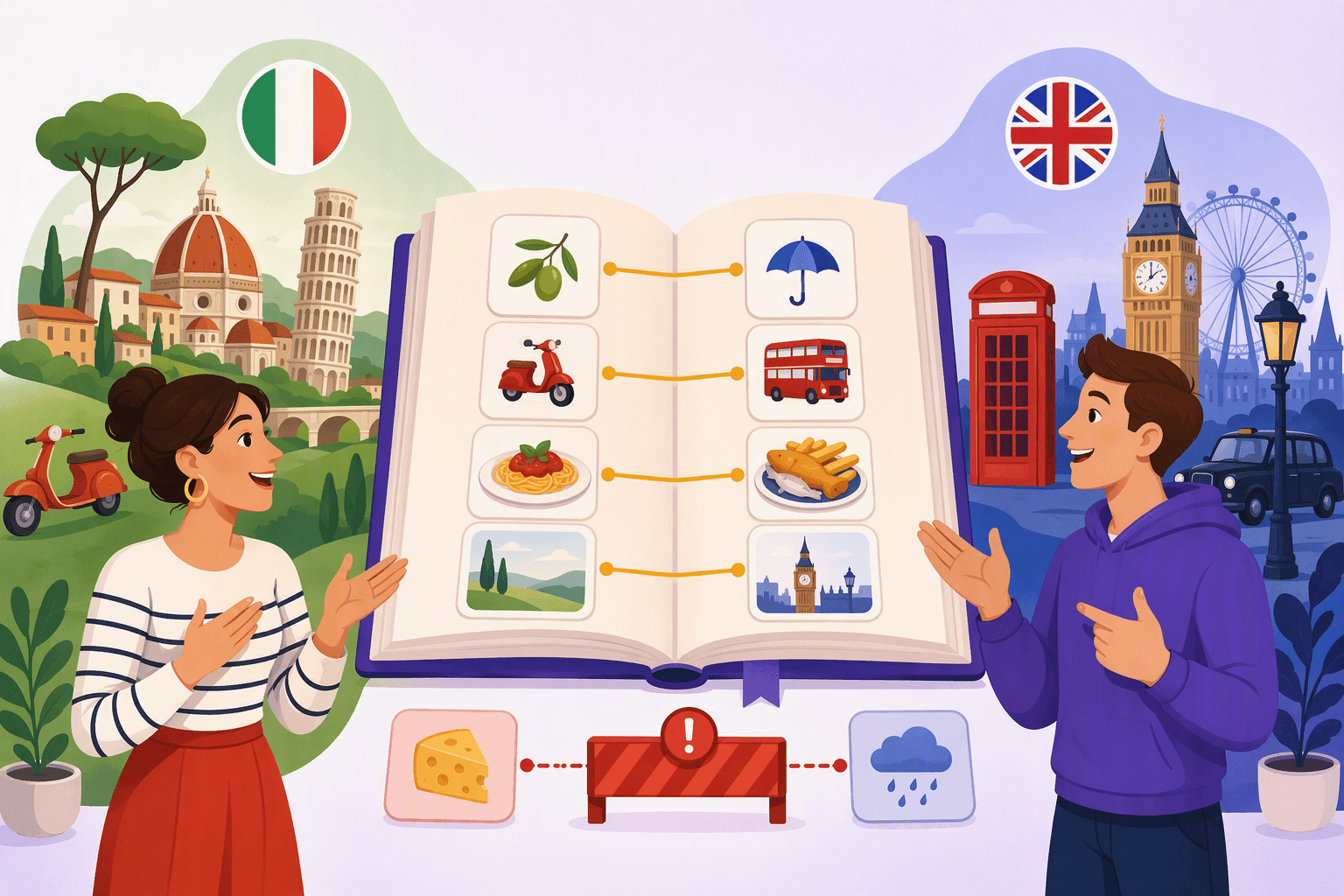
Why English and Italian Share So Much Vocabulary
English is a Germanic language, while Italian developed from spoken Latin. Yet English absorbed a huge amount of Latin-based vocabulary through French after the Norman Conquest and through later scholarly, legal, scientific, and religious writing.
That history explains why English speakers recognize many Italian words in formal and abstract vocabulary. Terms connected with politics, education, art, medicine, law, and philosophy are particularly likely to have a shared Latin source.
Martin Maiden's A Linguistic History of Italian traces how Italian developed from Latin varieties spoken across the peninsula. The connection is not a shortcut invented for learners: it is a historical relationship visible in word roots, suffixes, and patterns of change.
For example, English words ending in -tion often correspond to Italian words ending in -zione /ˈtsjoːne/. English information becomes informazione /informatˈtsjoːne/, and English situation becomes situazione /sitwatˈtsjoːne/.
This pattern will not solve every vocabulary problem, but it helps you make educated guesses while reading menus, signs, news headlines, and subtitles. See it as a recognition tool, not permission to invent Italian words.
The Most Useful Cognate Patterns
English -tion and Italian -zione
This is among the most productive patterns for beginners. English communication, organization, reservation, and tradition have close Italian relatives: comunicazione /komunikatˈtsjoːne/, organizzazione /organiddzatˈtsjoːne/, prenotazione /prenotatˈtsjoːne/, and tradizione /traditˈtsjoːne/.
Notice that Italian z in this ending is pronounced /ts/ or /dz/, not like the English sound in zoo. The doubled consonant in organizzazione /organiddzatˈtsjoːne/ is also meaningful: Italian consonant length is part of clear pronunciation.
English -ity and Italian -ità
English abstract nouns ending in -ity often have Italian counterparts ending in -ità /iˈta/. Examples include università /universiˈta/, possibilità /possibiliˈta/, necessità /netʃessiˈta/, and qualità /kwaliˈta/.
The accent mark matters. It tells you that stress falls on the final vowel, a pattern English speakers may overlook. Say each final vowel fully rather than reducing it.
English -al and Italian -ale
Words like natural, central, general, and special often match Italian naturale /natuˈraːle/, centrale /tʃenˈtraːle/, generale /dʒeneˈraːle/, and speciale /speˈtʃaːle/.
Italian typically adds a final vowel where English does not. That final vowel carries grammatical information and contributes to Italian's distinctive rhythm.
English -ic and Italian -ico
English adjectives ending in -ic frequently correspond to Italian forms ending in -ico /iko/ or -ica /ika/. Compare public with pubblico /ˈpubbliko/, historic with storico /ˈstɔːriko/, and political with politico /poˈliːtiko/.
Unlike English, Italian adjectives generally agree with the noun they describe. You may see politico /poˈliːtiko/ with a masculine noun and politica /poˈliːtika/ with a feminine noun.
💡 Use word families, not isolated words
When you learn possibile /posˈsiːbile/, add possibilità /possibiliˈta/ and possibilmente /possibilˈmente/. Related forms make vocabulary easier to remember and show you how Italian endings change grammar.
Pronunciation: Familiar Spelling, Different Sound
Cognates can create a pronunciation trap. You recognize the word, then unconsciously read it with English sound rules. Italian spelling is much more regular than English spelling, but it needs its own habits.
Every written vowel is usually audible. In importante /imporˈtante/, the final -e is pronounced, while English important ends with a consonant sound. In cultura /kulˈtuːra/, the vowels remain clear rather than becoming reduced sounds.
Italian c also changes according to the following vowel. Before e or i, it is usually /tʃ/, so centrale /tʃenˈtraːle/ starts with the sound in English chess. Before a, o, or u, it is /k/, as in cultura /kulˈtuːra/.
Italian doubled consonants deserve attention. Pubblico /ˈpubbliko/ has a longer, more forceful /b/ sound than a single consonant would. You do not need exaggerated drama, but you do need a small pause or hold.
For a foundation in sound patterns, use an Italian pronunciation guide alongside cognate study. Recognition becomes much more useful when listeners can understand your version of the word.
Cognates Still Need Grammar
A cognate may give you the meaning without giving you the grammar. Italian nouns have gender, adjectives change endings, and articles must agree with the noun.
For instance, problema /proˈblɛːma/ looks feminine because it ends in -a, but it is masculine: il problema /il proˈblɛːma/. This is a Greek-derived noun pattern, shared by words such as sistema /siˈstɛːma/ and programma /proˈɡramma/.
Similarly, famiglia /faˈmiʎʎa/ means family, but it requires feminine agreement: una famiglia italiana /una faˈmiʎʎa itaˈljaːna/. Memorize a noun with its article whenever possible.
Luca Serianni's Grammatica italiana emphasizes the central role of agreement in Italian grammar. A familiar root can make a word memorable, but articles and endings are what allow you to build accurate sentences around it.
Italian False Friends You Should Learn Early
False friends are not cognates in the practical learner sense. They look reassuringly familiar, then lead you to the wrong meaning. Learn common ones early, because they appear often in travel and daily conversation.
| Italian word | IPA | What it really means | English lookalike trap |
|---|---|---|---|
| camera | /ˈkaːmera/ | room | Not a camera |
| libreria | /libreˈriːa/ | bookstore or bookshop | Not a library |
| parenti | /paˈrɛnti/ | relatives | Not parents |
| educato | /eduˈkaːto/ | polite, well-mannered | Not educated |
| attualmente | /attwalˈmente/ | currently | Not actually |
| eventualmente | /eventwalˈmente/ | if necessary, possibly | Not eventually |
| pretendere | /preˈtɛndere/ | demand, expect | Not pretend |
| sensibile | /senˈsiːbile/ | sensitive | Not sensible |
| morbido | /ˈmɔrbido/ | soft | Not morbid |
| bravo | /ˈbraːvo/ | skilled, good, well done | Not necessarily brave |
The word camera /ˈkaːmera/ is especially useful for travelers. At a hotel, una camera means a room. If you want a camera for photographs, use macchina fotografica /ˈmakkina fotoˈɡraːfika/ or simply fotocamera /fotoˈkaːmera/.
🌍 Why 'bravo' means more than applause
In Italy, bravo /ˈbraːvo/ can praise a performer, a child, a colleague, or someone who has done a task well. It changes for gender and number: brava /ˈbraːva/, bravi /ˈbraːvi/, and brave /ˈbraːve/. It is a warm, ordinary compliment, not only something shouted after opera.
How to Turn Cognates Into Real Vocabulary
First, group words by a real situation. A travel group could include hotel /oˈtɛl/, ristorante /ristoˈrante/, prenotazione /prenotatˈtsjoːne/, informazione /informatˈtsjoːne/, and documento /dokuˈmento/. This lets you recognize a cluster of meaning in context.
Second, learn one short sentence for each word. Instead of memorizing possibile /posˈsiːbile/ alone, use È possibile pagare con la carta? /ɛ posˈsiːbile paˈɡaːre kon la ˈkarta/, meaning “Is it possible to pay by card?” The sentence supplies word order, pronunciation, and a realistic purpose.
Third, listen for cognates in media. Italian films, interviews, and television shows contain many Latin-based words in news reports, workplace scenes, university settings, and formal conversations. The words are easier to catch than entirely unfamiliar vocabulary, so they can anchor your listening practice.
This is also why cognates are excellent early reading material. Try subtitles, simple news summaries, museum descriptions, and restaurant menus. When you can recognize several words in a sentence, you can infer the rest more confidently.
For high-frequency basics that do not always resemble English, study the most common Italian words. Cognates accelerate your progress, but grammar words such as e /e/, di /di/, che /ke/, and non /non/ hold everyday sentences together.
A Practical 15-Minute Cognate Routine
Spend five minutes selecting five new cognates from one category. Write the Italian article beside each noun, and write both masculine and feminine forms for any adjective you expect to use.
Spend five minutes saying each word and one example sentence aloud. Focus on final vowels, doubled consonants, and Italian stress rather than reading with English habits.
Spend the final five minutes listening to a short Italian clip or reading a short passage. Mark words you recognize, then check only the ones that affect the overall message. This prevents cognate study from becoming a list-memorization exercise.
A useful next step is practicing familiar social vocabulary in full phrases, including how to say goodbye naturally in Italian and ways to say “I love you” in Italian. The strongest vocabulary is vocabulary you can use with another person.
The Key Rule: Guess Carefully, Then Verify
Italian cognates make the language feel less distant because they reveal its shared Latin history with much of English vocabulary. Use that advantage actively: notice word endings, identify roots, and predict meanings while you read and listen.
Then verify your guess. Check gender, pronunciation, tone, and whether the word is a false friend. Treccani and the Accademia della Crusca are valuable reference points for checking standard Italian meanings and usage.
Cognates are not a replacement for learning Italian. They are a fast, evidence-based bridge into it, one that can make your first conversations, films, menus, and texts feel much more understandable from day one.
Frequently Asked Questions
What are Italian cognates?
How many Italian cognates are there in English?
Are Italian cognates always pronounced like English words?
What are Italian false friends?
What is the fastest way to learn Italian cognates?
Sources & References
- Ethnologue, Italian, 27th edition, 2024
- Accademia della Crusca, Lingua italiana resources, accessed 2026
- Treccani, Vocabolario Treccani, accessed 2026
- Martin Maiden, A Linguistic History of Italian, Routledge
- Luca Serianni, Grammatica italiana, UTET
Start learning with Wordy
Watch real movie clips and build your vocabulary as you go. Free to download.


