Quick Answer
Italian adjectives usually agree with the noun in gender and number, and most come after the noun. Learn the four main endings, when adjectives go before a noun, and how position can change the meaning.
Italian adjectives must usually match the noun they describe in gender and number: masculine singular, feminine singular, masculine plural, or feminine plural. They usually follow the noun, as in una macchina rossa /ˈuna makˈkina ˈrossa/, “a red car,” but several very common adjectives come before it, and a few change meaning depending on position.
That sounds like a lot of rules, but the core pattern is reliable. Learn noun gender first, then attach the adjective ending that matches it. If you need a refresher on articles such as il /il/, la /la/, and gli /ʎi/, see our Italian gender and articles guide.
Italian is spoken by roughly 68 million first-language speakers, according to Ethnologue, and it is an official language in Italy, San Marino, Vatican City, and Switzerland. Across those communities, adjective agreement remains central to clear, natural speech, even though regional accents and vocabulary vary.
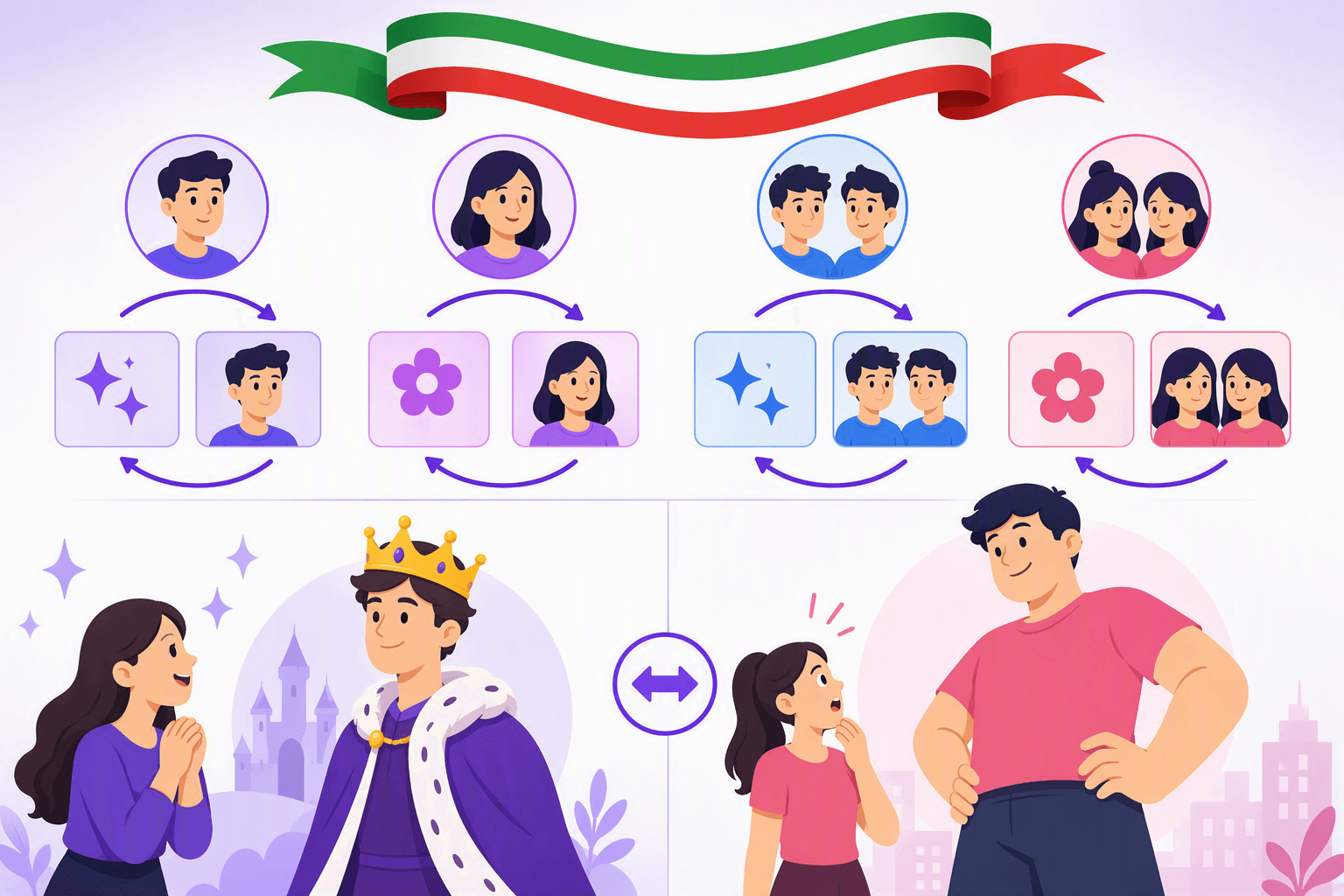
The core rule: adjectives agree with nouns
In Italian, a noun carries gender and number, and the adjective normally mirrors both. English does not do this: “a red car” and “red cars” keep red unchanged. Italian changes the adjective.
The most common adjective family ends in -o /o/. It has four forms:
| Noun type | Adjective ending | Example |
|---|---|---|
| Masculine singular | -o /o/ | un ragazzo italiano /un ratˈtsot itaˈljano/, an Italian boy |
| Feminine singular | -a /a/ | una ragazza italiana /ˈuna ratˈtsatsa itaˈljana/, an Italian girl |
| Masculine plural | -i /i/ | ragazzi italiani /ratˈtsatsi itaˈljani/, Italian boys |
| Feminine plural | -e /e/ | ragazze italiane /ratˈtsatse itaˈljane/, Italian girls |
This is the pattern behind adjectives such as alto /ˈalto/, “tall”; nuovo /ˈnwɔvo/, “new”; rosso /ˈrosso/, “red”; and italiano /itaˈljano/, “Italian.”
Rosso
Rosso /ˈrosso/ is a useful model because all four endings are easy to hear.
| English | Italian |
|---|---|
| a red book | un libro rosso /un ˈliːbro ˈrosso/ |
| a red bag | una borsa rossa /ˈuna ˈborsa ˈrossa/ |
| red books | libri rossi /ˈliːbri ˈrossi/ |
| red bags | borse rosse /ˈborse ˈrosse/ |
Notice that libro /ˈliːbro/ is masculine and borsa /ˈborsa/ is feminine. The adjective ending follows the grammatical gender, not the real-world object.
💡 Learn nouns and adjectives together
When you record new vocabulary, write a complete pair: una strada lunga /ˈuna ˈstrada ˈluŋɡa/, “a long street,” rather than only lungo /ˈluŋɡo/. The pair makes the agreement pattern easier to remember.
Adjectives ending in -e
A second major group ends in -e /e/. These adjectives have one singular form for masculine and feminine nouns, then change to -i /i/ in the plural.
| Noun type | Example with grande /ˈɡrande/, “big” |
|---|---|
| Masculine singular | un cane grande /un ˈkane ˈɡrande/, a big dog |
| Feminine singular | una casa grande /ˈuna ˈkaza ˈɡrande/, a big house |
| Masculine plural | cani grandi /ˈkani ˈɡrandi/, big dogs |
| Feminine plural | case grandi /ˈkaze ˈɡrandi/, big houses |
Other frequent -e adjectives include felice /feˈliːtʃe/, “happy”; triste /ˈtriste/, “sad”; difficile /difˈfiːtʃile/, “difficult”; and interessante /interesˈsante/, “interesting.”
The singular form does not reveal gender. You need the article or noun to identify it: un film interessante /um film interesˈsante/ and una storia interessante /ˈuna ˈstɔrja interesˈsante/.
Luca Serianni’s Grammatica italiana treats agreement as a structural feature of the noun phrase, not an optional decoration. In practical terms, listeners expect the article, noun, and adjective to work together. A mismatched ending is usually understandable, but it immediately signals learner speech.
Where Italian adjectives go
The default placement is after the noun:
- un ristorante economico /un ristoˈrante ekonoˈmiːko/, an inexpensive restaurant
- una lezione difficile /ˈuna letˈtsjone difˈfiːtʃile/, a difficult lesson
- un film divertente /um film diverˈtente/, a fun film
- una città moderna /ˈuna tʃitˈta moˈdɛrna/, a modern city
This is especially common with factual descriptions: size, color, nationality, material, shape, and other identifying details.
Italian adjective placement is flexible, though. A common adjective may appear before the noun when the speaker gives it a more subjective, familiar, emotional, or general quality.
Compare these examples:
| After the noun | Before the noun |
|---|---|
| un amico vecchio /un aˈmiːko ˈvɛkkjo/, an elderly friend | un vecchio amico /um ˈvɛkkjo aˈmiːko/, an old friend of long standing |
| una casa nuova /ˈuna ˈkaza ˈnwɔva/, a newly built house | una nuova casa /ˈuna ˈnwɔva ˈkaza/, another or new home |
| un uomo grande /un ˈwɔmo ˈɡrande/, a big or grown man | un grande uomo /uŋ ˈɡrande ˈwɔmo/, a great man |
| un povero uomo /um ˈpɔvero ˈwɔmo/, a pitiful man | un uomo povero /un ˈwɔmo ˈpɔvero/, a poor man |
This is one of the most expressive parts of Italian grammar. Word order can signal whether you are describing a measurable fact or offering an evaluation.
Anna Laura Lepschy and Giulio Lepschy, in The Italian Language, describe Italian word order as flexible but meaningful. That is the right mindset: adjective position is not random freedom. It shifts focus and, with a small set of common adjectives, can shift the definition itself.
Common adjectives that often come before the noun
Several high-frequency adjectives often appear before a noun in everyday Italian. You will hear them in introductions, love songs, films, and casual conversation.
Bello
Bello /ˈbɛllo/ means beautiful, handsome, nice, or lovely. Before a noun, it changes much like the definite article il /il/.
| Noun phrase | Meaning |
|---|---|
| un bel film /um bɛl film/ | a good or beautiful film |
| un bello spettacolo /um ˈbɛllo spetˈtaːkolo/ | a beautiful show |
| una bella giornata /ˈuna ˈbɛlla dʒorˈnaːta/ | a lovely day |
| bei libri /bɛi ˈliːbri/ | beautiful books |
| begli amici /ˈbeʎʎi aˈmiːtʃi/ | lovely friends |
Use bel /bɛl/ before most masculine singular nouns, such as bel posto /bɛl ˈposto/, “nice place.” Use bello /ˈbɛllo/ before masculine singular nouns beginning with s plus consonant, z /dz/, gn /ɲ/, ps /ps/, or x /ks/, as in bello studente /ˈbɛllo stuˈdɛnte/.
Buono
Buono /ˈbwɔno/ means good, kind, tasty, or suitable. Before a noun, it follows a pattern similar to the indefinite article un /un/.
| Noun phrase | Meaning |
|---|---|
| un buon caffè /um bwon kafˈfɛ/ | a good coffee |
| un buono studente /um ˈbwɔno stuˈdɛnte/ | a good student |
| una buona idea /ˈuna ˈbwɔna iˈdɛa/ | a good idea |
| buoni amici /ˈbwɔni aˈmiːtʃi/ | good friends |
| buone notizie /ˈbwɔne noˈtiːtsje/ | good news |
At a café, un buon caffè /um bwon kafˈfɛ/ is not merely grammatically correct. It sounds like a natural, appreciative comment on quality. For more useful food and ordering language, read our guide to Italian coffee culture.
Piccolo
Piccolo /ˈpikkolo/ means small or little. Before a masculine singular noun, it often becomes piccolo /ˈpikkolo/ or piccol /pikˈkɔl/ in more literary or fixed expressions.
In everyday speech, un piccolo problema /um pikˈkɔlo proˈblɛma/, “a small problem,” is very common. Before the noun, it can make the description feel less literal and more evaluative, as if the speaker is minimizing the issue.
Vecchio
Vecchio /ˈvɛkkjo/ means old. Before a noun, it often suggests a long-standing relationship or familiar status: un vecchio amico /um ˈvɛkkjo aˈmiːko/, “an old friend.”
After the noun, it usually describes age: un amico vecchio /un aˈmiːko ˈvɛkkjo/, “an elderly friend.” This contrast is highly useful because it appears in real conversations and subtitles.
Adjectives with special forms
Not every adjective fits neatly into the -o or -e patterns. Some are invariable, while others have shortened forms in particular positions.
Grande
Grande /ˈɡrande/ becomes gran /ɡran/ before many singular nouns:
- un gran giorno /uŋ ɡran ˈdʒorno/, a great day
- una gran bella idea /ˈuna ɡram ˈbɛlla iˈdɛa/, a really wonderful idea
- un grande libro /uŋ ˈɡrande ˈliːbro/, a large or great book
The shortened gran /ɡran/ is common in speech and writing. It is particularly frequent in enthusiastic phrases such as una gran fortuna /ˈuna ɡram forˈtuːna/, “great luck.”
Santo
Santo /ˈsanto/, “saint,” changes before names in traditional forms:
- San Marco /sam ˈmarko/
- Sant'Antonio /san tanˈtɔnjo/
- Santo Stefano /ˈsanto ˈsteːfano/
These forms matter mainly for place names, holidays, churches, and personal names. Treat them as fixed patterns rather than a general adjective rule.
Invariable adjectives
Some adjectives do not change, including many colors and borrowed words:
- rosa /ˈrɔza/, pink
- blu /blu/, blue
- viola /ˈvjɔla/, purple
- beige /bɛʒ/ or /bɛidʒ/, beige
- chic /ʃik/, chic
So you can say una borsa rosa /ˈuna ˈborsa ˈrɔza/, “a pink bag,” and due borse rosa /ˈduːe ˈborse ˈrɔza/, “two pink bags.” The color stays unchanged.
⚠️ Do not force every adjective to change
Words such as blu /blu/ and rosa /ˈrɔza/ are commonly invariable as color adjectives. Avoid creating forms such as blui or rose when you mean the colors blue and pink.
Adjective order with more than one description
Italian does not use a rigid adjective-order formula like English. When several adjectives appear, the most closely identifying description often stays near the noun, while broader opinion words may come before it.
For example:
- una bella casa antica /ˈuna ˈbɛlla ˈkaza anˈtiːka/, a beautiful old house
- un interessante film italiano /un interesˈsante film itaˈljano/, an interesting Italian film
- una piccola città costiera /ˈuna pikˈkɔla tʃitˈta kostˈjɛra/, a small coastal city
A natural order comes from meaning, not memorizing a long sequence. Nationality and classification adjectives frequently appear after the noun, while broad opinions such as bello /ˈbɛllo/ and brutto /ˈbrutto/ often come earlier.
This is especially noticeable in romantic language. Il mio caro amico /il ˈmiːo ˈkaːro aˈmiːko/ means “my dear friend,” with caro /ˈkaːro/ before the noun to express affection. For affectionate phrases and stronger declarations, see how to say I love you in Italian.
How to practice Italian adjectives with real speech
Start with short noun phrases, then turn them into full sentences. Say each form aloud rather than only reading a chart.
- Choose one noun: ragazzo /ratˈtsatso/, ragazza /ratˈtsatsa/, libro /ˈliːbro/, or casa /ˈkaza/.
- Add an adjective in all matching forms: alto /ˈalto/, alta /ˈalta/, alti /ˈalti/, alte /ˈalte/.
- Put the phrase into a sentence: La casa è alta /la ˈkaza ɛ ˈalta/, “The house is tall.”
- Listen for the same structure in dialogue and pause to repeat it.
Movie and TV scenes help because adjective agreement appears inside meaningful contexts: a character describes a person, complains about a difficult day, praises a meal, or calls someone a dear friend. Pair this grammar work with practical introductions from how to say hello in Italian and farewells from how to say goodbye in Italian.
🌍 Why adjective placement matters in Italian
Italian speakers often use adjective position to add warmth, irony, admiration, or understatement. Calling someone un caro amico /un ˈkaːro aˈmiːko/ communicates affection, while un amico caro /un aˈmiːko ˈkaːro/ is more likely to mean an expensive friend in a financial sense. These small shifts give Italian dialogue much of its tone.
The rule set to remember
Italian adjective grammar becomes manageable when you reduce it to four habits:
- Match the adjective to the noun’s gender and number.
- Use -o, -a, -i, -e for most adjectives ending in -o /o/.
- Use -e /e/ in both singular genders and -i /i/ in plurals for many other adjectives.
- Put adjectives after nouns by default, then learn the common before-noun adjectives as phrases.
Do not try to predict every subtle meaning shift immediately. Build confidence with high-frequency pairs such as bella giornata /ˈbɛlla dʒorˈnaːta/, buon lavoro /bwon laˈvoːro/, vecchio amico /ˈvɛkkjo aˈmiːko/, and grande città /ˈɡrande tʃitˈta/. Repeated exposure will make both agreement and placement feel increasingly automatic.
Frequently Asked Questions
Do Italian adjectives always go after the noun?
How do Italian adjectives agree with nouns?
What is the difference between bello and buono in Italian?
Can an Italian adjective change meaning depending on its position?
Do colors agree with nouns in Italian?
Sources & References
- Accademia della Crusca, Consulenza linguistica, accessed 2026
- Treccani, Enciclopedia dell'Italiano: Aggettivo, accessed 2026
- Ethnologue, Italian, 27th edition, 2024
- Luca Serianni, Grammatica italiana, UTET
- Anna Laura Lepschy and Giulio Lepschy, The Italian Language, Routledge
Start learning with Wordy
Watch real movie clips and build your vocabulary as you go. Free to download.


