How to Tell Time in English: A Practical Guide to Hours, Minutes, and Real Speech
Quick Answer
To tell time in English, you can say the digital time directly ("It's three fifteen") or use common spoken patterns like "quarter past three," "half past three," and "ten to four." In the US, people usually say times like "three fifteen" and use AM/PM, while the UK more often uses "quarter past" and "half past" in everyday speech.
To tell time in English, you can either say the numbers directly (like "three fifteen" for 3:15) or use everyday phrases like "quarter past three," "half past three," and "ten to four." The fastest path is to learn both styles, because movies, coworkers, and announcements switch between them depending on region and context.
English is also a practical choice to master early: Ethnologue estimates about 1.5 billion total English speakers worldwide (27th edition, 2024). That means time phrases are not just classroom vocabulary, they are survival language for travel, work calls, and schedules across dozens of countries.
If you want listening practice with real dialogue, pair this with English numbers because time is basically numbers plus a few key words. For natural exposure, use clips from movies to learn English where characters negotiate plans quickly and casually.
| English | Pronunciation | Formality |
|---|---|---|
| What time is it? | wuht TIME iz it | polite |
| Do you have the time? | doo yoo HAV thuh TIME | polite |
| It's three o'clock. | its THREE uh-KLOK | neutral |
| It's three fifteen. | its THREE fif-TEEN | neutral |
| It's quarter past three. | its KWOR-ter past THREE | neutral |
| It's half past three. | its HAF past THREE | neutral |
| It's twenty to four. | its TWEN-tee too FOR | neutral |
| It's almost four. | its AHL-mohst FOR | casual |
| It's around four. | its uh-ROWND FOR | casual |
| See you at four. | SEE yoo at FOR | casual |
| Let's meet at four thirty. | lets MEET at FOR THUR-tee | casual |
| I'll be there in ten minutes. | ayl bee THAIR in TEN MIN-its | casual |
The building blocks of time in English
Time-telling is a small system: a few nouns (hour, minute), a few reference points (noon, midnight), and a couple of linking words (past, to). Once those are automatic, you can understand most spoken times even when people speak fast.
David Shariatmadari’s work on modern English usage highlights how spoken English often prefers shorter, more direct phrasing than formal writing. Time is a perfect example: people say "three fifteen" far more than "fifteen minutes past three" in everyday conversation.
Core time vocabulary
| English | Pronunciation | Note |
|---|---|---|
| o'clock | uh-KLOK | Used for exact hours: 'six o'clock' = 6:00. |
| minute | MIN-it | In speech, often reduced: 'in a minute'. |
| hour | OW-er | Silent H. |
| AM | AY-em | Before noon, often said as letters. |
| PM | PEE-em | After noon, often said as letters. |
| noon | NOON | 12:00 PM. |
| midnight | MID-nyte | 12:00 AM. |
| quarter | KWOR-ter | 15 minutes. |
| half | HAF | 30 minutes. |
| past | past | Minutes after the hour: 'ten past three' = 3:10. |
| to | too | Minutes before the next hour: 'ten to four' = 3:50. |
| sharp | shahrp | Exactly on time: 'at 9 sharp'. |
| on the dot | on thuh DAHT | Exactly at that time: 'at 9 on the dot'. |
| about | uh-BOWT | Approximate time: 'about 9'. |
| around | uh-ROWND | Approximate time: 'around 9'. |
| almost | AHL-mohst | Close to the next time: 'almost 4'. |
| just after | just AF-ter | A little later than: 'just after 4'. |
| just before | just bih-FOR | A little earlier than: 'just before 4'. |
💡 Pronunciation shortcut that fixes many time mistakes
In fast speech, English reduces function words. "What time is it?" often sounds like "wuh TIME iz it," and "at" can sound like "ut" in "at four." Train your ear for reduced vowels, not just dictionary pronunciation.
Two main ways to say the time
Most English time expressions fall into two patterns. Both are correct, but they show different regional preferences.
Digital style: say the numbers
This is common in American English and very common in international workplaces.
- 3:05 = "three oh five" (THREE oh FYV) or "three zero five" (more formal, often for phone or travel contexts)
- 3:15 = "three fifteen" (THREE fif-TEEN)
- 3:30 = "three thirty" (THREE THUR-tee)
- 3:45 = "three forty-five" (THREE FOR-tee FYV)
This style is efficient, and it matches what you see on phones and laptops.
Relative style: past and to
This is especially common in the UK and Ireland, and it is widely understood elsewhere.
- 3:10 = "ten past three" (TEN past THREE)
- 3:15 = "quarter past three" (KWOR-ter past THREE)
- 3:30 = "half past three" (HAF past THREE)
- 3:40 = "twenty to four" (TWEN-tee too FOR)
- 3:45 = "quarter to four" (KWOR-ter too FOR)
Cambridge Dictionary entries for "quarter past" and "half past" reflect how established these phrases are in standard usage (accessed 2026). They are not slang, they are everyday English.
🌍 US vs UK: the 'half' difference learners worry about
In English, "half past three" is unambiguous: 3:30. Learners sometimes import "half to four" from other languages, but in English that usually sounds wrong. If you are speaking with a mixed international group, "three thirty" is the safest option.
How to ask for the time (and sound normal)
Asking the time is simple, but the tone matters. English politeness often uses softeners, especially with strangers, which aligns with classic pragmatics research on face and indirectness (Brown & Levinson, Politeness: Some Universals in Language Usage, Cambridge University Press).
"What time is it?"
"What time is it?" (wuht TIME iz it) is neutral and common. Add "Excuse me" to make it polite with strangers.
- "Excuse me, what time is it?" (ik-SKYOOZ mee, wuht TIME iz it)
"Do you have the time?"
"Do you have the time?" (doo yoo HAV thuh TIME) is slightly more formal and a little old-fashioned in some places, but still natural. It is common enough that you will hear it in films and on the street.
"Do you know what time it is?"
This is a softer, indirect option:
- "Do you know what time it is?" (doo yoo NOH wuht TIME it iz)
- "Do you happen to know what time it is?" (doo yoo HAP-en too NOH...)
Use this when you want to sound extra courteous.
Saying exact hours: o'clock, AM, PM, noon, midnight
When the minute hand is on 12, English has a special shortcut.
o'clock
Use "o'clock" (uh-KLOK) for exact hours:
- 6:00 = "six o'clock" (SIKS uh-KLOK)
In many professional contexts, people drop it and just say "six."
AM and PM
Merriam-Webster’s entries for "a.m." and "p.m." explain them as abbreviations used to distinguish times before and after noon (accessed 2026). In speech, people usually say the letters:
- 7:00 AM = "seven AM" (SEV-en AY-em)
- 7:00 PM = "seven PM" (SEV-en PEE-em)
In casual conversation, people often prefer context instead:
- "at seven in the morning"
- "at seven tonight"
noon and midnight
These are high-frequency words that reduce confusion.
- 12:00 PM = "noon" (NOON)
- 12:00 AM = "midnight" (MID-nyte)
⚠️ Avoid the '12 AM/12 PM' trap
Even native speakers hesitate with "12 AM vs 12 PM." If clarity matters (travel, work deadlines), say "noon" or "midnight," or add context like "midnight tonight" or "noon tomorrow."
Minutes: quarter, half, and the most common patterns
Once you know 15 and 30, you can understand a big chunk of real speech.
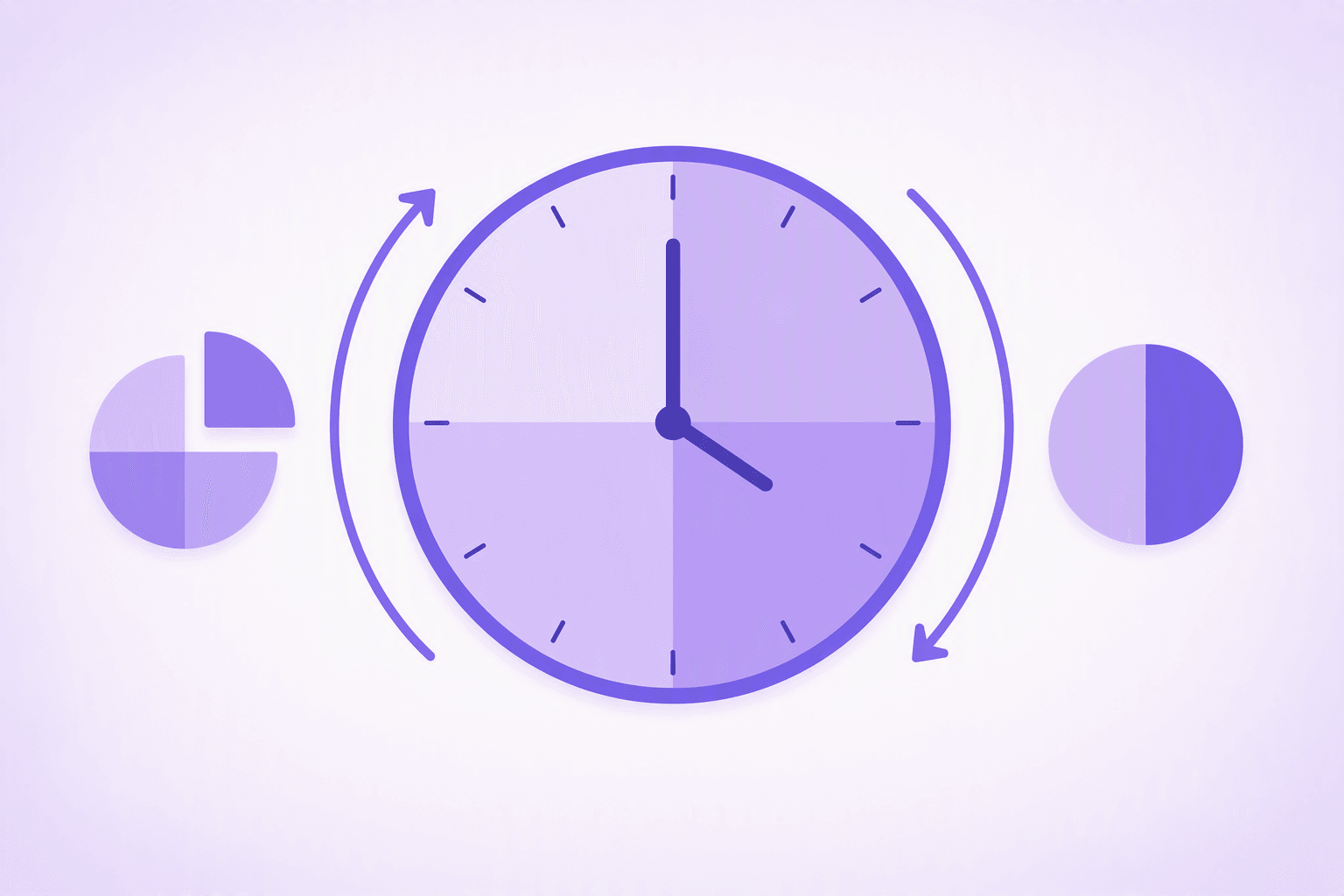
Quarter past
"Quarter past" means 15 minutes after the hour:
- 2:15 = "quarter past two" (KWOR-ter past TOO)
Half past
"Half past" means 30 minutes after the hour:
- 9:30 = "half past nine" (HAF past NYN)
Quarter to
"Quarter to" means 15 minutes before the next hour:
- 5:45 = "quarter to six" (KWOR-ter too SIKS)
Past and to with other numbers
Here is the logic:
- Minutes 1-30: use "past" the current hour
- Minutes 31-59: use "to" the next hour
Examples:
- 4:20 = "twenty past four" (TWEN-tee past FOR)
- 4:35 = "twenty-five to five" (TWEN-tee FYV too FYV)
If you already learned number pronunciation, this becomes automatic. If not, start with English numbers and come back.
Approximate time: the phrases people actually use
Real life is not always exact. English has a set of phrases for being intentionally vague.
About, around
- "It’s about four." (its uh-BOWT FOR)
- "Let’s meet around four." (lets MEET uh-ROWND FOR)
"About" can feel slightly more precise than "around," but both are normal.
Almost, just after, just before
- 3:58 = "It’s almost four." (its AHL-mohst FOR)
- 4:02 = "It’s just after four." (its just AF-ter FOR)
- 3:55 = "It’s just before four." (its just bih-FOR FOR)
These are extremely common in spoken English because they match how people perceive time, not how clocks display it.
In a minute, in a second
These are not literal.
- "I’ll be there in a minute." often means "soon," not exactly 60 seconds.
- "In a second" often means "very soon."
If you want to understand tone and exaggeration in casual speech, this overlaps with slang and informal registers. See English slang for more everyday phrasing patterns.
🌍 Punctuality culture and time language
In the US and UK, "at 7" often implies a real plan, but "around 7" gives flexibility. In many workplaces, "at 7 sharp" or "at 7 on the dot" signals that lateness will be noticed. The phrase you choose communicates expectations, not just time.
Time for schedules: at, on, in (the quick rule)
Learners often mix up prepositions with time. Keep it simple:
- at + clock time: "at 6:30" (at siks THUR-tee)
- on + day/date: "on Monday," "on August 3rd"
- in + month/year/part of day: "in August," "in 2026," "in the morning"
Examples:
- "The meeting is at 9:00." (thuh MEET-ing iz at NYN)
- "It’s on Friday." (its on FRY-day)
- "I work in the afternoon." (ay WURK in thee af-ter-NOON)
If you want a deeper foundation for these patterns, pair this with a broader grammar resource like English prepositions.
Common real-life scenarios (with natural phrasing)
These mini scripts are the fastest way to make time language usable.
Making plans with friends
- "What time should we meet?" (wuht TIME shood wee MEET)
- "How about six thirty?" (how uh-BOWT siks THUR-tee)
- "Cool, see you at six thirty." (KOOL, SEE yoo at siks THUR-tee)
Work and appointments
- "Are you free at 2 PM?" (ar yoo FREE at TOO PEE-em)
- "Can we do 2:30 instead?" (kan wee doo TOO THUR-tee in-STED)
- "Yes, 2:30 works." (yes, TOO THUR-tee wurks)
Travel and announcements
- "Boarding starts at 7:10." (BOR-ding starts at SEV-en TEN)
- "The train leaves at 14:05." (formal, 24-hour clock context)
British Council materials on telling the time emphasize practicing these contexts, not just memorizing forms (accessed 2026). That is because time language is mostly used under pressure: rushing, coordinating, and correcting misunderstandings.
Common mistakes (and quick fixes)
Mistake 1: Saying "half to" for 3:30
Fix: Say "half past three" or "three thirty."
Mistake 2: Confusing "to" and "past"
Fix: If you are counting down to the next hour, use "to." If you are counting up after the hour, use "past."
Mistake 3: Overusing "o'clock"
Fix: Use it for exact hours, but drop it when minutes are present. "Six fifteen o'clock" is not natural.
Mistake 4: Pronouncing "hour" with an H
Fix: "hour" is "OW-er," not "HOW-er."
💡 A listening trick from movies and TV
When a character says a time fast, listen for the stressed numbers, not every word. In "quarter to six," the brain-catchers are "quarter" and "six." This is one reason clip-based learning works well for time expressions. Start with movies to learn English and replay short scenes until the rhythm feels automatic.
Practice: convert digital time to spoken time
Use this as a quick self-test. Say each time out loud in two ways: digital style and relative style.
| Digital time | Digital style | Relative style |
|---|---|---|
| 1:00 | one o'clock | one o'clock |
| 1:05 | one oh five | five past one |
| 1:15 | one fifteen | quarter past one |
| 1:30 | one thirty | half past one |
| 1:40 | one forty | twenty to two |
| 1:45 | one forty-five | quarter to two |
| 1:55 | one fifty-five | five to two |
If you can do this without pausing, you can handle most everyday scheduling.
Where time language shows up in real English (and how to learn it faster)
Time expressions appear constantly in dialogue because they move the plot: missed trains, dates, deadlines, and quick negotiations. That is why they are high-value vocabulary.
For deliberate practice, Paul Nation’s work on vocabulary learning (especially frequency and repeated exposure) supports focusing on high-frequency chunks, not isolated words. In time-telling, the chunks are "quarter past," "half past," "ten to," "at nine," and "in the morning."
If you also want to understand how casual speech bends rules, compare time phrases with informal intensifiers and exaggeration in English slang. If you are learning what not to say in professional settings, keep English swear words separate from time language, because swearing often appears in late or stressful time contexts in movies.
A simple 7-day plan to make telling time automatic
Day 1: Memorize quarter, half, past, to, noon, midnight.
Day 2: Practice 10 random times using the table above.
Day 3: Listen for time phrases in a show episode and write down 10 examples.
Day 4: Practice asking and answering the time with a timer, 60 seconds per round.
Day 5: Switch between 12-hour and 24-hour formats for travel-style times.
Day 6: Practice approximate phrases: about, around, almost, just after.
Day 7: Do a full day in English: say the time out loud every time you check your phone.
If you want a steady stream of realistic examples, clip-based practice inside Wordy works best when you replay short scenes and shadow the line until your timing and stress match the actor. For more learning methods, browse the Wordy blog.
Frequently Asked Questions
How do you say 3:15 in English?
What is the difference between 'half past' and 'half to'?
Do English speakers use the 24-hour clock?
How do you ask the time politely in English?
Is it 'at night' or 'in the night' for times?
Sources & References
- Ethnologue: Languages of the World, English language entry (27th edition, 2024)
- British Council, LearnEnglish: telling the time (accessed 2026)
- Cambridge Dictionary, entries for 'quarter past', 'half past', and 'o'clock' (accessed 2026)
- Merriam-Webster, entries for 'a.m.' and 'p.m.' (accessed 2026)
Start learning with Wordy
Watch real movie clips and build your vocabulary as you go. Free to download.


