Quick Answer
English prepositions are short words like in, on, at, to, for, and by that show relationships in time, place, direction, and meaning. The fastest way to use them correctly is to learn the core patterns (in/on/at for time and place, to vs into for movement, for vs since for duration) and then practice them in real sentences you actually hear.
English prepositions are words like in, on, at, to, for, by, with that tell you how things relate in time, place, direction, and meaning, and you get them right fastest by mastering a few high-frequency patterns (especially in/on/at, to/into, and for/since) and practicing them in real sentences.
English is also worth learning well because it is the world’s biggest second language: Ethnologue estimates roughly 1.5 billion total speakers when you combine native and second-language speakers (Ethnologue, 27th ed., 2024). That means the preposition choices you make affect how clear you sound to a huge global audience, from job interviews to travel to texting.
If you want more everyday English that shows up in real dialogue, pair this with our English pronunciation guide and then practice with the kind of natural lines you hear in our best movies to learn English.
What prepositions do (and why they feel tricky)
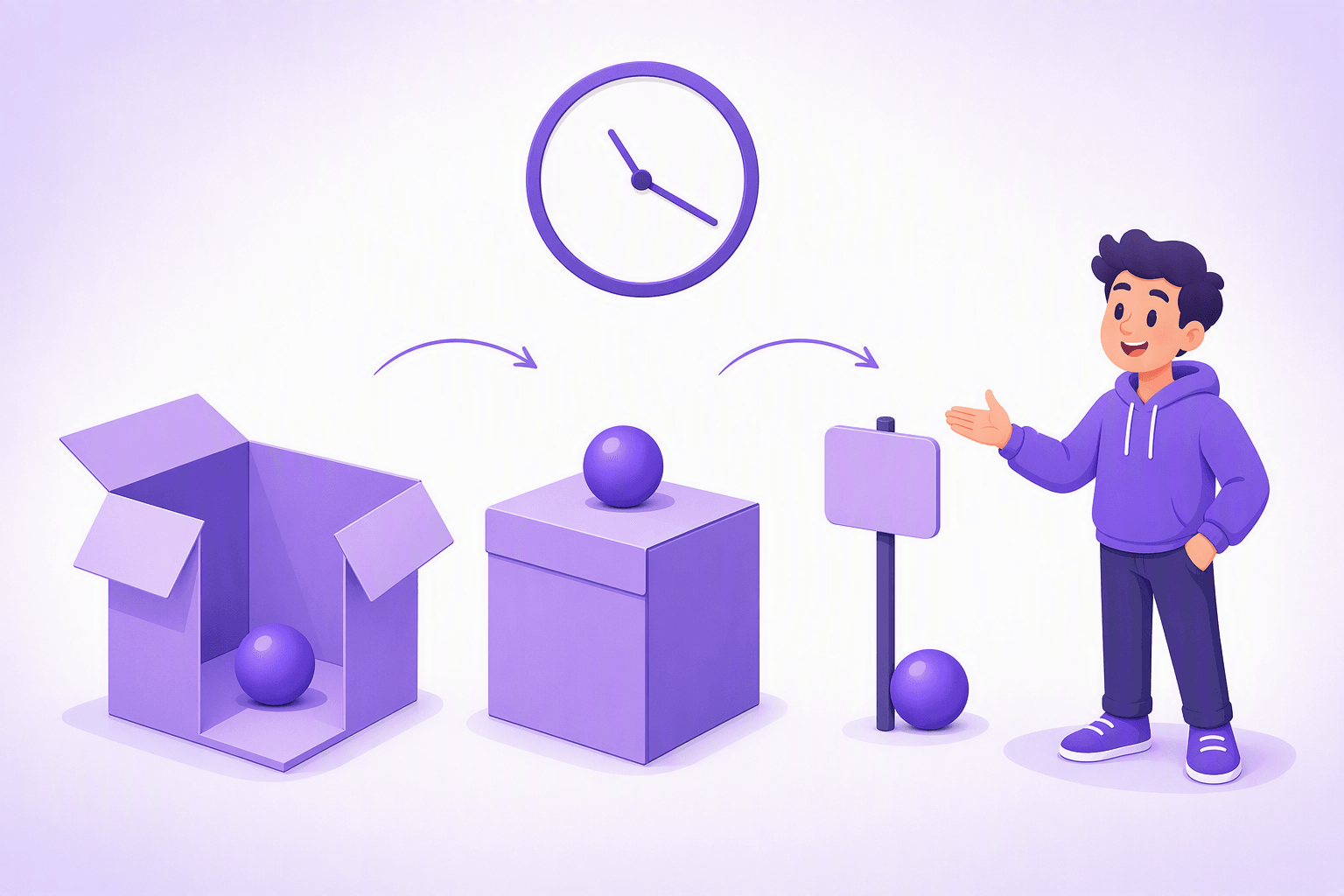
A preposition links a noun phrase to the rest of the sentence: in the kitchen, at 9, for two weeks, by train. Most of the time, it answers a relationship question: where, when, how, whose, or what about.
The tricky part is that English prepositions are not just “location words.” They also encode metaphor and convention: in trouble, on purpose, at risk, by mistake. These are not logical in a physics sense, they are conventional patterns you learn through exposure.
In The Cambridge Grammar of the English Language, Rodney Huddleston and Geoffrey Pullum treat prepositions as a major category with broad functions, including many uses that learners often mislabel as adverbs. That framing helps because it explains why English uses prepositions in places where other languages might use case endings or different word order.
💡 A practical learning rule
If you can replace the phrase with a question like "where?", "when?", "how?", or "which one?", you are often looking at a preposition phrase: "Where?" "in the office", "When?" "at noon", "How?" "by email".
The core set you must master first
There are dozens of prepositions, but daily English runs on a smaller core. Cambridge Dictionary and Merriam-Webster both define prepositions as words that show relationships, and in real conversation you will see the same ones repeatedly (Cambridge Dictionary, accessed 2026; Merriam-Webster, accessed 2026).
Start with these because they unlock the most sentences:
- in, on, at (place and time)
- to, into, onto (direction and movement)
- for, since, during (time relationships)
- by, with (method, tool, agent)
- from, of (origin, belonging)
- about (topic)
- over, under, above, below (position and comparison)
- between, among (relationships in a group)
In, on, at for place (the “container, surface, point” pattern)
This pattern is not perfect, but it is the best starting map.
In (place)
In is for something inside a space, or within a larger area.
- in a room, in a box, in a car
- in London, in Japan, in the countryside
- in my pocket, in the photo
Pronunciation: in (IN).
Common learner mistake: using at for large places.
- Natural: I live in Berlin.
- More specific point: I’m at the station.
On (place)
On is for contact with a surface, or for lines and routes.
- on the table
- on the wall
- on the floor
- on this street
- on the bus (common in many varieties of English)
Pronunciation: on (ON).
Cultural note: In American English, you will often hear in the car but on the bus/train/plane. It is not about logic, it is about how English categorizes these spaces socially, as shared public transport vs private vehicle.
At (place)
At is for a point, a specific spot, or an event location.
- at the door
- at the corner
- at home
- at work
- at a party
- at the airport
Pronunciation: at (AT).
Common learner mistake: saying in home.
- Natural: I’m at home.
- Also natural (different meaning): I’m in the house (inside the building, not necessarily “home” emotionally).
⚠️ Common confusion: 'in the hospital' vs 'at the hospital'
"In the hospital" often implies you are admitted as a patient (especially in American English). "At the hospital" usually means you are there as a visitor, worker, or for an appointment. Context can override this, but the difference is real in everyday speech.
In, on, at for time (the “long, day, point” pattern)
British Council teaching materials present these as the standard entry point for learners (British Council, accessed 2026). The same three words cover most time expressions.
In (time)
In is for longer periods and “within” time frames.
- in June
- in 2026
- in the morning (but: at night)
- in the summer
- in the past
- in two weeks (meaning: two weeks from now)
Pronunciation: in (IN).
On (time)
On is for days and dates.
- on Monday
- on my birthday
- on May 3rd
- on the weekend (common in American English; British English also uses at the weekend)
Pronunciation: on (ON).
At (time)
At is for exact times and specific moments.
- at 7:30
- at noon
- at midnight
- at the moment
- at the end of the week
Pronunciation: at (AT).
To vs into (direction vs entering)
This pair causes a lot of “almost right” sentences.
To
To expresses direction toward a destination.
- go to school
- walk to the station
- send it to me
- talk to your manager
Pronunciation: to (TOO) in careful speech, often reduced in fast speech.
Into
Into emphasizes movement from outside to inside.
- go into the room
- put it into the bag
- get into the car
Pronunciation: into (IN-too).
A clean test: if the endpoint is clearly “inside,” into is often best. If you are focusing on the destination as a place or institution, to is often best: go to the hospital (destination), go into the hospital (enter the building).
On vs onto (position vs movement)
- on = location: The keys are on the table.
- onto = movement: Put the keys onto the table.
Pronunciation: onto (ON-too).
In fast speech, many native speakers say on even when movement is implied, but writing and careful speech often keep onto.
For vs since (duration vs starting point)
This is one of the highest-value distinctions in English.
For
For + length of time.
- for two hours
- for a long time
- for three days
- for years
Pronunciation: for (FOR).
Since
Since + starting point in time.
- since Monday
- since 2019
- since I was a kid
- since we met
Pronunciation: since (SINSS).
Most common tense pairing: present perfect.
- I’ve lived here for five years.
- I’ve lived here since 2021.
If you need a refresher on numbers for dates and times, our numbers in English guide helps you say years and times clearly.
During vs for (the “inside the period” vs “length” difference)
Learners often use during when they mean for.
-
during answers “when within a period?”
- during the meeting
- during the summer
- during the night (also: at night)
-
for answers “how long?”
- for the whole meeting
- for the entire summer
- for the night (less common, but possible in specific contexts)
Pronunciation: during (DOOR-ing) or (DYUR-ing), both are heard.
By vs with (agent/method vs tool/companionship)
This pair is a frequent source of unnatural sentences.
By
By is used for:
- the agent in passive voice: The book was written by her.
- method/transport: by train, by email, by hand
- deadlines: by Friday (no later than Friday)
Pronunciation: by (BYE).
With
With is used for:
- tools and instruments: with a pen, with a knife
- accompaniment: with my friends
- manner: with confidence
Pronunciation: with (WITH) or (WITH) with a softer th in fast speech.
A useful contrast:
- I sent it by email. (method)
- I sent it with an email. (sounds like the email is an extra object you included)
From vs of (origin vs belonging and “made of”)
From
From marks origin, starting point, or source.
- I’m from Canada.
- This is from my boss.
- from 9 to 5
Pronunciation: from (FRUHM).
Of
Of marks belonging, connection, or composition.
- a friend of mine
- the capital of France
- made of wood
- a cup of tea
Pronunciation: of (UHV) in most natural speech.
Cultural insight: In fast spoken English, of is often reduced so much it sounds like uhv or even just a soft vowel. That reduction is one reason learners miss it in movies, then omit it in their own speech.
About vs on (topic, vibe, and formality)
Both can introduce a topic, but they feel different.
- about is general and conversational: We talked about work.
- on is more structured or “presentation-like”: a lecture on climate policy, a book on photography
Pronunciation: about (uh-BOWT), on (ON).
You will also see about in approximate numbers: about 20 minutes. This is common in everyday scheduling.
Between vs among (two vs group, with real usage)
Traditional rules say:
- between for two
- among for three or more
In modern English, between is also used for relationships inside a group when the relationships are one-to-one or clearly defined: negotiations between the EU member states can sound natural.
Pronunciation: between (bih-TWEEN), among (uh-MUHNG).
Prepositions at the end (and why it is normal)
You will hear “preposition stranding” constantly:
- Who are you going with?
- That’s the person I was talking about.
- This is the chair I sat on.
This is not “bad English.” It is a standard feature of the language, and forcing a rewrite can sound unnatural: With whom are you going? is grammatical, but it is formal and rare in everyday speech.
If you want to sound natural in casual conversation, focus on hearing these patterns in context. That is one reason movie and TV dialogue is useful, see our best movies to learn English list for level-appropriate picks.
Fixed combinations you should learn as chunks
A lot of preposition accuracy is not a rule, it is a collocation. In English Grammar in Use, Raymond Murphy popularized teaching grammar through high-frequency patterns and examples, and preposition chunks are a perfect case for that approach.
Here are some of the most useful “learn as one unit” combinations:
Verb + preposition
- depend on: It depends on the weather.
- listen to: Listen to this.
- wait for: I’m waiting for the bus.
- look at: Look at that.
- talk about: We talked about it.
- agree with (a person) / agree on (a plan): I agree with you. / We agreed on a date.
Adjective + preposition
- good at: She’s good at math.
- interested in: I’m interested in design.
- afraid of: He’s afraid of flying.
- responsible for: I’m responsible for the report.
- different from (also: different to in some varieties): This is different from what I expected.
Noun + preposition
- a reason for: What’s the reason for this?
- a solution to: We need a solution to the problem.
- an increase in: an increase in prices
💡 How to learn chunks from real dialogue
When you watch a scene, do not write down single words. Write down the whole unit: "responsible for", "interested in", "a solution to". Then make one new sentence about your life. That is how you convert input into usable grammar.
The “at home” and “in bed” cultural patterns
Some preposition choices are cultural defaults, not logic puzzles.
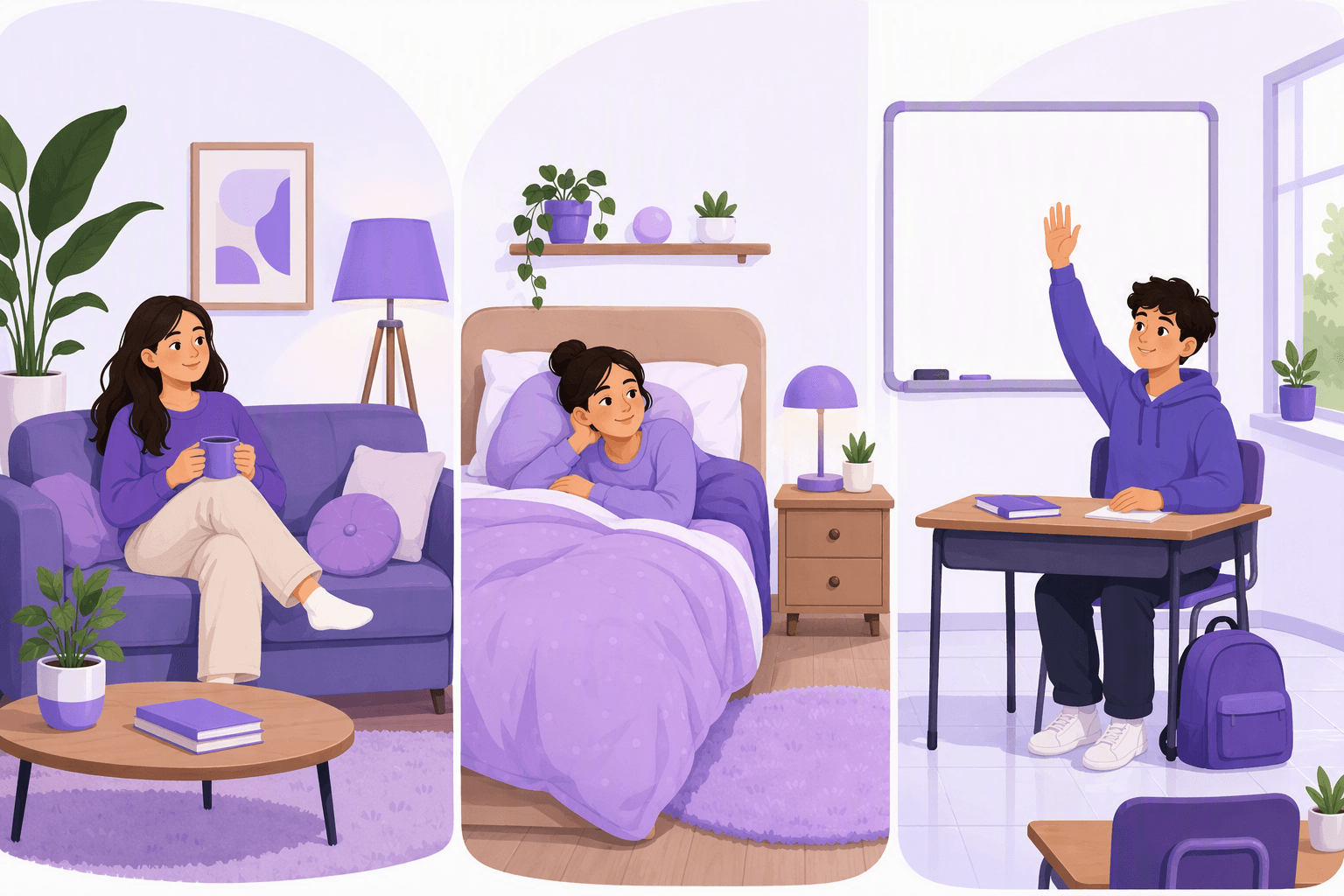
- at home is the standard state phrase, like “in a home state.”
- in bed is the standard location phrase, even though you are physically “on” a bed.
- in class means attending class, not necessarily inside a classroom.
- at school often means “as a student/at the institution,” while in the school is more literal, inside the building.
These patterns show how English uses prepositions to encode social roles and situations, not just geometry.
A short practice plan that actually works
Prepositions improve fastest when you combine rules with exposure. If you only memorize rules, you will still hesitate. If you only watch content, you may not notice the pattern.
- Pick one theme per week: time, place, movement, or chunks.
- Collect 10 real examples from dialogue or reading.
- Say them out loud, then swap one detail: time, place, object.
- Write 5 sentences you might actually use tomorrow.
If you need a steady stream of natural lines, use movie clips with subtitles and replay. It is the same reason we recommend authentic listening in our best movies to learn English guide.
Common mistakes that instantly sound non-native (and the fixes)
Mistake 1: "married with" (when you mean the relationship)
Natural: married to someone.
- She’s married to Alex.
With is possible in a different meaning: married with two kids is an older, less common structure, and many speakers avoid it.
Mistake 2: "discuss about"
In standard English, discuss does not take about.
- Natural: Let’s discuss the plan.
- Also natural: Let’s talk about the plan.
Mistake 3: "explain me"
Use explain to with the person.
- Natural: Explain it to me.
- Not: Explain me.
Mistake 4: "in the weekend" (variety differences)
American English: on the weekend. British English: at the weekend is common.
Both are real. Choose one variety and stay consistent.
Mistake 5: "arrive to"
Standard patterns:
- arrive at (small place): arrive at the station
- arrive in (city/country): arrive in Paris
Where slang and swearing change prepositions
Prepositions also show up in slang and strong language, often in fixed phrases: pissed at someone, pissed off, fed up with, down for something (meaning willing), out of it (meaning exhausted or confused).
If you are learning informal English, read our English slang guide and be careful with intensity. Some expressions overlap with profanity, and tone matters a lot, see our English swear words guide for context and severity.
🌍 Prepositions are a politeness tool
In workplace English, prepositions can soften requests: "Could you look at this?" feels lighter than "Review this." Similarly, "I’m concerned about X" sounds more collaborative than "X is wrong." Small grammar choices shape how direct you sound, especially in multicultural teams.
A quick checklist for choosing the right preposition
- Are you talking about time? Start with in/on/at, then check for/since/by.
- Are you talking about place? Start with in/on/at, then check if it is a point (at) or inside (in).
- Is there movement? Consider to/into/onto.
- Is it a fixed collocation? Learn it as a chunk: good at, interested in, depend on.
- Does your sentence feel “translated”? Search your memory for a common phrase you have heard in real English, then copy the structure.
If you want a structured path for building everyday accuracy, combine this with our 100 most common English words list so you practice prepositions with the words you will use constantly.
Practice with real clips (and track what you miss)
Prepositions are easy to skip when listening because they are short and often reduced in speech. That is why subtitles help, and why replay matters.
A good routine is: listen once without reading, then replay with subtitles and circle every preposition you missed. Over time, your brain starts predicting them automatically, which is the real goal.
When you are ready, pick a movie you already like from our best movies to learn English list and do 5 minutes a day. Consistency beats cramming for prepositions.
If you want to practice with short, repeatable scenes, Wordy is built for this exact problem: hearing real English, noticing the small grammar words, and turning them into sentences you can actually say.
Frequently Asked Questions
What are prepositions in English?
What is the difference between in, on, and at?
Is it wrong to end a sentence with a preposition?
How do I choose between for and since?
Why are English prepositions so hard?
Sources & References
- Cambridge Dictionary, 'preposition' (accessed 2026)
- Merriam-Webster Dictionary, 'preposition' (accessed 2026)
- British Council, LearnEnglish: Prepositions of place and time (accessed 2026)
- Ethnologue, 27th edition, 2024
- Huddleston, R. & Pullum, G.K., The Cambridge Grammar of the English Language, Cambridge University Press
Start learning with Wordy
Watch real movie clips and build your vocabulary as you go. Free to download.


