Quick Answer
The standard way to say Happy New Year in Korean is 새해 복 많이 받으세요, meaning 'please receive lots of luck in the new year.' Use it with almost anyone, especially around January 1 and Seollal, the Korean Lunar New Year.
| English | Korean | Pronunciation | Formality |
|---|---|---|---|
| Happy New Year | 새해 복 많이 받으세요 | seh-HEH pok MAH-nee pah-DEU-seh-yoh | polite |
| Happy New Year, friend | 새해 복 많이 받아 | seh-HEH pok MAH-nee pah-DAH | casual |
| Please receive much luck in the new year | 새해 복 많이 받으십시오 | seh-HEH pok MAH-nee pah-DEU-ship-shee-oh | formal |
| I hope you receive many blessings | 새해에도 좋은 일만 가득하세요 | seh-HEH-eh-doh JOH-eun eel-mahn kah-DEUK-hah-seh-yoh | polite |
| Have a happy New Year | 새해 잘 보내 | seh-HEH jahl boh-NEH | casual |
To say Happy New Year in Korean, use 새해 복 많이 받으세요 /sɛ.he pok̚ ma.nʰi pa.dɯ.se.jo/. It is the standard polite greeting for the season and literally means please receive lots of good fortune in the new year. It works for January 1 and for Seollal, Korea's Lunar New Year. If you are learning everyday greetings, pair it with how to say hello in Korean so your first seasonal conversation sounds natural.
Korean is spoken by more than 80 million people worldwide, mainly in South Korea and North Korea, with major diaspora communities in China, the United States, Japan, and Central Asia. Although the two Korean states use different political systems and some vocabulary differs, the New Year wish 새해 복 많이 받으세요 /sɛ.he pok̚ ma.nʰi pa.dɯ.se.jo/ is widely recognized.
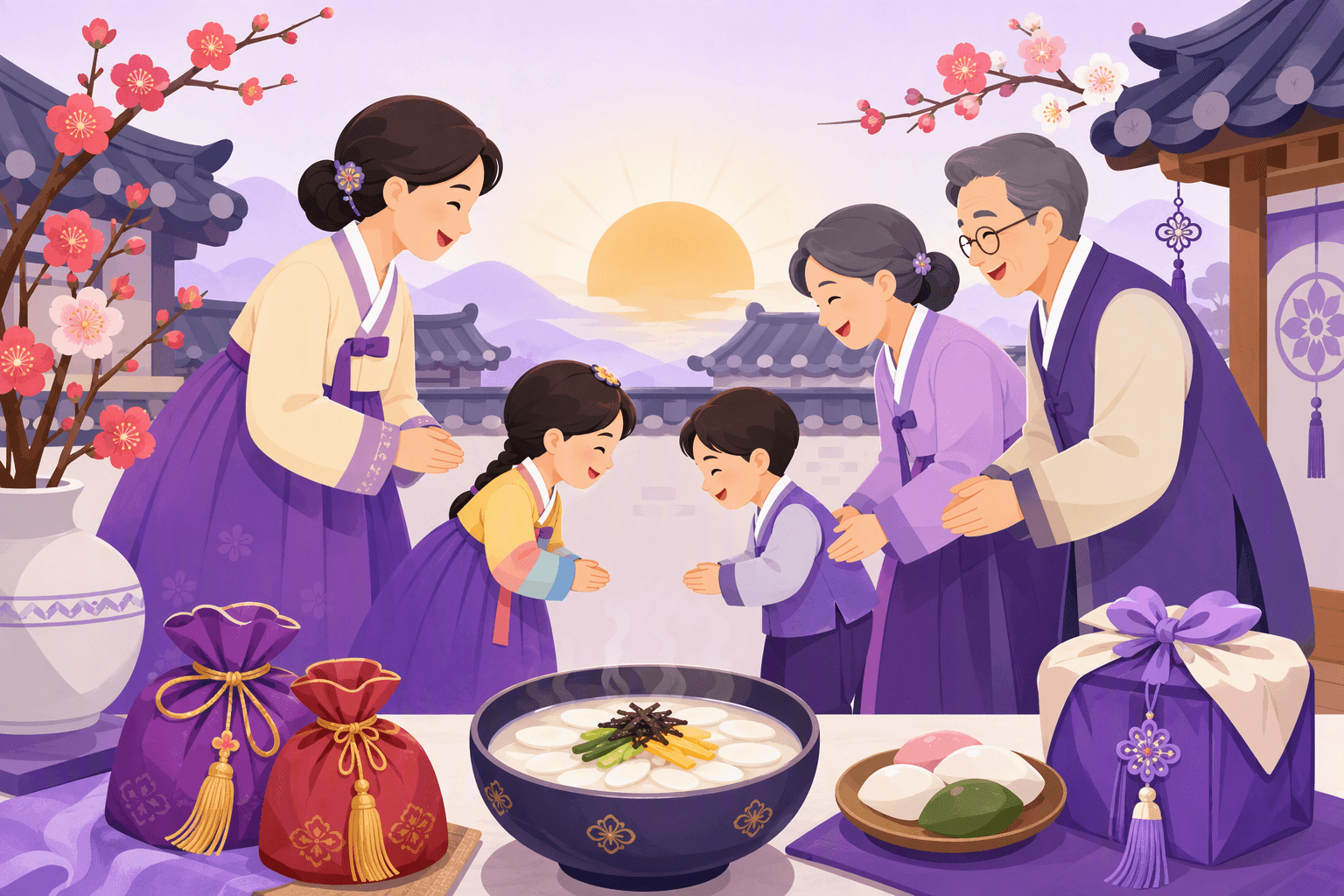
The standard Korean New Year greeting
새해 복 많이 받으세요
새해 복 많이 받으세요 /sɛ.he pok̚ ma.nʰi pa.dɯ.se.jo/ is the safest, most useful way to say Happy New Year in Korean. Say it to a teacher, coworker, neighbor, older relative, shop owner, or friend you do not know well.
/seh-HEH pok MAH-nee pah-DEU-seh-yoh/
Literal meaning: Please receive lots of good fortune in the new year.
“새해 복 많이 받으세요! 올해도 건강하세요.”
Happy New Year! Please stay healthy this year too.
This is the standard seasonal greeting in Korea. It is appropriate around January 1 and Seollal, the Lunar New Year.
The phrase has four useful pieces. 새해 /sɛ.he/ means new year, 복 /pok̚/ means luck, good fortune, or blessings, 많이 /ma.nʰi/ means a lot, and 받으세요 /pa.dɯ.se.jo/ is a polite form of receive.
This wording reveals something cultural: Korean New Year wishes often focus on fortune, health, success, and peaceful relationships rather than only happiness. The greeting is a wish directed toward the listener's future, not merely a cheerful seasonal label.
Ho-min Sohn's The Korean Language describes how Korean honorific choices organize social relationships in everyday speech. The ending -세요 /se.jo/ makes this greeting respectfully warm without making it stiff or distant.
Polite, formal, and casual versions
Your relationship with the listener determines the ending. Korean speech levels matter, especially when age, workplace rank, family role, or social distance is involved.
새해 복 많이 받아
For close friends, siblings, a romantic partner, or younger people, say 새해 복 많이 받아 /sɛ.he pok̚ ma.nʰi pa.da/. It drops the polite ending and sounds relaxed and affectionate.
/seh-HEH pok MAH-nee pah-DAH/
Literal meaning: Receive lots of good fortune in the new year.
“지민아, 새해 복 많이 받아!”
Jimin, Happy New Year!
Use this with close friends, peers, younger siblings, and a partner. Do not use it with a teacher or an older relative unless your relationship is unusually close.
You may also see 새해 복 많이 받어 /sɛ.he pok̚ ma.nʰi pa.dʌ/ in casual writing or speech. It is colloquial, but 받아 /pa.da/ is clearer for learners and fits more situations.
새해 복 많이 받으십시오
새해 복 많이 받으십시오 /sɛ.he pok̚ ma.nʰi pa.dɯ.ɕip̚.ɕi.o/ is a highly formal version. You might hear it in official announcements, speeches, business messages, broadcasts, or a respectful greeting to a large audience.
/seh-HEH pok MAH-nee pah-DEU-ship-shee-oh/
Literal meaning: Please receive abundant good fortune in the new year.
“여러분, 새해 복 많이 받으십시오.”
Everyone, please have a happy New Year.
This level is respectful and ceremonial. It is excellent in formal writing but can sound overly official between ordinary friends.
The ending -십시오 /ɕip̚.ɕi.o/ is more ceremonious than -세요 /se.jo/. For most learners, 새해 복 많이 받으세요 /sɛ.he pok̚ ma.nʰi pa.dɯ.se.jo/ is the best default.
💡 A simple formality rule
Use 새해 복 많이 받으세요 /sɛ.he pok̚ ma.nʰi pa.dɯ.se.jo/ unless you are certain the relationship is casual. Being slightly more polite is almost never a mistake in Korean, especially with someone older or in a professional setting.
More Korean wishes for the new year
A New Year message often adds a personal wish after the standard greeting. These additions make a text, card, or spoken greeting feel more sincere.
건강하세요
건강하세요 /kʌn.ɡaŋ.ha.se.jo/ means please stay healthy. Health is a particularly common New Year wish, especially for parents, grandparents, coworkers, and anyone who has had a difficult year.
You can say: 새해 복 많이 받으세요. 올해도 건강하세요. /sɛ.he pok̚ ma.nʰi pa.dɯ.se.jo o.ɾɛ.do kʌn.ɡaŋ.ha.se.jo/. This means Happy New Year. Please stay healthy this year too.
좋은 일만 가득하세요
좋은 일만 가득하세요 /tɕo.ɯn il.man ka.dɯkʰa.se.jo/ means may your year be full of only good things. It is a graceful addition for colleagues, acquaintances, and older relatives.
The word 가득 /ka.dɯk̚/ means full or filled up. This phrase is not limited to money or career success. It can include health, family peace, opportunities, and ordinary happiness.
소망하시는 일 모두 이루세요
소망하시는 일 모두 이루세요 /so.maŋ.ha.ɕi.nɯn il mo.du i.ɾu.se.jo/ means may everything you hope for come true. It is especially suitable in a card, a workplace message, or a longer holiday text.
The verb 이루다 /i.ɾu.da/ means to achieve or fulfill. Because it refers to the listener's hopes, it feels more personal than a generic greeting.
행복한 한 해 되세요
행복한 한 해 되세요 /hɛŋ.bo.kʰan han hɛ twe.se.jo/ means may you have a happy year. It is close to the English idea of Happy New Year, though it works best as a supportive second sentence.
A natural full message is: 새해 복 많이 받으세요. 행복한 한 해 되세요. /sɛ.he pok̚ ma.nʰi pa.dɯ.se.jo hɛŋ.bo.kʰan han hɛ twe.se.jo/.
January 1 and Seollal are not identical
Koreans celebrate January 1, 신정 /ɕin.dʑʌŋ/, but Seollal, 설날 /sʌl.lal/, is traditionally the major family New Year holiday. Seollal follows the lunar calendar, so its date changes each year and usually falls between late January and mid-February.
During Seollal, families often travel to their hometowns, prepare ancestral memorial rites, and share food. One famous dish is 떡국 /t͈ʌk̚.kuk̚/, sliced rice-cake soup. A traditional saying connects eating a bowl of it with becoming a year older.
🌍 Why New Year greetings can be physically respectful
On Seollal, younger family members may perform 세배 /se.be/, a formal New Year bow to elders. Elders commonly give 세뱃돈 /se.bet̚.t͈on/, New Year money, and offer wishes for the younger person's health and future. Saying 새해 복 많이 받으세요 /sɛ.he pok̚ ma.nʰi pa.dɯ.se.jo/ during this exchange is entirely natural.
The National Folk Museum of Korea documents Seollal as a major seasonal custom built around family reunion, respect for elders, food, and wishes for the coming year. This context explains why a simple greeting may carry more emotional weight than a routine January message.
For a foreign visitor, you do not need to perform a deep formal bow perfectly. A small nod, a warm smile, and the polite greeting are appropriate in most social settings. If an elder initiates a more formal family ritual, follow the family's guidance.
How to pronounce 새해 복 많이 받으세요
The phrase 새해 복 많이 받으세요 /sɛ.he pok̚ ma.nʰi pa.dɯ.se.jo/ has a steady rhythm. Break it into five meaningful chunks:
- 새해 /sɛ.he/: new year
- 복 /pok̚/: good fortune
- 많이 /ma.nʰi/: a lot
- 받으 /pa.dɯ/: receive
- 세요 /se.jo/: polite ending
Do not pronounce 복 /pok̚/ with a strongly released final sound. Korean final consonants are often unreleased, so the /k̚/ ends cleanly rather than becoming a full extra syllable.
The first syllable of 많이 /ma.nʰi/ contains the consonant /nʰ/ in careful pronunciation, though everyday speech can make the phrase flow more smoothly. Focus on being understandable, not on producing every sound with exaggerated force.
The Korean language is written in 한글 /han.ɡɯl/, an alphabet designed around syllable blocks. If you can read the script, you will notice that 새해 복 많이 받으세요 is far easier to remember as meaningful chunks than as one long Romanized phrase. Start with our guide to reading Hangul if you want to recognize greetings in messages, dramas, and greeting cards.
New Year texts and social media messages
For a text message, the standard polite greeting is enough:
새해 복 많이 받으세요! /sɛ.he pok̚ ma.nʰi pa.dɯ.se.jo/
To make it warmer, add a name and a personal hope:
민수님, 새해 복 많이 받으세요. 올해 하시는 일 모두 잘 되길 바랍니다. /min.su.nim sɛ.he pok̚ ma.nʰi pa.dɯ.se.jo o.ɾɛ ha.ɕi.nɯn il mo.du tɕal twe.ɡil pa.ɾam.ni.da/
This means: Minsu, Happy New Year. I hope everything you do this year goes well. The honorific 님 /nim/ after a name is polite and useful for coworkers, clients, and people older than you.
For a close friend, keep it short:
새해 복 많이 받아! 올해도 잘 부탁해! /sɛ.he pok̚ ma.nʰi pa.da o.ɾɛ.do tɕal pu.tʰakʰɛ/
The second sentence means please continue to treat me well this year. It sounds natural between friends, classmates, teammates, and coworkers who already know each other.
🌍 Avoid translating English word for word
Do not force a direct Korean equivalent of the English adjective happy. Koreans normally say 새해 복 많이 받으세요 /sɛ.he pok̚ ma.nʰi pa.dɯ.se.jo/, with its focus on good fortune. This is the culturally expected phrase and sounds much more natural than a literal translation.
What to say back
When someone says 새해 복 많이 받으세요 /sɛ.he pok̚ ma.nʰi pa.dɯ.se.jo/ to you, repeating the same words back is perfect. Korean greetings often work as reciprocal wishes.
A polite response is:
감사합니다. 새해 복 많이 받으세요. /kam.sa.ham.ni.da sɛ.he pok̚ ma.nʰi pa.dɯ.se.jo/
That means thank you, Happy New Year to you too. With a close friend, say 너도 새해 복 많이 받아 /nʌ.do sɛ.he pok̚ ma.nʰi pa.da/, meaning you too, receive lots of luck in the new year.
If you are speaking to someone older, do not use 너도 /nʌ.do/, because 너 /nʌ/ can sound too direct. Repeat the polite greeting instead, or say 감사합니다 /kam.sa.ham.ni.da/ and smile.
Learn the phrase from real Korean scenes
New Year greetings are easy to memorize but harder to use with natural timing. Listen for them in Korean dramas, variety shows, holiday broadcasts, family scenes, and short video messages around Seollal.
Pay attention to how the speaker changes their voice for grandparents, coworkers, close friends, and romantic partners. Korean politeness is not only grammar. It also involves pacing, facial expression, body language, and knowing when a simple phrase is enough.
For more relationship-focused Korean, see how to say I love you in Korean. And because greetings often lead into farewells after holiday visits, keep how to say goodbye in Korean nearby too.
The phrase to remember is 새해 복 많이 받으세요 /sɛ.he pok̚ ma.nʰi pa.dɯ.se.jo/. Use it politely, say it with a small nod, and you will offer a greeting that sounds kind, culturally appropriate, and genuinely Korean.
Frequently Asked Questions
What is the most common way to say Happy New Year in Korean?
Can I say 새해 복 많이 받아 to a friend?
When do Koreans say Happy New Year?
What does 새해 복 많이 받으세요 literally mean?
How do I respond when someone says Happy New Year in Korean?
Sources & References
- National Institute of Korean Language, Standard Korean Language Dictionary, accessed 2026
- King Sejong Institute Foundation, Korean Language Learning Resources, accessed 2026
- Ethnologue, Korean, 27th edition, 2024
- Ho-min Sohn, The Korean Language, Cambridge University Press
- National Folk Museum of Korea, Seollal and Korean Seasonal Customs, accessed 2026
Start learning with Wordy
Watch real movie clips and build your vocabulary as you go. Free to download.


