Quick Answer
The most common way to say cheers in Italian is cin cin, pronounced /tʃin tʃin/. You can also say salute or alla salute, while alla nostra is a warm toast among friends. The best choice depends on whether you are at a casual aperitivo, a family meal, or making a formal speech.
| English | Italian | Pronunciation | Formality |
|---|---|---|---|
| Cheers! | Cin cin! | cheen CHEEN | casual |
| To your health! | Alla salute! | AH-lah sah-LOO-teh | polite |
| To us! | Alla nostra! | AH-lah NOHS-trah | casual |
| Let's make a toast! | Facciamo un brindisi! | fah-CHAH-moh oon breen-DEE-zee | polite |
| Let's toast! | Brindiamo! | breen-DYAH-moh | casual |
The usual way to say cheers in Italian is cin cin, pronounced /tʃin tʃin/. Raise your glass, say it with a smile, lightly clink glasses if everyone else does, and take a sip. For a more heartfelt toast, say alla salute /alla saˈluːte/, while alla nostra /alla ˈnɔstra/ means “to us” and suits close friends, couples, or a group celebrating together.
Italian is spoken by roughly 68 million people worldwide, according to Ethnologue estimates, and is the official language of Italy, San Marino, and Vatican City. Yet a toast is not only about vocabulary: the choice between /tʃin tʃin/, /saˈluːte/, and /ˈbrindizi/ signals the mood of the table.
If you already know how to say hello in Italian, learning a natural toast is one of the fastest ways to sound comfortable at an Italian meal or aperitivo.
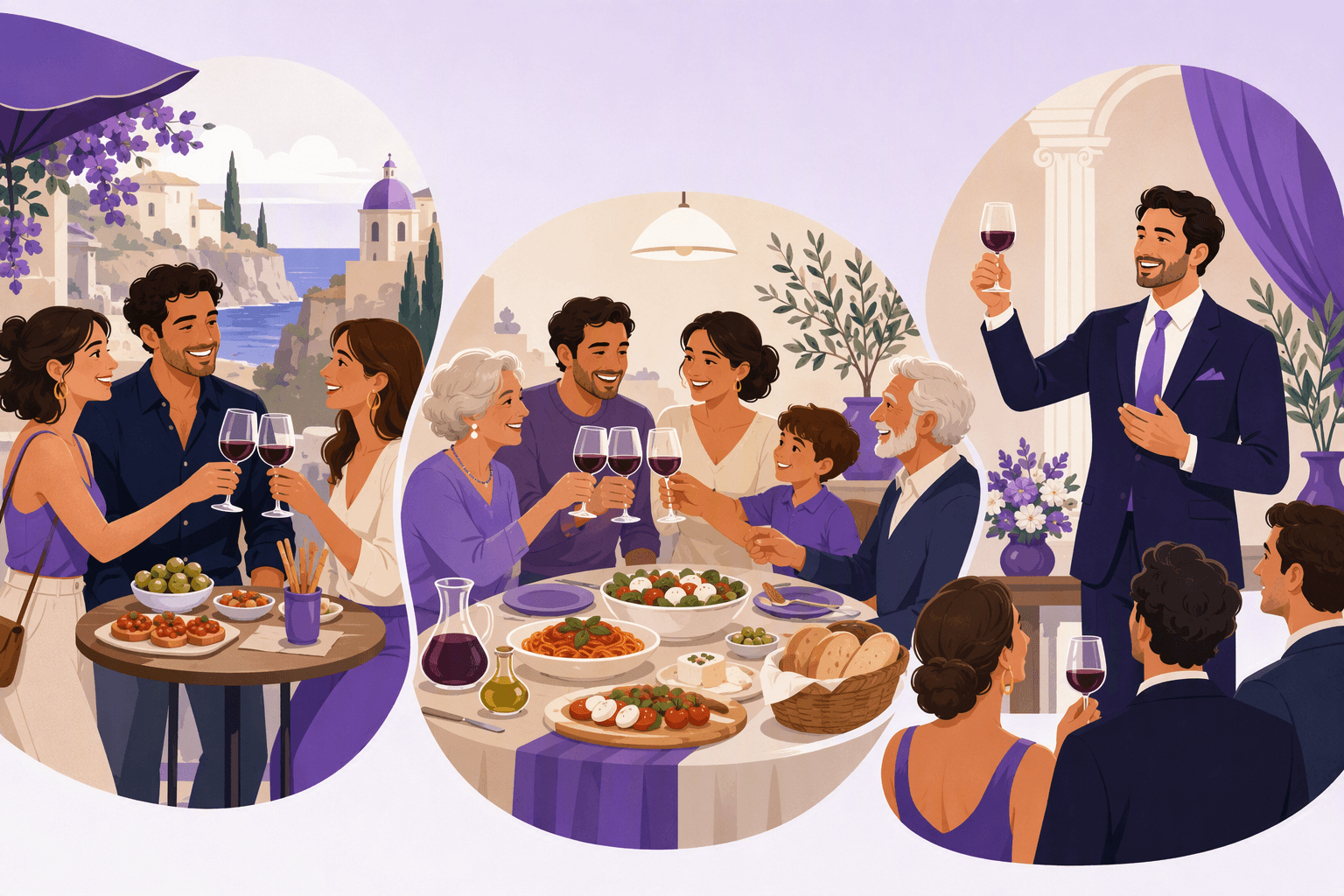
The best Italian word for cheers
For most travelers and Italian learners, cin cin /tʃin tʃin/ is the answer. It is brief, cheerful, and common at dinners, birthdays, aperitivi, and casual celebrations.
Unlike English “cheers,” /tʃin tʃin/ is used specifically when drinking or toasting. You would not normally use it as a casual way to say thank you or goodbye.
Cin cin
Cin cin /tʃin tʃin/ is the safest phrase to use when people are already holding glasses. It can be used with wine, beer, prosecco, cocktails, or a non-alcoholic drink.
/cheen CHEEN/
Literal meaning: A conventional Italian drinking toast.
“Cin cin! Alla tua nuova casa!”
Cheers! To your new home!
The standard friendly toast among friends, family, and colleagues. Say it just before the first sip.
The repeated sound makes /tʃin tʃin/ memorable, but its history is more international than many people expect. Treccani traces it to a Chinese polite expression transmitted through contact between European sailors and Chinese speakers. In Italian, it developed a specialized social meaning: a ritual word said before drinking.
Do not confuse /tʃin tʃin/ with a personal name or use it as a greeting. It belongs at the moment of the toast.
Other ways to say cheers in Italian
Italian gives you several options depending on what you are celebrating and who is around the table. The words are simple, but their social tone matters.
Salute
Salute /saˈluːte/ literally means health. As a toast, it is similar to “to your health” in English.
/sah-LOO-teh/
Literal meaning: Health.
“Salute a tutti!”
Cheers to everyone!
A warm, slightly more meaningful toast than cin cin. It can also appear in wishes for wellbeing, so context makes the drinking meaning clear.
You may hear /saˈluːte/ alone, but alla salute /alla saˈluːte/ is especially natural when you are toasting a person’s wellbeing. For example, you might say alla salute di Maria /alla saˈluːte di maˈriːa/, meaning “to Maria’s health.”
Italian also uses salute! /saˈluːte/ after someone sneezes, equivalent to “bless you.” The raised-glass setting makes the intended meaning obvious.
Alla salute
Alla salute /alla saˈluːte/ is a fuller toast that means “to health.” It works well when the event calls for a little more warmth than a quick /tʃin tʃin/.
/AH-lah sah-LOO-teh/
Literal meaning: To health.
“Alla salute, e a tanti anni felici!”
To health, and to many happy years!
Useful at family meals, birthdays, reunions, and celebrations where the toast expresses a sincere wish.
If you want to specify whose health you are celebrating, add a possessive adjective: alla tua salute /alla ˈtuːa saˈluːte/ means “to your health,” while alla vostra salute /alla ˈvɔstra saˈluːte/ means “to your health” when speaking to several people or using polite plural address.
Alla nostra
Alla nostra /alla ˈnɔstra/ is a compact, affectionate way to say “to us.” The implied word is salute /saˈluːte/, so the full idea is “to our health.”
/AH-lah NOHS-trah/
Literal meaning: To ours, meaning to our health.
“Siamo finalmente tutti insieme. Alla nostra!”
We are finally all together. To us!
A close, inclusive toast for friends, family, teammates, or romantic partners. It emphasizes the group rather than an individual achievement.
Use /alla ˈnɔstra/ when the point is shared connection. It sounds right at a reunion, the start of a holiday with friends, or a small celebration with someone you love. For romantic language beyond a toast, see these ways to say I love you in Italian.
Brindiamo
Brindiamo /brinˈdjaːmo/ means “let’s toast.” It comes from the noun brindisi /ˈbrindizi/, a toast or formal celebratory speech.
/breen-DYAH-moh/
Literal meaning: Let us toast.
“Brindiamo al successo del progetto!”
Let's toast to the success of the project!
Useful when you are inviting the group to raise their glasses. It suits both relaxed and organized celebrations.
This is useful when you are the person starting the moment. Say brindiamo a /brinˈdjaːmo a/ plus the person or event: brindiamo agli sposi /brinˈdjaːmo aʎʎi ˈspoːzi/ means “let’s toast the newlyweds.”
Facciamo un brindisi
Facciamo un brindisi /fatˈtʃaːmo um ˈbrindizi/ also means “let’s make a toast.” It is slightly more explicit and works particularly well before a short speech.
You might hear it at a birthday lunch, graduation dinner, office celebration, or wedding reception. After saying it, name the reason for the toast: facciamo un brindisi alla famiglia /fatˈtʃaːmo um ˈbrindizi alla faˈmiʎʎa/, “let’s make a toast to the family.”
How Italians toast at the table
The words matter, but the timing and body language make the toast feel natural. In Italy, an aperitivo often begins with a drink and small snacks before dinner, while longer meals create several opportunities for a toast.
Italian food culture is regional, and no single rule governs every household. Still, a few habits are widely recognizable.
Wait until everyone has a drink
Do not rush to say /tʃin tʃin/ as soon as you receive your glass. Wait until the group is served and someone signals the toast, especially at a hosted dinner.
At a restaurant with friends, the first person with a full drink may naturally say cin cin /tʃin tʃin/. At a formal meal, wait for the host, guest of honor, or oldest family member to begin.
Make eye contact, but keep it relaxed
A brief glance at each person while clinking glasses is a common sign of attention and inclusion. You do not need to hold intense eye contact or perform a ritual perfectly.
The real goal is social: acknowledge the people sharing the moment with you. This fits the broader relationship-centered function of politeness described in Giuseppe Antonelli’s work on Italian communication and public language.
Clink gently
Wine glasses do not need a dramatic impact. A small, gentle clink near the bowl of the glass is enough, and some people simply raise their glasses toward each other when the table is crowded.
At a large dinner, it is normal not to clink with every person. Raise your glass, smile, say /tʃin tʃin/, and drink.
🌍 Do not say 'cin cin' before the glasses arrive
In Italian, /tʃin tʃin/ belongs to the shared act of toasting. Wait until drinks are poured and everyone can participate. If you are unsure, copy the timing of your host or the people at the table.
Toasts for common Italian situations
A good toast can be as short as one word. For a milestone, Italians often add the person, event, or hope being celebrated after the toast phrase.
| Situation | Natural Italian toast | IPA |
|---|---|---|
| Casual drinks with friends | Cin cin! | /tʃin tʃin/ |
| A person’s wellbeing | Alla tua salute! | /alla ˈtuːa saˈluːte/ |
| The whole group | Alla nostra! | /alla ˈnɔstra/ |
| A birthday | Auguri! Alla tua salute! | /auˈɡuːri alla ˈtuːa saˈluːte/ |
| A wedding | Agli sposi! | /aʎʎi ˈspoːzi/ |
| A new year | Al nuovo anno! | /al ˈnwɔvo ˈanno/ |
| A success | Al successo! | /al sutˈtʃɛsso/ |
| Starting a toast | Brindiamo! | /brinˈdjaːmo/ |
Auguri /auˈɡuːri/ means “best wishes” or “congratulations.” It can be said while raising a glass for a birthday, but it is not a direct replacement for /tʃin tʃin/ in every situation.
Agli sposi /aʎʎi ˈspoːzi/ means “to the newlyweds.” It is a classic wedding toast and is easy to use even if you do not have the vocabulary for a longer speech.
A simple Italian toast you can actually use
For a short, natural toast, use this three-part structure:
- Invite the toast with brindiamo /brinˈdjaːmo/.
- Say who or what you are celebrating.
- End with cin cin /tʃin tʃin/ or alla salute /alla saˈluːte/.
For example:
Brindiamo alla vostra felicità. Cin cin!
/brinˈdjaːmo alla ˈvɔstra felitʃiˈta tʃin tʃin/
“Let’s toast to your happiness. Cheers!”
For a friend’s achievement, try:
Al tuo successo, cin cin!
/al ˈtuːo sutˈtʃɛsso tʃin tʃin/
“To your success, cheers!”
Tullio De Mauro’s work on the social history of Italian highlights how a shared national language developed alongside powerful local traditions. Toasting reflects that balance: the core phrases are understood nationally, but a family in Naples, a wine bar in Milan, and a village celebration in Tuscany may create very different atmospheres around the same words.
What not to say
Avoid translating English word-for-word when Italian already has an established toast. Saying evviva /evˈviːva/ can mean “hooray” or “long live,” but it is more of a celebratory shout than the standard equivalent of “cheers.”
Prosit /ˈprɔzit/ exists in Italian and is associated with Latin, but it can sound old-fashioned, formal, playful, or regionally marked. You may encounter it, particularly in northern Italy, but learners should choose /tʃin tʃin/ first.
Also avoid assuming every Italian social gathering involves alcohol. Raise any drink you have, including water or a soft drink, and participate in the toast. The shared gesture matters more than the beverage.
💡 The one phrase to memorize
If you remember only one phrase, make it Cin cin! /tʃin tʃin/. It is natural, friendly, easy to pronounce, and appropriate in almost every casual Italian drinking situation.
Practice with real Italian dialogue
Toasts are short, but real speech helps you learn their rhythm, timing, facial expressions, and the warm overlap of voices around a table. Watch for /tʃin tʃin/, /alla saˈluːte/, and /brinˈdjaːmo/ in Italian films, restaurant scenes, wedding scenes, and family comedies.
Pair the toast with useful arrival and departure phrases. After drinks, you may need these guides for saying goodbye in Italian, or broaden your dining vocabulary with our Italian restaurant phrase guide.
The key is not to deliver a perfect speech. Raise your glass at the right moment, say cin cin /tʃin tʃin/ clearly, and share the occasion with the people at the table.
Frequently Asked Questions
What is the most common way to say cheers in Italian?
Does salute mean cheers in Italian?
Do Italians clink glasses when saying cin cin?
Can I say cin cin at a formal Italian dinner?
Why does cin cin sound Chinese?
Sources & References
- Accademia della Crusca, Vocabolario and language advice resources, accessed 2026
- Treccani, Vocabolario Treccani entries for brindisi, salute, and cin cin, accessed 2026
- Ethnologue, Italian, 27th edition, 2024
- Tullio De Mauro, Storia linguistica dell'Italia unita, Laterza
- Giuseppe Antonelli, L'italiano nella società della comunicazione, il Mulino
Start learning with Wordy
Watch real movie clips and build your vocabulary as you go. Free to download.


