Quick Answer
To prepare for a trip abroad, confirm entry rules, protect your passport and money, arrange health coverage, learn essential local phrases, and make an arrival plan before you fly. The best preparation reduces avoidable stress while leaving room to adapt once you arrive.
Preparing for a trip abroad means doing five things before departure: verify your passport and entry requirements, arrange health and money backups, plan your first 24 hours, learn practical communication basics, and research local customs. A good plan does not eliminate surprises, but it prevents the expensive and stressful problems that are easiest to avoid.
International travel has returned at enormous scale. UN Tourism reported roughly 1.4 billion international tourist arrivals in 2024, close to pre-pandemic levels. That scale is useful perspective: airports, borders, hotels, and public transport are built for travelers, but each country has its own paperwork, payment habits, etiquette, and expectations.
If English is not the main language where you are going, prepare a small set of survival phrases before you leave. Our English travel phrases guide is especially useful for travelers visiting English-speaking destinations or communicating in international airports.
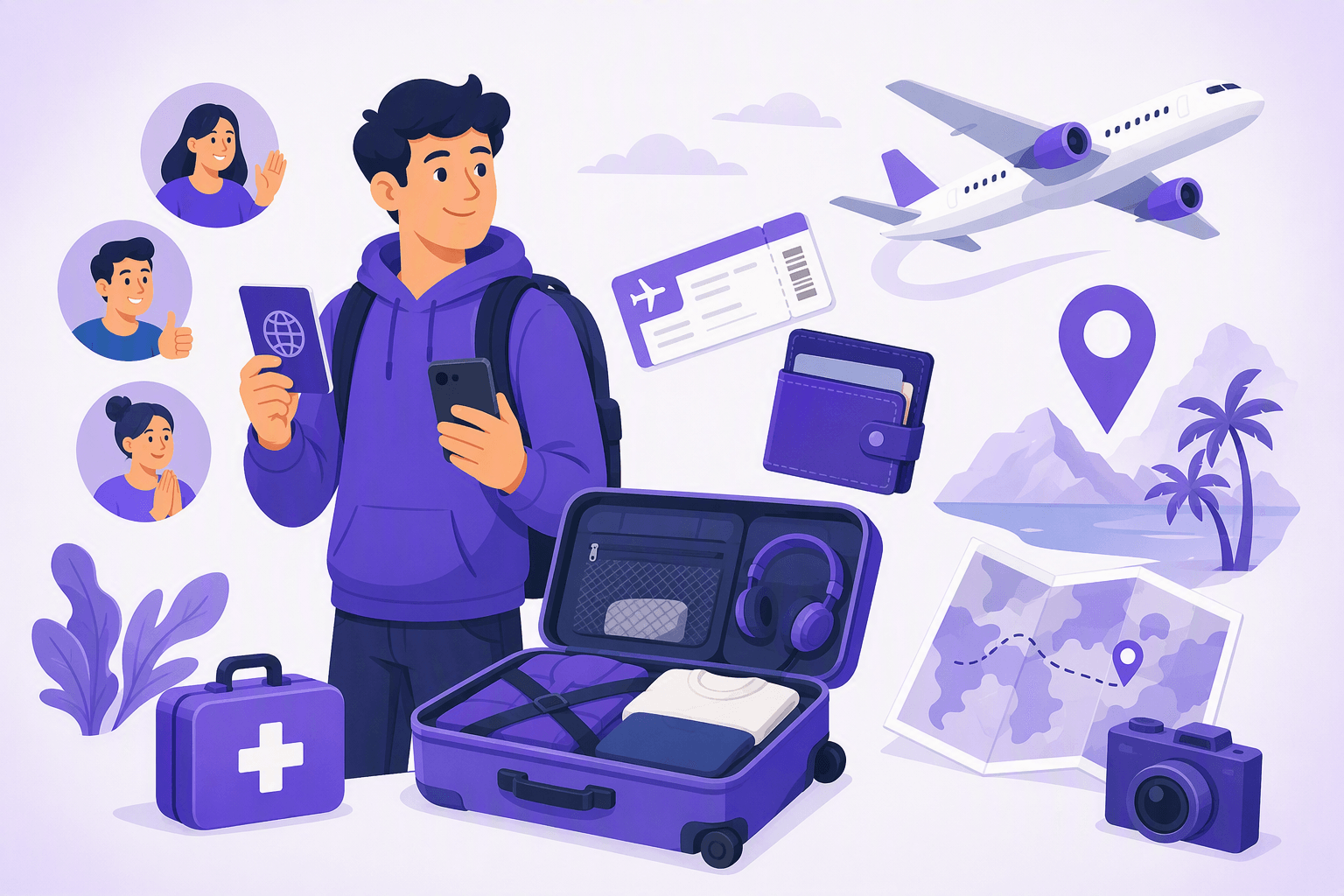
Start with documents and entry rules
Your passport is the first item to check, not the last. Many destinations require it to remain valid for several months after your planned departure date, even if it is technically valid throughout the trip.
Check passport validity
Look at the expiry date now. If you are close to the commonly required six-month window, renew before booking non-refundable travel where possible.
Check that your passport has enough blank pages for visas or entry stamps. Requirements vary, and airlines can refuse boarding when a passenger does not meet the destination's document rules.
Confirm visa and transit requirements
Do not assume that a short holiday means no visa is needed. Entry rules depend on your nationality, the purpose and length of your trip, and sometimes the countries where you change planes.
Use official government immigration sources and your destination's embassy or consulate. The International Air Transport Association Travel Centre is also a useful cross-check for airline-facing entry information, but an embassy remains the final authority.
Pay attention to transit rules. A connection in another country can require a transit visa, health form, or additional document even if you never leave the airport.
Make secure copies
Create two kinds of backup:
- A password-protected digital folder containing passport, visa, insurance, tickets, and accommodation details.
- One paper copy stored separately from the originals.
Also write down the phone number and address of your embassy or consulate. If your passport is lost, that information becomes immediately useful instead of another problem to solve in an unfamiliar place.
💡 Keep your documents separated
Carry your passport securely on travel days, but do not keep every card, document, and emergency cash note in the same bag. A lost wallet is inconvenient. Losing your wallet, passport, and only bank card together can interrupt the entire trip.
Build a health plan that fits your destination
Health preparation is not only about vaccines. It includes prescriptions, insurance, food safety, climate, emergency contacts, and realistic knowledge of what your policy covers.
The CDC's Yellow Book is one of the most reliable starting points for destination-specific health advice. It covers vaccination recommendations, disease risks, medication considerations, and advice for travelers with particular medical needs.
Book medical appointments early
Some vaccinations require multiple doses or time to become effective. Schedule a travel-health appointment well ahead of departure if you are visiting a destination with specific health recommendations.
Bring enough prescription medication for the entire trip, plus a small extra supply if your doctor permits it. Keep medication in original labeled containers in your carry-on bag, not in checked luggage.
Ask your doctor for a letter describing essential medication, particularly if you carry injectables, controlled substances, or medical devices. Rules for medication differ substantially across borders.
Read travel insurance carefully
Do not choose insurance based only on the lowest price. Check whether it covers emergency medical treatment, hospital stays, medical evacuation, canceled transport, lost luggage, and activities such as skiing, diving, or motorbike riding.
A policy that reimburses treatment later may be harder to use than one that coordinates emergency care directly. Save the insurer's 24-hour emergency number offline and know how to contact it from abroad.
Prepare for ordinary problems
Pack a small kit with basic supplies appropriate for you: pain relief, bandages, rehydration sachets, allergy medication, and any personal items that may be difficult to find. This is not a substitute for medical advice, but it can make a minor problem manageable.
Research local emergency numbers, too. The number is not always 911. In much of Europe, 112 works across many countries, but you should still confirm your destination's local system.
Set up money, cards, and a realistic budget
A travel budget should include more than flights and hotels. Add local transport, meals, tips, entry fees, mobile data, laundry, unexpected taxi rides, and a contingency fund.
Use a simple daily estimate rather than trying to predict every purchase. This gives you flexibility without turning the trip into constant arithmetic.
Bring more than one way to pay
Travel with at least two payment methods: for example, a primary debit or credit card and a backup card stored elsewhere. Keep a small amount of local cash for arrival transport, smaller shops, rural areas, or temporary card-terminal outages.
Before you leave, check foreign transaction fees, ATM withdrawal limits, and your card issuer's fraud procedures. Some banks no longer require travel notifications, but checking your account settings prevents a declined payment at an inconvenient moment.
Learn to recognize the local currency and its basic denominations. If you are traveling in English-speaking countries, practice numbers in English before departure, especially prices, dates, addresses, platform numbers, and phone numbers.
Avoid conversion traps
When a card terminal or ATM offers to charge you in your home currency, it may be using dynamic currency conversion. The convenience can hide a worse exchange rate.
Paying in the local currency is often the better option, though your own card's terms still matter. Keep receipts for major purchases and check your banking app regularly for unexpected transactions.
🌍 Tipping is a local rule, not a universal rule
Tipping can be expected, appreciated, optional, or even awkward depending on the destination and setting. Research restaurants, taxis, hotel staff, and tour guides in the specific place you are visiting. Do not assume practices from your home country apply everywhere.
Plan the first 24 hours before you board
The first hours after landing are when fatigue, unfamiliarity, and poor connectivity combine. A written arrival plan prevents impulsive decisions and helps you spot scams or misunderstandings.
Save the name and address of your accommodation in the local writing system if relevant. Screenshot the booking confirmation, check-in details, and a map route from the airport.
Decide how you will reach your accommodation
Research official airport trains, buses, taxis, rideshare pickup points, and late-night options. Know the approximate journey time and normal price range before you arrive.
If you will use a taxi, find out whether the airport has an official queue, fixed fares, or a meter system. Avoid accepting unsolicited rides inside terminals unless your accommodation has arranged a verified transfer.
Solve mobile data before landing
An eSIM, local SIM card, or international roaming plan can make arrival far easier. Download maps for offline use even if you expect a connection, and save key addresses and transport details as screenshots.
You should also download your airline app, accommodation app, translation app, and banking app updates while you still have reliable internet. Bring a power bank and the appropriate plug adapter.
Learn the local address format
Addresses are not organized the same way everywhere. Some places rely heavily on landmarks, neighborhood names, building entrances, or apartment numbers. In Japan and South Korea, addresses can feel especially unfamiliar to visitors used to street-number systems.
Write your accommodation's address clearly, along with the host's phone number. If you cannot pronounce it, showing it on your phone is entirely normal.
Learn the language you will actually need
Ethnologue estimates that English has around 1.5 billion total speakers worldwide when first- and second-language speakers are counted. That makes English a powerful travel bridge, especially in aviation, tourism, and international business, but it does not mean people everywhere should be expected to speak it.
Learning a few local words signals respect and makes routine interactions smoother. Focus on phrases you are likely to say aloud, not long textbook dialogues.
Prioritize high-value phrases
Learn how to say:
- Hello and goodbye
- Please and thank you
- Excuse me
- Do you speak English?
- I do not understand
- Where is the bathroom?
- How much is this?
- I need help
- I have an allergy to...
- Can you repeat that slowly?
Pronunciation does not need to be perfect. Clear effort, a calm voice, and a translation screen can go a long way.
Edward T. Hall's Beyond Culture distinguishes between communication styles that rely heavily on shared context and styles that state information more directly. As a traveler, that idea is a useful reminder: a short answer, silence, indirect refusal, or pause may have a different social meaning than it would at home.
Watch for tone, not just vocabulary
A phrase can be grammatically correct yet too casual for the setting. Learn the polite form of greetings and requests, especially when speaking to older people, service workers, officials, or strangers.
This matters in English too. Slang can make a traveler sound friendly among peers, but it can sound confusing or overly familiar in a hotel, clinic, or border control setting. Review our guide to English slang to recognize informal language, rather than assuming every expression is appropriate to copy.
Avoid repeating swear words you hear in films or social media. They often carry stronger local force than learners expect. If you are unsure, treat the term as recognition vocabulary and consult our English swear words guide for context.
Research culture without reducing people to stereotypes
Good cultural preparation is specific and humble. Read about local norms, but do not treat every person as a predictable representative of a national profile.
Erin Meyer's The Culture Map offers practical frameworks for thinking about differences in communication, feedback, hierarchy, and scheduling. Use such frameworks as questions to ask yourself, not fixed labels to apply to strangers.
Check everyday expectations
Before you leave, research:
- Greetings and personal space
- Dress expectations at religious sites and formal venues
- Restaurant etiquette and eating customs
- Photography rules, especially in temples, museums, markets, and near security sites
- Public behavior on trains, buses, and streets
- Queueing, punctuality, and appointment culture
For example, speaking loudly on public transport may be ordinary in one city and disruptive in another. Removing shoes at a home or religious building may be expected rather than optional. Small adjustments communicate consideration more clearly than perfect grammar does.
Prepare for consent and privacy norms
Ask before photographing people, particularly children, workers, worshippers, and performers. Do not assume a public place makes every person available for a photo.
Be cautious when posting your location in real time, sharing images of other travelers, or displaying your passport and boarding pass online. A boarding pass can contain booking information that strangers may misuse.
Pack for flexibility, not every possibility
Overpacking makes every transfer harder. Build a capsule wardrobe around weather, laundry access, cultural expectations, and the activities you have actually booked.
Wear or carry your most essential items during transit: passport, medication, phone, charger, backup payment method, glasses, and one change of clothes. Checked luggage can be delayed even on a direct route.
Use a practical packing system
Pack clothing that works in layers rather than relying on a single heavy item. Choose shoes you have already worn comfortably, not new shoes that might cause blisters on day one.
Check airline baggage allowances for size, weight, liquids, batteries, and sharp items. Power banks and spare lithium batteries generally belong in carry-on luggage, but airline rules can change, so verify before packing.
⚠️ Do not pack only for photos
A packed itinerary and impractical clothing can turn a good trip into a tiring one. Leave room for walking, weather changes, delayed transport, laundry, and a day when you simply need rest. Comfortable preparation gives you more freedom once you arrive.
Use entertainment as practical preparation
Films and television cannot replace cultural research, but they can train your ear for natural speed, gestures, everyday settings, and conversational rhythm. Choose material made in or about your destination, then notice how people greet, apologize, order food, disagree, and say goodbye.
For English learners, our list of movies to learn English can help you hear regional accents and everyday dialogue before you travel. Watch short scenes repeatedly and write down expressions you can recognize, rather than trying to memorize whole scripts.
The goal is not to imitate every phrase. It is to become less startled by real speech, especially when people speak quickly or use informal contractions.
Final checklist for the week before departure
In the final week, confirm the details that can change:
- Check your passport, visa, entry authorization, and airline booking name.
- Confirm airport transfer, accommodation check-in process, and local address.
- Download offline maps, tickets, insurance documents, and translation tools.
- Pack medication and valuables in your carry-on.
- Tell a trusted person your itinerary and emergency contact details.
- Check weather, baggage rules, and airport arrival time.
- Review local emergency numbers and embassy contact details.
- Carry a backup card, small cash reserve, and charger.
Preparation is not about controlling every moment abroad. It is about protecting the essentials so you can pay attention to the place, the people, and the experiences you traveled for. Plan carefully, stay observant, and allow yourself room to learn once the trip begins.
Frequently Asked Questions
How far in advance should I prepare for an international trip?
What documents should I bring when traveling abroad?
Should I exchange money before traveling abroad?
How much of the local language should I learn before a trip?
What should I do if I lose my passport abroad?
Sources & References
- U.S. Department of State, International Travel Checklist, accessed 2026
- Centers for Disease Control and Prevention, CDC Yellow Book 2026: Health Information for International Travel, 2026
- International Air Transport Association, Travel Centre, accessed 2026
- Ethnologue, 27th edition, 2024
- UN Tourism, World Tourism Barometer, 2025
Start learning with Wordy
Watch real movie clips and build your vocabulary as you go. Free to download.


