Quick Answer
The fastest way to learn French is to combine daily comprehensible listening, high-frequency vocabulary, speaking practice, and short grammar sessions. A focused 90-day routine can take a committed beginner from basic phrases to handling everyday conversations.
The fastest way to learn French is to study every day with a mix of understandable listening, high-frequency vocabulary, basic grammar, and active speaking. For most beginners, a focused 90-day routine of 45 to 90 minutes a day produces much faster results than occasional long study sessions, especially when French appears in real conversations, films, and TV scenes rather than isolated exercises.
French is not only a school subject or a travel language. The Organisation internationale de la Francophonie reported 321 million French speakers worldwide in 2022, and French is an official language in 29 countries. That range matters: learning French means getting used to different accents, rhythms, and everyday expressions from France, Belgium, Quebec, West Africa, the Caribbean, and beyond.
If you are starting from zero, do not try to memorize every grammar rule. Build a working system that helps you understand and respond. Start with practical greetings through this guide to saying hello in French, then make listening and speaking part of your routine from week one.
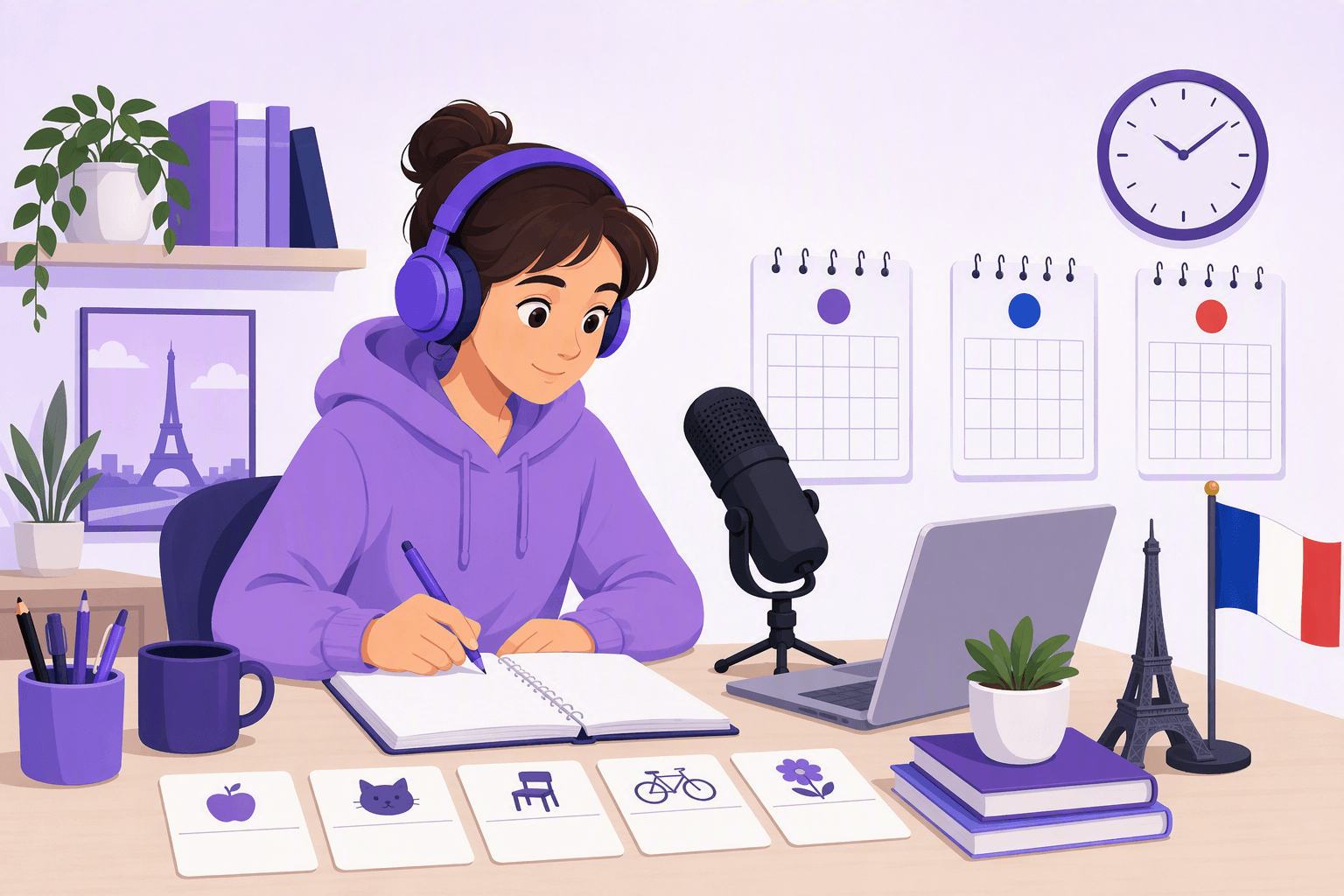
What Learning French Fast Actually Means
Learning French fast does not mean becoming indistinguishable from a native speaker in a month. It means reaching useful milestones quickly: understanding familiar topics, responding without translating every word, and coping with normal daily situations.
The CEFR, developed by the Council of Europe, describes language ability across six levels, from A1 to C2. A strong three-month target is early A2: you can manage predictable exchanges, describe basic routines, ask questions, and understand clear, slow speech about familiar subjects.
At that stage, you may be able to say things such as Bonjour, je voudrais un café /bɔ̃.ʒuʁ ʒə vu.dʁɛ œ̃ ka.fe/, meaning “Hello, I would like a coffee,” or Je ne comprends pas, encore une fois, s'il vous plaît /ʒə nə kɔ̃.pʁɑ̃ pa ɑ̃.kɔʁ yn fwa sil vu plɛ/, meaning “I do not understand, one more time, please.”
That is a practical result, not a small one.
The Four Skills That Produce Fast Progress
Listening comes first
French can look more transparent on paper than it sounds in conversation. Final consonants are often silent, words connect across boundaries, and common words may be reduced in fast speech.
For example, learners may know je ne sais pas /ʒə nə sɛ pa/, “I do not know,” but hear something closer to j'sais pas /ʃɛ pa/ in relaxed conversation. Both are useful to recognize, but the full form is safer when you are beginning.
Stephen D. Krashen’s work on second-language acquisition emphasizes the value of input learners can mostly understand while still containing a manageable amount of new language. In practice, this means choosing material that is interesting but not overwhelmingly difficult.
Watch a short French scene several times. First, use French subtitles if available. Next, identify one or two repeated expressions. Finally, replay the scene without reading and see what you now catch.
For a structured version of this method, read our guide on learning a language with movies. Film and TV clips give you pronunciation, facial expressions, social context, and natural pacing at the same time.
Vocabulary should be useful, not random
A beginner does not need 50 names of vegetables before learning how to ask a question. High-frequency vocabulary gives you the greatest return because the same words appear constantly.
Start with common verbs such as être /ɛtʁ/, “to be,” avoir /a.vwaʁ/, “to have,” aller /a.le/, “to go,” faire /fɛʁ/, “to do or make,” vouloir /vu.lwaʁ/, “to want,” and pouvoir /pu.vwaʁ/, “to be able to.”
Then add connectors that make your speech longer and clearer:
- mais /mɛ/, “but”
- parce que /paʁs kə/, “because”
- donc /dɔ̃k/, “therefore” or “so”
- après /a.pʁɛ/, “after” or “later”
- maintenant /mɛ̃.tə.nɑ̃/, “now”
- toujours /tu.ʒuʁ/, “always” or “still”
Paul Nation, in Learning Vocabulary in Another Language, distinguishes between knowing a word superficially and being able to recognize, retrieve, pronounce, and use it. That is why a flashcard should not be the end of your learning process. Meet the word in a sentence, hear it spoken, and use it in your own response.
Instead of memorizing fatigué /fa.ti.ɡe/, “tired,” alone, learn Je suis fatigué /ʒə sɥi fa.ti.ɡe/, “I am tired.” Then make the feminine version if needed: Je suis fatiguée /ʒə sɥi fa.ti.ɡe/. The sound stays the same, but the spelling changes.
Speak before you feel ready
Many learners wait until they have mastered grammar before speaking. That plan creates a hidden problem: they become good at recognizing French but freeze when they need to produce it.
Start speaking with short, reusable patterns:
- Je m'appelle... /ʒə ma.pɛl/, “My name is...”
- J'habite à... /ʒa.bit a/, “I live in...”
- J'aime... /ʒɛm/, “I like...”
- Je voudrais... /ʒə vu.dʁɛ/, “I would like...”
- Est-ce que vous pouvez répéter ? /ɛs kə vu pu.ve ʁe.pe.te/, “Can you repeat?”
- Comment on dit... en français ? /kɔ.mɑ̃ ɔ̃ di ɑ̃ fʁɑ̃.sɛ/, “How do you say... in French?”
Say the phrases aloud every day. Then change one element. Replace the food, city, activity, or time. This builds fluency through patterns rather than memorized scripts.
💡 Use a two-minute speaking recording
Record yourself answering the same three questions each day: who you are, what you did, and what you plan to do tomorrow. Listen back once a week. You will hear which words have become automatic and which gaps need attention.
Grammar supports communication
Grammar is not the enemy of fast learning. Studying too much grammar before using it is the problem.
Your first grammar priorities should be articles, present tense, negation, question forms, adjective agreement, and the most common past structure. These cover a remarkable amount of daily communication.
For example, learn the pattern for negation early:
| Positive | Negative | Meaning |
|---|---|---|
| Je comprends /ʒə kɔ̃.pʁɑ̃/ | Je ne comprends pas /ʒə nə kɔ̃.pʁɑ̃ pa/ | I understand / I do not understand |
| J'aime ça /ʒɛm sa/ | Je n'aime pas ça /ʒə nɛm pa sa/ | I like that / I do not like that |
| Il vient /il vjɛ̃/ | Il ne vient pas /il nə vjɛ̃ pa/ | He is coming / He is not coming |
In informal speech, people often drop ne /nə/, so Je ne comprends pas /ʒə nə kɔ̃.pʁɑ̃ pa/ may sound like Je comprends pas /ʒə kɔ̃.pʁɑ̃ pa/. Understand both, but learn the standard structure first. Our French negation guide explains when and why this change happens.
Your 90-Day French Learning Plan
Days 1 to 30: Build survival French
Your first month is about sound, essential phrases, and a small core vocabulary. Study 10 to 15 useful words daily, but review old words before adding many new ones.
Spend 15 minutes on pronunciation and listening. French vowels such as u /y/ and nasal vowels in words like bon /bɔ̃/ may be unfamiliar, so imitate short audio rather than guessing from spelling.
Spend 15 minutes on basic grammar. Focus on the present tense of être /ɛtʁ/, avoir /a.vwaʁ/, aller /a.le/, and faire /fɛʁ/. Add 15 minutes of vocabulary review, then 10 minutes of speaking aloud.
By day 30, you should be able to introduce yourself, discuss your routine, ask simple questions, order in a café, and recognize common greetings. Learn polite openings alongside casual ones through French greetings for every situation.
Days 31 to 60: Turn words into conversations
In month two, stop studying mainly individual words. Learn chunks that native speakers actually use.
Useful examples include ça marche /sa maʁʃ/, meaning “that works,” d'accord /da.kɔʁ/, meaning “okay,” on y va /ɔ̃ ni va/, meaning “let’s go,” and du coup /dy ku/, a common conversational connector that can mean “so” or “as a result.”
Start watching short scenes with French subtitles. Pause only when a line repeats or feels especially useful. Write down no more than five expressions per clip, then repeat them with the actor’s rhythm.
Add the passé composé for completed actions. You do not need every irregular verb yet. Learn high-value forms such as j'ai mangé /ʒe mɑ̃.ʒe/, “I ate,” j'ai vu /ʒe vy/, “I saw,” and je suis allé /ʒə sɥi a.le/, “I went.”
🌍 French conversation is often more indirect than textbook dialogues
A direct English request can sound abrupt if it lacks a softener in French. Instead of only saying un café /œ̃ ka.fe/, use bonjour /bɔ̃.ʒuʁ/, then je voudrais un café, s'il vous plaît /ʒə vu.dʁɛ œ̃ ka.fe sil vu plɛ/. The greeting and polite framing are part of the interaction, not optional decoration.
Days 61 to 90: Increase speed and independence
During the final month, make French a regular part of your day. Listen while walking, replay short scenes, change your phone’s selected apps to French if that feels manageable, and write brief messages or diary entries.
Aim for three real speaking sessions each week, even if each lasts only 15 minutes. You can speak with a tutor, exchange partner, friend, or yourself through recorded role-plays.
Use topics that force repetition: your work or studies, food, family, weekend plans, entertainment, and travel. Reusing the same vocabulary in different settings is how it becomes available under pressure.
At this point, practice natural endings too. A simple au revoir /o ʁə.vwaʁ/ works in formal settings, but you will hear à bientôt /a bjɛ̃.to/, “see you soon,” and à plus tard /a ply taʁ/, “see you later,” in everyday life. Our French goodbye guide explains the social differences.
A Daily French Routine That Fits Real Life
Here is a realistic 60-minute routine:
| Time | Activity | Goal |
|---|---|---|
| 15 minutes | Review vocabulary with spaced repetition | Recall useful words and chunks |
| 15 minutes | Listen to a short French clip | Train your ear for connected speech |
| 15 minutes | Study one grammar pattern | Make clearer sentences |
| 10 minutes | Speak or shadow audio | Improve speed and pronunciation |
| 5 minutes | Write three sentences | Notice gaps and reinforce recall |
If you only have 30 minutes, keep listening, vocabulary review, and speaking. Those three habits give you the strongest daily return.
Do not measure success by how many pages you complete. Measure it by what you can now understand and say without checking a translation.
Common Mistakes That Slow Down French Learners
Translating every sentence
French word order and idioms do not always match English. Translate for quick clarification, then return to the French sentence and notice its pattern.
For instance, tu me manques /ty mə mɑ̃k/ literally has the structure “you are missing to me,” but it means “I miss you.” Learn expressions as complete units. For more relationship language, see how to say I love you in French.
Ignoring pronunciation until later
French spelling contains historical information, but it does not always tell you how a full sentence sounds. Learn from audio immediately, especially liaison, rhythm, and nasal vowels.
Do not expect perfect pronunciation at first. Aim to be understood, then improve one sound or pattern at a time.
Consuming material that is too difficult
A full French crime drama without support may be entertaining, but it is not always efficient for a beginner. Choose scenes where the setting, action, and emotional tone help you infer meaning.
Rewatching a 45-second clip can teach more than passively watching an entire episode you barely understand.
Treating slang as beginner vocabulary
You will eventually hear informal French, including words such as bah /ba/, a hesitation sound similar to “well,” and euh /ø/, meaning “um.” Recognizing them helps listening, but do not make slang your foundation.
The same applies to insults and profanity. Learn what you may encounter, but understand the social risk before repeating it. Our French swear words guide provides context and severity information.
⚠️ Do not confuse exposure with active learning
Watching French content for hours can be valuable, but only if some of that time includes attention and reuse. Pause occasionally, repeat a line, notice a pattern, and try using it yourself. Passive exposure alone rarely produces fast speaking gains.
How Long Does It Take to Feel Comfortable?
With 45 to 90 minutes of daily study, many learners can reach basic conversational ability in three to six months. Comfort in spontaneous conversation often takes longer because listening speed, cultural references, and regional accents require sustained exposure.
Your background matters. English speakers benefit from shared vocabulary such as important /ɛ̃.pɔʁ.tɑ̃/, “important,” possible /pɔ.sibl/, “possible,” and restaurant /ʁɛs.tɔ.ʁɑ̃/, “restaurant.” But familiar spellings can also lead to English-style pronunciation, so listen before assuming a cognate sounds the same.
Fast learning is not about rushing through a course. It is about frequent contact with meaningful French, immediate practice, and a plan you can repeat tomorrow. Build those habits for 90 days, and French will stop feeling like a code on a page and start becoming a language you can use.
Frequently Asked Questions
Can I learn French in 3 months?
How many hours a day should I study French to learn fast?
What is the fastest way to memorize French vocabulary?
Should beginners learn French grammar first?
Is French difficult for English speakers?
Sources & References
- Organisation internationale de la Francophonie, La langue française dans le monde, 2022
- Council of Europe, Common European Framework of Reference for Languages: Companion Volume, 2020
- Institut français, French Language Learning Resources, accessed 2026
- Pauline G. Nation, Learning Vocabulary in Another Language, Cambridge University Press
- Stephen D. Krashen, Principles and Practice in Second Language Acquisition, Pergamon Press
Start learning with Wordy
Watch real movie clips and build your vocabulary as you go. Free to download.


