Quick Answer
German pronouns change form depending on case: who is doing the action (nominative), who is directly affected (accusative), and who receives or is involved (dative). Mastering a small set of high-frequency pronouns like ich, du, Sie, mich, mir, dich, dir, and the possessives (mein, dein, Ihr) will make your German sound immediately more natural and reduce common word-order mistakes.
German pronouns are words like ich, du, Sie, er, sie, es that change form depending on case (nominative, accusative, dative, and sometimes genitive). If you learn the high-frequency forms in small groups, especially ich/mich/mir and du/dich/dir, you can build correct German sentences much faster and avoid the classic mistake of translating English word order directly.
German is spoken by tens of millions of people across Europe, and it is an official language in multiple countries. Ethnologue estimates about 90 million native speakers worldwide, plus many additional second-language speakers (Ethnologue, 27th edition, 2024). That means the pronoun choice you make, especially du vs Sie, is not just grammar, it is social positioning.
If you want a quick refresher on how Germans open and close conversations, pair this guide with how to say hello in German and how to say goodbye in German. Pronouns show up immediately in those everyday lines.
What German pronouns do (and why cases matter)
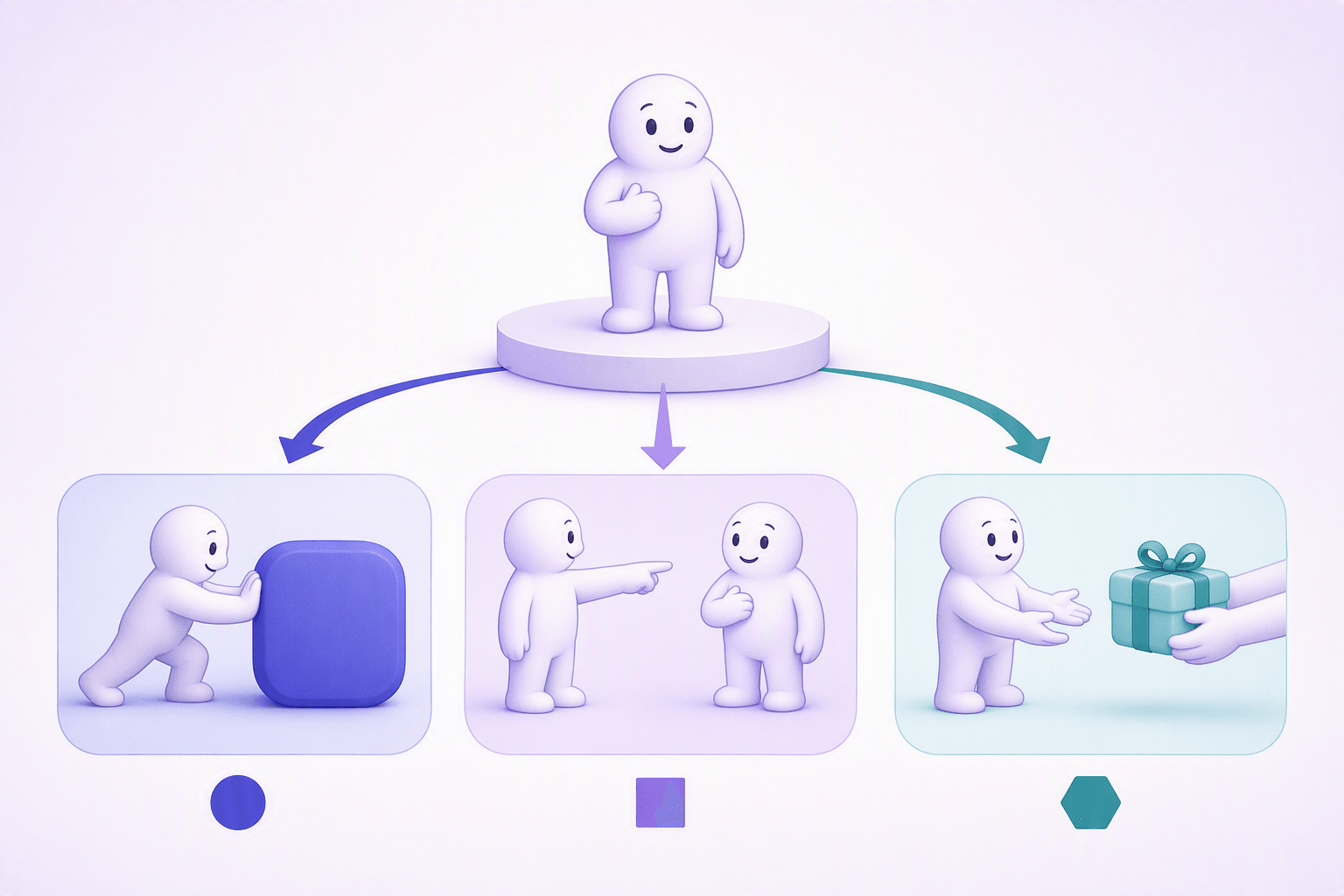
Pronouns replace nouns, but in German they also carry information that English often leaves to word order. German uses case marking to show who is doing what to whom, so pronoun forms are not optional decoration.
A useful way to think about it:
- Nominative: the subject, who does the action.
- Accusative: the direct object, who or what is directly affected.
- Dative: the indirect object, who benefits, receives, or is involved.
- Genitive: possession, mostly formal or fixed expressions today.
Duden and the IDS grammis system both treat case as a core organizing principle of German grammar, not a side topic (Duden, accessed 2026; IDS grammis, accessed 2026). Once you accept that, pronouns become predictable.
Personal pronouns in the nominative (subject forms)
These are the forms you use for the subject of the sentence.
| Person | Pronoun | Pronunciation |
|---|---|---|
| I | ich | ish (with a soft "sh" sound) |
| you (informal singular) | du | doo |
| he | er | ehr |
| she | sie | zee |
| it | es | ess |
| we | wir | veer |
| you (informal plural) | ihr | eer |
| they | sie | zee |
| you (polite) | Sie | zee |
ich
ich (ish) is “I.” The key sound is the German ich-Laut, often described as a soft, front-of-mouth fricative, close to a gentle "sh" for many learners.
You will hear ich reduced in fast speech, especially in casual conversation, but in careful speech it stays clear.
du
du (doo) is informal “you” to one person. It is common among friends, classmates, children, and in many modern workplaces.
In Germany, switching to du is often treated as a social agreement. If you are unsure, start with Sie.
Sie
Sie (zee) is polite “you.” It takes third-person plural verb forms, for example Sie sind (you are) and Sie haben (you have).
That verb agreement is one of the easiest ways to spot it in real dialogue. If you are training your ear with authentic clips, listen for sind and haben after Sie.
🌍 Du vs Sie is not just formality
In many German-speaking workplaces, the default can be Sie at first, then a deliberate switch to du after a short relationship forms. In startups and some university contexts, du is immediate. In customer service, Sie is still a safe default, especially with older customers.
Accusative pronouns (direct object)
Accusative pronouns answer “whom” or “what” is directly affected.
| Nominative | Accusative | Pronunciation (accusative) |
|---|---|---|
| ich | mich | mish |
| du | dich | dish (soft "sh") |
| er | ihn | een |
| sie | sie | zee |
| es | es | ess |
| wir | uns | oons |
| ihr | euch | oysh (approx.) |
| sie/Sie | sie/Sie | zee |
The big wins for learners are mich and dich, because they appear constantly in everyday German.
mich
mich (mish) is “me” as a direct object.
- Er sieht mich. (He sees me.)
- Kannst du mich hören? (Can you hear me?)
Notice how German can move pieces around for emphasis, but the pronoun form still signals the role. This is one reason German word order feels flexible.
dich
dich (dish) is “you” (informal singular) as a direct object.
- Ich liebe dich. (I love you.)
- Ich sehe dich. (I see you.)
If you are learning romantic lines, how to say I love you in German is basically a pronoun workout.
ihn
ihn (een) is “him” as a direct object.
Learners often mishear it because it is short and the h is not strongly pronounced. Train yourself to notice the vowel length.
- Ich kenne ihn. (I know him.)
- Ich rufe ihn an. (I’m calling him.)
Dative pronouns (indirect object and dative verbs)
Dative pronouns are the forms that cause the most trouble, because English does not mark them clearly. In German, many very common verbs require dative even when English uses a direct object.
| Nominative | Dative | Pronunciation (dative) |
|---|---|---|
| ich | mir | meer |
| du | dir | deer |
| er | ihm | eem |
| sie | ihr | eer |
| es | ihm | eem |
| wir | uns | oons |
| ihr | euch | oysh (approx.) |
| sie/Sie | ihnen/Ihnen | EE-nen |
Duden and Goethe-Institut explanations emphasize learning dative with the verb, not as an abstract rule (Duden, accessed 2026; Goethe-Institut, accessed 2026). That advice matches what teachers see in real classrooms.
mir
mir (meer) is “to me” or “for me,” and also “me” after dative verbs.
- Kannst du mir helfen? (Can you help me?)
- Es geht mir gut. (I’m doing well, literally “it goes to me well.”)
That second example is a cultural and grammatical two-in-one: German often frames wellbeing as how things “go” for you, and the dative marks the experiencer.
dir
dir (deer) is “to you” (informal singular) or “you” after dative verbs.
- Ich gebe dir das Buch. (I give you the book.)
- Das gefällt dir. (You like that, literally “that pleases you.”)
gefallen is a classic dative verb. If you try to force accusative here, your sentence will sound off immediately.
Ihnen
Ihnen (EE-nen) is the dative of polite Sie.
- Kann ich Ihnen helfen? (Can I help you?)
- Ich gebe Ihnen die Rechnung. (I’ll give you the bill.)
In shops, hotels, and offices, this is one of the most useful pronoun forms you can learn early.
💡 A fast dative checklist
If the verb is helfen, danken, gefallen, gehören, or passen, expect dative pronouns (mir, dir, ihm, ihr, uns, euch, ihnen/Ihnen). Learn each verb with one example sentence and you will stop guessing.
Genitive pronouns (what still matters)
Genitive pronouns exist, but in everyday speech they are limited. You will still see them in writing, formal contexts, and fixed phrases.
Common genitive forms include:
- meiner, deiner, seiner, ihrer, unser, euer, ihrer/Ihrer
In many spoken situations, German prefers von + dative instead of genitive, especially in some regions. That said, formal writing and careful speech still use genitive, and grammar references treat it as part of the standard system (IDS grammis, accessed 2026).
Possessive pronouns and determiners (mein, dein, Ihr)
German possessives behave like articles. They change endings based on gender, number, and case of the noun that follows.
Base forms:
- mein (mine), dein (your informal), sein (his), ihr (her/their), unser (our), euer (your plural informal), Ihr (your polite)
Pronunciation basics:
- mein: mine (like English "mine")
- dein: dine
- sein: zine (initial sound closer to "z")
- Ihr/Ihr-: eer
The practical rule: possessives copy article endings
If you already know der/die/das patterns, possessives follow the same logic. For example:
- Das ist mein Buch. (nominative neuter)
- Ich sehe meinen Bruder. (accusative masculine)
- Ich helfe meiner Schwester. (dative feminine)
You do not need to memorize every table at once. Start with the combinations you actually say: “my” plus a few nouns you use daily.
Reflexive pronouns (sich) in real German
Reflexive pronouns show that the subject and object are the same person. German uses reflexives more often than English in everyday verbs.
Key forms:
- mich (myself), dich (yourself), sich (himself/herself/itself/themselves), uns (ourselves), euch (yourselves)
Examples:
- Ich erinnere mich. (I remember, literally “I remind myself.”)
- Du setzt dich hin. (You sit down.)
- Er fühlt sich gut. (He feels good.)
Many learners over-translate and avoid reflexives, but in German they are often the default. Helbig and Buscha’s reference grammar treats reflexive constructions as a normal part of verb patterns you learn with the verb itself (Helbig & Buscha, Deutsche Grammatik, Langenscheidt).
Pronouns and word order: why German feels different
German word order is structured, but it allows rearrangement for emphasis. Pronouns interact with this because short pronouns often come earlier than longer noun phrases.
A common pattern in the middle of the sentence is:
- pronoun before noun: Ich gebe dir das Buch. (I give you the book.)
- dative before accusative when both are pronouns: Ich gebe es dir. (I give it to you.)
- but accusative noun before dative noun can happen depending on emphasis and information structure.
This is where real input helps. If you watch German dialogue, you will hear pronouns placed to keep the sentence flowing, not to match an English template. If you want more listening-first practice, Wordy-style clip study works well here because pronouns are short and frequent, so you get many repetitions quickly.
For a wider foundation of everyday function words, combine this with 100 most common German words. Pronouns sit right in that high-frequency core.
Sie, du, and regional workplace culture
German-speaking Europe is not one single etiquette system. Germany, Austria, and Switzerland share the Sie/du distinction, but norms differ by region, age group, and industry.
A few patterns you will actually encounter:
- Retail, hotels, government: Sie is the safe default.
- Universities: students usually use du with each other, and often Sie with staff unless invited otherwise.
- Tech and startups: du is common, but not universal.
- Clubs, sports teams, online communities: du is typical.
In Switzerland, you may also hear Swiss German dialects where pronoun forms differ from Standard German, but in writing and formal situations Standard German pronouns remain important. If you are learning for travel, German travel phrases will reinforce the polite forms you need most.

Common mistakes (and how to fix them fast)
Mixing up sie, Sie, and ihr
Three forms look similar:
- sie: she or they
- Sie: polite you
- ihr: her (dative) or your (plural informal) depending on context
Fix: always check the verb and the situation.
- Sie sind = polite you are
- sie ist = she is
- sie sind = they are
Overusing nominative after prepositions
Many prepositions force a case. If you say mit ich you will be understood, but it is incorrect. It must be mit mir.
A few high-frequency ones:
- mit (with) + dative: mit mir, mit dir
- für (for) + accusative: für mich, für dich
- bei (at/with) + dative: bei ihm, bei ihr
Guessing dative vs accusative instead of learning verb patterns
If you treat dative as a puzzle every time, you will stay slow. The better approach is to learn the verb with its typical object, as recommended in many teaching grammars and supported by usage-focused descriptions like those on grammis (IDS grammis, accessed 2026).
Start with a short list:
- helfen + dative: Hilf mir.
- danken + dative: Ich danke dir.
- sehen + accusative: Ich sehe dich.
- kennen + accusative: Ich kenne ihn.
⚠️ A quick note on insults and pronouns
If you explore strong language, pronouns still matter. Many insults target the listener directly with du forms, which can escalate the tone quickly. If you are curious, keep it separate from polite conversation practice, and see German swear words for context and severity.
A mini practice plan that actually sticks
Step 1: Memorize pronouns as sets, not lists
Learn these first:
- ich, mich, mir
- du, dich, dir
- Sie, Sie, Ihnen (nominative, accusative, dative)
That covers a huge share of daily interactions.
Step 2: Attach each set to 3 verbs
Pick verbs you use constantly:
- sehen (accusative): Siehst du mich?
- helfen (dative): Hilfst du mir?
- geben (both): Ich gebe dir das.
Step 3: Shadow real dialogue for rhythm and placement
Pronouns are short, and German reduces them in fast speech. Short clips are ideal because you can replay the same sentence until your mouth produces it smoothly.
If you want more structured listening, start with greetings and closings, then expand. The pronouns you learn here will immediately appear in how to say hello in German and how to say goodbye in German.
Quick cheat sheet: the forms you will use every day
Here are the highest-frequency pronoun forms to prioritize:
- ich (ish), mich (mish), mir (meer)
- du (doo), dich (dish), dir (deer)
- Sie (zee), Ihnen (EE-nen)
- er (ehr), ihn (een), ihm (eem)
- sie (zee), ihr (eer)
- wir (veer), uns (oons)
- ihr (eer), euch (oysh, approx.)
- sie (zee), ihnen (EE-nen)
If you can produce those without hesitation, you are past the biggest pronoun barrier.
Learn pronouns the way you hear them
German pronouns are small words with outsized impact: they control case, politeness, and sentence flow. Build them from real sentences, and your grammar will improve without feeling like pure memorization.
For more structured practice with everyday dialogue, browse the Wordy blog and then reinforce what you learn through real TV and movie clips on German learning.
Frequently Asked Questions
What are the German personal pronouns?
What is the difference between Sie and sie in German?
When do I use mich vs mir?
Do Germans still use du and Sie a lot in 2026?
Why does German have so many pronoun forms?
Sources & References
- Ethnologue, 27th edition, 2024
- Duden, 'Die Grammatik' (online reference), accessed 2026
- Institut für Deutsche Sprache (IDS), grammis information system, accessed 2026
- Goethe-Institut, German learning resources and grammar explanations, accessed 2026
Start learning with Wordy
Watch real movie clips and build your vocabulary as you go. Free to download.


