Quick Answer
German house vocabulary includes das Haus for house, die Wohnung for apartment, das Zimmer for room, die Küche for kitchen, and das Badezimmer for bathroom. Learn the gender with every noun, because articles and adjective endings change throughout German.
German house vocabulary starts with das Haus /haʊs/ for house, die Wohnung /ˈvoːnʊŋ/ for apartment, das Zimmer /ˈtsɪmɐ/ for room, die Küche /ˈkʏçə/ for kitchen, and das Bad /baːt/ for bathroom. The fastest way to make these words usable is to learn each noun with its gender and use it in short sentences about your own home.
German is spoken by roughly 130 million people worldwide according to the Goethe-Institut, and it is an official or co-official language in six European countries: Germany, Austria, Switzerland, Liechtenstein, Luxembourg, and Belgium. Home vocabulary matters across all of them, whether you are introducing your apartment, reading a rental listing, staying with a host family, or following dialogue in a German film.
For foundational greetings to use when visiting someone, see how to say hello in German. Then use the words below to describe what you see once you are inside.
| English | German | Pronunciation | Note |
|---|---|---|---|
| house | das Haus | HOWSS | IPA /haʊs/. Plural: die Häuser. |
| apartment / flat | die Wohnung | VOH-noong | IPA /ˈvoːnʊŋ/. Common word for an apartment. |
| home | das Zuhause | tsoh-HOW-zuh | IPA /tsuˈhaʊzə/. Usually refers to home as a place or feeling. |
| room | das Zimmer | TSIM-mer | IPA /ˈtsɪmɐ/. Plural: die Zimmer. |
| floor / storey | der Stock | SHTOK | IPA /ʃtɔk/. Also called das Stockwerk. |
| basement | der Keller | KEL-ler | IPA /ˈkɛlɐ/. A common storage and laundry area. |
| attic | der Dachboden | DAHKH-boh-den | IPA /ˈdaxboːdən/. Literally 'roof floor'. |
| hallway | der Flur | FLOOR | IPA /fluːɐ̯/. Also means corridor. |
| stairs | die Treppe | TREP-puh | IPA /ˈtrɛpə/. Usually singular in German. |
| balcony | der Balkon | bal-KOHN | IPA /balˈkoːn/. Plural: die Balkone. |
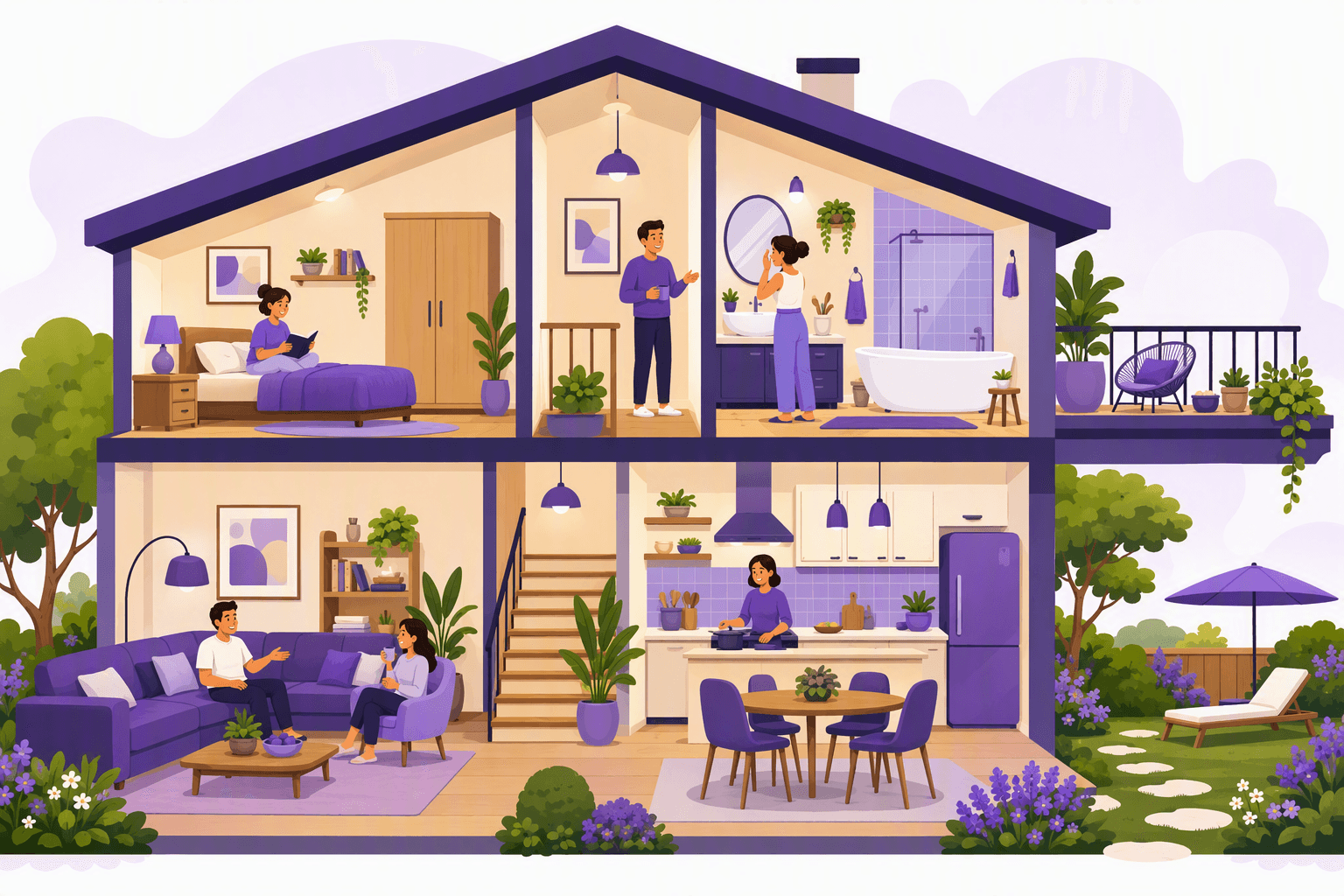
Start with the building and layout
A German noun is not fully learned until you know its article. Haus /haʊs/ is neuter, Wohnung /ˈvoːnʊŋ/ is feminine, and Flur /fluːɐ̯/ is masculine. Keep the article attached when reviewing: das Haus, not just Haus.
This is especially useful with compound nouns. German creates precise home words by joining familiar nouns together: Dachboden /ˈdaxboːdən/ combines Dach /dax/, roof, with Boden /ˈboːdən/, floor or ground. The final element normally determines the compound's gender, so der Dachboden is masculine because der Boden is masculine.
Elke Donalies, in Die Wortbildung des Deutschen, examines this ability to form compounds as a central feature of German word formation. For learners, compounds are not random long words. They are often clues you can take apart.
Haus
Haus /haʊs/ can mean a private house, a building, or an institution depending on context. Ich bin zu Hause /ɪç bɪn tsuˈhaʊzə/ means “I am at home,” but it does not use an article.
Say bei mir zu Hause /baɪ miːɐ̯ tsuˈhaʊzə/ for “at my place.” This is a natural phrase when inviting a friend over: Wir essen heute bei mir zu Hause /viːɐ̯ ˈʔɛsn̩ ˈhɔʏtə baɪ miːɐ̯ tsuˈhaʊzə/.
Wohnung
Wohnung /ˈvoːnʊŋ/ is the everyday word for an apartment or flat. A tenant may say Ich wohne in einer kleinen Wohnung /ɪç ˈvoːnə ɪn ˈaɪnɐ ˈklaɪnən ˈvoːnʊŋ/, meaning “I live in a small apartment.”
German rental listings often use abbreviations such as 2-Zimmer-Wohnung /ˈtsvaɪ ˈtsɪmɐ ˈvoːnʊŋ/. This means a two-room apartment, generally counting living and sleeping rooms, not the kitchen or bathroom. The exact convention can vary by listing, so read the floor plan carefully.
Zimmer
Zimmer /ˈtsɪmɐ/ means room, but German speakers commonly use a compound to specify its function. Schlafzimmer /ˈʃlaːftsɪmɐ/ is bedroom, while Wohnzimmer /ˈvoːntsɪmɐ/ is living room.
A useful question is Wie viele Zimmer hat die Wohnung? /viː ˈfiːlə ˈtsɪmɐ hat diː ˈvoːnʊŋ/, “How many rooms does the apartment have?” For more everyday questions, build on the patterns in our German question words guide.
Rooms in German
| English | German | Pronunciation | Note |
|---|---|---|---|
| living room | das Wohnzimmer | VOHN-tsim-mer | IPA /ˈvoːntsɪmɐ/. Literally 'living room'. |
| bedroom | das Schlafzimmer | SHLAHF-tsim-mer | IPA /ˈʃlaːftsɪmɐ/. Literally 'sleep room'. |
| kitchen | die Küche | KUE-kuh | IPA /ˈkʏçə/. The umlaut ü has no exact English equivalent. |
| bathroom | das Badezimmer | BAHD-uh-tsim-mer | IPA /ˈbaːdət͡sɪmɐ/. Short form: das Bad. |
| toilet | die Toilette | twa-LET-tuh | IPA /toaˈlɛtə/. Das WC is also widely used. |
| dining room | das Esszimmer | ESS-tsim-mer | IPA /ˈɛstsɪmɐ/. Often absent in smaller apartments. |
| office / study | das Arbeitszimmer | AHR-byts-tsim-mer | IPA /ˈaʁbaɪtstsɪmɐ/. Literally 'work room'. |
| children's room | das Kinderzimmer | KIN-der-tsim-mer | IPA /ˈkɪndɐtsɪmɐ/. A room for a child or children. |
| laundry room | die Waschküche | VASH-kue-kuh | IPA /ˈvaʃkʏçə/. More common in shared buildings than private homes. |
| garage | die Garage | gah-RAH-zhuh | IPA /ɡaˈʁaːʒə/. Pronunciation varies somewhat by region. |
Küche
Küche /ˈkʏçə/ means kitchen. Notice the ü sound in Küche /ˈkʏçə/: round your lips as if saying /uː/, but try to produce /iː/. It is a front rounded vowel, not the same as the vowel in English “cook.”
To say that something is in the kitchen, use in der Küche /ɪn deːɐ̯ ˈkʏçə/. German location phrases change articles according to case, so die Küche becomes der Küche after in when there is no movement.
Wohnzimmer
Wohnzimmer /ˈvoːntsɪmɐ/ is the living room. It combines wohnen /ˈvoːnən/, to live, with Zimmer /ˈtsɪmɐ/, room.
In many German-speaking homes, the Wohnzimmer /ˈvoːntsɪmɐ/ is the shared social space, with a sofa, television, bookshelves, and sometimes a dining table. A line such as Setz dich ins Wohnzimmer /zɛts dɪç ɪns ˈvoːntsɪmɐ/, “Sit down in the living room,” is useful in everyday scenes.
Bad
Bad /baːt/ is the usual short form for bathroom. Although it looks close to English “bad,” its vowel is long, and the final d is pronounced like /t/ because of German final devoicing.
In apartment advertisements, Bad mit Dusche /baːt mɪt ˈdʊʃə/ means bathroom with shower, while Bad mit Wanne /baːt mɪt ˈvanə/ means bathroom with bathtub. If you need practical German for a stay or travel situation, combine this vocabulary with our German travel phrases.
Furniture and household objects
| English | German | Pronunciation | Note |
|---|---|---|---|
| table | der Tisch | TISH | IPA /tɪʃ/. Plural: die Tische. |
| chair | der Stuhl | SHTOOL | IPA /ʃtuːl/. Plural: die Stühle. |
| sofa | das Sofa | ZOH-fah | IPA /ˈzoːfa/. Die Couch is also common. |
| bed | das Bett | BET | IPA /bɛt/. Plural: die Betten. |
| wardrobe | der Kleiderschrank | KLY-der-shrahngk | IPA /ˈklaɪdɐʃʁaŋk/. Literally 'clothes cabinet'. |
| shelf | das Regal | reh-GAHL | IPA /ʁeˈɡaːl/. Plural: die Regale. |
| lamp | die Lampe | LAM-puh | IPA /ˈlampə/. A ceiling light is often die Deckenlampe. |
| door | die Tür | TUE-er | IPA /tyːɐ̯/. The ü is a rounded front vowel. |
| window | das Fenster | FEN-ster | IPA /ˈfɛnstɐ/. Plural: die Fenster. |
| key | der Schlüssel | SHLUE-sel | IPA /ˈʃlʏsl̩/. The final syllable is often reduced in speech. |
| wall | die Wand | VAHNT | IPA /vant/. Do not confuse with die Wand meaning wall. |
| floor | der Boden | BOH-den | IPA /ˈboːdən/. Can mean floor surface or ground. |
How to describe where things are
Once you know the objects, position words make your German immediately more useful. Auf dem Tisch /aʊf deːm tɪʃ/ means “on the table,” and unter dem Bett /ˈʊntɐ deːm bɛt/ means “under the bed.”
Use neben /ˈneːbn̩/ for beside, vor /foːɐ̯/ for in front of, and hinter /ˈhɪntɐ/ for behind. These are prepositions, and they often require the dative case when describing a fixed location.
| English | German | Example |
|---|---|---|
| on the table | auf dem Tisch /aʊf deːm tɪʃ/ | Das Buch liegt auf dem Tisch. |
| under the bed | unter dem Bett /ˈʊntɐ deːm bɛt/ | Die Katze schläft unter dem Bett. |
| next to the door | neben der Tür /ˈneːbn̩ deːɐ̯ tyːɐ̯/ | Der Schrank steht neben der Tür. |
| in front of the window | vor dem Fenster /foːɐ̯ deːm ˈfɛnstɐ/ | Der Tisch steht vor dem Fenster. |
| in the living room | im Wohnzimmer /ɪm ˈvoːntsɪmɐ/ | Wir sitzen im Wohnzimmer. |
Peter Eisenberg’s Grundriss der deutschen Grammatik treats case marking as a core structural feature of German. At beginner level, you do not need to analyze every grammar label before speaking, but you should learn frequent chunks such as im Wohnzimmer /ɪm ˈvoːntsɪmɐ/ and in der Küche /ɪn deːɐ̯ ˈkʏçə/ as complete units.
💡 Learn nouns as mini phrases
Instead of memorizing Tisch alone, learn der Tisch, auf dem Tisch, and der Tisch steht am Fenster. This gives you gender, a useful preposition pattern, and a sentence frame at the same time.
Useful sentences about your home
Start with short, accurate sentences. German word order is manageable in simple main clauses: subject, verb, then the rest of the information.
-
Ich wohne in einer Wohnung. /ɪç ˈvoːnə ɪn ˈaɪnɐ ˈvoːnʊŋ/
I live in an apartment. -
Meine Wohnung hat drei Zimmer. /ˈmaɪnə ˈvoːnʊŋ hat draɪ ˈtsɪmɐ/
My apartment has three rooms. -
Die Küche ist klein, aber hell. /diː ˈkʏçə ɪst klaɪn ˈaːbɐ hɛl/
The kitchen is small but bright. -
Das Sofa steht im Wohnzimmer. /das ˈzoːfa ʃteːt ɪm ˈvoːntsɪmɐ/
The sofa is in the living room. -
Wo ist der Schlüssel? /voː ɪst deːɐ̯ ˈʃlʏsl̩/
Where is the key? -
Das Fenster ist offen. /das ˈfɛnstɐ ɪst ˈɔfn̩/
The window is open.
The Institute for the German Language notes that noun gender is part of a noun’s lexical identity, not a logical property of the object. That is why der Tisch /deːɐ̯ tɪʃ/, die Tür /diː tyːɐ̯/, and das Fenster /das ˈfɛnstɐ/ must be learned individually.
German home culture: practical details learners notice
In Germany, the word Hausordnung /ˈhaʊsʔɔʁdnʊŋ/, house rules, appears in apartment buildings. It may cover quiet hours, shared hallways, rubbish sorting, laundry rooms, and rules for bicycles or pets. These are not merely vocabulary details, they shape everyday neighborly interaction.
Another useful word is Hausschuh /ˈhaʊsʃuː/, house slipper. Taking off outdoor shoes at home is common in many households, though practices differ from family to family. If a host offers Hausschuhe /ˈhaʊsʃuːə/, accept them as a practical courtesy rather than a formal ritual.
🌍 The meaning of 'Kehrwoche'
In parts of southern Germany, especially Swabia, Kehrwoche /ˈkeːɐ̯vɔxə/ refers to a rotating responsibility for cleaning shared areas such as stairs or sidewalks. The custom is regionally associated with order and neighborly duties, although its exact form varies by building and city.
When you leave a friend’s home, pair this vocabulary with a natural farewell from our German goodbye guide. For personal conversations at home, German expressions of affection can also help you recognize warmer family dialogue.
A simple practice routine
Choose one room each day and name ten things in it. First label objects mentally: der Tisch /deːɐ̯ tɪʃ/, die Lampe /diː ˈlampə/, das Fenster /das ˈfɛnstɐ/. Then make location sentences using auf /aʊf/, unter /ˈʊntɐ/, and neben /ˈneːbn̩/.
Watch a German scene set in an apartment, pause it, and describe the room aloud. Real dialogue supplies context for words like Küche /ˈkʏçə/ and Schlüssel /ˈʃlʏsl̩/ that a word list alone cannot provide.
Most importantly, keep gender visible in every note. Die Wohnung /diː ˈvoːnʊŋ/, das Wohnzimmer /das ˈvoːntsɪmɐ/, and der Schlüssel /deːɐ̯ ˈʃlʏsl̩/ will become much easier to use when you learn them as complete vocabulary units.
Frequently Asked Questions
What is house in German?
What is the difference between Haus and Wohnung in German?
Do I need to learn German noun gender for house vocabulary?
How do I say my room is on the second floor in German?
What German house vocabulary should beginners learn first?
Sources & References
- Goethe-Institut, German Language, accessed 2026
- Duden, Online Dictionary entries for Haus, Wohnung, Zimmer, and Möbel, accessed 2026
- Institut für Deutsche Sprache, Grammis: Noun Gender and Compounds, accessed 2026
- Peter Eisenberg, Grundriss der deutschen Grammatik, Metzler
- Elke Donalies, Die Wortbildung des Deutschen, Narr Francke Attempto
Start learning with Wordy
Watch real movie clips and build your vocabulary as you go. Free to download.


