Quick Answer
German and English share thousands of cognates because both developed from the Germanic language family. Learn the most useful matching words, predictable sound changes, and the false friends that can mislead English speakers.
German cognates with English are words that share a historical root and still look or sound familiar, such as Haus /haʊs/ and house, Wasser /ˈvasɐ/ and water, or Finger /ˈfɪŋɐ/ and finger. Because English and German are closely related West Germanic languages, English speakers can recognize thousands of German words faster by learning a few dependable sound patterns and checking for false friends.
| English | German | Pronunciation | Note |
|---|---|---|---|
| house | Haus | /haʊs/ | Same Germanic root as English house. |
| hand | Hand | /hant/ | A close spelling match. |
| name | Name | /ˈnaːmə/ | The final e is pronounced in German. |
| friend | Freund | /fʁɔʏnt/ | Related to English friend. |
| water | Wasser | /ˈvasɐ/ | German w is pronounced /v/. |
| apple | Apfel | /ˈapfl̩/ | Related to English apple. |
| butter | Butter | /ˈbʊtɐ/ | Almost identical in writing. |
| salt | Salz | /zalts/ | German z is pronounced /ts/. |
| summer | Sommer | /ˈzɔmɐ/ | German s before a vowel is often /z/. |
| winter | Winter | /ˈvɪntɐ/ | German w is /v/. |
| drink | trinken | /ˈtʁɪŋkn̩/ | Related to English drink. |
| find | finden | /ˈfɪndn̩/ | A high-frequency everyday verb. |
| help | helfen | /ˈhɛlfn̩/ | Related to English help. |
| come | kommen | /ˈkɔmən/ | Related to English come. |
| make | machen | /ˈmaxn̩/ | The ch has a back-throat sound after a. |
| learn | lernen | /ˈlɛʁnən/ | A close match in meaning and form. |
| old | alt | /alt/ | Related through an older Germanic root. |
| new | neu | /nɔʏ/ | Related to English new. |
| blue | blau | /blaʊ/ | A useful spelling match. |
| long | lang | /laŋ/ | German a is short here. |
| arm | Arm | /aʁm/ | Same word and meaning. |
| finger | Finger | /ˈfɪŋɐ/ | Nearly identical. |
| mother | Mutter | /ˈmʊtɐ/ | A core family-word cognate. |
| brother | Bruder | /ˈbʁuːdɐ/ | Related despite the vowel change. |
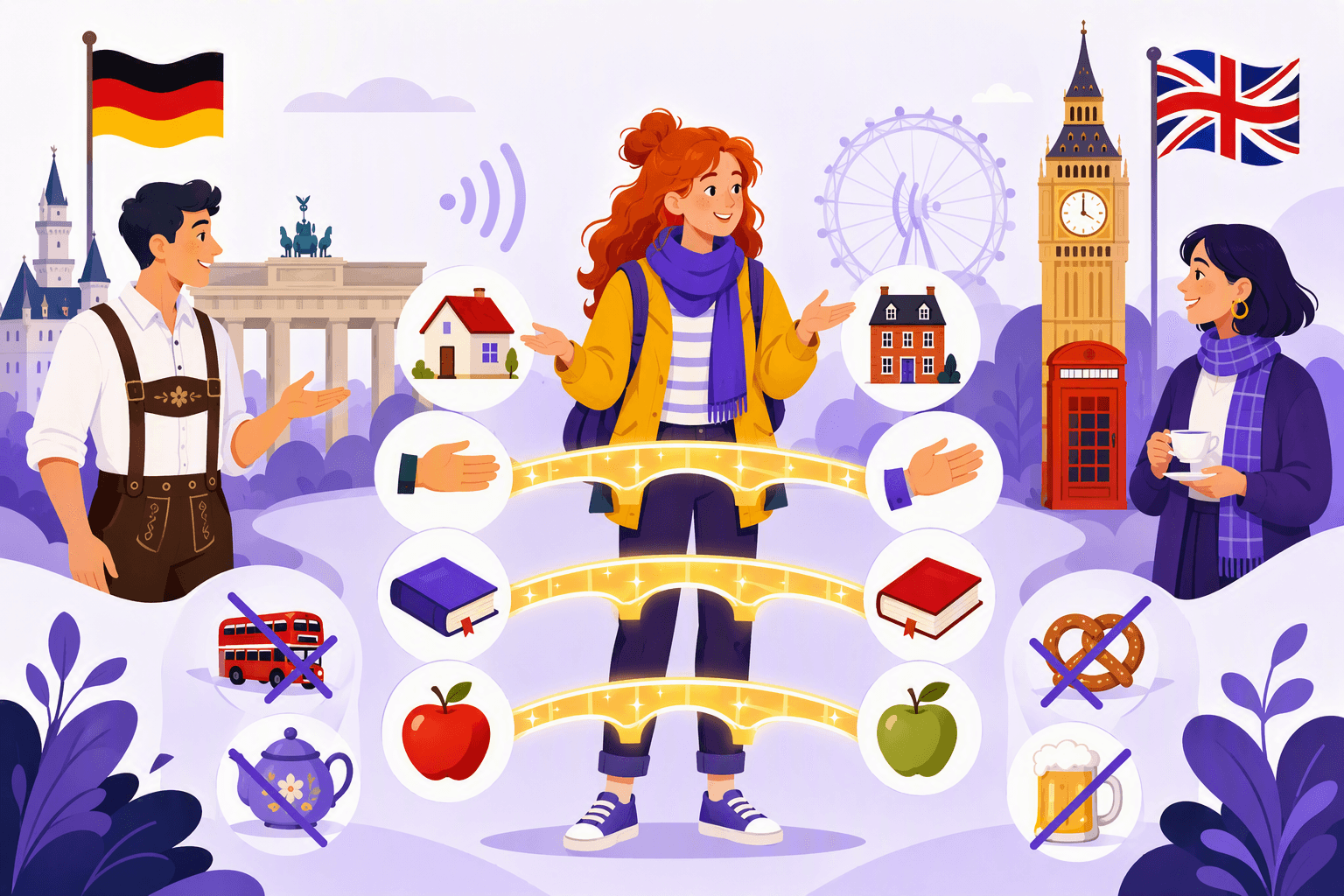
Why English speakers recognize German words
English is often treated as separate from German because it absorbed so much vocabulary from French, Latin, Greek, and languages around the world. Its oldest everyday layer, however, remains Germanic. That is why basic words such as Mutter /ˈmʊtɐ/, Bruder /ˈbʁuːdɐ/, Sonne /ˈzɔnə/, and Winter /ˈvɪntɐ/ can feel familiar.
German is spoken by roughly 90 million native speakers and is an official language in six European countries: Germany, Austria, Liechtenstein, Switzerland, Belgium, and Luxembourg. Ethnologue records substantially more total speakers when second-language users are included. For learners, that means German offers a large body of media, travel situations, and regional varieties in which these shared roots appear.
The connection goes back long before modern national borders. In From Proto-Indo-European to Proto-Germanic, historical linguist Don Ringe traces how Germanic languages developed shared sound systems and vocabulary from earlier ancestors. English and German later changed in different directions, but their relationship is still visible in ordinary words.
This is also why your first German reading experience can feel less opaque than expected. A sign saying Hotel /hoˈtɛl/, Restaurant /ʁɛstoˈʁã/ or Bank /baŋk/ is recognizable partly through international borrowing, while a word such as Hand /hant/ is recognizable because of a much older family connection.
The most useful cognate patterns
Memorizing isolated lookalikes helps, but patterns give you more value. Once you notice a regular correspondence, you can make an informed guess about unfamiliar vocabulary without treating every guess as certain.
English w often matches German w, but the sound changes
German w is normally pronounced /v/. So English water resembles Wasser /ˈvasɐ/, English winter resembles Winter /ˈvɪntɐ/, and English week resembles Woche /ˈvɔxə/.
The spelling can make these words easy to identify, but pronunciation can initially hide the relationship. Practice hearing wie /viː/, meaning how, and wo /voː/, meaning where, in real dialogue. A German hello guide is a useful next step because greetings quickly make this sound feel normal.
English th often matches German d
One famous historical pattern is English th and German d. English three corresponds to drei /dʁaɪ/, English thumb to Daumen /ˈdaʊmən/, and English thousand to tausend /ˈtaʊzənt/.
This does not mean every English th has a German d equivalent, and it does not give permission to invent words. It is a recognition tool. When you see a German d-word in a basic semantic field, checking whether an English th-word exists can reveal a genuine family resemblance.
English t may match German z or s
German z /ts/ often reflects a sound that remained t in English. English tongue is related to Zunge /ˈtsʊŋə/, and English ten is related to zehn /tseːn/.
Another frequent relationship is English t and German s. English that relates historically to das /das/, and English two relates to zwei /tsvaɪ/ through a more complex set of sound changes. These are not shortcuts for speaking German, but they make vocabulary less arbitrary.
German f can connect to English p
The German word Pfeffer /ˈpfɛfɐ/, meaning pepper, is related to a Latin borrowing rather than the oldest Germanic layer, so it is not the best example of this pattern. A clearer inherited pair is English pipe and German Pfeife /ˈpfaɪfə/, meaning whistle or pipe.
The major sound shift that shaped High German explains many differences like this. Historical linguists call it the High German consonant shift, and it is one reason German can look familiar while sounding more sharply articulated than English.
Cognates you can use in real German
Cognates become useful when they appear inside complete phrases, not when they remain a passive list. Start with words you are likely to hear in a café, at a station, during an introduction, or in a TV scene.
Ich lerne Deutsch /ɪç ˈlɛʁnə dɔɪtʃ/ means I am learning German. The verb lerne /ˈlɛʁnə/ is related to learn, while Deutsch /dɔɪtʃ/ has a more distant historical relationship to words meaning people or nation.
Wir trinken Wasser /viːɐ̯ ˈtʁɪŋkən ˈvasɐ/ means we drink water. Both trinken /ˈtʁɪŋkn̩/ and Wasser /ˈvasɐ/ are excellent cognates, but the sentence also teaches a key point: recognizing nouns does not remove the need to learn German word order and verb endings.
Mein Freund kommt morgen /maɪn fʁɔʏnt kɔmt ˈmɔʁɡn̩/ means my friend is coming tomorrow. Freund /fʁɔʏnt/ and kommt /kɔmt/ are closely related to English friend and come, while morgen /ˈmɔʁɡn̩/ can mean tomorrow or morning depending on context.
💡 Use cognates as listening anchors
When watching German scenes, do not pause for every unknown word. First listen for recognizable anchors such as Name /ˈnaːmə/, Problem /pʁoˈbleːm/, Musik /muˈziːk/, or Telefon /teleˈfoːn/. Then use the surrounding action, tone, and subtitles to work out what the full line is doing.
For vocabulary that is truly frequent rather than merely familiar-looking, pair cognate spotting with a list of common German words. High-frequency function words such as und /ʊnt/, aber /ˈaːbɐ/, and nicht /nɪçt/ are not always transparent to English speakers, yet they hold sentences together.
False friends: familiar is not always correct
A false friend looks similar to an English word but has a different meaning in modern German. These words are memorable because the mistake can produce an unintentionally strange sentence.
| German word | IPA | What it actually means | English trap |
|---|---|---|---|
| Gift | /ɡɪft/ | poison | a present |
| bekommen | /bəˈkɔmən/ | to receive, get | to become |
| bald | /balt/ | soon | without hair |
| Rat | /ʁaːt/ | advice or council | a rodent |
| Chef | /ʃɛf/ | boss | a cook |
| aktuell | /aktuˈɛl/ | current, topical | actual |
| eventuell | /ɛvɛntuˈɛl/ | possibly | eventually |
| also | /ˈalzoː/ | so, therefore | also |
| sensibel | /zɛnˈziːbl̩/ | sensitive | sensible |
The classic example is Gift /ɡɪft/. Its English-looking spelling is not a clue that you have received something pleasant. Duden and the Digitales Wörterbuch der deutschen Sprache document the word’s modern meaning as poison, even though its older history is connected with giving.
Another risky pair is bekommen /bəˈkɔmən/. If you say Ich bekomme ein Taxi /ɪç bəˈkɔmə aɪn ˈtaksi/, you mean I am getting a taxi, not I am becoming a taxi. Build a small personal list of these traps and review it whenever you encounter one in context.
🌍 Why false friends matter more in German conversation
German speakers are usually used to hearing English and can often infer what an English learner intended. Still, false friends can make you sound overly literal. In work settings, aktuell /aktuˈɛl/ is especially useful to learn correctly because it appears in updates, schedules, and news discussions.
Cognates do not replace German grammar
Cognates are a fast route into vocabulary, not a substitute for grammar. German nouns have grammatical gender, verbs change with the subject, and the language uses cases that English mostly lost.
For example, der Freund /deːɐ̯ fʁɔʏnt/ means the friend, but mit dem Freund /mɪt deːm fʁɔʏnt/ means with the friend. The familiar noun is still there, but dem /deːm/ signals the dative case. Learn the article with the noun from the start.
John A. Hawkins, in A Comparative Typology of English and German, examines structural differences between the two languages. The practical learner lesson is clear: use shared vocabulary to understand more quickly, then study the patterns that control how those words fit together. Our German cases guide can help when familiar vocabulary starts appearing in unfamiliar forms.
German compounds are another place where English speakers can make productive guesses. Handschuh /ˈhantʃuː/ literally combines hand and shoe, but means glove. Zahnbürste /ˈtsaːnbʏʁstə/ combines tooth and brush, meaning toothbrush.
The parts may be recognizable, but compound meaning is not always literal. Treat the pieces as clues, then confirm the actual meaning through a dictionary, a subtitle, or a clear real-world context.
A practical way to learn cognates
Choose 10 to 15 cognates at a time, preferably words you will hear often. Say each aloud, notice its German sound pattern, and place it in a short sentence.
Then watch a short German clip once without stopping. On the second viewing, identify any cognates you can hear. On the third, repeat one complete line aloud, including the small grammar words around the familiar vocabulary.
This method prevents a common beginner mistake: collecting attractive word lists but failing to recognize those words at normal speed. Video gives each word a voice, emotion, and situation, which makes Freund /fʁɔʏnt/ more memorable than a translation card alone.
Finish by learning social phrases that contain vocabulary you can reuse. After mastering greetings, practice a natural German goodbye and build toward warmer expressions with ways to say I love you in German. Cognates lower the entry barrier, but repeated contextual exposure turns recognition into usable German.
Frequently Asked Questions
Why do German and English have so many similar words?
How many German cognates are there with English?
Are all similar German and English words cognates?
What are the easiest German cognates for English speakers?
Do German cognates sound the same as English words?
Sources & References
- Ethnologue, 27th edition, 2024
- Dudenredaktion, Duden online etymology and dictionary entries, accessed 2026
- Berlin-Brandenburg Academy of Sciences and Humanities, Digitales Wörterbuch der deutschen Sprache, accessed 2026
- Don Ringe, From Proto-Indo-European to Proto-Germanic, Oxford University Press
- John A. Hawkins, A Comparative Typology of English and German, Routledge
Start learning with Wordy
Watch real movie clips and build your vocabulary as you go. Free to download.


