Quick Answer
French noun gender is mostly predictable: many noun endings strongly signal masculine or feminine, and the article (le/la/les) is what you actually memorize. Use high-signal endings, learn gender in phrases (not isolated words), and treat common exceptions as a short list. With a few patterns, you can guess correctly most of the time in real conversation.
French noun gender is best learned by memorizing the article with the noun (un, une, le, la) and using a handful of high-signal endings to guess correctly most of the time, because French gender is not fully logical but it is far from random.
French is spoken by hundreds of millions of people worldwide, across dozens of countries and territories, and it is an official language in many international institutions. That means gender mistakes are common among learners, and also very forgivable, but they can make your French feel less clear and less natural.
If you want more everyday context for how native speakers actually talk, pair this guide with a greeting clip lesson like how to say hello in French and a closing line like how to say goodbye in French. Gender shows up immediately in tiny words like un, une, le, la, and it affects everything around them.
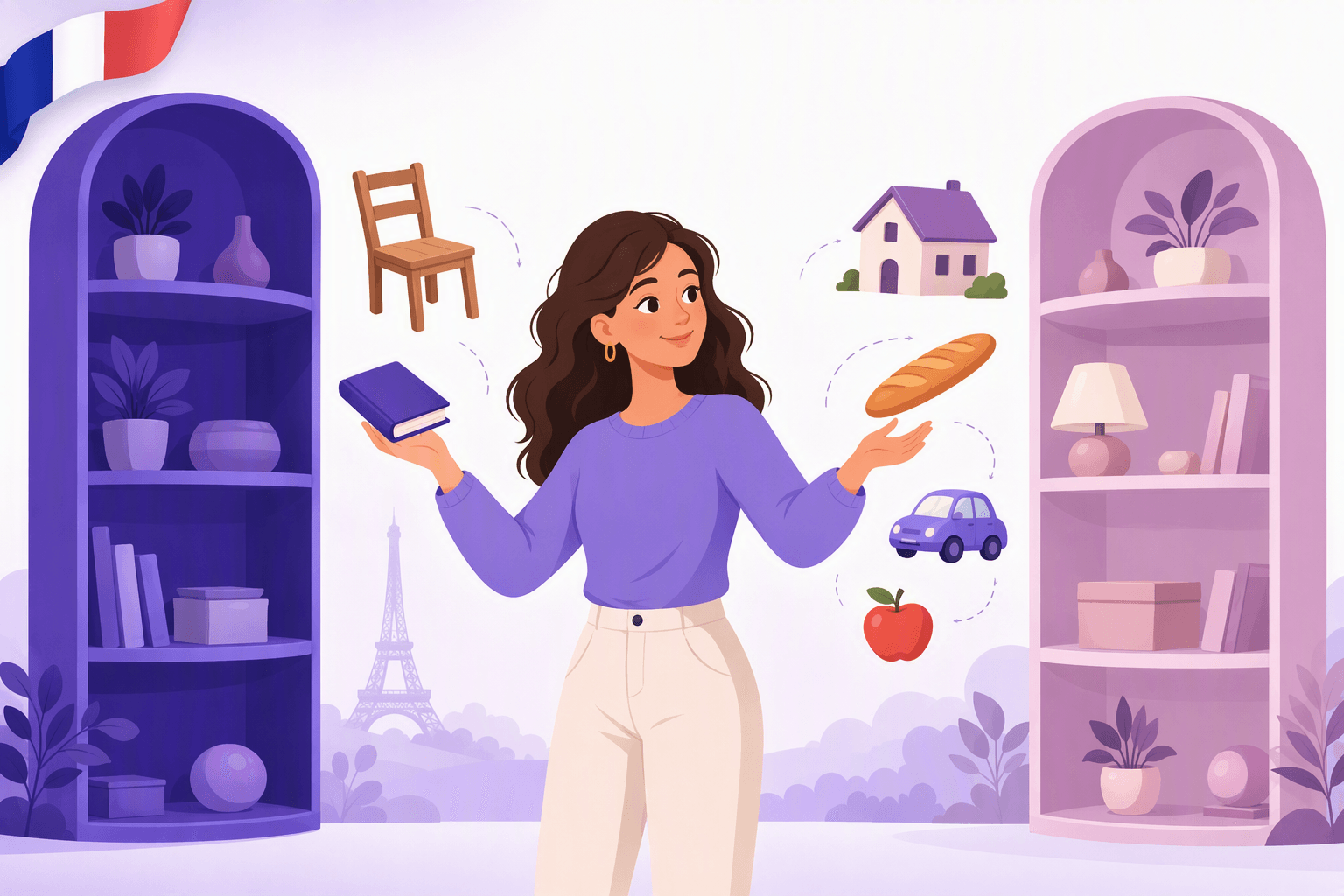
What French noun gender actually is (and what it affects)
Every French noun is grammatically masculine or feminine. Gender is a property of the word, not the object.
A chair is not inherently feminine, but the word chaise is feminine, so you say une chaise. A book is not inherently masculine, but the word livre is masculine, so you say un livre.
The three places gender hits you in real speech
Gender matters because it controls agreement, and agreement is what listeners hear.
- Articles and determiners: un/une, le/la, ce/cette, mon/ma.
- Adjectives: petit/petite, content/contente.
- Pronouns: il/elle, and sometimes le/la as object pronouns.
If you only memorize the noun without its article, you force yourself to guess later, right when you are trying to speak fluently.
💡 The single best habit
Learn every noun as a mini-phrase: article plus noun plus one adjective you can picture. For example: "une petite table" (OON puh-TEET TAH-bluh) or "un grand problème" (uhn grahn proh-BLEHM). This makes gender automatic because you rehearse it the way you will use it.
The articles: un, une, le, la, les (with pronunciation)
French gender is usually taught as a rule set, but in daily conversation it is mostly an article choice.
Here are the core forms you will use constantly:
- Masculine singular: un (uhn), le (luh)
- Feminine singular: une (OON), la (lah)
- Plural (both genders): des (day), les (lay)
l' and the vowel problem
Before a vowel or mute h, le and la become l': l'ami (lah-MEE), l'idée (lee-DAY). This hides gender.
To reveal it, switch to a determiner that does not elide:
- un ami (uhn ah-MEE) vs une idée (OON ee-DAY)
- ce livre (suh LEE-vruh) vs cette idée (SEHT ee-DAY)
The "mute h" vs "aspirated h" detail (why it matters)
Some h words behave like vowels (mute h): l'homme (LOHM). Others block elision and liaison (aspirated h): le héros (luh ay-ROH), not l'héros.
You do not need to master the full list early. Use a dictionary that marks it, like CNRTL, and learn high-frequency h words as chunks.
How predictable is French noun gender?
There is no single rule that covers everything, but there are strong patterns, especially in noun endings. In practice, you can get a high success rate by combining:
- endings that are almost always masculine or feminine
- a short, curated exception list
- learning nouns with articles
This approach matches what you see in serious reference works like Le Bon Usage (Grevisse & Goosse), which treats gender as a mix of morphology (word form) and usage rather than a simple semantic system.
High-signal feminine endings (usually feminine)
When you see these endings, your default guess should be feminine. Do not treat them as absolute laws, but they are strong enough to build confidence.
-tion, -sion
Examples: la nation, la situation, la décision.
Pronunciation tip: situation is see-too-ah-syohn.
-té, -tié
Examples: la liberté, la beauté, l'amitié.
These abstract nouns are extremely common. You will hear them in films, news, and everyday talk.
-ure
Examples: la culture, la voiture, la blessure.
Be careful: there are masculine exceptions like le murmure.
-ance, -ence
Examples: la différence, la patience, la présence.
-ette, -elle, -esse
Examples: la baguette, la nouvelle, la jeunesse.
These endings often feel "small" or "collective" to learners, but the real reason to trust them is simply frequency and consistency.
⚠️ Do not over-trust -e
Many learners assume "ends in -e" means feminine. It often does, but it is not reliable enough on its own. High-frequency masculine nouns like "le problème", "le système", and "le musée" will punish that shortcut fast.
High-signal masculine endings (usually masculine)
Masculine defaults are also learnable. The trick is to focus on endings that are both frequent and consistent.
-age
Examples: le village, le message, le fromage.
Common exception: la page.
-ment
Examples: le gouvernement, le moment, le changement.
Pronunciation tip: changement is shahnj-MAHN.
-isme
Examples: le tourisme, le réalisme, le capitalisme.
-oir, -eau, -eu
Examples: le miroir, le bureau, le jeu.
These are high-frequency in everyday speech, especially bureau and jeu.
-phone, -scope, -gramme
Examples: le téléphone, le microscope, le programme.
A lot of these are international scientific or technical formations, and French keeps them masculine.
Meaning-based rules that actually help (and the ones that mislead)
Endings beat meaning most of the time. Still, a few semantic categories are useful, especially at beginner levels.
Days, months, and languages
- Days of the week are masculine: lundi, mardi, samedi.
- Months are masculine: janvier, février, août.
- Languages are masculine: le français, l'espagnol.
If you are building your core vocabulary, the 100 most common French words list is a good place to start, because you will meet these patterns constantly.
Trees vs fruits (a classic rule with real payoff)
A traditional guideline: tree names tend to be masculine, and fruit names tend to be feminine.
- le pommier (pohm-YAY) vs la pomme (POM)
- le cerisier (suh-ree-ZYAY) vs la cerise (suh-REEZ)
It is not perfect, but it is memorable and surprisingly practical.
People nouns: often aligned, but not guaranteed
Many roles have a masculine and feminine form: un acteur (uhn ahk-TUR) vs une actrice (OON ahk-TREESS).
Some nouns stay fixed: une personne is always feminine, and un bébé is masculine in standard usage. If you want a broader view of how French changes by region and community, the OIF’s reporting on French worldwide is a good reminder that usage is not identical everywhere.
The exception list you actually need (high-frequency traps)
You do not need thousands of exceptions. You need the ones you will say every week.
Here are a few that cause outsized pain:
- le problème (luh proh-BLEHM)
- le système (luh seess-TEM)
- le musée (luh my-ZAY)
- le silence (luh see-LAHNS)
- la main (lah MAHN)
- la fin (lah FAN)
- la mer (lah MEHR)
- la page (lah PAHZH)
If you want to hear these in natural speed, movie and TV dialogue is ideal because articles are reduced and linked in real speech. That is also why clip-based practice can help you stop translating and start chunking.
Agreement: the real reason gender matters
Most learners obsess over le vs la, but the real cost of wrong gender is the chain reaction.

Adjectives (the patterns you will hear)
Many adjectives add -e for feminine:
- petit (puh-TEE) vs petite (puh-TEET)
- grand (grahn) vs grande (GRAHND)
Some change more:
- beau (boh) vs belle (BEHL)
- nouveau (noo-VOH) vs nouvelle (noo-VEHL)
When you learn a noun, pairing it with a common adjective makes agreement automatic. This lines up with usage-focused teaching approaches you see across modern pedagogy and with culture-focused perspectives like Claire Kramsch’s work on language and culture, where form and social meaning are learned together, not as isolated rules.
Possessives: mon/ma/mes and the vowel trick
Normally:
- mon livre (mohn LEE-vruh)
- ma table (mah TAH-bluh)
But before a vowel or mute h, French uses mon even with feminine nouns:
- mon amie (mohn ah-MEE), not ma amie
This is about sound flow, not gender change. The noun stays feminine, and agreement still follows feminine forms elsewhere.
Pronouns: il/elle and ce/cette
Pronouns are where gender becomes unavoidable.
- Il est grand (eel ay grahn) for a masculine noun.
- Elle est grande (ehl ay GRAHND) for a feminine noun.
For demonstratives:
- ce (suh) + masculine: ce livre
- cette (SEHT) + feminine: cette idée
A practical method: how to get to "mostly correct" fast
You do not need perfection to sound good. You need a system that holds up under speed.
Step 1: Learn nouns as chunks, not labels
Your brain retrieves phrases better than isolated facts.
Good: une petite maison, un grand jardin.
Bad: "maison = feminine" written alone in a list.
If you want a structured review habit, spaced repetition helps, but it works best when your cards are phrases. Our Anki for language learning guide shows how to set that up without turning your deck into busywork.
Step 2: Use endings as default guesses, then confirm in input
When you meet a new noun in a subtitle line or a sentence, do two things:
- Notice the ending and make a quick guess.
- Confirm by checking the article in the same sentence, or in a dictionary entry.
CNRTL is especially useful because it clearly marks gender in lexical entries.
Step 3: Keep an exception list that is personal and small
Your exception list should be based on your life: work, school, hobbies, travel.
A student needs le cours and la classe. A traveler needs la gare and le billet. A film fan needs le film and la scène.
Regional and register notes (why you will see variation)
French is spoken across many countries and communities, and learners meet it through France, Canada, Africa, and the Caribbean. Ethnologue’s global language data and the OIF’s reporting both highlight how wide that footprint is.
Gender itself does not usually flip by region, but what changes is which nouns you hear most, and which job titles or social labels are preferred. If you are focusing on Québec, also read our Canadian French guide because pronunciation and everyday vocabulary can shift enough to affect what you notice in input.
Common learner mistakes (and quick fixes)
Mistake 1: Overusing "le" as a default
Many learners default to masculine because it feels safer. It is understandable, but it creates repeated agreement errors.
Fix: force yourself to say une out loud in drills, even with easy nouns, until it stops feeling marked.
Mistake 2: Treating elision as gender-neutral
l' hides gender, but it does not remove it.
Fix: practice with un/une pairs: un ami vs une amie, un hôtel vs une histoire.
Mistake 3: Memorizing rules without hearing them
Gender is a listening skill as much as a memorization skill. In real speech, articles are short and often reduced.
Fix: use short clips with subtitles and replay the same line until the article feels glued to the noun. If you are building a broader routine around real input, how to learn a language with movies lays out a method that does not collapse into passive watching.
A quick reality check: you can be wrong and still communicate
Native speakers will usually understand you even if you say le table. But repeated agreement errors can make your speech harder to parse, especially in longer sentences with pronouns and adjectives.
The goal is not to become a walking grammar book. The goal is to make the small words automatic so your attention stays on meaning.
Practice plan: 10 minutes a day for two weeks
Day 1 to 3: pick 30 nouns you use constantly. Write each as un/une + adjective + noun.
Day 4 to 7: add endings. Group your nouns by ending and notice which groups are consistent.
Day 8 to 14: add input. Watch or listen to short scenes and pause only to capture noun phrases, not isolated nouns.
If you want a fun, low-pressure way to keep that habit going, finish with a clip-based session and then reinforce the same nouns in a spaced review. For more French culture and real usage, browse the Wordy blog and keep your next target list tied to the scenes you actually enjoy.
Frequently Asked Questions
Is French noun gender random?
What is the fastest way to learn le vs la?
Do all nouns for people match biological gender?
How do I know gender when the noun starts with a vowel?
What happens if I use the wrong gender in French?
Sources & References
- Organisation internationale de la Francophonie (OIF), La langue française dans le monde (latest report, accessed 2026)
- Ethnologue, 27th edition, 2024
- Académie française, Le site de l'Académie (usage and grammar notes, accessed 2026)
- CNRTL, Centre National de Ressources Textuelles et Lexicales (lexical entries and gender, accessed 2026)
- Grevisse & Goosse, Le Bon Usage, De Boeck
Start learning with Wordy
Watch real movie clips and build your vocabulary as you go. Free to download.


