Quick Answer
French articles show whether a noun is specific, general, singular, plural, masculine, or feminine. Learn when to use le, la, les, un, une, des, du, de la, and de l', plus the contractions and exceptions that make French articles feel difficult at first.
French articles are the small words before nouns, such as le /lə/, la /la/, les /le/, un /œ̃/, and une /yn/. Use them to show gender, number, and whether you mean a particular thing, any one thing, or an unspecified amount. The fastest way to improve is to learn every French noun together with its article, not as an isolated word.
Articles appear in nearly every French conversation, from bonjour /bɔ̃.ʒuʁ/ to restaurant orders and romantic messages. If you can say le café /lə ka.fe/ instead of only café /ka.fe/, your French immediately sounds more structurally natural. Start with French greetings and listen for these short words before nouns.
French is spoken by an estimated 321 million people worldwide, according to the Organisation internationale de la Francophonie's 2022 report. It is an official language in 29 sovereign states, so article use naturally varies slightly by region, but the core grammar is shared across France, Québec, Belgium, Switzerland, and much of Africa.
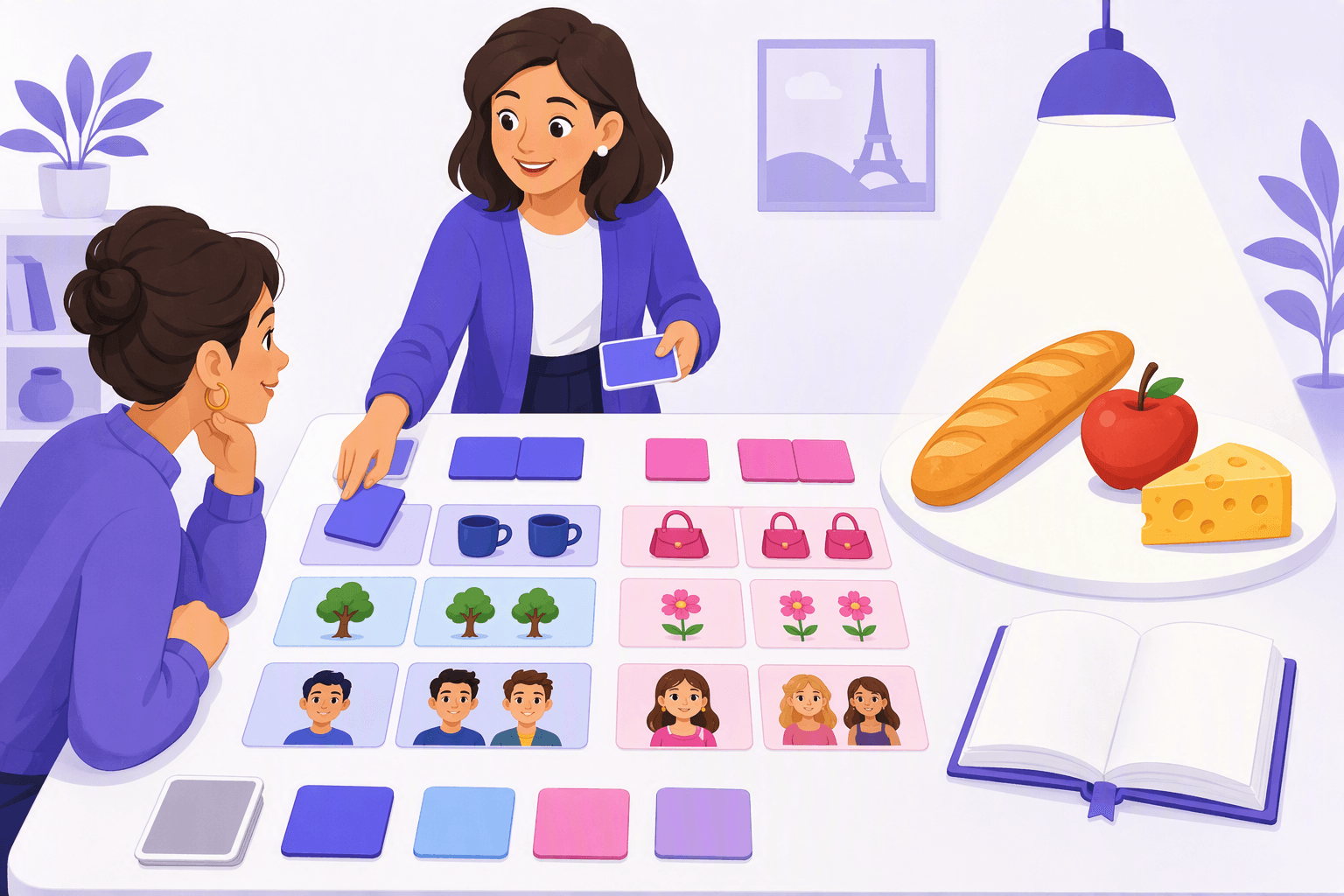
The three types of French articles
French has three main article groups:
| Type | Main forms | What it does |
|---|---|---|
| Definite | le /lə/, la /la/, les /le/ | Refers to a specific thing or things, or things in general |
| Indefinite | un /œ̃/, une /yn/, des /de/ | Refers to one or some non-specific things |
| Partitive | du /dy/, de la /də la/, de l' /də l/ | Refers to an unspecified amount of something |
Unlike English, French nouns always have grammatical gender: masculine or feminine. Gender is not about biological sex. A table is feminine, la table /la tabl/, while a book is masculine, le livre /lə livʁ/.
Maurice Grevisse and André Goosse's Le Bon Usage treats the article as a central part of the French noun phrase because it helps signal how the speaker frames a noun: known, unknown, counted, or uncounted. That is the key idea behind all the rules below.
Definite articles: le, la, l', and les
Use a definite article when you mean the, when the listener can identify the noun, or when you are talking about something in general.
| Article | Use | Example |
|---|---|---|
| le /lə/ | Masculine singular | le film /lə film/, the film |
| la /la/ | Feminine singular | la musique /la my.zik/, the music |
| l' /l/ | Singular before vowel or silent h | l'hôtel /lo.tɛl/, the hotel |
| les /le/ | All plural nouns | les amis /lez‿a.mi/, the friends |
Le, la, les
The basic rule is straightforward: masculine singular nouns take le /lə/, feminine singular nouns take la /la/, and plural nouns take les /le/.
- Le chat dort. /lə ʃa dɔʁ/ means The cat is sleeping.
- La porte est ouverte. /la pɔʁt ɛ.t‿u.vɛʁt/ means The door is open.
- Les enfants jouent. /lez‿ɑ̃.fɑ̃ ʒu/ means The children are playing.
The pronunciation of les changes before a vowel because of liaison. In les amis /lez‿a.mi/, the final s sounds like /z/. You do not need to force every liaison immediately, but recognizing it will help your listening.
L'
Before a vowel sound or a silent h, French shortens le /lə/ and la /la/ to l' /l/. This is called elision.
- l'école /le.kɔl/, the school
- l'ami /la.mi/, the friend
- l'heure /lœʁ/, the hour
- l'hôtel /lo.tɛl/, the hotel
You cannot say le école or la amie. The vowel collision must be avoided.
A useful trap: not every word beginning with h has a silent h. With so-called aspirated h words, elision does not happen. For example, le héros /lə e.ʁo/, the hero, keeps le even though the written word begins with h. This is a lexical feature, so memorize it when you encounter it.
French uses the definite article for general ideas
English often omits the when talking about something generally. French usually keeps an article.
- J'aime le cinéma. /ʒɛm lə si.ne.ma/ means I like cinema.
- Le café est populaire en France. /lə ka.fe ɛ pɔ.py.lɛʁ ɑ̃ fʁɑ̃s/ means Coffee is popular in France.
- Les chiens sont fidèles. /le ʃjɛ̃ sɔ̃ fi.dɛl/ means Dogs are loyal.
This is why direct English-to-French translation often fails. English says I like music, but French says j'aime la musique /ʒɛm la my.zik/.
The same pattern appears with languages:
- Je parle français. /ʒə paʁl fʁɑ̃.sɛ/ means I speak French.
- Le français est difficile. /lə fʁɑ̃.sɛ ɛ di.fi.sil/ means French is difficult.
No article follows parler /paʁ.le/ when naming a language, but the definite article returns when the language itself is the subject.
💡 Learn nouns as pairs
Write la voiture /la vwa.tyʁ/, not only voiture /vwa.tyʁ/. Write le problème /lə pʁɔ.blɛm/, not only problème /pʁɔ.blɛm/. This trains gender and article choice together from day one.
Indefinite articles: un, une, and des
Indefinite articles match English a, an, and some. Use them when you introduce something not yet identified, or when its exact identity does not matter.
| Article | Use | Example |
|---|---|---|
| un /œ̃/ | Masculine singular | un café /œ̃ ka.fe/, a coffee |
| une /yn/ | Feminine singular | une idée /yn i.de/, an idea |
| des /de/ | Plural | des fleurs /de flœʁ/, some flowers |
Examples in context:
- J'ai un frère. /ʒe œ̃ fʁɛʁ/ means I have a brother.
- Elle cherche une chambre. /ɛl ʃɛʁʃ yn ʃɑ̃bʁ/ means She is looking for a room.
- Nous avons des questions. /nu za.vɔ̃ de kɛs.tjɔ̃/ means We have some questions.
The gender distinction between un /œ̃/ and une /yn/ matters. You can often hear it clearly in careful speech, although fast connected speech can make the contrast subtle.
Des changes before some plural adjectives
When a plural noun is preceded by an adjective, des /de/ frequently becomes de /də/, especially in standard written French.
- des livres intéressants /de livʁ ɛ̃.te.ʁe.sɑ̃/, interesting books
- de grands arbres /də ɡʁɑ̃ zaʁbʁ/, tall trees
- de belles maisons /də bɛl mɛ.zɔ̃/, beautiful houses
This is not a rule to panic over in conversation. Native speakers will understand des grands arbres, and usage can vary. But de grands arbres is the expected standard form.
Martin Riegel, Jean-Christophe Pellat, and René Rioul explain in Grammaire méthodique du français that articles do more than label a noun. They also interact with number, adjectives, negation, and the speaker's intended meaning. That is why a short word such as de /də/ can replace an entire plural article.
Partitive articles: du, de la, de l', and des
Partitive articles express an unspecified amount of something, especially food, drink, materials, and abstract ideas. English may use some, but it often uses no article at all.
| Form | Use | Example |
|---|---|---|
| du /dy/ | Masculine singular | du pain /dy pɛ̃/, some bread |
| de la /də la/ | Feminine singular | de la soupe /də la sup/, some soup |
| de l' /də l/ | Before vowel or silent h | de l'eau /də lo/, some water |
| des /de/ | Plural things | des légumes /de le.ɡym/, some vegetables |
At a café, you might hear:
- Je voudrais du café. /ʒə vu.dʁɛ dy ka.fe/ means I would like some coffee.
- Elle boit de l'eau. /ɛl bwa də lo/ means She drinks water.
- On mange de la salade. /ɔ̃ mɑ̃ʒ də la sa.lad/ means We are eating salad.
For ordering phrases and meal vocabulary, see our guide to eating at a restaurant in French. Restaurant dialogue is one of the best places to hear partitive articles repeatedly and naturally.
The contractions you must know
French combines certain prepositions with definite articles. These are not optional stylistic shortcuts. They are required forms.
| Meaning | Correct French | Never say |
|---|---|---|
| to the masculine singular | au /o/ | à le /a lə/ |
| to the plural | aux /o/ | à les /a le/ |
| from the masculine singular | du /dy/ | de le /də lə/ |
| from the plural | des /de/ | de les /də le/ |
Examples:
- Je vais au cinéma. /ʒə vɛ o si.ne.ma/ means I am going to the cinema.
- Elle parle aux étudiants. /ɛl paʁl o ze.ty.djɑ̃/ means She is speaking to the students.
- Il revient du marché. /il ʁə.vjɛ̃ dy maʁ.ʃe/ means He is returning from the market.
- Les pages des livres sont jaunes. /le paʒ de livʁ sɔ̃ ʒon/ means The pages of the books are yellow.
There is no contraction with la /la/ or l' /l/:
- à la gare /a la ɡaʁ/, to the station
- de la gare /də la ɡaʁ/, from the station
- à l'aéroport /a le.ʁɔ.pɔʁ/, to the airport
- de l'aéroport /də le.ʁɔ.pɔʁ/, from the airport
Articles after negation
This is one of the most important French article patterns. After a standard negation, un /œ̃/, une /yn/, des /de/, du /dy/, and de la /də la/ generally change to de /də/ or d' /d/.
| Positive | Negative | Meaning |
|---|---|---|
| J'ai un chien. /ʒe œ̃ ʃjɛ̃/ | Je n'ai pas de chien. /ʒə nɛ pa də ʃjɛ̃/ | I have a dog. / I do not have a dog. |
| Elle boit du thé. /ɛl bwa dy te/ | Elle ne boit pas de thé. /ɛl nə bwa pa də te/ | She drinks tea. / She does not drink tea. |
| Nous avons des amis. /nu za.vɔ̃ de za.mi/ | Nous n'avons pas d'amis. /nu na.vɔ̃ pa da.mi/ | We have friends. / We do not have friends. |
The major exception is the verb être /ɛtʁ/, meaning to be.
- C'est un problème. /sɛ tœ̃ pʁɔ.blɛm/ means It is a problem.
- Ce n'est pas un problème. /sə nɛ pa œ̃ pʁɔ.blɛm/ means It is not a problem.
Because the noun identifies what something is, French normally retains un /œ̃/ or une /yn/ after negative être /ɛtʁ/.
⚠️ Do not translate English article by article
English may say I do not have any money. French normally says je n'ai pas d'argent /ʒə nɛ pa daʁ.ʒɑ̃/, not a direct version with aucun /o.kœ̃/ in ordinary neutral speech. Learn the whole negative pattern.
Articles with body parts, days, and possession
French articles are especially visible in everyday expressions where English uses a possessive word.
Body parts
When the owner is already clear from the sentence, French normally uses the definite article.
- Je me lave les mains. /ʒə mə lav le mɛ̃/ means I wash my hands.
- Il ferme les yeux. /il fɛʁm le zjø/ means He closes his eyes.
- Elle a mal à la tête. /ɛl a mal a la tɛt/ means Her head hurts.
English requires my, his, or her in these sentences. French lets the reflexive pronoun or context establish ownership.
Days of the week
A day without an article often refers to a specific upcoming or recent day.
- Je travaille lundi. /ʒə tʁa.vaj lœ̃.di/ means I am working on Monday.
A day with le /lə/ usually describes a habit.
- Je travaille le lundi. /ʒə tʁa.vaj lə lœ̃.di/ means I work on Mondays.
This distinction is short but powerful. It can change a one-time plan into a regular routine.
Expressions of love and affection
In French, articles and possessives can combine in warm, familiar ways. Mon amour /mɔ̃ na.muʁ/ means my love, while l'amour /la.muʁ/ means love as an idea or known topic. For the wider cultural context, read how to say I love you in French.
🌍 Why article mistakes are normal
French articles encode information English often leaves to context: grammatical gender, quantity, familiarity, and general meaning. A learner who says la problème /la pʁɔ.blɛm/ has made a grammar error, but still communicates. Repeated listening helps the correct article become automatic before you can always explain the rule.
How to remember French article gender
There are useful patterns, but no perfect shortcut. Nouns ending in -tion /sjɔ̃/ and -sion /zjɔ̃/ are often feminine, such as la situation /la si.tɥa.sjɔ̃/ and la décision /la de.si.zjɔ̃/. Nouns ending in -age /aʒ/ are often masculine, such as le village /lə vi.laʒ/.
However, exceptions matter. La plage /la plaʒ/, beach, is feminine despite ending in -age /aʒ/. Learn patterns as clues, then confirm the article in a reliable dictionary.
The Académie française and CNRTL both provide reference entries that show grammatical gender. When you look up a new noun, check whether it is marked n. m. for masculine or n. f. for feminine, then record the article immediately.
A practical way to master articles through real French
Do not spend all your study time filling in isolated blanks. Articles work best when learned inside full chunks of speech.
- Choose a short scene with clear dialogue.
- Listen once for the nouns and their articles.
- Write three phrases exactly as you hear them.
- Say each phrase aloud, keeping the article connected to the noun.
- Rewatch the scene two or three days later.
For example, learn au revoir /o ʁə.vwaʁ/ as a complete phrase, not as separate words. Then compare it with à la prochaine /a la pʁɔ.ʃɛn/, see you next time, where no contraction occurs because the article is feminine. Our French goodbye guide gives you practical phrases to practice this distinction.
The goal is not to recite every rule before speaking. It is to hear du pain /dy pɛ̃/, de l'eau /də lo/, and les amis /lez‿a.mi/ often enough that the correct form feels expected. Grammar explanations make the pattern visible, while real dialogue makes it usable.
Frequently Asked Questions
How do I know whether to use le or la in French?
What is the difference between un, une, and des in French?
Why does de become du, de la, or des in French?
When do French articles disappear after de?
Do French use articles more often than English speakers do?
Sources & References
- Académie française, Dire, Ne pas dire: Articles définis et indéfinis, accessed 2026
- CNRTL, Trésor de la langue française informatisé: article, accessed 2026
- Maurice Grevisse and André Goosse, Le Bon Usage, De Boeck Supérieur
- Martin Riegel, Jean-Christophe Pellat, and René Rioul, Grammaire méthodique du français, Presses Universitaires de France
- Organisation internationale de la Francophonie, La langue française dans le monde, 2022
Start learning with Wordy
Watch real movie clips and build your vocabulary as you go. Free to download.


