English Words From Italian: 80+ Loanwords You Already Use (and How to Pronounce Them)
Quick Answer
English has borrowed dozens of everyday words from Italian, especially for food, music, art, and banking, because Italian city-states shaped European trade and culture and later influenced the US through immigration. You already use many of them, like pizza, espresso, opera, and balcony. This guide lists 80+ Italian loanwords in modern English with practical pronunciation and usage notes.
English has borrowed a large, recognizable set of words from Italian, especially in food, music, art, architecture, and finance, and you already use many of them daily, like pizza, espresso, opera, and balcony. Below you will find 80+ Italian-origin words that are standard in modern English, with clear pronunciations and the cultural reasons they entered English in the first place.
Italian is also one of the world’s major languages, with roughly 60 to 70 million native speakers depending on how sources count Italy’s regional languages and dialects, and it is used across multiple countries and diaspora communities (Ethnologue, 27th edition, 2024). That reach matters because loanwords spread through trade, migration, and media, not just textbooks.
If you like tracing where everyday English comes from, you may also enjoy our guides to English words from French and English words from Spanish.

| Category + word | English | Pronunciation | Note |
|---|---|---|---|
| Food and drink: pizza | pizza | PEET-suh | In English, the 'i' is often shorter than Italian. |
| Food and drink: pasta | pasta | PAH-stuh | Generic term in English, not just one shape. |
| Food and drink: espresso | espresso | ess-PRESS-oh | Often mis-said as 'expresso' in casual speech. |
| Food and drink: gelato | gelato | juh-LAH-toh | Italian-style ice cream, denser than typical US ice cream. |
| Food and drink: cappuccino | cappuccino | kap-oo-CHEE-noh | Coffee drink name used internationally. |
| Food and drink: latte | latte | LAH-tay | In Italian, 'latte' means 'milk'. |
| Food and drink: mozzarella | mozzarella | maht-suh-REH-luh | US pronunciation varies by region. |
| Food and drink: parmesan | parmesan | par-muh-ZAHN | From 'Parmigiano'; English uses a shortened form. |
| Food and drink: prosciutto | prosciutto | proh-SHOO-toh | Cured ham, often served thin-sliced. |
| Food and drink: salami | salami | suh-LAH-mee | In English, a general category of cured sausage. |
| Food and drink: risotto | risotto | ree-ZOT-oh | Rice dish cooked to a creamy texture. |
| Food and drink: tiramisu | tiramisu | teer-uh-mee-SOO | Dessert name, spelling often keeps Italian form. |
| Food and drink: pesto | pesto | PESS-toh | Sauce name used widely in English. |
| Food and drink: bruschetta | bruschetta | broo-SKEH-tuh | The 'sch' is a hard 'sk' sound. |
| Food and drink: biscotti | biscotti | bee-SKOT-ee | In Italian, plural; in English, often treated as singular. |
| Food and drink: panini | panini | puh-NEE-nee | Plural in Italian, singular in many English menus. |
| Food and drink: al dente | al dente | ahl DEN-tay | Cooking term meaning 'to the tooth' texture. |
| Food and drink: antipasto | antipasto | an-tee-PAH-stoh | Often used for a starter platter in English. |
| Food and drink: espresso bar | espresso bar | ess-PRESS-oh bar | Common collocation in English. |
| Music: opera | opera | OP-er-uh | A major Italian cultural export. |
| Music: soprano | soprano | suh-PRAH-noh | Voice type; Italian terms dominate classical music. |
| Music: alto | alto | AL-toh | Voice range term used in choirs. |
| Music: tenor | tenor | TEN-er | Voice type; common in music and metaphorically in speech. |
| Music: concerto | concerto | kun-CHER-toh | Instrumental composition term. |
| Music: sonata | sonata | suh-NAH-tuh | Form name used across classical music. |
| Music: libretto | libretto | lih-BRET-oh | Text of an opera or musical work. |
| Music: allegro | allegro | uh-LEH-groh | Tempo marking meaning fast and lively. |
| Music: adagio | adagio | uh-DAH-joh | Tempo marking meaning slow. |
| Music: crescendo | crescendo | kruh-SHEN-doh | Gradual increase in loudness; also used figuratively. |
| Music: forte | forte | FOR-tay | Loud in music; in English also means 'strength'. |
| Music: piano | piano | pee-AN-oh | Instrument name shortened from 'pianoforte'. |
| Music: diva | diva | DEE-vuh | From opera culture; now also means a demanding star. |
| Art and architecture: fresco | fresco | FRESS-koh | Wall-painting technique associated with Renaissance art. |
| Art and architecture: studio | studio | STOO-dee-oh | Art workspace, then general workplace term. |
| Art and architecture: chiaroscuro | chiaroscuro | kee-AHR-uh-SKYOOR-oh | Art term for light-dark contrast. |
| Art and architecture: cupola | cupola | KYOO-puh-luh | Small dome, common in architecture. |
| Art and architecture: loggia | loggia | LOH-juh | Covered exterior gallery, used in architecture writing. |
| Art and architecture: balcony | balcony | BAL-kuh-nee | Everyday English word with Italian roots. |
| Art and architecture: piazza | piazza | pee-AH-tsuh | Public square; used in travel and urban design contexts. |
| Art and architecture: portico | portico | POR-tih-koh | Columned entrance, common in architecture. |
| Art and architecture: terrazzo | terrazzo | tuh-RAH-tsoh | Flooring material; also used in interior design. |
| Art and architecture: grotto | grotto | GROT-oh | Cave-like space; used in landscaping too. |
| Business and finance: bank | bank | BANK | Often traced to Italian 'banca' in etymology references. |
| Business and finance: bankrupt | bankrupt | BANGK-rupt | Etymology often linked to 'banca rotta' in reference works. |
| Business and finance: tariff | tariff | TAIR-iff | Common trade term; etymologies vary by pathway. |
| Everyday and media: scenario | scenario | suh-NAIR-ee-oh | Now general English for a possible situation. |
| Everyday and media: finale | finale | fih-NAL-ee | Common in TV and sports. |
| Everyday and media: umbrella | umbrella | um-BREL-uh | Standard English word with Romance pathways, including Italian. |
| Everyday and media: graffiti | graffiti | gruh-FEE-tee | Plural in Italian; treated as mass noun in English. |
| Everyday and media: ghetto | ghetto | GET-oh | Historically specific term, now broader usage; handle with care. |
| Everyday and media: fiasco | fiasco | fee-AS-koh | Meaning shifted to 'disaster' in English. |
| Everyday and media: incognito | incognito | in-kog-NEE-toh | Used for hidden identity. |
| Everyday and media: bravo | bravo | BRAH-voh | Audience praise, also NATO alphabet word. |
| Everyday and media: paparazzi | paparazzi | pah-puh-RAHT-see | Plural in Italian; singular 'paparazzo' exists in English too. |
| Everyday and media: prima donna | prima donna | PREE-muh DON-uh | From opera, now also a personality label. |
| Fashion and design: bellissimo | bellissimo | beh-LEE-sih-moh | Used in English as an expressive compliment. |
| Fashion and design: sprezzatura | sprezzatura | spret-sah-TOOR-uh | Deliberate nonchalance, used in style writing. |
| Military and history: arsenal | arsenal | AHR-suh-nuhl | Etymologies often pass through Italian in European history. |
| Sports: calcio | calcio | KAL-choh | Used in English mainly to refer to Italian football. |
| Transport: gondola | gondola | GON-duh-luh | Venice boat, also ski lift car. |
| Transport: limousine | limousine | LIH-muh-zeen | Not purely Italian origin, but Italian usage influenced car culture terms. |
| Science and academia: influenza | influenza | in-floo-EN-zuh | Medical term with Italian pathway in many etymologies. |
| Science and academia: neutrino | neutrino | noo-TREE-noh | Coined in Italian scientific context; now global term. |
| Food and drink: vermouth | vermouth | ver-MOOTH | International drinks vocabulary; spelling varies by language. |
| Food and drink: ravioli | ravioli | rah-vee-OH-lee | Plural in Italian; often singular in English. |
| Food and drink: gnocchi | gnocchi | NYOH-kee | The initial 'gn' is like 'ny' in 'canyon'. |
| Food and drink: focaccia | focaccia | foh-KAH-chuh | Bread name common in US and UK. |
| Food and drink: mortadella | mortadella | mor-tuh-DEL-uh | Often referenced in deli contexts. |
| Food and drink: espresso martini | espresso martini | ess-PRESS-oh mar-TEE-nee | Cocktail name; 'martini' is also Italian-origin via place name. |
| Food and drink: martini | martini | mar-TEE-nee | Cocktail name; pronunciation varies by accent. |
| Art and culture: manifesto | manifesto | man-uh-FESS-toh | Used in politics and art movements. |
| Art and culture: virtuoso | virtuoso | vur-choo-OH-soh | Highly skilled performer; plural 'virtuosi' appears too. |
| Art and culture: mezzo-soprano | mezzo-soprano | MET-soh suh-PRAH-noh | Voice type between soprano and alto. |
| Art and culture: prima ballerina | prima ballerina | PREE-muh bal-uh-REE-nuh | Ballet title; Italian terms appear in dance too. |
| Everyday and media: lava | lava | LAH-vuh | Scientific term widely used; etymology often traced through Italian. |
| Everyday and media: stanza | stanza | STAN-zuh | Poetry term; Italian 'stanza' also means 'room'. |
| Everyday and media: cartoon | cartoon | kar-TOON | Art term with European pathways including Italian 'cartone' in etymologies. |
| Everyday and media: motto | motto | MOT-oh | Common English word; often traced to Italian in etymology references. |
| Architecture: façade | façade | fuh-SAHD | Often via French, but used heavily in Italian architecture discourse too. |
| Food and drink: granita | granita | gruh-NEE-tuh | Semi-frozen dessert, especially associated with Sicily. |
| Food and drink: affogato | affogato | ah-foh-GAH-toh | Dessert of espresso poured over ice cream or gelato. |
| Food and drink: amaretto | amaretto | am-uh-RET-oh | Almond-flavored liqueur. |
| Food and drink: limoncello | limoncello | lee-mon-CHELL-oh | Lemon liqueur, often served chilled. |
| Food and drink: ciabatta | ciabatta | chuh-BAH-tuh | Bread name common in supermarkets. |
| Food and drink: espresso shot | espresso shot | ess-PRESS-oh shot | Everyday cafe English. |
| Music: a cappella | a cappella | ah kuh-PELL-uh | Singing without instruments. |
| Music: solo | solo | SOH-loh | Now fully naturalized in English. |
| Music: duet | duet | doo-ET | Often via Italian 'duetto' in music history. |
| Music: tempo | tempo | TEM-poh | Used in music and metaphorically ('pick up the tempo'). |
| Music: finale (music) | finale | fih-NAL-ee | Also common in TV series talk. |
| Art and architecture: cupola (dome) | cupola | KYOO-puh-luh | Common in architecture writing and travel. |
Why English borrows from Italian (and why these words stuck)
Italian loanwords in English cluster in a few domains for a reason: prestige, contact, and usefulness.
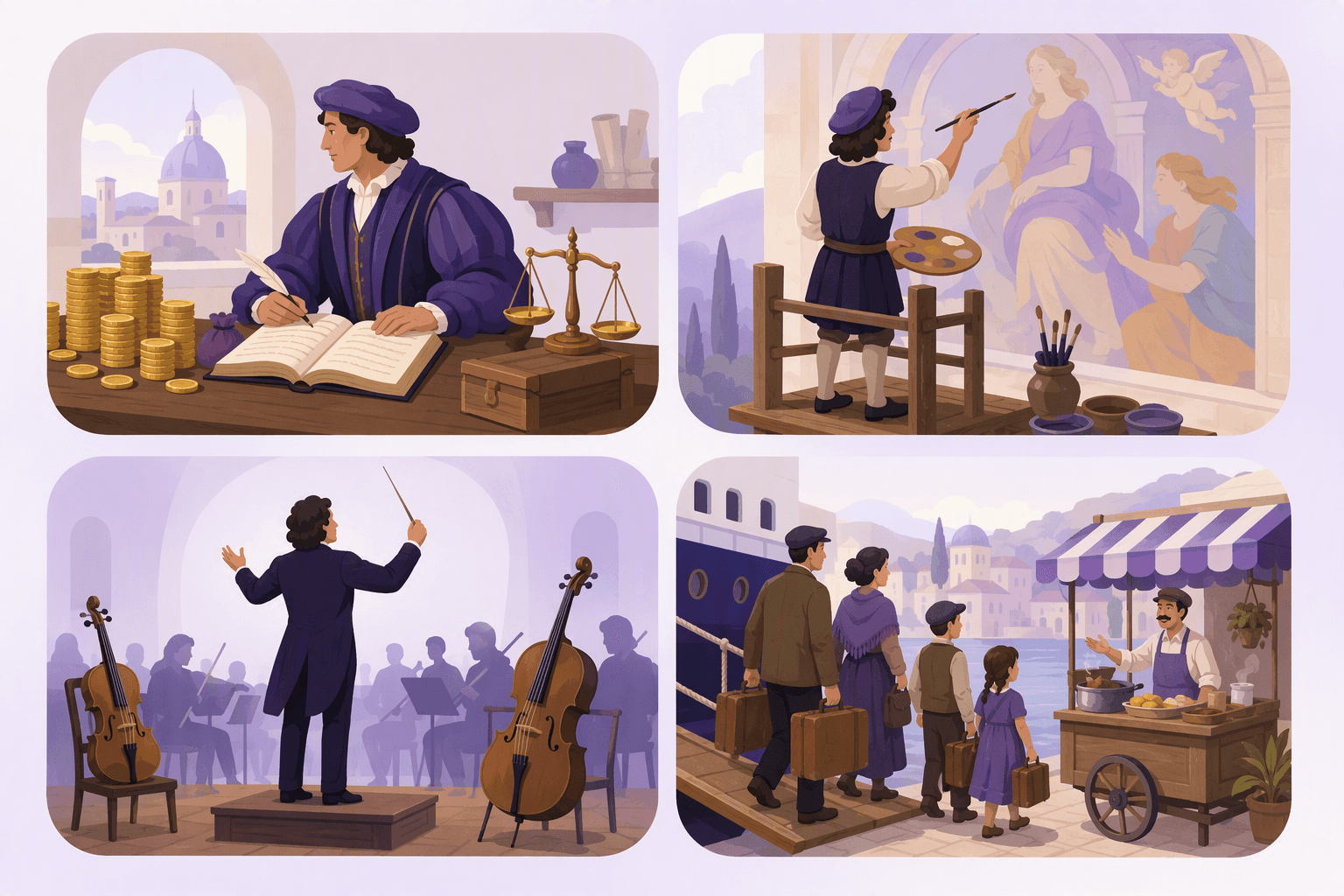
First, the Italian city-states were major trade and banking hubs for centuries, so commercial vocabulary traveled with merchants and contracts. Etymology references like the OED and Merriam-Webster document how many terms entered English through trade networks and later print culture (Oxford English Dictionary, accessed 2026; Merriam-Webster, accessed 2026).
Second, Renaissance Italy shaped European art and architecture. When English writers needed precise labels for techniques, spaces, and styles, borrowing was easier than inventing new terms.
Third, music education standardized Italian as a technical language. If you have ever seen allegro or adagio on sheet music, you have met Italian as a global “instruction set” for performance practice.
Finally, migration matters. The United States has one of the largest Italian diasporas in the world, and food words in particular spread through restaurants, neighborhood commerce, and later mass media.
💡 A quick reality check on 'Italian pronunciation'
In English, loanwords rarely keep fully Italian pronunciation. Aim for the standard English forms first, especially if you are speaking to other English learners or in international settings. If you are in Italy, shift closer to Italian sounds, but do not overcorrect in everyday English conversation.
The patterns you can actually use: spelling and pronunciation shortcuts
Italian spelling is relatively consistent, which is why English often keeps the original look. The tricky part is that English speakers apply English sound rules anyway.
c / ch
In Italian, ch before e or i is a hard K sound, which is why bruschetta is broo-SKEH-tuh, not “broo-SHET-uh.” English menus often mislead learners here.
gn
Italian gn is like “ny” in canyon. That is why gnocchi is NYOH-kee.
zz
Italian zz can be voiced or unvoiced depending on the word, but English usually simplifies. Mozzarella in American English is commonly maht-suh-REH-luh.
stress and rhythm
Italian tends to have clearer vowel timing than English. English often reduces vowels to schwa, which is why scenario becomes suh-NAIR-ee-oh for many speakers.
If you want to improve overall English rhythm, our English pronunciation guide breaks down stress and reduction with practical drills.
Food and drink loanwords: why menus are basically an Italian lesson
Food terms are the most visible Italian borrowings because they are tied to products you can buy. Once a food becomes common, the name becomes common too.
pizza
pizza (PEET-suh) is so naturalized that it behaves like any other English noun: two pizzas, pizza night, pizza place. In Italian, the vowel quality differs, but English has settled on a stable form.
espresso
espresso (ess-PRESS-oh) is a good example of spelling stability with pronunciation drift. Many people say “expresso,” but dictionaries list espresso as the standard spelling (Merriam-Webster, accessed 2026).
gelato
gelato (juh-LAH-toh) is often used in English to signal an Italian-style product, not just any ice cream. That is a cultural meaning, not just a dictionary meaning.
al dente
al dente (ahl DEN-tay) is a phrase that stayed Italian because it labels a specific texture goal. Translating it to “firm to the bite” loses the quick, shared shorthand.
If you are building practical vocabulary for eating out, pair this article with English food vocabulary so you can describe what you want, not only name the dish.
Music terms: Italian as the operating language of classical performance
Italian dominates Western classical music terminology. Even when composers were German, French, or Russian, the markings often stayed Italian because the tradition had already standardized.
Music terms also spread beyond music. Crescendo is now normal in business talk and sports commentary.
opera
opera (OP-er-uh) is both an art form and a cultural institution. The word traveled with the institution.
soprano
soprano (suh-PRAH-noh) and related voice types are technical labels that English never replaced. You will see them in choir rehearsals, reviews, and casting announcements.
allegro
allegro (uh-LEH-groh) is a tempo marking, but it also shows how loanwords can stay “specialized” for centuries. You do not usually say “play it fast” on a score, you say allegro.
For learners, this is a useful reminder: specialized vocabulary often resists translation because it is tied to a professional community.
Art, architecture, and the Renaissance pipeline
Many Italian loanwords entered English through art history writing, travel writing, and later university education.
Here, Italian words often function as precise labels. They can sound “academic,” but they are normal in museum audio guides and architecture journalism.
fresco
fresco (FRESS-koh) names a technique, not just a painting. That is why the Italian word stayed useful.
chiaroscuro
chiaroscuro (kee-AHR-uh-SKYOOR-oh) is a classic example of a term English keeps because it compresses a complex concept into one label. Art historians use it constantly.
loggia
loggia (LOH-juh) appears in architecture and travel contexts. If you read about Italian palazzi or Renaissance urban spaces, you will meet it.
To see how these words show up in real dialogue, watching films and series with subtitles helps. Our list of best movies to learn English is built around clear speech and high-frequency vocabulary.
Everyday Italian loanwords that no longer feel Italian
Some borrowings have become so normal that they do not signal “Italian” at all anymore.
scenario
scenario (suh-NAIR-ee-oh) is now a general English word for a possible situation: Worst-case scenario. It is used in business, politics, and casual conversation.
finale
finale (fih-NAL-ee) is common in TV talk: season finale, series finale. This is a good example of how media accelerates vocabulary spread.
studio
studio (STOO-dee-oh) expanded from an art space to any production space: recording studio, yoga studio, studio apartment.
David Crystal’s broader point in The Cambridge Encyclopedia of the English Language is that English vocabulary growth is strongly shaped by contact and borrowing, especially when a domain has prestige. Italian is a clean example because the borrowed domains are easy to see: music, art, food.
Plurals and “wrong” Italian in English: panini, graffiti, biscotti
Loanwords often keep Italian plural forms at first, then English reinterprets them.
panini
In Italian, panino is singular and panini is plural. In English, panini is commonly treated as singular, especially on menus.
That is not “bad English,” it is normal language change. Dictionaries record usage, they do not enforce Italian grammar.
graffiti
In Italian, graffiti is plural. In English, it is often a mass noun: There’s graffiti on the wall. You can still say a piece of graffiti if you want a countable unit.
biscotti
Similar story: plural in Italian, but frequently singular in English retail contexts.
⚠️ Do not correct people mid-conversation
Correcting someone’s 'panini is plural' in the middle of lunch usually reads as performative, not helpful. If you care about Italian, save it for a language-learning context. In everyday English, choose clarity over policing.
How dictionaries decide these are “English words” now
A practical way to think about it: once a word is used widely across regions, appears in edited writing, and develops stable meanings in English, it is part of English.
That is why sources like the OED and Merriam-Webster are useful here. They track attested usage and evolving senses, including when a word shifts meaning after borrowing (Oxford English Dictionary, accessed 2026; Merriam-Webster, accessed 2026).
For Italian-side meanings, Treccani is a reliable reference for how the word behaves in Italian today (Treccani, accessed 2026). Comparing the two helps you see the “semantic gap” that borrowing creates.
A culture note: Italian words as signals of taste and identity
Italian loanwords do more than label objects. They often signal a vibe: craft, tradition, style, or authenticity.
Ordering espresso instead of “coffee” is not only about caffeine, it can be about identity. Sociolinguists often discuss how borrowed words can index social meaning, like sophistication or cosmopolitan taste, even when a native equivalent exists.
That is also why some Italian words stay in Italian even when translation is easy. The foreignness is part of the message.
If you are also learning informal English, compare this “prestige borrowing” effect with how slang spreads in the opposite direction in our English slang guide. One is about institutional prestige, the other is about social groups and trend cycles.
How to learn these words fast using movies and TV clips
Loanwords are easiest when you learn them as chunks in real scenes: ordering, reacting, praising, complaining.
- Listen for the word in context, not in isolation.
- Copy the stress pattern, not the “perfect Italian vowel.”
- Save the whole phrase you heard: season finale, a cappella group, al dente pasta.
If you want a structured way to do that, Wordy teaches vocabulary through short movie and TV clips with interactive subtitles and review. For a broader plan, start with 100 most common English words so your base vocabulary keeps up with the borrowed terms.
A small “false friend” warning: Italian meaning vs English meaning
Some borrowings drift.
Diva can still mean a celebrated singer, but in everyday English it often means someone difficult. Fiasco is “disaster” in English, even if the original cultural story is more specific in Italian contexts.
Treat the English meaning as primary when you are speaking English. If you want the Italian meaning, check an Italian dictionary like Treccani (accessed 2026).
Wrap-up: the 20 you will hear most often
If you only memorize a short list, prioritize the words you will actually hear weekly:
pizza, pasta, espresso, latte, gelato, mozzarella, parmesan, prosciutto, panini, biscotti, opera, piano, soprano, crescendo, studio, balcony, scenario, finale, bravo, paparazzi.
And if you want to understand how English absorbs vocabulary from everywhere, keep going with English words from German and American vs British English to see how pronunciation and meaning shift across communities.
Frequently Asked Questions
Why does English have so many words from Italian?
Are Italian loanwords pronounced the Italian way in English?
Is it 'panini' or 'panini sandwich' in correct English?
What are the most common Italian words used in English?
Did English borrow more from Italian or French?
Sources & References
- Ethnologue, 27th edition, 2024
- Oxford English Dictionary, OED Online, accessed 2026
- Merriam-Webster Dictionary, online edition, accessed 2026
- Treccani, Vocabolario Treccani (Italian dictionary), accessed 2026
Start learning with Wordy
Watch real movie clips and build your vocabulary as you go. Free to download.


