Quick Answer
English has borrowed dozens of high-frequency words from German, especially for food, culture, psychology, and modern history, for example kindergarten, pretzel, and zeitgeist. This guide explains 60+ common German loanwords in English with easy pronunciations, what they originally meant, and why they stuck. German is spoken by roughly 90 million native speakers and is a major source of scientific and cultural vocabulary that English continues to absorb.
English has borrowed a long list of everyday words from German, especially for education, food, culture, psychology, and modern history, words like "kindergarten," "pretzel," "rucksack," "angst," and "zeitgeist." Below you will find 60+ of the most useful German-derived words in modern English, with easy pronunciations and the cultural reasons they entered English in the first place.
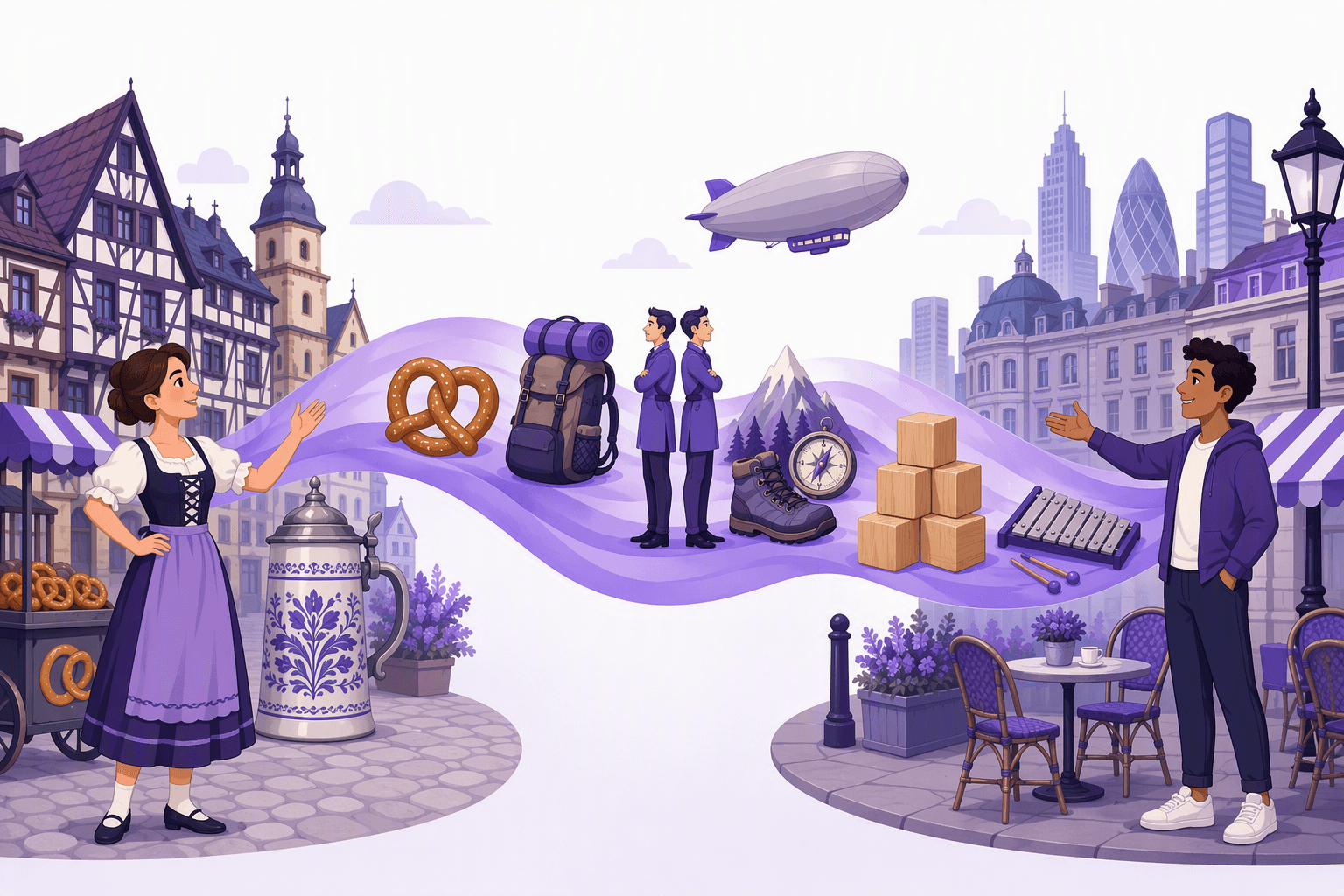
| English | English (from German) | Pronunciation | Formality |
|---|---|---|---|
| Preschool (loanword) | kindergarten | KIN-der-gar-ten | casual |
| A strong desire to travel | wanderlust | WON-der-lust | casual |
| The spirit of an era | zeitgeist | ZYTE-gyst | formal |
| A look-alike double | doppelgänger | DOP-uhl-gang-er | casual |
| A backpack | rucksack | RUK-sak | casual |
| A twisted baked snack | pretzel | PRET-suhl | casual |
| A small, cozy feeling | gemütlich | guh-MOOT-likh | casual |
| A noisy party | fest | FEST | casual |
Why English borrows from German (and why these words stick)
German is spoken by roughly 90 million native speakers and is widely used as a second language in Europe, which makes contact with English historically common (Ethnologue, 2024). More importantly, German had long periods of cultural and academic influence, especially in philosophy, music, engineering, and psychology.
A lot of German loanwords fill a gap, they name something English speakers did not have a neat label for. Others arrived with the thing itself, like foods, institutions, and social customs.
"English has repeatedly expanded its vocabulary by borrowing, and it does so most readily when it needs names for new ideas, objects, and institutions."
David Crystal, linguist, The Cambridge Encyclopedia of the English Language (2019)
If you also want a broader map of how English grows, see our English language overview. For modern informal vocabulary, compare this list with English slang.
How to read the pronunciations in this guide
German spelling can look intimidating, but the English versions are usually simpler in speech.
Here is the quick decoding you will see in pronunciations:
- "ch" in German is often softened in English loanwords, but you will hear both versions.
- "sch" is usually "sh" (for example, "schnitzel" is SHNIT-suhl).
- Umlauts (ä, ö, ü) are often dropped in English spelling, but sometimes kept in print (for example, "doppelgänger").
💡 A practical pronunciation rule
If a German loanword feels hard to say, use the common English pronunciation first. Being understood matters more than sounding native, and many of these words are already fully anglicized in everyday speech.
60+ common English words borrowed from German (grouped by theme)
The lists below focus on words you will actually see in movies, TV, news, menus, and everyday conversation. For each term, you get an English-friendly pronunciation and the meaning in modern English.
Education and everyday life
These are some of the most "normal" German borrowings, to the point that many speakers do not realize they are loanwords.
| English word (from German) | Pronunciation | What it means in English | Cultural note |
|---|---|---|---|
| kindergarten | KIN-der-gar-ten | preschool, early childhood class | Popularized with German education models in the 19th century |
| rucksack | RUK-sak | backpack | Common in UK English and outdoors contexts |
| kaput | kuh-PUT | broken, ruined | Often spelled "kaputt" in German |
| spiel | SHPEEL | a rehearsed pitch or talk | Often used in sales or politics |
| nix | NIKS | nothing | Casual, often in "I got nix" |
| gesundheit | guh-ZOOND-hyte | said after someone sneezes | Literally "health" in German |
| poltergeist | POHL-ter-gyst | a noisy ghost | Entered English via folklore interest and later horror media |
| doppelgänger | DOP-uhl-gang-er | a double, look-alike | Often used in thrillers and celebrity talk |
| wunderkind | WOON-der-kind | child prodigy | Used in arts, chess, tech headlines |
| leitmotif | LYTE-moh-teef | recurring theme in music/story | Strong association with Wagner and film scoring |
🌍 Why 'kindergarten' stayed German
English could have translated it as "children's garden," but the German term carried prestige because it referred to a specific educational philosophy. Borrowing the original word signaled that the institution was imported, not just a generic daycare.
Food and drink
German food words spread through migration, tourism, and restaurant culture. In the US alone, German immigration in the 19th century helped normalize items like pretzels and sausages, and later Oktoberfest branding kept the vocabulary visible.
| English word (from German) | Pronunciation | What it means in English | Cultural note |
|---|---|---|---|
| pretzel | PRET-suhl | twisted baked bread snack | Commonly associated with Bavaria and beer culture |
| bratwurst | BRAT-wurst | a type of sausage | In US usage, often shortened to "brat" |
| schnitzel | SHNIT-suhl | breaded cutlet | Often served as "Wiener schnitzel" in menus |
| strudel | STROO-duhl | layered pastry, often apple | "Apfelstrudel" is a frequent menu term |
| sauerkraut | SOW-er-krowt | fermented cabbage | Strongly linked to German-American cuisine |
| pumpernickel | PUM-per-nik-uhl | dark rye bread | The name itself is part of its brand identity |
| lager | LAH-ger | a type of beer | Now global beer vocabulary |
| bock | BOK | strong lager style | You will see "doppelbock" too |
| kirsch | KEERSH | cherry brandy | Often appears in dessert recipes |
| spritzer | SPRIT-ser | wine or soda mixed drink | In German, "Spritzer" relates to "splash" |
🌍 Menu reading tip
In English-speaking restaurants, German food words often become category labels rather than strict recipes. A "schnitzel" might be pork, chicken, or even eggplant, depending on the country and the chef.
Psychology, feelings, and personality
German has a reputation for naming complex inner states with compact nouns. English borrowed several of these because they feel precise and a bit intellectual.
| English word (from German) | Pronunciation | What it means in English | Cultural note |
|---|---|---|---|
| angst | ANGST | anxiety, dread | Widely used in teen drama and criticism |
| schadenfreude | SHAH-den-froy-duh | pleasure at someone else's misfortune | Often used humorously in commentary |
| gestalt | guh-SHTALT | a whole pattern, not just parts | Key term in psychology and design |
| zeitgeist | ZYTE-gyst | the spirit of the times | Common in journalism and culture writing |
| weltschmerz | VELT-shmerts | sadness about the world's problems | More literary than everyday speech |
| übermensch | OO-ber-mensh | Nietzschean "superman" concept | Often discussed in philosophy and pop culture |
| gemütlich | guh-MOOT-likh | cozy, warm, convivial | Used in travel writing and lifestyle talk |
Politics, history, and society
A noticeable cluster of German loanwords in English is tied to 20th-century European history. These words often keep German spelling because they refer to specific institutions or concepts.
| English word (from German) | Pronunciation | What it means in English | Cultural note |
|---|---|---|---|
| blitz | BLITS | sudden attack or campaign | From "Blitzkrieg" shortened in English |
| blitzkrieg | BLITS-kreeg | lightning war, rapid offensive | Historical term, also metaphorical in sports |
| realpolitik | ray-AHL-poh-lih-teek | pragmatic politics | Often used in foreign policy analysis |
| Anschluss | AN-shloos | annexation, especially Austria 1938 | Usually capitalized in historical writing |
| Reich | RYKE | empire/realm, especially Nazi Germany | Sensitive historical context |
| Führer | FYUR-er | leader, associated with Hitler | Often avoided outside historical context |
| Gestapo | guh-STAH-poh | Nazi secret police | Used historically, sometimes metaphorically with caution |
⚠️ Historical terms need context
Words like "Reich," "Führer," and "Gestapo" are strongly tied to Nazi history in English. Use them only in accurate historical discussion, not as casual insults. In many workplaces and classrooms, metaphorical use is seen as inappropriate.
Music, arts, and culture
German-speaking Europe shaped classical music vocabulary, and English kept many German terms because musicians and critics used them internationally.
| English word (from German) | Pronunciation | What it means in English | Cultural note |
|---|---|---|---|
| lieder | LEE-der | German art songs | Often used in classical programs |
| kapellmeister | kuh-PEL-my-ster | music director/conductor | More specialist usage |
| glockenspiel | GLOK-en-sheel | bell instrument | Also used for toy instruments |
| kitsch | KITCH | tacky art, sentimental bad taste | Common in design and criticism |
| ersatz | AIR-zahts | substitute, often inferior | Used in politics and reviews |
| bildungsroman | BIL-doongs-roh-mahn | coming-of-age novel | Common in literary criticism |
If you like how English absorbs culture words, you will also enjoy our guide to common Latin phrases in English.
Outdoors, travel, and the body in motion
Some German words became popular because they match a specific vibe: hiking, roaming, and being out in nature.
| English word (from German) | Pronunciation | What it means in English | Cultural note |
|---|---|---|---|
| wanderlust | WON-der-lust | strong desire to travel | Big in social media captions and travel ads |
| wanderer | WON-der-er | someone who roams | Cognate, but the borrowing reinforced the romantic tone |
| hinterland | HIN-ter-land | remote region behind a coast/city | Used in geography and politics |
| berg | BERG | mountain, often in place names | Seen in "iceberg" and surnames |
| iceberg | EYSS-berg | floating mass of ice | Coined via Germanic roots, popularized in English usage |
Science, engineering, and technical vocabulary
German was a major language of science in the 19th and early 20th centuries, which is one reason English technical vocabulary includes German-origin terms (Crystal, 2019). Many of these are now fully international.
| English word (from German) | Pronunciation | What it means in English | Cultural note |
|---|---|---|---|
| quartz | KWORTS | mineral used in watches, geology | Documented as German origin in major dictionaries |
| cobalt | KOH-bawlt | chemical element | Name traveled through European scientific usage |
| diesel | DEE-zuhl | diesel engine/fuel | From Rudolf Diesel's surname |
| zeppelin | ZEP-uh-lin | rigid airship | From Count Zeppelin's surname |
| x-ray (via Röntgen) | EKS-ray | radiography | "Roentgen" still appears in technical contexts |
| kindergarten method (Fröbel) | KIN-der-gar-ten | early education approach | Borrowing tied to named educational movement |
🌍 German surnames as English nouns
English often turns German names into common nouns when the invention spreads globally. "Diesel" and "zeppelin" are classic examples: the word becomes bigger than the person, and the pronunciation shifts to English patterns.
Patterns you can spot: why these loanwords feel "German"
German loanwords in English often share a few recognizable features:
- Compound structure: long words built from smaller parts, like "schadenfreude" or "bildungsroman."
- Consonant clusters: "schl," "schn," "tsch," which English speakers simplify in speech.
- Capitalization in German: German capitalizes nouns, but English does not, except in historical proper nouns.
These patterns are useful when you are watching movies or reading nonfiction and you see a "new" word that looks German. You can often guess the meaning from context, then confirm later.
German loanwords vs Germanic roots: a common confusion
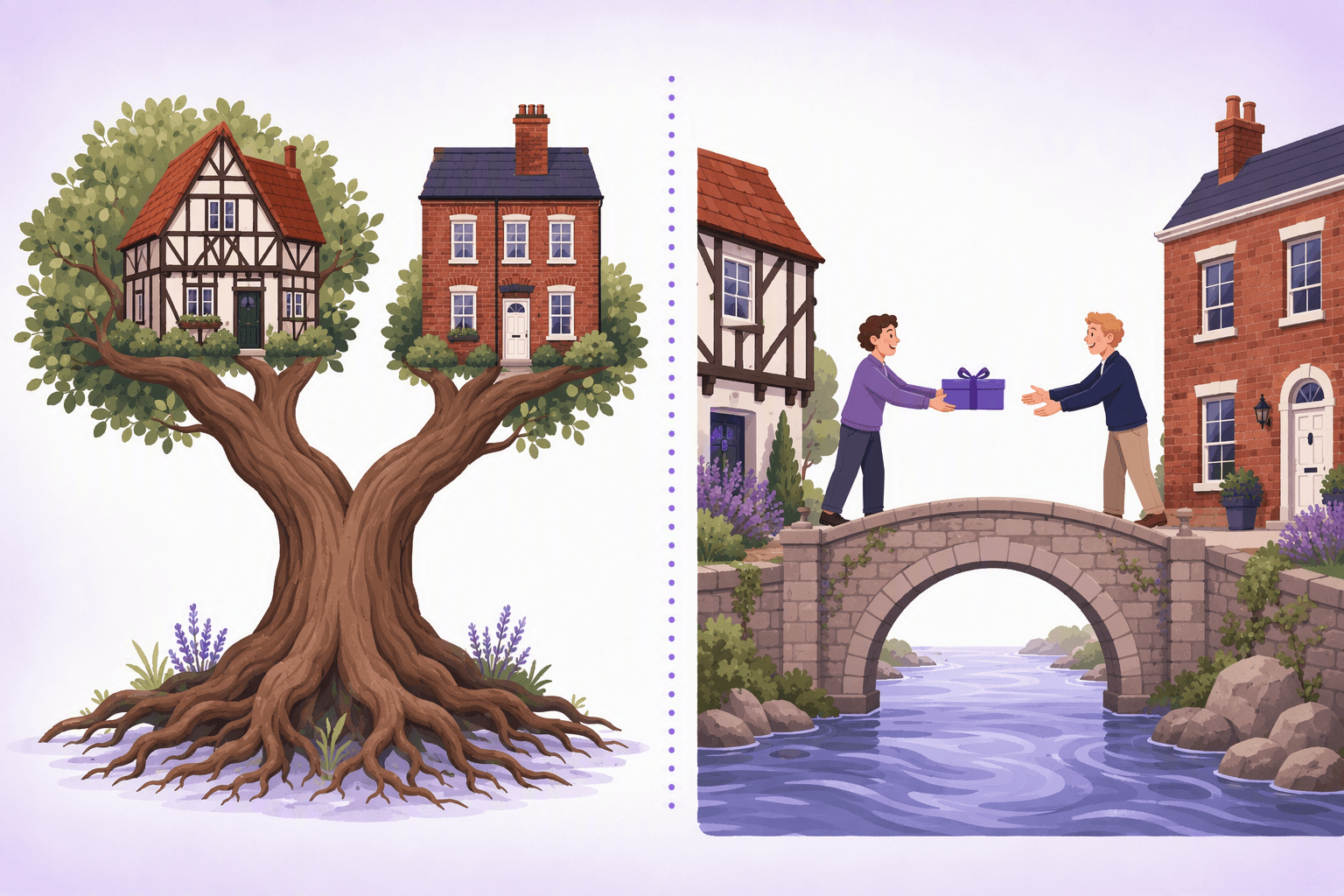
English is a Germanic language, so it shares deep ancestry with German. That is different from borrowing.
For example, "house" and German "Haus" are related by origin, but English did not borrow "house" from modern German. In contrast, "kindergarten" is a direct borrowing, the word entered English as a German label for a German-style institution (OED; Merriam-Webster).
💡 A quick test
If the English word keeps a distinctly German spelling pattern, like "sch," "ä/ö/ü," or a compound that feels untranslated, it is often a borrowing. If it looks like basic everyday English, it is more likely a shared Germanic root.
Where you will hear these words in real movies and TV
German loanwords show up in predictable genres and scenes:
- School and parenting scenes: "kindergarten," "gesundheit."
- Food and bar scenes: "pretzel," "lager," "bratwurst," "Oktoberfest."
- Thrillers and mysteries: "doppelgänger," "poltergeist."
- Culture commentary: "zeitgeist," "kitsch," "ersatz."
- Character psychology: "angst," "gestalt."
Wordy is built around this exact kind of exposure: you learn vocabulary the way you actually meet it, in dialogue. If you are building a foundation, pair this with high-frequency basics like English numbers and English months.
A short, practical study plan (so you remember them)
Memorizing 60+ loanwords as a list is inefficient. Use a small rotation and attach each word to a scene.
Step 1: Pick 10 words you will actually use
Start with: kindergarten, pretzel, rucksack, wanderlust, zeitgeist, doppelgänger, angst, schadenfreude, blitz, kitsch.
Step 2: Make one sentence per word
Keep it natural and modern. Example: "That movie captured the zeitgeist perfectly."
Step 3: Listen for them in context
When you hear one, pause and repeat the whole line. This is how pronunciation sticks.
If you want to contrast formal vocabulary with informal speech, read English slang. If you are curious about taboo vocabulary and when not to use it, see English swear words.
Quick recap: the most useful German loanwords to know
If you only learn a handful, prioritize the ones that appear across everyday contexts:
- kindergarten (KIN-der-gar-ten)
- pretzel (PRET-suhl)
- rucksack (RUK-sak)
- wanderlust (WON-der-lust)
- doppelgänger (DOP-uhl-gang-er)
- zeitgeist (ZYTE-gyst)
- angst (ANGST)
- schadenfreude (SHAH-den-froy-duh)
- kitsch (KITCH)
- blitz (BLITS)
They are common, expressive, and easy to recognize once you know what to listen for.
For more vocabulary that shows up constantly in dialogue, browse the Wordy blog index or start practicing directly on /learn/english.
Frequently Asked Questions
How many English words come from German?
What are the most common German loanwords in English?
Are Yiddish words in English also German words?
Why did English borrow so many words from German in science and psychology?
Do English speakers pronounce German loanwords correctly?
Sources & References
- Oxford English Dictionary (OED), Entries and Etymologies for German Loanwords, accessed 2026
- Merriam-Webster Dictionary, Word Origin and Etymology Notes for German Borrowings, accessed 2026
- Ethnologue (27th ed.), German: Speaker and Status Data, 2024
- Institut für Deutsche Sprache (IDS), German Language Facts and Research Resources, accessed 2026
- Crystal, David, The Cambridge Encyclopedia of the English Language (3rd ed.), 2019
Start learning with Wordy
Watch real movie clips and build your vocabulary as you go. Free to download.


