Quick Answer
English has borrowed hundreds of words from Spanish, especially for food, animals, geography, and life in the Americas. You already use many of them daily, like 'patio,' 'taco,' 'mosquito,' and 'canyon.' This guide explains the most common Spanish-origin English words, how to pronounce them naturally in English, and what they originally meant in Spanish.
English has borrowed hundreds of words from Spanish, and many are so common that they no longer feel foreign, words like "patio," "taco," "mosquito," "canyon," and "rodeo." Below you will find the most useful Spanish-origin English words, grouped by theme, with clear English-style pronunciations and the cultural history that explains why these borrowings stuck.
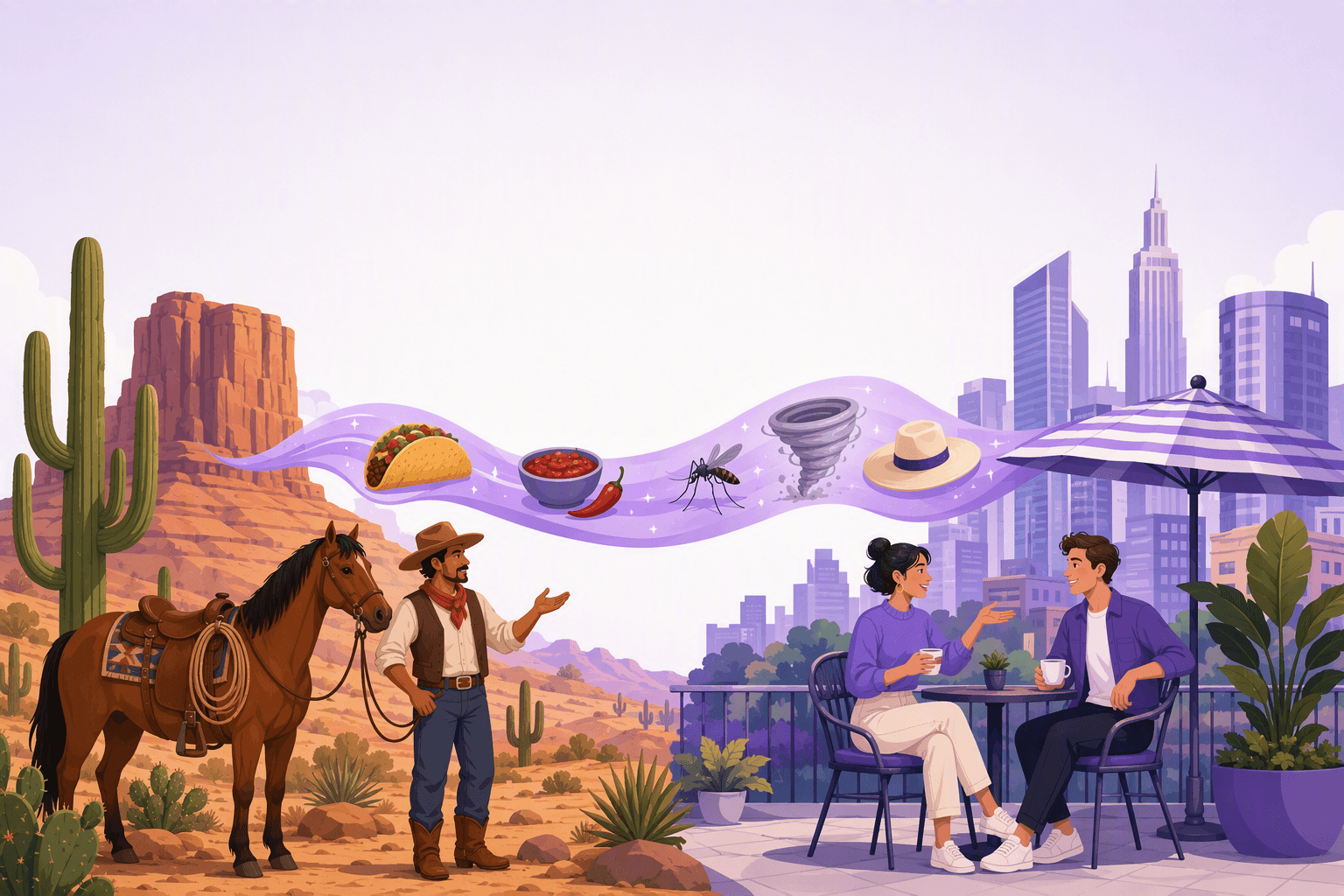
| English | English (from Spanish) | Pronunciation | Formality |
|---|---|---|---|
| Outdoor courtyard | patio | PAT-ee-oh | casual |
| Public square | plaza | PLAH-zuh | casual |
| Deep valley | canyon | KAN-yun | casual |
| Small biting insect | mosquito | muh-SKEE-toh | casual |
| Spinning storm | tornado | tor-NAY-doh | casual |
| Mexican-style folded tortilla | taco | TAH-koh | casual |
| Sauce or dance style | salsa | SAWL-suh | casual |
| Ranching competition | rodeo | ROH-dee-oh | casual |
| Throwing rope | lasso | LAS-oh | casual |
| A small party | fiesta | fee-ESS-tuh | casual |
Why English borrows so much from Spanish
Spanish is one of the world’s most widely spoken languages, with hundreds of millions of speakers worldwide (Instituto Cervantes, 2023). Ethnologue’s 2024 edition also places Spanish among the top global languages by first-language speakers, which helps explain its international influence (Ethnologue, 2024).
In the United States alone, Spanish has had centuries of contact with English, especially in the Southwest, Florida, and major urban centers. That contact created a practical need for shared vocabulary: place names, local wildlife, ranching terms, foods, and everyday social life.
Borrowing is not a sign of "bad English." It is one of the main ways languages expand efficiently.
"English has always been a vacuum cleaner of a language, readily sucking in words from other tongues."
David Crystal, linguist, The Cambridge Encyclopedia of the English Language (2003)
If you enjoy how English absorbs new expressions, you will also like our overview of modern usage in English slang.
How to pronounce Spanish-origin words in natural English
Most Spanish-origin words in English follow English stress patterns, even when the spelling looks Spanish. That is why many English speakers say "tor-TEE-yuh" for tortilla and "fee-ESS-tuh" for fiesta.
Here are reliable pronunciation habits for standard English:
- Final -o often becomes a clear "oh": patio (PAT-ee-oh), taco (TAH-koh).
- Double L (ll) is usually simplified: tortilla (tor-TEE-yuh), not a strong Spanish "y" for everyone.
- Spanish j rarely keeps the throaty sound in English: jalapeño is often hah-luh-PEN-yoh or hal-uh-PEN-yoh.
- Accent marks are usually dropped in English spelling, but the word may keep a Spanish-like rhythm: piñata (pin-YAH-tuh).
💡 A practical rule for learners
If you are speaking English, use the English pronunciation confidently. If you are speaking Spanish, switch to Spanish pronunciation. Mixing them can sound performative in either direction, especially with words tied to identity and community.
The most useful English words borrowed from Spanish (by topic)
The lists below focus on words you will actually see in movies, TV, news, menus, and everyday conversation. Meanings reflect modern English usage, even when Spanish meanings are broader.
Food and drink borrowings
Food is one of the fastest ways words travel, because the name of a dish often travels with the dish. In the US, Mexican, Tex-Mex, and broader Latin American cuisines made many Spanish terms mainstream.
| English word | English pronunciation | What it means in English | Cultural note |
|---|---|---|---|
| taco | TAH-koh | folded tortilla with filling | Became a national fast-casual staple in the US |
| burrito | buh-REE-toh | wrapped flour tortilla | Strong regional styles (Mission vs Tex-Mex) |
| tortilla | tor-TEE-yuh | flatbread | Corn vs flour matters culturally and regionally |
| salsa | SAWL-suh | sauce, also dance style | In Spanish it simply means "sauce" |
| guacamole | gwah-kuh-MOH-lee | avocado dip | Word entered via Spanish, origin is Nahuatl |
| jalapeño | hah-luh-PEN-yoh | a chili pepper | Often spelled without ñ in English contexts |
| tamale | tuh-MAH-lee | corn dough parcel | English plural is often "tamales" |
| enchilada | en-chuh-LAH-duh | rolled tortilla dish | Also used figuratively: "the whole enchilada" |
| empanada | em-puh-NAH-duh | filled pastry | Different fillings across Latin America |
| tequila | tuh-KEE-luh | agave spirit | Protected designation tied to Mexican regions |
🌍 Why menus keep Spanish words
Restaurants often keep Spanish names because translation loses precision. "Corn dough parcel steamed in a husk" is accurate, but "tamale" is the recognized label. Borrowing becomes the simplest agreement between cultures.
If you want to build everyday English vocabulary beyond loanwords, our guides to English months and English numbers are good foundational sets.
Nature, weather, and geography
Many Spanish-origin nature words entered English through exploration and settlement in the Americas. English speakers adopted Spanish labels for landscapes and animals they had not named before.
| English word | English pronunciation | What it means in English | Original sense |
|---|---|---|---|
| canyon | KAN-yun | deep valley with steep sides | from Spanish cañón, "tube" or "gorge" |
| mesa | MAY-suh | flat-topped hill | Spanish mesa, "table" |
| prairie | PRAIR-ee | grassland | via French, but often paired with Spanish terms in the West |
| tornado | tor-NAY-doh | violent rotating storm | from Spanish tronada, "thunderstorm" (OED) |
| mosquito | muh-SKEE-toh | small biting insect | Spanish mosquito, "little fly" |
| alligator | AL-ih-gay-ter | large reptile | from Spanish el lagarto, "the lizard" |
| hurricane | HUR-ih-kayn | tropical cyclone | entered via Spanish, origin is Taíno (OED) |
| iguana | ih-GWAH-nuh | lizard | via Spanish, origin is Arawakan |
| savanna | suh-VAN-uh | tropical grassland | via Spanish, origin is Taíno |
Notice a pattern: English sometimes borrowed through Spanish even when Spanish had borrowed earlier from Indigenous languages. That is normal in contact zones, and dictionaries like the OED track both the pathway and deeper origin.
Ranching, Western, and frontier vocabulary
A large set of Spanish-origin words in English comes from ranching and horse culture. This is not just "cowboy movie" vocabulary, it is real occupational language from regions where Spanish-speaking vaqueros shaped ranch work.
| English word | English pronunciation | What it means in English | Where you hear it |
|---|---|---|---|
| rodeo | ROH-dee-oh | ranch competition, event | sports, local festivals, TV |
| lasso | LAS-oh | rope used to catch animals | Westerns, ranching contexts |
| ranch | RANCH | large farm, cattle operation | everyday US English |
| bronco | BRON-koh | untrained horse | sports team names, rodeo |
| mustang | MUS-tang | wild horse | cars, mascots, Western talk |
| corral | kuh-RAL | enclosure for animals | ranching, figurative "corral the team" |
| buckaroo | buhk-uh-ROO | cowboy | from vaquero through English reshaping (OED) |
🌍 Vaquero vs cowboy
In many parts of the American West, the techniques, equipment, and vocabulary of ranching were established in Spanish first. English did not just borrow words, it borrowed a working system, then built mythology around it in books and film.
Social life, celebrations, and everyday places
Some Spanish borrowings feel casual and friendly in English, often tied to leisure, architecture, and public life.
| English word | English pronunciation | What it means in English | Usage note |
|---|---|---|---|
| patio | PAT-ee-oh | outdoor courtyard | common in real estate and restaurants |
| plaza | PLAH-zuh | public square, shopping center | US English also uses it for malls |
| fiesta | fee-ESS-tuh | party | can sound playful or themed |
| siesta | see-ESS-tuh | midday nap | often used humorously in English |
| amigo | uh-MEE-goh | friend | can sound warm or stereotyped depending on context |
| señor / senor | SEN-yor | Spanish title "Mr." | often appears without ñ in English |
| señorita / senorita | sen-yuh-REE-tuh | "miss" (young woman) | can feel dated in English |
⚠️ A note on stereotypes
Words like "amigo" and "señorita" can sound like a movie caricature if you use them with strangers. In English, they are safest when quoting, joking with friends who share the context, or discussing Spanish language and culture directly.
Politics, institutions, and media
Some Spanish-origin words became international terms because Spanish-speaking societies played a major role in global history, and because English-language media reports on Spanish-speaking countries frequently.
| English word | English pronunciation | What it means in English | Note |
|---|---|---|---|
| embargo | em-BAR-goh | official trade restriction | used in law and politics |
| junta | JOON-tuh | military council or group | often political in news contexts |
| guerrilla | guh-RIL-uh | irregular fighter, tactics | spelling keeps Spanish double l |
| vigilante | vij-uh-LAN-tee | self-appointed enforcer | often used in crime reporting |
| plaza (de armas) | PLAH-zuh | central square | appears in travel writing |
Words that look Spanish but changed meaning in English
Loanwords often shift meaning. English may narrow a word to one specific thing, or broaden it into slang.
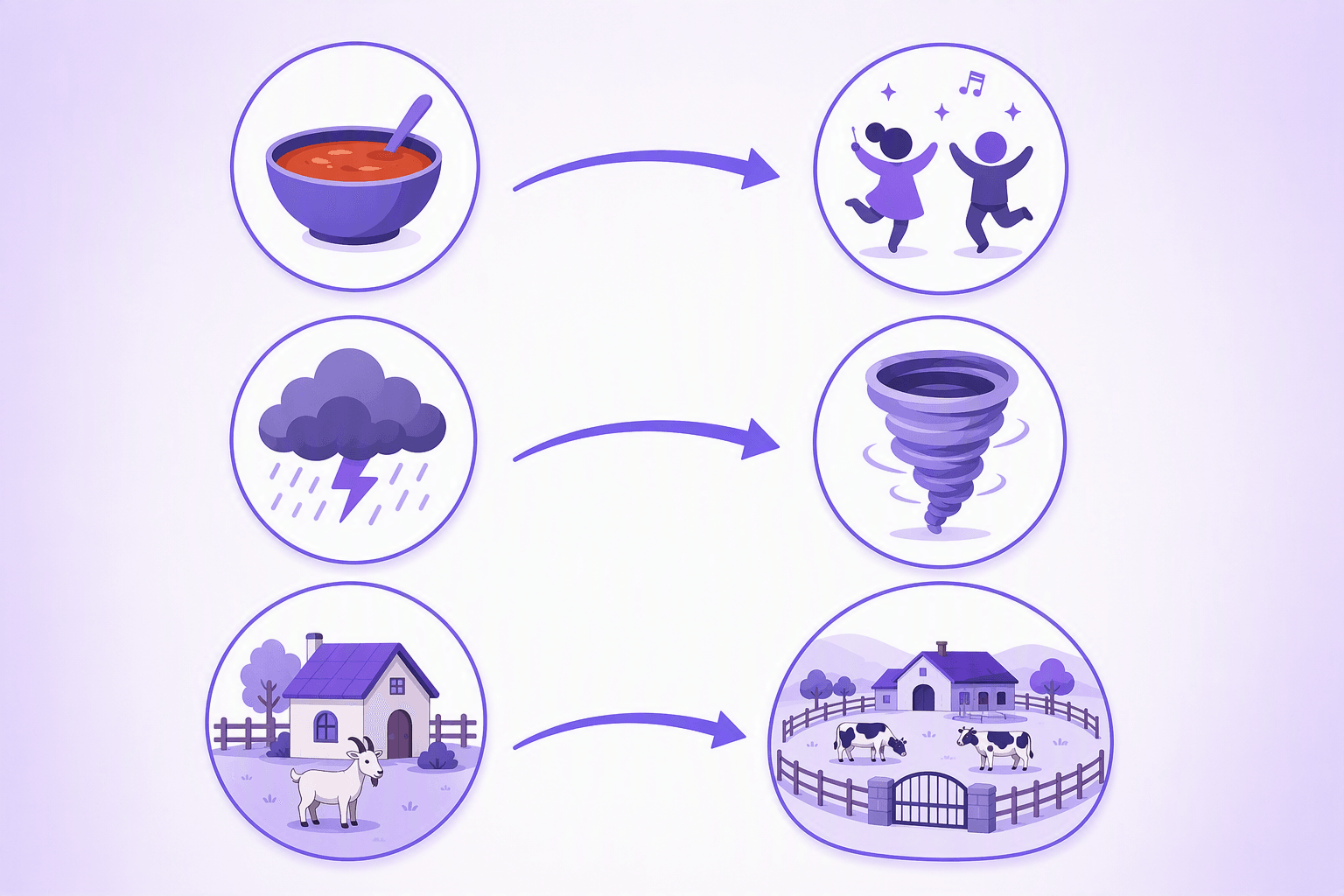
Here are common meaning shifts:
- salsa: In Spanish it is any sauce, in English it often means a specific tomato-based dip, plus a dance genre.
- fiesta: In Spanish it can be a religious festival or any celebration, in English it often implies a lively party vibe.
- ranch: Spanish rancho can refer to a rural place or small farm, English ranch often implies a larger cattle operation.
- tornado: Spanish tronada is closer to "thunderstorm," English tornado is a specific rotating funnel.
This is why etymology is helpful: it explains both the shared root and the divergence. Dictionaries like the OED document these shifts in dated citations and senses (OED).
Spanish influence in English: the cultural map
Spanish is an official language in 20 countries, plus Puerto Rico as a US territory, and it is widely used in many more communities worldwide. That geographic spread matters because it creates multiple pipelines into English: migration, trade, tourism, music, film, and the internet.
In the US, Spanish is also the most studied second language and the most widely spoken non-English language at home. That constant contact makes Spanish-origin vocabulary feel normal in American English, especially in:
- Food and retail: menus, grocery aisles, brand names.
- Music and dance: salsa, merengue, reggaetón terminology (some terms are Spanish, some are Spanglish).
- Place names: Los Angeles, Colorado, Nevada, Florida, and thousands more.
If you are learning English through media, this is one reason movie clips work well: you hear loanwords in realistic settings, not as isolated vocabulary. For more on learning with real dialogue, browse the Wordy blog or compare approaches in our best language learning apps guide.
How these words show up in movies and TV (and how to learn them)
Spanish-origin words appear in English dialogue in predictable scenes:
- Restaurant scenes: ordering tacos, salsa, tequila.
- Crime and news scenes: embargo, junta, guerrilla, vigilante.
- Western or rural scenes: ranch, rodeo, lasso, corral.
- Travel scenes: plaza, patio, siesta.
A practical learning method is to capture the whole "chunk" around the word, not the word alone. For example, "on the patio," "at the plaza," "a mosquito bite," "under an embargo."
🌍 Borrowings often carry identity
Some Spanish-origin words are neutral (patio, canyon). Others can signal identity, region, or politics (amigo, señorita, guerrilla). In English, the same word can feel friendly in one context and awkward in another, so context is part of meaning.
A curated list: 60+ Spanish-origin English words to recognize fast
This table is designed for quick recognition while reading subtitles.
| English | English (borrowed from Spanish) | Pronunciation | Note |
|---|---|---|---|
| courtyard | patio | PAT-ee-oh | Common in housing and restaurants. |
| square / mall | plaza | PLAH-zuh | Public square or shopping center. |
| party | fiesta | fee-ESS-tuh | Often playful in English. |
| midday nap | siesta | see-ESS-tuh | Often humorous in English. |
| friend | amigo | uh-MEE-goh | Can sound stereotyped with strangers. |
| canyon | canyon | KAN-yun | From Spanish cañón. |
| flat-topped hill | mesa | MAY-suh | Common in US Southwest geography. |
| storm funnel | tornado | tor-NAY-doh | Shifted meaning from Spanish. |
| biting insect | mosquito | muh-SKEE-toh | Literally 'little fly' in Spanish. |
| large reptile | alligator | AL-ih-gay-ter | From Spanish 'el lagarto'. |
| tropical cyclone | hurricane | HUR-ih-kayn | Entered via Spanish, Indigenous origin. |
| lizard | iguana | ih-GWAH-nuh | Via Spanish. |
| food: folded tortilla | taco | TAH-koh | Everyday US English. |
| food: wrapped tortilla | burrito | buh-REE-toh | Regional styles vary. |
| flatbread | tortilla | tor-TEE-yuh | Corn vs flour is meaningful. |
| sauce / dip | salsa | SAWL-suh | Also a dance genre. |
| avocado dip | guacamole | gwah-kuh-MOH-lee | Via Spanish, Nahuatl origin. |
| chili pepper | jalapeño | hah-luh-PEN-yoh | Often written without ñ. |
| corn dough dish | tamale | tuh-MAH-lee | Plural often 'tamales'. |
| rolled tortilla dish | enchilada | en-chuh-LAH-duh | Also idiom: 'the whole enchilada'. |
| filled pastry | empanada | em-puh-NAH-duh | Many regional versions. |
| agave spirit | tequila | tuh-KEE-luh | Tied to Mexican regions. |
| ranch | ranch | RANCH | From rancho. |
| ranch event | rodeo | ROH-dee-oh | From rodear, 'to surround' (OED). |
| throwing rope | lasso | LAS-oh | Common in Western contexts. |
| animal enclosure | corral | kuh-RAL | Also figurative in business talk. |
| wild horse | mustang | MUS-tang | Also brand and mascot usage. |
| untrained horse | bronco | BRON-koh | Common in sports names. |
| trade restriction | embargo | em-BAR-goh | Formal register. |
| military council | junta | JOON-tuh | Often political in English news. |
| irregular fighter | guerrilla | guh-RIL-uh | Also metaphorical: 'guerrilla marketing'. |
| self-appointed enforcer | vigilante | vij-uh-LAN-tee | Often negative or critical. |
Common learner mistakes (and how to avoid them)
Even though these are English words now, learners still stumble on spelling, stress, and register.
Over-rolling Spanish sounds in English
If you pronounce "taco" with a strong Spanish rolled r (there is no r) or an exaggerated accent, it can distract from your English fluency. Aim for clear English vowels: TAH-koh.
Assuming the Spanish meaning equals the English meaning
"Salsa" is the classic trap. In Spanish it is any sauce, but in English it often means a specific dip. When you read subtitles, interpret the English sense first.
Using identity-marked words with strangers
Words like "amigo" can be friendly among friends, but can also sound like you are imitating a stereotype. If you want a casual English equivalent, "buddy" or "friend" is safer.
If you are curious about how register works in English overall, our guide to English swear words explains why context matters so much, even when you "know" the dictionary meaning.
A quick historical note: Spanish as a gateway language
In etymology, Spanish is sometimes the gateway rather than the origin. For example, English "chocolate" came through Spanish, but Spanish borrowed it from Nahuatl. The RAE’s DLE is a useful reference for how Spanish defines and records these words in Spanish today (RAE, DLE).
This matters culturally because it reminds us that language contact in the Americas was not just English vs Spanish. It also involved many Indigenous languages, and many borrowings traveled across multiple communities before reaching modern English.
Learn these words faster with real dialogue
Loanwords are easiest when you hear them in realistic scenes: ordering food, describing weather, talking about travel, or telling a story set in the West. That is exactly why movie and TV clips are efficient, you get pronunciation, context, and social meaning at the same time.
To keep building modern, real-world English, pair this article with English slang, then reinforce basics like English numbers and English months. If you want a broader roadmap, start at learn English.
Frequently Asked Questions
How many English words come from Spanish?
What are the most common English words borrowed from Spanish?
Do English speakers pronounce these words the Spanish way?
Are some 'Spanish' words in English actually from Indigenous languages?
Why did English borrow so many Spanish words in the Americas?
Sources & References
- Oxford English Dictionary (OED), Oxford University Press, accessed 2026
- Real Academia Española (RAE), Diccionario de la lengua española (DLE), current edition
- Instituto Cervantes, El español: una lengua viva (annual report), 2023
- Ethnologue, Ethnologue: Languages of the World, 27th edition, 2024
- Crystal, David, The Cambridge Encyclopedia of the English Language, 2nd ed., Cambridge University Press, 2003
Start learning with Wordy
Watch real movie clips and build your vocabulary as you go. Free to download.


