Quick Answer
English phrasal verbs are verb + particle combinations like "pick up" or "run into" that often change meaning and sound more natural than formal alternatives. To learn them fast, focus on the most frequent ones, learn them in real scenes and situations, and practice the most common particles (up, out, off, on) so you can guess meaning in context.
English phrasal verbs are verb + particle combinations like "pick up" or "run into" that are essential for natural, everyday English, and the fastest way to learn them is to master the most common particles, learn each verb in a real situation (not as a translation), and practice the separable vs inseparable grammar with short, repeatable examples.

| English | English | Pronunciation | Formality |
|---|---|---|---|
| meet unexpectedly | run into | RUN in-too | casual |
| start (a device) | turn on | TURN on | casual |
| stop (a device) | turn off | TURN off | casual |
| continue | keep on | KEEP on | casual |
| postpone | put off | PUT off | casual |
| cancel | call off | KAWL off | casual |
| recover from | get over | GET OH-ver | casual |
| take care of | look after | LOOK AF-ter | polite |
| search for | look for | LOOK for | polite |
| discover by chance | come across | KUM uh-KRAWSS | casual |
| return | come back | KUM bak | casual |
| enter (a vehicle) | get in | GET in | casual |
Why phrasal verbs matter (and why you hear them everywhere)
Phrasal verbs are not a small "advanced" topic, they are a core feature of modern English. In everyday conversation, speakers often prefer "find out" over "discover" and "put off" over "postpone" because the phrasal verb sounds more direct and less formal.
English is also a global language at massive scale. Ethnologue estimates roughly 1.5 billion total English speakers worldwide (L1 plus L2), which means you will hear phrasal verbs across many accents and regions, not just in the US or UK (Ethnologue, 2024).
If you want a broader picture of how English works as a world language, start with our English language overview. It helps you place phrasal verbs inside the bigger system of registers, dialects, and real-life usage.
A linguist’s view: why context beats memorization
"Conversation is the most basic and pervasive form of language use, and it is in conversation that many of the characteristic patterns of grammar are most clearly seen."
David Crystal, linguist, The Cambridge Encyclopedia of the English Language (Cambridge University Press)
That is exactly why phrasal verbs click faster when you learn them through scenes, not lists. In movies and TV, you see who is speaking, what they want, and how the relationship shapes the wording.
What counts as a phrasal verb (and what does not)
A phrasal verb is typically a verb plus a particle such as "up," "out," "off," "on," "in," "over." Dictionaries label them explicitly, for example in the OED and Cambridge Dictionary (OED; Cambridge Dictionary, accessed 2026).
Two common patterns matter most:
- Verb + adverb particle: "turn off," "pick up," "give up."
- Verb + preposition (prepositional verb): "look after," "run into," "listen to."
Learners often call both "phrasal verbs," and for practical learning that is fine. The key is that the second word changes the meaning and affects grammar.
💡 A quick pronunciation reality check
In fast speech, the particle is often reduced: "pick it up" can sound like "PIK it-uhp." Train your ear with short clips and repeat the whole chunk, not the individual words.
The grammar you must know: separable vs inseparable
The single biggest grammar problem with phrasal verbs is word order. If you get this right, you instantly sound more natural.
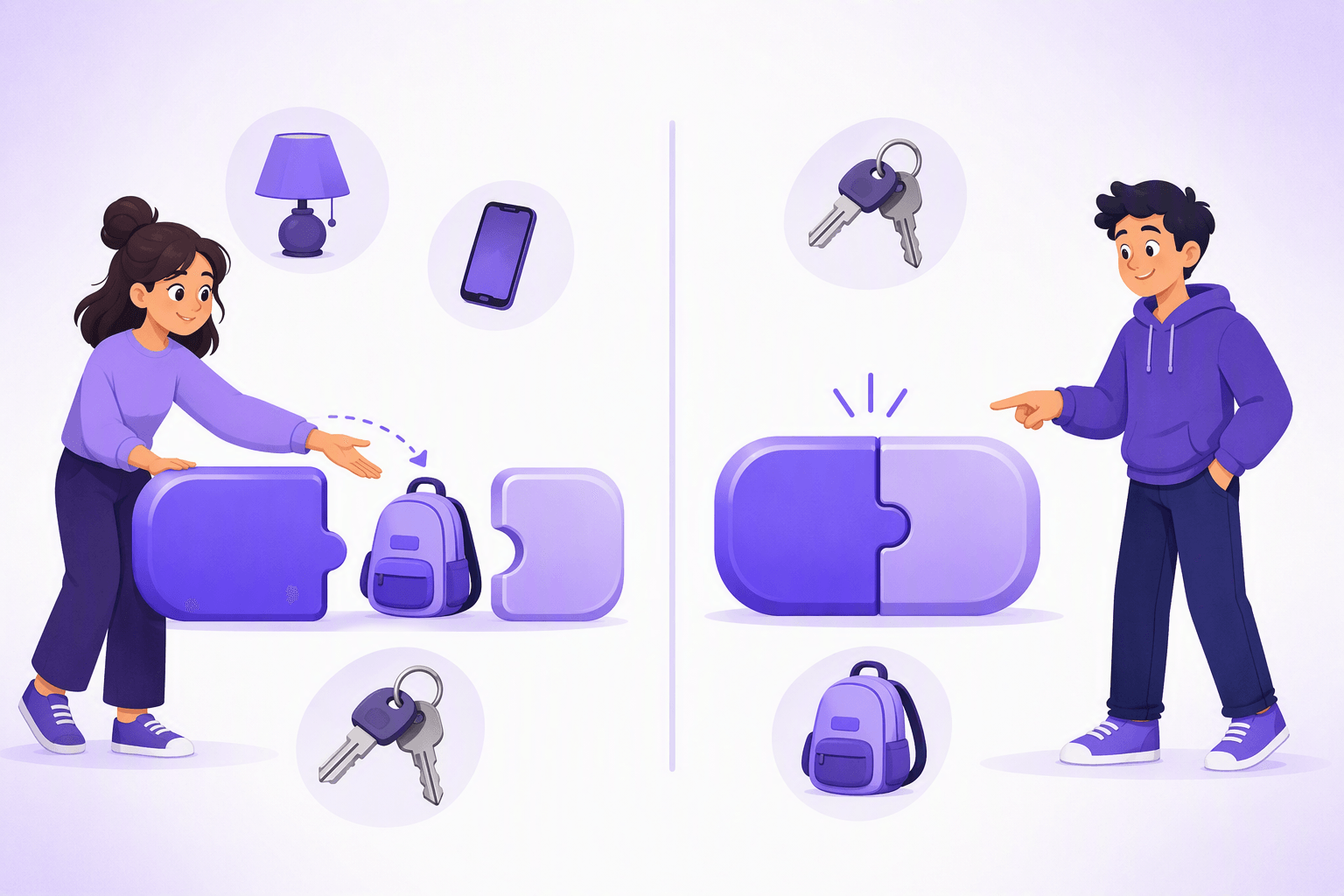
Separable phrasal verbs
With separable phrasal verbs, the object can go in the middle or at the end.
- "Pick up the phone." / "Pick the phone up."
- "Turn off the lights." / "Turn the lights off."
But with pronouns, separation is basically required:
- "Pick it up." (NOT "Pick up it.")
- "Turn them off." (NOT "Turn off them.")
Inseparable phrasal verbs
With inseparable ones, you cannot split the verb and particle.
- "I ran into my teacher." (NOT "I ran my teacher into.")
- "She looks after her brother." (NOT "She looks her brother after.")
Three-particle verbs (rare, but real)
You will also hear longer ones like "look forward to" (LOOK FOR-werd too). These are common in polite conversation and work emails, even though they are longer.
- "I’m looking forward to meeting you."
The particles that unlock meaning
If you learn particles as "meaning signals," you can guess new phrasal verbs more accurately. This is not perfect, but it works surprisingly often.
Up
"Up" often suggests completion, increase, or making something "ready."
- "finish up" (FIN-ish up): finish completely
- "set up" (SET up): arrange, prepare
- "pick up" (PIK up): lift, collect, learn informally
Out
"Out" often suggests removal, distribution, or discovery.
- "find out" (FIND out): discover information
- "hand out" (HAND out): distribute
- "run out" (RUN out): have none left
Off
"Off" often suggests stopping, separation, or cancellation.
- "turn off" (TURN off): stop a device
- "cut off" (KUT off): interrupt, disconnect
- "call off" (KAWL off): cancel
On
"On" often suggests continuation or activation.
- "keep on" (KEEP on): continue
- "turn on" (TURN on): activate a device
- "carry on" (KAR-ee on): continue (often British)
🌍 A real-world register pattern
In English-speaking workplaces, phrasal verbs are not "unprofessional." People often choose a phrasal verb to sound friendly and efficient: "Can you look into it?" feels less stiff than "Can you investigate it?" The formal verb is still useful, but the phrasal verb is the default in many teams.
40+ high-frequency phrasal verbs you can use immediately
Below are practical, high-utility phrasal verbs grouped by situation. Focus on one group per week, then recycle them in your own sentences.
Daily life and routines
| Phrasal verb | Pronunciation | Meaning | Example |
|---|---|---|---|
| wake up | WAYK up | stop sleeping | "I wake up at 7." |
| get up | GET up | leave bed | "Get up, we’re late." |
| sit down | SIT down | take a seat | "Sit down for a second." |
| stand up | STAND up | rise to feet | "Stand up straight." |
| go out | GO out | leave home for fun | "Do you want to go out tonight?" |
| stay in | STAY in | remain at home | "I’m staying in tonight." |
| come back | KUM bak | return | "Come back at 5." |
| head out | HED out | leave, depart | "We should head out." |
Relationships and social moments
| Phrasal verb | Pronunciation | Meaning | Example |
|---|---|---|---|
| hang out | HANG out | spend time casually | "We hung out after class." |
| catch up | KATCH up | update each other | "Let’s catch up soon." |
| run into | RUN in-too | meet unexpectedly | "I ran into Alex downtown." |
| get along | GET uh-LAWNG | have a good relationship | "Do you get along with your boss?" |
| break up | BRAYK up | end a relationship | "They broke up last month." |
| make up | MAYK up | reconcile | "We argued, then made up." |
Work and study
| Phrasal verb | Pronunciation | Meaning | Example |
|---|---|---|---|
| figure out | FIG-yer out | understand/solve | "I can’t figure it out." |
| look into | LOOK in-too | investigate | "I’ll look into it." |
| fill out | FIL out | complete a form (US common) | "Fill out this form." |
| fill in | FIL in | complete a form (UK common) | "Fill in this form." |
| keep up | KEEP up | maintain pace | "I can’t keep up." |
| catch on | KATCH on | understand gradually | "He’s catching on fast." |
| hand in | HAND in | submit | "Hand in your homework." |
Plans, changes, and problems
| Phrasal verb | Pronunciation | Meaning | Example |
|---|---|---|---|
| put off | PUT off | postpone | "Don’t put it off." |
| call off | KAWL off | cancel | "They called off the meeting." |
| show up | SHOH up | arrive/appear | "He didn’t show up." |
| turn out | TURN out | result | "It turned out fine." |
| work out | WERK out | succeed, be resolved | "It’ll work out." |
| mess up | MES up | make a mistake | "I messed up." |
| deal with | DEEL with | handle | "I can’t deal with this today." |
Money, shopping, and practical tasks
| Phrasal verb | Pronunciation | Meaning | Example |
|---|---|---|---|
| pay back | PAY bak | return money | "I’ll pay you back." |
| pick up | PIK up | collect (a person/thing) | "Can you pick me up?" |
| drop off | DROP off | deliver, leave | "I’ll drop it off." |
| check out | CHEK out | look at, examine | "Check out this place." |
| run out | RUN out | have none left | "We ran out of milk." |
Tech and communication
| Phrasal verb | Pronunciation | Meaning | Example |
|---|---|---|---|
| log in | LOG in | access an account | "Log in again." |
| sign up | SYNE up | register | "Sign up here." |
| scroll down | SKROHL down | move down a page | "Scroll down a bit." |
| turn on | TURN on | start a device | "Turn on the TV." |
| turn off | TURN off | stop a device | "Turn off notifications." |
⚠️ Avoid the 'one-word synonym' trap
Many phrasal verbs have a formal synonym, but they are not always interchangeable. "Look into" is often lighter and more conversational than "investigate," which can sound serious or even accusatory. Always learn the typical situation, not just the dictionary meaning.
Common mistakes that instantly sound non-native
1) Splitting inseparable verbs
Wrong: "She ran her friend into."
Right: "She ran into her friend." (RUN in-too)
If you are unsure, check a learner-friendly dictionary entry. Cambridge Dictionary is especially clear about separability (Cambridge Dictionary, accessed 2026).
2) Using the wrong pronoun position
Wrong: "Pick up it."
Right: "Pick it up."
This one is worth drilling because it appears constantly in real speech.
3) Overusing phrasal verbs in formal writing
In essays, legal writing, or academic reports, phrasal verbs can sound too casual. You can still use them, but choose carefully.
For example:
- More formal: "The results indicate..."
- More conversational: "It turns out..."
US vs UK differences you will actually notice
Phrasal verbs exist everywhere, but certain choices are more common in one variety.
| Situation | American English | British English |
|---|---|---|
| complete a form | fill out | fill in |
| continue | keep on | carry on |
| tolerate | put up with | put up with (same, very common) |
| call someone | call (them) back | ring (them) back (also "call back") |
If you enjoy noticing these differences in dialogue, pair this guide with our British slang guide and American slang guide. Slang and phrasal verbs often travel together in the same scenes.
A movie-and-TV method that works (and fits real life)
Phrasal verbs are ideal for clip-based learning because they are short, frequent, and tied to action. You can hear the stress pattern, see the situation, and copy the rhythm.
Use this 4-step routine:
- Catch the chunk: listen for the whole phrase, like "pick it up" (PIK it UP).
- Name the situation: "phone call," "argument," "apology," "deadline."
- Swap the object: "pick it up" becomes "pick them up," "pick your bag up."
- Recycle tomorrow: use it again in a new sentence.
If you want more everyday spoken vocabulary that appears in the same kinds of scenes, read our English slang expressions guide. For boundaries and tone in stronger language, our English swear words guide explains what shows say vs what you should repeat.
Practice: build your own “phrasal verb map”
Instead of a long list, build a small personal map around particles you hear most.
Start with five particles: up, out, off, on, in. Then add 3 verbs you already know well: get, take, put.
Now create combinations you actually meet in daily English:
- get up, get in, get out, get over
- take off, take on, take out
- put off, put on, put away
This approach matches how fluent speakers process language: patterns first, then exceptions.
A quick self-test you can do in 2 minutes
Try answering these out loud:
- If your friend says "I’ll pick you up at 8," what happens at 8?
- If a meeting is "called off," do you go or not?
- If you "ran into" someone, did you plan it?
If you hesitate, you do not need more phrasal verbs yet. You need more repetitions of the same few in clear contexts.
Phrasal verbs and numbers, dates, and scheduling language
Phrasal verbs show up constantly when planning time:
- "move up" (MOOv up): make earlier
- "push back" (PUSH bak): make later
- "set up" (SET up): arrange
- "show up" (SHOH up): arrive
When you combine these with time phrases, your English becomes instantly more practical. For support with the building blocks, see English numbers 1-100 and months in English, then practice scheduling lines like "Can we push it back to May?"
Final checklist: what to learn first
If you want the highest return in the next 30 days, do this:
- Learn 25 phrasal verbs that match your daily life (work, school, family).
- Master separable word order with pronouns: "turn it off," "pick them up."
- Learn particle meanings as signals, especially up/out/off/on.
- Practice with short dialogue clips and repeat the whole chunk.
That is enough to noticeably improve listening comprehension and make your speaking sound more natural, even if your grammar is not perfect yet.
For more practical English you can steal from real dialogue, browse the Wordy blog and keep your learning tied to scenes you can remember.
Frequently Asked Questions
What are phrasal verbs in English?
Why are phrasal verbs so hard for learners?
What is the difference between separable and inseparable phrasal verbs?
Are phrasal verbs British or American?
How many phrasal verbs do I need to know to sound fluent?
Sources & References
- Oxford English Dictionary (OED), 'phrasal verb' entry, accessed 2026
- Cambridge Dictionary, 'phrasal verb' and particle usage notes, accessed 2026
- Biber, D., Johansson, S., Leech, G., Conrad, S., Finegan, E. Longman Grammar of Spoken and Written English, 1999
- Ethnologue, English (27th edition), 2024
- British Council, LearnEnglish: Phrasal verbs overview and teaching guidance, accessed 2026
Start learning with Wordy
Watch real movie clips and build your vocabulary as you go. Free to download.


