Quick Answer
English house vocabulary includes words for rooms such as kitchen and bedroom, furniture such as sofa and wardrobe, and household objects such as sink, plug, and cupboard. Learn the core words by room so you can describe where you live, understand TV scenes, and handle everyday conversations.
English house vocabulary is the set of words you need to describe rooms, furniture, appliances, and everyday objects at home. Start with practical words such as kitchen /ˈkɪtʃən/, bedroom /ˈbɛdruːm/, chair /tʃɛr/, window /ˈwɪndoʊ/, and shower /ˈʃaʊər/, then learn them by room instead of as one long list.
English is spoken by roughly 1.5 billion people worldwide when first- and second-language speakers are counted, according to Ethnologue estimates. That means home vocabulary changes slightly across countries, especially between American and British English. You may hear apartment in the United States and flat in the United Kingdom, but both name the same basic kind of home.
Knowing these words also makes everyday media much easier to follow. A character in a sitcom might ask someone to put food in the fridge, leave shoes in the hallway, or sit on the couch. Pair this list with English food vocabulary and English clothing vocabulary to describe daily life in far more detail.
| English | Pronunciation | Note |
|---|---|---|
| house | HOWSS | A separate building where people live. |
| home | HOHM | A place where someone lives or feels they belong. |
| apartment | uh-PAHRT-ment | Common American English for a home in a larger building. |
| flat | FLAT | Common British English for an apartment. |
| room | ROOM | A separate area inside a building. |
| living room | LIV-ing ROOM | Main room for relaxing and receiving guests. |
| kitchen | KITCH-en | Room for preparing food. |
| bedroom | BED-room | Room where people sleep. |
| bathroom | BATH-room | Room with a toilet and sink, often a shower or bath. |
| dining room | DY-ning ROOM | Room for eating meals. |
| hallway | HAWL-way | Passage connecting rooms. |
| garage | guh-RAHZH | Covered place for a car or storage. |
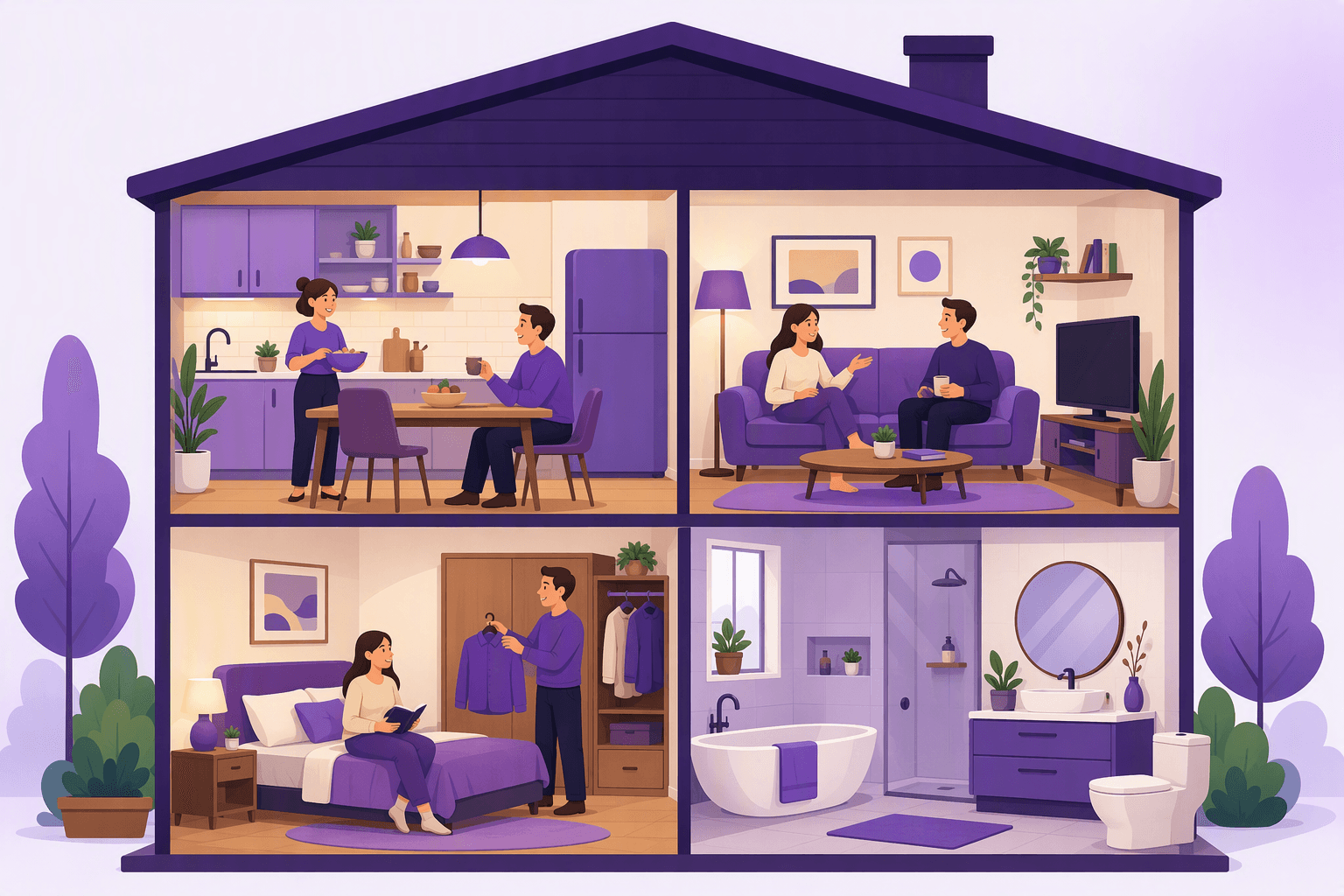
The essential English words for rooms
A house /haʊs/ is the building itself, while a home /hoʊm/ has an emotional meaning as well. A home can be a house, an apartment, a room, or any place where a person lives and feels settled.
In American English, an apartment /əˈpɑrtmənt/ is a residence in a larger building. In British English, speakers usually say flat /flæt/. The word flat also means level or not curved in American English, so context matters.
Kitchen
The kitchen /ˈkɪtʃən/ is where people prepare food. In many homes it is also a social space, especially when the kitchen includes a table, counter stools, or an open connection to the living room.
A counter /ˈkaʊntər/ is the flat work surface where you chop vegetables or place appliances. British speakers often use worktop /ˈwɜrktɑp/ for the same surface.
Living room
The living room /ˈlɪvɪŋ ruːm/ is a shared room for relaxing, watching television, talking, or hosting visitors. It may also be called a lounge /laʊndʒ/, especially in British English.
Some homes have a family room /ˈfæməli ruːm/, a more informal sitting area used mainly by household members. The distinction is not universal, so do not worry if a home has only one room for both purposes.
Bedroom
A bedroom /ˈbɛdruːm/ is a room for sleeping. A master bedroom is still widely used in North American real-estate language, although primary bedroom is increasingly preferred because it avoids the historical associations of the older label.
A guest room /ɡɛst ruːm/ is a bedroom for visitors. In a small apartment, a studio /ˈstuːdioʊ/ has one main room that functions as both a living and sleeping space.
Bathroom
A bathroom /ˈbæθruːm/ in American English normally means a room with a toilet and sink, whether or not it has a bath. In British English, speakers may distinguish between a bathroom with a bath or shower and a toilet /ˈtɔɪlət/ or WC /ˌdʌbəljuː ˈsiː/ for a separate toilet room.
A small bathroom containing only a toilet and sink is often called a half bath /hæf bæθ/ or powder room /ˈpaʊdər ruːm/ in the United States.
Hallway
A hallway /ˈhɔːlweɪ/ connects rooms and often begins at the front door. British English commonly uses hall /hɔːl/ for this area, while American English may use entryway /ˈɛntriweɪ* for the entrance area.
The stairs /stɛrz/ lead between floors. A landing /ˈlændɪŋ/ is the flat area at the top, bottom, or turn of a staircase.
Furniture vocabulary for every room
Furniture is made up of the larger movable objects in a home. The word furniture /ˈfɜrnɪtʃər/ is uncountable in English, so say some furniture or a piece of furniture, not furnitures.
| English | Pronunciation | Note |
|---|---|---|
| sofa | SOH-fuh | A long, upholstered seat for two or more people. |
| couch | KOWCH | Common American English synonym for sofa. |
| armchair | AHRM-chair | A comfortable chair with side supports for arms. |
| coffee table | KAW-fee TAY-bul | Low table placed in front of a sofa. |
| dining table | DY-ning TAY-bul | Table used for meals. |
| chair | CHAIR | Seat for one person. |
| bed | BED | Furniture used for sleeping. |
| mattress | MAT-riss | Soft part of a bed that supports the body. |
| pillow | PIL-oh | Soft support for the head in bed. |
| wardrobe | WOR-drohb | Tall movable furniture for clothes. |
| closet | KLOZ-it | Built-in storage space, especially in American English. |
| bookshelf | BOOK-shelf | Furniture with shelves for books. |
Sofa and couch
A sofa /ˈsoʊfə/ and a couch /kaʊtʃ/ are both large padded seats. Sofa works across major varieties of English, while couch is especially common in North America.
A sectional /ˈsɛkʃənəl/ is a sofa made of connected sections, often arranged in an L shape. You may hear this word in American home-design shows.
Bed, mattress, and bedding
The bed /bɛd/ is the full piece of furniture, but the mattress /ˈmætrəs/ is the padded surface you sleep on. Bedding /ˈbɛdɪŋ/ is a collective word for sheets, blankets, pillowcases, and similar fabric items.
A duvet /duːˈveɪ/ is a soft, filled bed cover, common in British English and increasingly common in North America. Americans also say comforter /ˈkʌmfərtər/ for a thick quilted bed cover.
Wardrobe and closet
A wardrobe /ˈwɔːrdroʊb/ is a freestanding cabinet for clothes. A closet /ˈklɑzət/ is usually built into the wall and may store clothes, towels, cleaning equipment, or coats.
The Cambridge Dictionary records both terms, but their everyday distribution differs by region. In a British home tour, you are more likely to hear wardrobe. In an American apartment listing, you are more likely to see walk-in closet /ˌwɔːk ɪn ˈklɑzət/.
💡 Use objects in sentences
Do not memorize furniture as isolated labels. Say practical sentences such as: "The keys are on the coffee table," "My jacket is in the closet," and "There is a lamp next to the bed." Position and action make vocabulary easier to remember.
Kitchen and household object vocabulary
The kitchen contains some of the most useful English nouns because cooking, cleaning, and sharing meals create frequent conversation. Watch a cooking scene and you will hear many of these words repeatedly.
| English | Pronunciation | Note |
|---|---|---|
| fridge | FRIJ | Informal everyday word for refrigerator. |
| freezer | FREE-zer | Appliance or compartment that keeps food frozen. |
| oven | UV-en | Appliance used for baking and roasting. |
| stove | STOHV | Cooking appliance with burners, common in American English. |
| hob | HOB | British English word for the burner surface on a cooker. |
| microwave | MY-kroh-wayv | Appliance for heating food quickly. |
| sink | SINK | Basin with taps for washing. |
| cupboard | KUB-erd | Storage cabinet, especially for dishes or food. |
| cabinet | KAB-in-it | Storage unit with doors, common in American English. |
| dishwasher | DISH-wosh-er | Machine that washes dishes. |
| washing machine | WOSH-ing muh-SHEEN | Machine that washes clothes. |
| vacuum cleaner | VAK-yoom KLEE-ner | Machine used to clean floors. |
Fridge and refrigerator
Refrigerator /rɪˈfrɪdʒəreɪtər/ is the full word, but fridge /frɪdʒ/ is far more common in conversation. Both are correct, and fridge is not considered careless or childish.
A freezer /ˈfriːzər/ stores food below freezing temperature. It may be a separate appliance or the top, bottom, or side section of a fridge.
Stove, oven, cooker, and hob
In American English, a stove /stoʊv/ commonly refers to the whole cooking appliance, including burners and oven. In British English, cooker /ˈkʊkər/ may refer to the whole appliance, while a hob /hɑb/ is the heated surface on top.
An oven /ˈʌvən/ is specifically the enclosed part used for baking. You bake a cake in the oven, but fry eggs in a pan on the stove or hob.
Cupboard and cabinet
A cupboard /ˈkʌbərd/ is a storage unit with doors. Notice that the spelling contains cup, but the pronunciation begins with /ˈkʌb/, not /ˈkʌp/.
A cabinet /ˈkæbɪnət/ is also a storage unit, especially in American kitchen vocabulary. You can say kitchen cabinets, bathroom cabinet, or medicine cabinet.
Bathroom, cleaning, and utility words
The bathroom has a precise set of words that learners need for travel, renting accommodation, and daily routines. For a wider practical vocabulary set, see English travel phrases.
Shower
A shower /ˈʃaʊər/ is both the device that sprays water and the act of washing under it. You can say, “I need to take a shower,” or “The shower is broken.”
A bathtub /ˈbæθtʌb/ is the long container you sit or lie in to wash. British English often shortens this to bath /bæθ/ or /bɑːθ/, depending on the accent.
Towel
A towel /ˈtaʊəl/ is used to dry your body, hands, dishes, or surfaces. Be specific when needed: a bath towel, hand towel, tea towel, or kitchen towel.
A toilet roll /ˈtɔɪlət roʊl/ is common British English. In North America, people usually say toilet paper /ˈtɔɪlət ˌpeɪpər/.
Laundry
Laundry /ˈlɔːndri/ means clothes that need washing, are being washed, or have been washed. It is usually uncountable, so say “I need to do the laundry,” not “I need to do laundries.”
The washing machine /ˈwɑːʃɪŋ məˌʃiːn/ washes clothes. A dryer /ˈdraɪər/ dries them. In many British homes, people use a washing line /ˈwɑːʃɪŋ laɪn/ or clothesline /ˈkloʊðzlaɪn/ outdoors instead.
🌍 A home is a major conversation topic
English speakers often use homes as easy small-talk material: moving house, renting, redecorating, noisy neighbors, cleaning, and cooking. Asking "Do you live in a house or an apartment?" is natural in many casual settings, though asking the price of someone's home can feel too personal.
American and British house vocabulary differences
Vocabulary differences are useful to recognize, but they rarely stop communication. Films and television expose learners to both varieties, which is one reason watching movies to learn English can build flexible listening skills.
| American English | British English | Meaning |
|---|---|---|
| apartment | flat | Home in a larger residential building |
| elevator | lift | Machine that carries people between floors |
| yard | garden | Outdoor area around a home |
| closet | wardrobe | Place for storing clothes |
| faucet | tap | Device controlling water flow |
| trash can | bin | Container for rubbish |
| stove | cooker | Main cooking appliance |
| garbage | rubbish | Things thrown away |
Linguist David Crystal, in The Cambridge Encyclopedia of the English Language, emphasizes that English has many established national varieties rather than one single global standard. House vocabulary is a clear example: the object stays the same while the everyday label changes.
The OED also shows how household words develop long histories and accumulate regional senses. Rather than treating one form as correct and another as wrong, learn the version used in the people, media, or place you interact with most.
How to practice house vocabulary effectively
Start with your actual surroundings. Look around one room and name ten objects aloud. Then make five location sentences using in, on, under, next to, and between. These small words are essential for describing a home accurately.
For example: “The remote is on the sofa.” “The shoes are under the bed.” “The lamp is next to the bookshelf.” If prepositions feel difficult, review the patterns in our English prepositions guide.
Next, use scenes instead of word lists. Pause a home scene in a film or series and identify the room, furniture, objects, and actions. You might notice someone loads the dishwasher, sets the table, takes out the trash, or makes the bed.
Paul Nation's work on vocabulary learning distinguishes between knowing a word's form, meaning, and use. For house vocabulary, that means recognizing cupboard, knowing it stores things, pronouncing it /ˈkʌbərd/, and being able to say “The mugs are in the cupboard.”
Finally, learn useful word partnerships. English speakers usually make the bed, do the laundry, vacuum the floor, take out the trash, set the table, and wash the dishes. These combinations will make your speech sound much more natural than memorizing nouns alone.
A strong home vocabulary gives you language for daily routines, rentals, shopping, TV scenes, and conversations about where you live. Learn one room at a time, use the objects around you, and return to the words whenever you see them in real life.
Frequently Asked Questions
What are the most important house vocabulary words in English?
What is the difference between a house and a home?
Do Americans say flat or apartment?
What is the difference between a closet and a wardrobe?
How can I remember English vocabulary for rooms and furniture?
Sources & References
- Cambridge Dictionary, British and American English vocabulary entries, accessed 2026
- Oxford English Dictionary, house and home entries, accessed 2026
- Merriam-Webster, Dictionary entries for household vocabulary, accessed 2026
- British Council, LearnEnglish vocabulary resources, accessed 2026
Start learning with Wordy
Watch real movie clips and build your vocabulary as you go. Free to download.


