Quick Answer
To ask 'What time is it?' in Spanish, say ¿Qué hora es? /ke ˈoɾa es/. For a polite question to a stranger, say ¿Me puede decir la hora, por favor? /me ˈpweðe deˈsiɾ la ˈoɾa poɾ faˈβoɾ/. Learn the most natural ways to ask, answer, and understand time in Spanish.
To say “What time is it?” in Spanish, use ¿Qué hora es? /ke ˈoɾa es/. It is the standard question across the Spanish-speaking world. If you are asking a stranger, ¿Me puede decir la hora, por favor? /me ˈpweðe deˈsiɾ la ˈoɾa poɾ faˈβoɾ/ is a safer, more polite choice.
Spanish is spoken by more than 600 million potential speakers worldwide according to Instituto Cervantes, and it is an official language in 20 sovereign countries. Time expressions are highly recognizable across those places, but the rhythm of daily life, meal times, and preferred clock format can vary a lot. Start with this core question, then build toward natural answers.
If you are learning basic social phrases too, review how to say hello in Spanish. A friendly greeting before asking for the time makes even a short interaction sound more natural.
| English | Spanish | Pronunciation | Formality |
|---|---|---|---|
| What time is it? | ¿Qué hora es? | keh OH-rah ess | polite |
| Do you know what time it is? | ¿Sabes qué hora es? | SAH-behs keh OH-rah ess | casual |
| Do you have the time? | ¿Tienes hora? | TYEH-nehs OH-rah | casual |
| Could you tell me the time, please? | ¿Me puede decir la hora, por favor? | meh PWEH-deh deh-SEER lah OH-rah por fah-BOR | formal |
| What time does it open? | ¿A qué hora abre? | ah keh OH-rah AH-breh | polite |
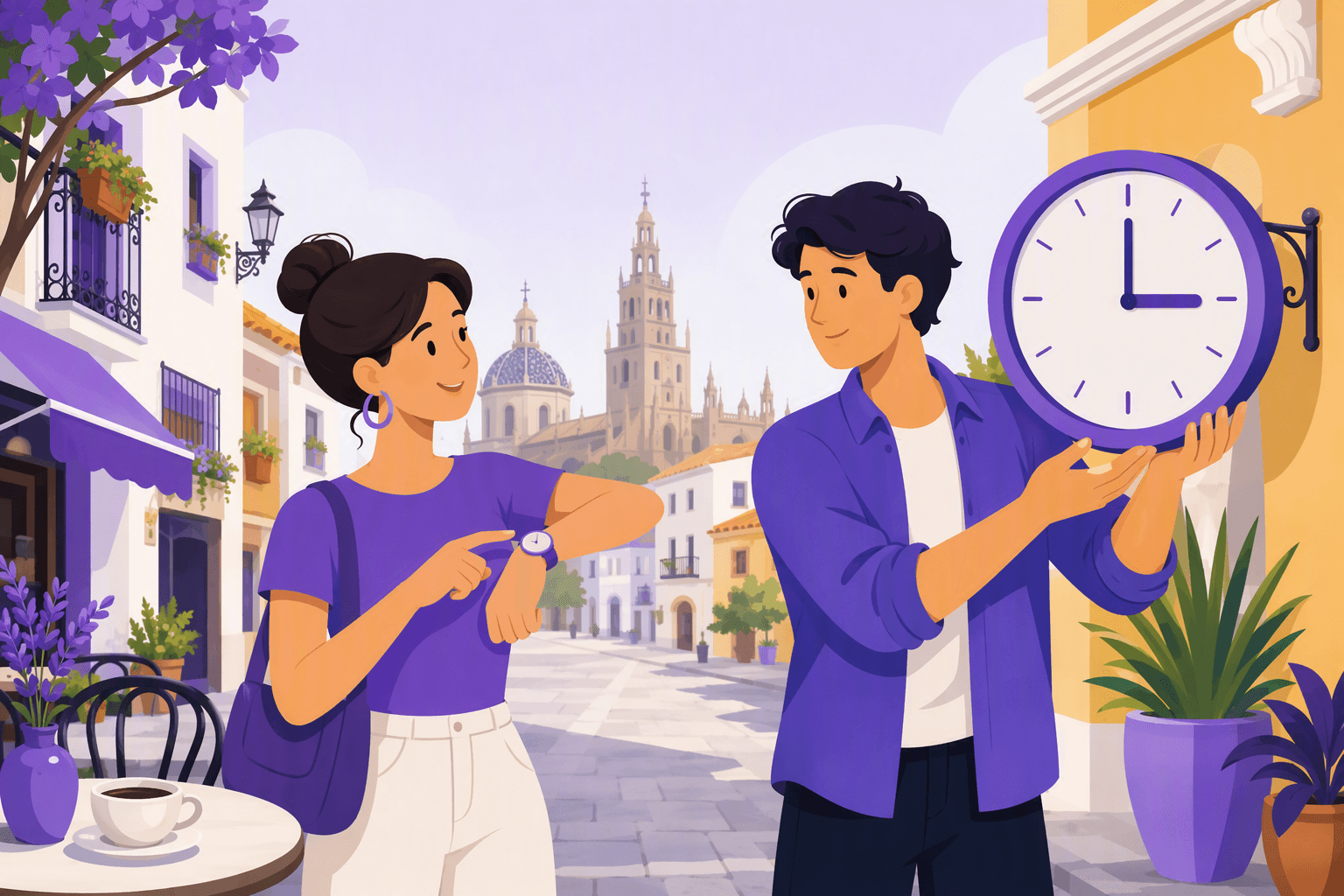
The essential Spanish question
¿Qué hora es?
¿Qué hora es? /ke ˈoɾa es/ literally asks “What hour is it?” It is the default expression, suitable for asking a friend, a hotel receptionist, a coworker, or someone waiting at a bus stop.
The word qué /ke/ means “what,” hora /ˈoɾa/ means “hour” or “time,” and es /es/ means “is.” Spanish uses inverted question marks in writing, so remember to put ¿ at the beginning as well as ? at the end.
You do not need to add ahora /aˈoɾa/, meaning “now.” The question already refers to the current time unless a wider context changes it.
/keh OH-rah ess/
Literal meaning: What hour is it?
“Perdón, ¿qué hora es?”
Excuse me, what time is it?
This is the neutral, widely understood question for asking the current time. Add perdón and por favor when addressing an unfamiliar person.
¿Tienes hora?
¿Tienes hora? /ˈtjenes ˈoɾa/ is an informal shortcut used with someone you know, especially in Spain and many parts of Latin America. It roughly means “Do you have the time?”
Because it uses tienes /ˈtjenes/, the informal tú form of “you have,” avoid it with someone you would address as usted /usˈteð/. It is fine among classmates, friends, siblings, and peers.
A useful alternative is ¿Sabes qué hora es? /ˈsaβes ke ˈoɾa es/, meaning “Do you know what time it is?” This is friendly and slightly less direct because it asks whether the listener knows.
¿Me puede decir la hora, por favor?
For a stranger, employee, older person, or formal setting, say ¿Me puede decir la hora, por favor? /me ˈpweðe deˈsiɾ la ˈoɾa poɾ faˈβoɾ/. It means “Could you tell me the time, please?”
The grammar uses puede /ˈpweðe/, the formal usted form. You can also use ¿Me podrías decir la hora? /me poˈðɾias deˈsiɾ la ˈoɾa/ with a person you know but want to approach politely.
💡 Use a soft opener
Start with perdón /peɾˈðon/ or disculpe /disˈkulpe/ when stopping a stranger. For example: Disculpe, ¿me puede decir la hora, por favor? /disˈkulpe me ˈpweðe deˈsiɾ la ˈoɾa poɾ faˈβoɾ/.
How to answer the question
Spanish tells time with ser /seɾ/, “to be.” The one exception that matters immediately is one o'clock: Spanish uses singular es /es/ for one, but plural son /son/ for all other hours.
| Time | Spanish answer | IPA |
|---|---|---|
| 1:00 | Es la una. | /es la ˈuna/ |
| 2:00 | Son las dos. | /son las dos/ |
| 3:00 | Son las tres. | /son las tɾes/ |
| 6:00 | Son las seis. | /son las seis/ |
| 10:00 | Son las diez. | /son las ðjes/ |
| 12:00 | Son las doce. | /son las ˈðose/ |
The Real Academia Española records hora /ˈoɾa/ as a feminine noun. That is why Spanish says la una /la ˈuna/, one o'clock, and las dos /las dos/, two o'clock.
Es la una
Use Es la una /es la ˈuna/ only for 1:00. The singular verb es agrees with the singular phrase la una.
For 1:15, say Es la una y cuarto /es la ˈuna i ˈkwaɾto/. For 1:30, say Es la una y media /es la ˈuna i ˈmeðja/.
Son las
From two o'clock onward, use Son las /son las/. This is the pattern to memorize because it covers almost every time you will say.
For example, Son las ocho /son las ˈotʃo/ means “It is eight o'clock.” If someone asks the time in a film scene, listen for son las followed by the hour.
| English | Spanish | Pronunciation | Note |
|---|---|---|---|
| one o'clock | la una | lah OO-nah | Uses singular es. |
| two o'clock | las dos | lahs dohs | Uses plural son. |
| quarter past | y cuarto | ee KWAHR-toh | Add after the hour. |
| half past | y media | ee MEH-dyah | The normal spoken form for :30. |
| quarter to | menos cuarto | MEH-nohs KWAHR-toh | Counts back from the next hour. |
| in the morning | de la mañana | deh lah mah-NYAH-nah | Used to clarify time of day. |
| in the afternoon | de la tarde | deh lah TAHR-deh | Often used after noon. |
| at night | de la noche | deh lah NOH-cheh | Used for evening and nighttime. |
Minutes past and minutes to
Spanish has two equally valid systems for minutes. In casual speech, rounded phrases such as y cuarto /i ˈkwaɾto/ and y media /i ˈmeðja/ are very common. For precise appointments, people often state the exact minutes.
Y cuarto
Y cuarto /i ˈkwaɾto/ means “and a quarter,” or fifteen minutes past.
- Son las cuatro y cuarto. /son las ˈkwatɾo i ˈkwaɾto/, It is 4:15.
- Son las siete y cuarto. /son las ˈsjete i ˈkwaɾto/, It is 7:15.
Y media
Y media /i ˈmeðja/ means “and a half.” It is the most natural everyday expression for :30.
- Son las cinco y media. /son las ˈsiŋko i ˈmeðja/, It is 5:30.
- Es la una y media. /es la ˈuna i ˈmeðja/, It is 1:30.
The feminine media /ˈmeðja/ matches the omitted feminine noun hora /ˈoɾa/. Learners sometimes say medio, but y media is the correct time expression.
Menos cuarto
For times approaching the next hour, use menos /ˈmenos/, meaning “minus” or “less.”
- Son las tres menos cuarto. /son las tɾes ˈmenos ˈkwaɾto/, It is 2:45.
- Son las nueve menos diez. /son las ˈnweβe ˈmenos ðjes/, It is 8:50.
This structure can feel backward to English speakers. Think of it as naming the coming hour, then subtracting the remaining minutes.
Exact digital-style times
To state exact minutes, add y /i/, “and,” plus the minute number.
- Son las dos y veinte. /son las dos i ˈβejnte/, It is 2:20.
- Son las seis y treinta y cinco. /son las seis i ˈtɾejnta i ˈsiŋko/, It is 6:35.
- Son las once y cincuenta. /son las ˈonse i siŋˈkwenta/, It is 11:50.
In daily conversation, a speaker may choose Son las seis y media /son las seis i ˈmeðja/ rather than Son las seis y treinta /son las seis i ˈtɾejnta/. Both are understood, but y media usually sounds less mechanical.
Add the part of the day
A Spanish time can be ambiguous, especially if it is written with a 12-hour clock. Add a time-of-day phrase when the listener needs clarity.
- de la mañana /de la maˈɲana/, in the morning
- de la tarde /de la ˈtaɾðe/, in the afternoon
- de la noche /de la ˈnotʃe/, at night
- del mediodía /del meðjoˈðia/, at noon
- de la madrugada /de la maðuˈɣɾaða/, in the early morning hours
For example, Son las ocho de la mañana /son las ˈotʃo de la maˈɲana/ means 8 a.m. Son las ocho de la noche /son las ˈotʃo de la ˈnotʃe/ means 8 p.m.
Mediodía /meðjoˈðia/ is noon, while medianoche /meðjaˈnotʃe/ is midnight. Therefore, Es mediodía /es meðjoˈðia/ means “It is noon,” and Es medianoche /es miðjaˈnotʃe/ means “It is midnight.”
🌍 Dinner time changes the context
In Spain, dinner often begins much later than many visitors expect, commonly around 9 p.m. or later. In much of Latin America, evening meals may happen earlier. So an invitation for a las ocho de la noche /a las ˈotʃo de la ˈnotʃe/ can suggest different expectations depending on the country and social setting.
Asking when something happens
Once you know ¿Qué hora es? /ke ˈoɾa es/, the next useful pattern is ¿A qué hora...? /a ke ˈoɾa/. It asks what time an event happens.
- ¿A qué hora abre? /a ke ˈoɾa ˈaβɾe/, What time does it open?
- ¿A qué hora cierra? /a ke ˈoɾa ˈsjera/, What time does it close?
- ¿A qué hora sale el tren? /a ke ˈoɾa ˈsale el tɾen/, What time does the train leave?
- ¿A qué hora empieza la película? /a ke ˈoɾa emˈpjesa la peˈlikula/, What time does the movie start?
- ¿A qué hora quedamos? /a ke ˈoɾa keˈðamos/, What time shall we meet?
For an event at a stated time, Spanish uses a la /a la/ for one o'clock and a las /a las/ for other hours.
| English | Spanish | IPA |
|---|---|---|
| at one | a la una | /a la ˈuna/ |
| at two | a las dos | /a las dos/ |
| at six thirty | a las seis y media | /a las seis i ˈmeðja/ |
| at quarter to nine | a las nueve menos cuarto | /a las ˈnweβe ˈmenos ˈkwaɾto/ |
The grammar description in the Nueva gramática de la lengua española distinguishes this event-time use of a /a/ from the current-time statement with ser /seɾ/. That contrast is simple but essential: Son las seis says what time it is, while La clase es a las seis /la ˈklase es a las seis/ says when class is.
12-hour and 24-hour time in Spanish
The 24-hour clock is common in Spanish-language timetables. Train stations, airports, cinemas, hospitals, television listings, and official documents often write times such as 18:30.
When reading that schedule aloud, a person may say dieciocho treinta /djeˈsjoitʃo ˈtɾejnta/ in formal contexts. In normal conversation, they are just as likely to say seis y media de la tarde /seis i ˈmeðja de la ˈtaɾðe/.
John M. Lipski’s work on Latin American Spanish emphasizes that regional varieties share a large grammatical core while differing in local habits and vocabulary. Time-telling follows that pattern: ¿Qué hora es? is universal, while the choice between a 24-hour reading, an exact-minute answer, and a rounded expression can reflect the situation and region.
⚠️ Do not translate English time phrases word for word
Avoid saying son las dos y un cuarto for 2:15. Spanish says son las dos y cuarto /son las dos i ˈkwaɾto/. Also avoid using es for every hour. Only 1:00 uses es la una. All other clock hours use son las.
Pronunciation points that make time clearer
Spanish spelling is relatively consistent, but time phrases contain several sounds learners often blur. Keep each vowel clear: hora /ˈoɾa/ has an open /o/ followed by /a/, not an English-style reduced vowel.
The single r in hora /ˈoɾa/ is a quick tap. It is not the stronger rolled rr /r/ sound found in words such as rápido /ˈrapiðo/.
In cuarto /ˈkwaɾto/, pronounce ua as /wa/. In media /ˈmeðja/, the d between vowels is usually soft, close to /ð/. Clear vowels and steady rhythm matter more than trying to imitate one country’s accent.
For a focused sound practice plan, use our Spanish pronunciation guide. Listening to short scenes repeatedly is especially helpful because you hear how fast speakers connect son las /son las/ and numbers in real conversation.
A practical mini-dialogue
Here is a natural exchange at a station:
A: Disculpe, ¿me puede decir la hora, por favor? /disˈkulpe me ˈpweðe deˈsiɾ la ˈoɾa poɾ faˈβoɾ/
B: Sí, son las dos y veinte de la tarde. /si son las dos i ˈβejnte de la ˈtaɾðe/
A: Gracias. ¿A qué hora sale el tren a Sevilla? /ˈɣɾasjas a ke ˈoɾa ˈsale el tɾen a seˈβiʎa/
B: Sale a las dos y media. /ˈsale a las dos i ˈmeðja/
The traveler asks the current time with a formal question, then switches to ¿A qué hora sale...? /a ke ˈoɾa ˈsale/ for the departure time. This exact distinction appears constantly in travel conversations.
Before a trip, pair these expressions with Spanish airport phrases and Spanish travel phrases. You will be able to understand schedules, ask about departures, and confirm meeting times without relying on your phone.
The key pattern to remember
Use ¿Qué hora es? /ke ˈoɾa es/ to ask the current time. Answer with Es la una /es la ˈuna/ at one o'clock and Son las... /son las/ for every other hour.
For appointments and schedules, ask ¿A qué hora...? /a ke ˈoɾa/. Add de la mañana /de la maˈɲana/, de la tarde /de la ˈtaɾðe/, or de la noche /de la ˈnotʃe/ when the time of day is unclear.
Once you can ask the time, you have one of the most useful tools for real Spanish interactions. Practice the phrases aloud, notice them in shows and travel videos, and use them alongside everyday greetings and Spanish goodbyes.
Frequently Asked Questions
How do you say what time is it in Spanish?
Is it qué hora es or qué horas son in Spanish?
How do Spanish speakers say 1:30?
What does menos cuarto mean in Spanish time?
Do Spanish-speaking countries use the 24-hour clock?
Sources & References
- Instituto Cervantes, El español en el mundo, 2024
- Real Academia Española, Diccionario de la lengua española, accessed 2026
- Real Academia Española and ASALE, Nueva gramática de la lengua española
- John M. Lipski, Latin American Spanish, Routledge
- Ethnologue, Spanish Language Profile, 27th edition, 2024
Start learning with Wordy
Watch real movie clips and build your vocabulary as you go. Free to download.


