Quick Answer
At the airport in Spanish, start with practical phrases such as ¿Dónde está el mostrador de facturación? for check-in, ¿Dónde está la puerta de embarque? for your gate, and Necesito ayuda for assistance. This guide gives you the phrases needed from arrival to customs, with pronunciation and cultural context.
At the airport in Spanish, the phrases you need most are ¿Dónde está el mostrador de facturación? /ˈdonde esˈta el mostraˈðoɾ ðe faktuɾaˈsjon/ for “Where is the check-in desk?”, ¿Dónde está la puerta de embarque? /ˈdonde esˈta la ˈpweɾta ðe emˈbaɾke/ for “Where is the gate?”, and Necesito ayuda /neseˈsito aˈʝuða/ for “I need help.” Learn these before you travel and you can handle check-in, security, boarding, baggage, and unexpected delays with far less stress.
Spanish is spoken by roughly 560 million people worldwide when native and second-language speakers are counted, according to Ethnologue, and it is an official language in 20 countries. That makes airport Spanish useful far beyond Spain, from Mexico City and Bogotá to Madrid, Lima, and Buenos Aires.
If you are still building your basics, begin with how to say hello in Spanish. At an airport, a clear greeting plus one prepared question is often all you need.
| English | Spanish | Pronunciation | Formality |
|---|---|---|---|
| Where is the check-in desk? | ¿Dónde está el mostrador de facturación? | DOHN-deh es-TAH el mohs-trah-DOR deh fak-too-rah-SYON | polite |
| I have a reservation. | Tengo una reserva. | TEHN-goh OO-nah reh-SEHR-bah | polite |
| Where is the boarding gate? | ¿Dónde está la puerta de embarque? | DOHN-deh es-TAH lah PWEHR-tah deh em-BAR-keh | polite |
| I need help. | Necesito ayuda. | neh-seh-SEE-toh ah-YOO-dah | polite |
| My flight is delayed. | Mi vuelo está retrasado. | mee BWEH-loh es-TAH reh-trah-SAH-doh | polite |
| I missed my flight. | Perdí mi vuelo. | pehr-DEE mee BWEH-loh | polite |
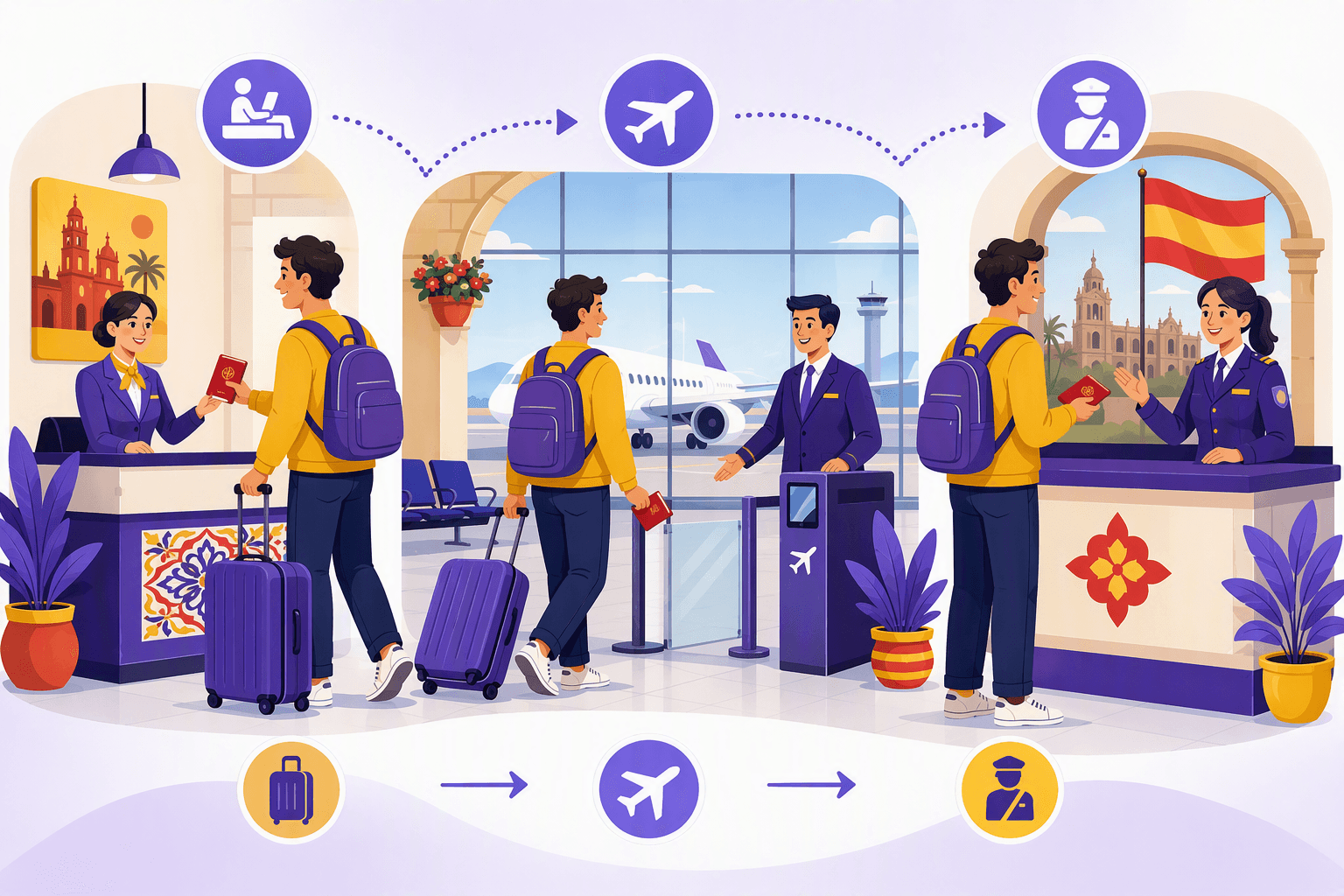
Start with polite airport Spanish
Airport interactions are brief, practical, and usually formal. A simple buenos días /ˈbwenos ˈdi.as/ or buenas tardes /ˈbwenas ˈtaɾðes/, followed by por favor /poɾ faˈβoɾ/, makes even a short request sound courteous.
Spanish speakers often soften requests with ¿Me puede ayudar? /me ˈpweðe aʝuˈðaɾ/, meaning “Can you help me?” The verb form is polite because it addresses the listener as usted /usˈteð/. For more on this distinction, see our guide to tú vs usted in Spanish.
Pragmatics researcher María Victoria Escandell-Vidal explains that meaning depends not only on grammar but also on social context. At an airport, polite wording is the safe default because you are usually speaking to staff you do not know.
Por favor
Por favor /poɾ faˈβoɾ/ means “please.” Put it at the end of a request or use it alone when handing over a document.
/meh PWEH-deh ah-yoo-DAR por fah-BOR/
Literal meaning: Can you help me, please?
“Disculpe, ¿me puede ayudar, por favor?”
Excuse me, can you help me, please?
This is a dependable polite request for airline, security, customs, and information-desk staff.
Disculpe
Use disculpe /disˈkulpe/ to get someone’s attention politely, similar to “excuse me.” It is especially useful before a question when staff are busy or when you need to approach a stranger.
Do not confuse it with perdón /peɾˈdon/, which can also mean “sorry” or “excuse me.” Both work, but disculpe sounds particularly appropriate when beginning a request.
Check-in and baggage phrases
At check-in, staff may ask for your passport, reservation, destination, and luggage. The Spanish word for check-in varies a little: Spain often uses facturación /faktuɾaˈsjon/, while some Latin American airports use registro /reˈxistɾo/ or the English borrowing check-in /ˈtʃek.in/.
The Real Academia Española records facturar /faktuˈɾaɾ/ as the verb used for checking baggage or processing it for transport. Knowing that verb helps you recognize signs such as facturación de equipaje /faktuɾaˈsjon ðe ekiˈpaxe/.
Tengo una reserva
Say Tengo una reserva /ˈteŋɡo ˈuna reˈseɾβa/ when you arrive at the airline desk. You can follow it with your name: Está a nombre de... /esˈta a ˈnombɾe ðe/, meaning “It is under the name of…”
/TEHN-goh OO-nah reh-SEHR-bah ah NOHM-breh deh Smith/
Literal meaning: I have a reservation in the name of Smith.
“Buenos días, tengo una reserva a nombre de Smith.”
Good morning, I have a reservation under the name of Smith.
Reservation systems typically recognize surnames first. Have your passport and booking confirmation ready.
Quiero facturar una maleta
Quiero facturar una maleta /ˈkjeɾo faktuˈɾaɾ ˈuna maˈleta/ means “I want to check a suitcase.” A maleta /maˈleta/ is a suitcase, while equipaje /ekiˈpaxe/ is baggage in general.
In Mexico and several other Latin American countries, you may hear documentar una maleta /dokumenˈtaɾ ˈuna maˈleta/ for checking luggage. John M. Lipski’s work on Latin American Spanish emphasizes that regional vocabulary differs even when communication remains fully straightforward.
| English | Spanish | Pronunciation | Note |
|---|---|---|---|
| Passport | pasaporte | pah-sah-POR-teh | The document required for international travel. |
| Boarding pass | tarjeta de embarque | tahr-HEH-tah deh em-BAR-keh | Also called tarjeta de abordar in some regions. |
| Suitcase | maleta | mah-LEH-tah | A suitcase or large travel bag. |
| Carry-on baggage | equipaje de mano | eh-kee-PAH-heh deh MAH-noh | Baggage you take into the cabin. |
| Checked baggage | equipaje facturado | eh-kee-PAH-heh fak-too-RAH-doh | Baggage placed in the aircraft hold. |
| Baggage allowance | franquicia de equipaje | frahn-KEE-syah deh eh-kee-PAH-heh | The baggage amount included with a ticket. |
💡 Show documents while you speak
If pronunciation feels difficult, say the key phrase, then show your passport, phone confirmation, or boarding pass. Airport staff are used to helping international travelers, and visual context makes communication much easier.
Security, gates, and boarding
Security signs often use control de seguridad /konˈtɾol ðe seɣuɾiˈðað/. You may be asked to place items in a tray, remove electronics, or show your boarding pass.
For the gate, look for puerta de embarque /ˈpweɾta ðe emˈbaɾke/. In many Latin American airports, announcements and signs may instead say sala de abordar /ˈsala ðe aβoɾˈðaɾ/. Both refer to the place where passengers board.
¿Dónde está la puerta de embarque?
This is the essential direction question: ¿Dónde está la puerta de embarque? /ˈdonde esˈta la ˈpweɾta ðe emˈbaɾke/. Add your flight number if you have it: ¿Dónde está la puerta para el vuelo 432? /ˈdonde esˈta la ˈpweɾta ˈpaɾa el ˈbwelo kwatɾoˈsjentos tɾejnta i ˈðos/.
/ah keh OH-rah em-PYEH-sah el em-BAR-keh/
Literal meaning: At what time does boarding begin?
“¿A qué hora empieza el embarque para Madrid?”
What time does boarding begin for Madrid?
Embarque means boarding. On screens, you may see embarcando for boarding in progress.
¿Este es el vuelo para...?
Use ¿Este es el vuelo para...? /ˈeste es el ˈbwelo ˈpaɾa/ when you want to confirm the destination before boarding. It is a useful backup if gate changes or announcements make you uncertain.
A related phrase is ¿Este asiento está libre? /ˈeste aˈsjento esˈta ˈliβɾe/, “Is this seat free?” This works in the gate area and on board.
Delays, missed flights, and connections
A delay is un retraso /un reˈtɾaso/. If the airline makes an announcement too quickly, ask ¿Puede repetirlo, por favor? /ˈpweðe repeˈtiɾlo poɾ faˈβoɾ/, meaning “Can you repeat it, please?”
For a connecting flight, use conexión /konekˈsjon/. In some regions, passengers also say vuelo de conexión /ˈbwelo ðe konekˈsjon/ or escala /esˈkala/, though an escala can also mean a scheduled stop.
Mi vuelo está retrasado
Say Mi vuelo está retrasado /mi ˈbwelo esˈta retrasaˈðo/ when explaining the problem. You can then ask ¿Voy a perder mi conexión? /boi a peɾˈðeɾ mi konekˈsjon/, “Am I going to miss my connection?”
/pehr-DEE mee koh-nehk-SYON keh PWEH-doh ah-SEHR/
Literal meaning: I lost my connection. What can I do?
“Perdí mi conexión por el retraso. ¿Qué puedo hacer?”
I missed my connection because of the delay. What can I do?
Go to the airline's transfer desk as soon as possible. Keep your boarding passes and any delay notice.
Perdí mi vuelo
Perdí mi vuelo /peɾˈði mi ˈbwelo/ means “I missed my flight.” This can be stressful, but clear facts help: state your flight number, show your booking, and ask for the next step.
You might hear reprogramar /repɾoɣɾaˈmaɾ/ for rescheduling or cambiar el vuelo /kamˈbjaɾ el ˈbwelo/ for changing the flight. The exact policy depends on your airline and fare conditions.
🌍 Why announcements can sound fast
Airport announcements often use formal, standardized Spanish and are delivered quickly over loudspeakers. Focus on your airline name, flight number, destination, gate number, and words such as retrasado, cancelado, embarque, and última llamada. You do not need to understand every sentence.
Customs and arrivals
After landing, follow signs for llegadas /ʝeˈɣaðas/, meaning arrivals, and recogida de equipaje /rekoˈxiða ðe ekiˈpaxe/, baggage claim. In many Latin American airports, baggage claim may be labeled reclamo de equipaje /reˈklamo ðe ekiˈpaxe/.
At customs, aduana /aˈðwana/, answer plainly and honestly. You may be asked ¿Tiene algo que declarar? /ˈtjene ˈalɣo ke deklaˈɾaɾ/, meaning “Do you have anything to declare?”
No tengo nada que declarar
No tengo nada que declarar /no ˈteŋɡo ˈnaða ke deklaˈɾaɾ/ is the standard answer if you have nothing to declare. If you do need clarification, say No entiendo /no enˈtjendo/ or ¿Puede hablar más despacio? /ˈpweðe aˈβlaɾ mas ðesˈpasjo/, “Can you speak more slowly?”
The Diccionario panhispánico de dudas is useful here because it reflects shared Spanish usage across countries, not only Spain. Airport Spanish is largely international, but local labels, accents, and a few terms can change.
A practical airport mini-dialogue
Here is how several phrases fit together in a realistic check-in interaction. Read it aloud once, then practice replacing the destination and surname.
Pasajero: Buenos días. Tengo una reserva a nombre de Lee.
Agente: Buenos días. ¿Me muestra su pasaporte, por favor?
Pasajero: Sí, aquí tiene. Quiero facturar una maleta.
Agente: Perfecto. ¿Tiene equipaje de mano?
Pasajero: Sí. ¿Dónde está la puerta de embarque?
Agente: La puerta 18. El embarque empieza a las 14:20.
Pasajero: Muchas gracias.
The final phrase, muchas gracias /ˈmutʃas ˈɣɾasjas/, matters. A friendly close leaves a better impression, especially after a rushed interaction. You can also review how to say goodbye in Spanish before your trip.
How to practice airport Spanish before flying
Do not memorize 40 phrases as isolated text. Practice them in short situations: find the check-in desk, check a bag, locate a gate, report a delay, and pass through customs.
Watch scenes involving travel, pause after a line, repeat it, then say the line with your own destination and name. This builds faster recall than reading a list once. For broader preparation, our Spanish travel phrases guide covers hotels, restaurants, directions, and emergencies too.
Before leaving for the airport, save five phrases on your phone: Necesito ayuda /neseˈsito aˈʝuða/, No entiendo /no enˈtjendo/, ¿Puede repetirlo? /ˈpweðe repeˈtiɾlo/, ¿Dónde está la puerta de embarque? /ˈdonde esˈta la ˈpweɾta ðe emˈbaɾke/, and Perdí mi conexión /peɾˈði mi konekˈsjon/. Those five cover the moments when language support matters most.
Frequently Asked Questions
What are the most useful Spanish phrases at an airport?
How do I ask where the gate is in Spanish?
Is Spanish at airports different in Spain and Latin America?
How do I say I missed my flight in Spanish?
Should I use tú or usted with Spanish airport staff?
Sources & References
- Instituto Cervantes, El español: una lengua viva, 2024
- Real Academia Española and Asociación de Academias de la Lengua Española, Diccionario panhispánico de dudas, accessed 2026
- Real Academia Española, Diccionario de la lengua española, accessed 2026
- Ethnologue, 27th edition, 2024
- John M. Lipski, Latin American Spanish, Routledge
Start learning with Wordy
Watch real movie clips and build your vocabulary as you go. Free to download.


