Quick Answer
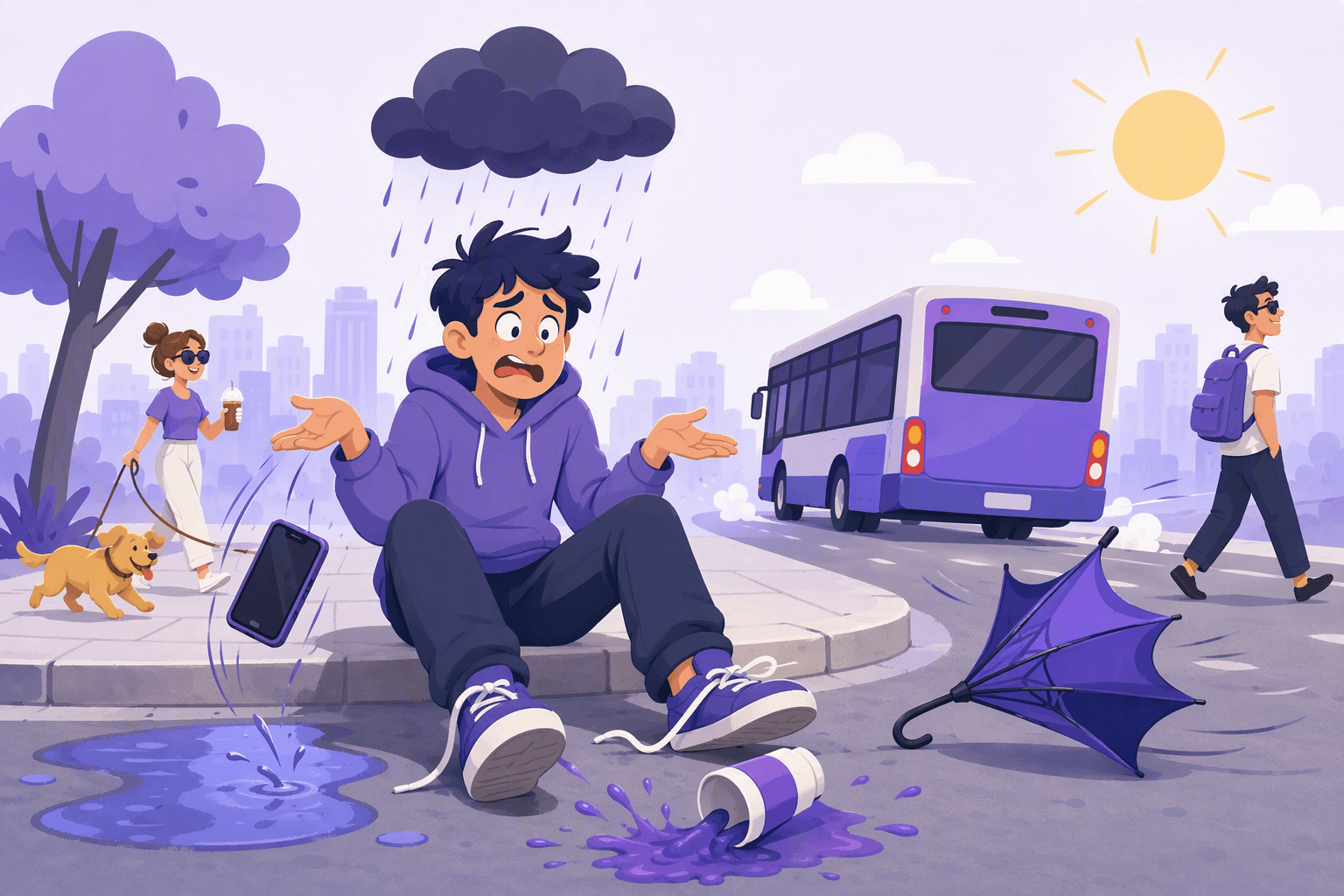
FML means 'f*** my life.' People use it online and in texts to express frustration, embarrassment, or bad luck, often with humor or exaggeration. It is vulgar because it contains a swear word, so it can sound too intense in professional settings, with strangers, or around kids.
FML means "f*** my life," a slang acronym people use in texts, memes, and social posts to express frustration, embarrassment, or bad luck, often with a joking, exaggerated tone. Because it includes a swear word, it can sound harsher than it looks, and it is best avoided in professional or mixed-age settings.
| English | English | Pronunciation | Formality |
|---|---|---|---|
| Meaning | FML = 'f*** my life' | EFF-em-ELL | slang |
| Typical tone | Frustrated, embarrassed, dark-humor | N/A | slang |
| Safer alternative | I can't catch a break | eye kant KATCH uh BRAYK | polite |
| Where to avoid | Work, school, family chats | N/A | formal |
What FML means (and what it implies)
FML is shorthand for "f*** my life." It is a compressed way to say, "I feel like everything is going wrong for me right now."
Even when it is used as a joke, it still carries a negative emotional punch. In English-speaking cultures, swearing often signals intensity, closeness, or loss of control, so readers may interpret FML as stronger than the situation deserves.
The pronunciation you will actually hear
People often say the letters out loud: "EFF-em-ELL." In speech, it can be a quick punchline after a story.
Some people also say the full phrase, but that is much more explicit. If you are learning English, treat the acronym as profanity-adjacent, not neutral vocabulary.
Is FML a swear word?
FML contains a swear word, but it is not always treated the same as writing the full profanity. Many platforms and workplaces still consider it inappropriate because the meaning is obvious.
If you want a fuller map of what counts as mild vs strong profanity, see our English swear words guide. It helps you judge how risky something is before you copy it from a meme.
Where FML came from (and why it spread)
FML is part of a broader internet pattern: turning emotional phrases into short acronyms that are fast to type and easy to reuse. Dictionaries now track these forms because they are stable, widely understood, and show up in edited writing online (Oxford English Dictionary, 2026).
FML also fits meme culture. It is short, dramatic, and works as a caption under a photo of a minor disaster.
Why acronyms feel "safer" than full profanity
Acronyms create distance. You are not typing the swear word, so it can feel less confrontational.
But most readers decode FML instantly, especially native speakers. That means the social effect is often similar to swearing, even if the letters look cleaner.
How strong is FML? Tone, intensity, and context
FML can mean anything from "ugh, annoying" to "I feel hopeless," depending on context. That range is exactly why it can be risky.
A useful rule is to read it as a volume knob. The letters are small, but the emotional volume can be loud.
"Meaning in digital communication is not carried by words alone, but by context, relationship, and shared norms. The same expression can be playful among friends and alarming in a different audience."
Professor Naomi S. Baron, linguist and author of "Words Onscreen"
When FML is usually playful
You will often see FML after:
- Small bad luck: missed train, spilled drink, wrong file uploaded
- Social embarrassment: awkward typo, tripped in public
- Relatable annoyance: long lines, broken phone screen
In these cases, it functions like a dramatic sigh. The humor comes from exaggeration.
When FML can signal something more serious
If FML appears with:
- Mentions of depression, panic, or "I can't do this"
- Talk about self-harm, suicide, or "no reason to live"
- A sudden change in someone’s normal tone
Treat it as a possible distress signal. You do not need to diagnose anything, but you should check in privately and directly.
⚠️ If you are not sure, ask
If a friend uses FML in a way that feels heavier than usual, respond with something simple and human: "Are you okay?" or "Do you want to talk?" In English, direct concern is normal and often appreciated.
When you should not use FML (even if others do)
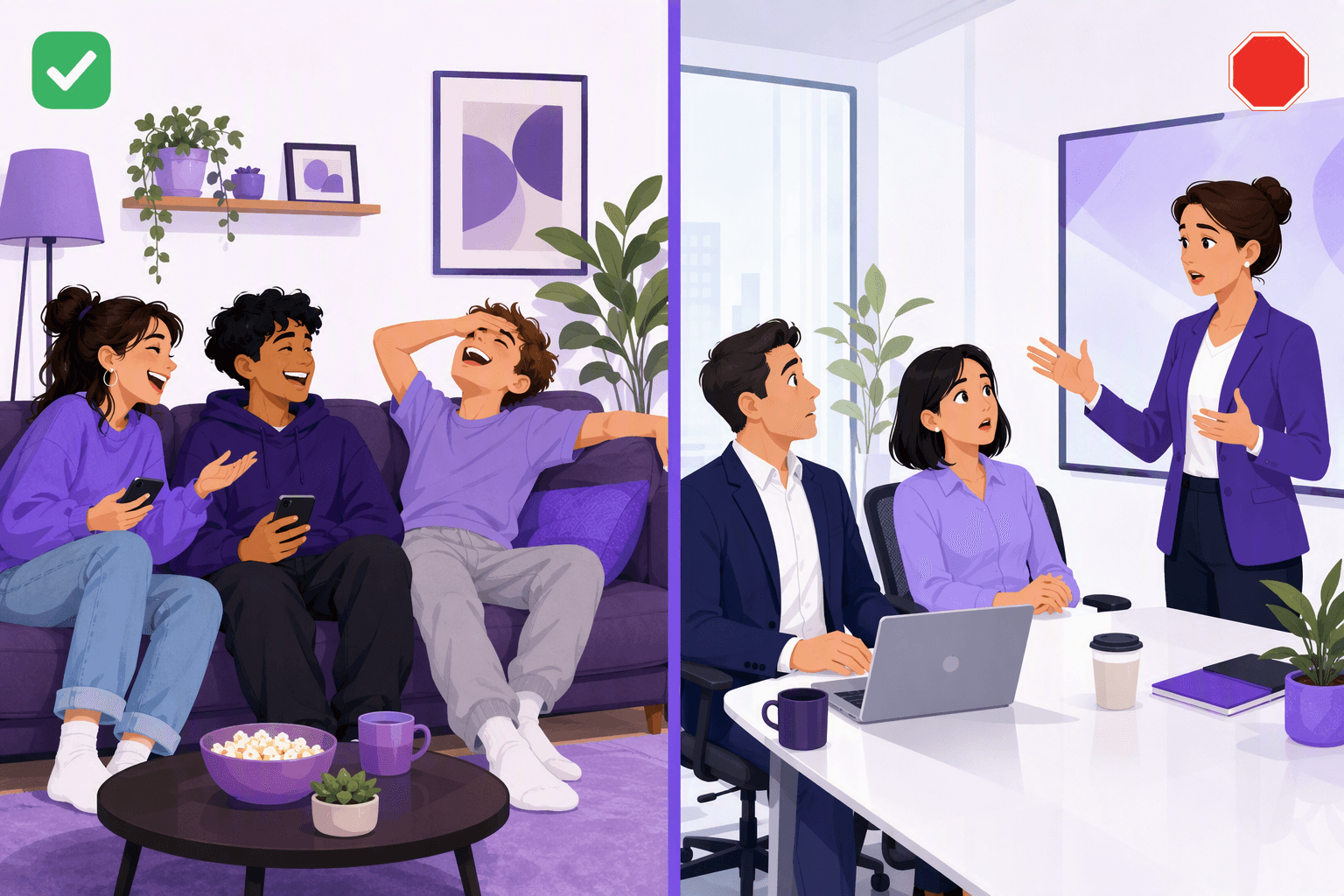
FML is common online, but "common" is not the same as "appropriate." In English, profanity is strongly shaped by setting and power dynamics.
Avoid FML in:
- Work chats, emails, and meetings
- School or university messages with instructors
- Customer service interactions
- Public posts tied to your real name, especially if you are job hunting
If you want workplace-safe phrasing, you will get better results with neutral complaint language. Think "That’s frustrating" or "I’m having a rough day."
Why it lands differently in professional English
Professional English norms prioritize emotional control and clarity. Swearing can be read as impulsive, hostile, or immature, even when self-directed.
This is also why many learners feel confused: a coworker might swear casually in person, but still expect clean language in writing.
Real-world usage: texts, memes, and spoken English
FML is primarily written slang. It appears in:
- Text messages and group chats
- Comment sections
- Meme captions
- Gaming and streaming chat
In spoken English, it is more common to hear "FML" as letters than the full phrase. It is also more common among younger speakers and online communities.
The scale of English online (why you will see FML everywhere)
English is the dominant language of much global internet culture. Ethnologue estimates about 1.5 billion English speakers worldwide when you combine native and second-language speakers (Ethnologue, 2024).
That scale matters because slang spreads faster when a language is used across many countries, platforms, and fandoms. A short acronym like FML travels well.
Teens and online language norms
Online slang is especially visible among teens and young adults. Pew Research Center reports that 95% of US teens have access to a smartphone, and 46% say they are online "almost constantly" (Pew Research Center, 2022).
High-frequency online interaction creates a perfect environment for acronyms, in-jokes, and shorthand emotional expressions like FML.
FML vs similar acronyms (and how they differ)
FML is part of a cluster of frustration acronyms. They are not interchangeable, and native speakers notice the differences.
| Acronym | Typical meaning | Target of frustration | Vulgar? | Notes |
|---|---|---|---|---|
| FML | "f*** my life" | self, situation | yes | self-pity, bad luck, embarrassment |
| WTF | "what the f***" | event, statement | yes | shock, disbelief, sometimes anger |
| FFS | "for f***’s sake" | person, situation | yes | impatience, often directed outward |
| SMH | "shaking my head" | person, situation | no | disapproval, mild frustration |
| RIP | "rest in peace" | event, loss | no | used seriously or ironically |
If you want more everyday internet expressions that are not necessarily profane, read our English slang list.
Safer alternatives that keep the feeling
If you like the emotional clarity of FML but need a cleaner register, English has many options. The key is choosing the right intensity.
Mild frustration (work-safe)
- "That’s frustrating."
- "What a day."
- "Of course that happened."
- "I’m having a rough morning."
Bad luck vibe (still safe)
- "Just my luck."
- "I can’t catch a break."
- "Everything’s going wrong today."
Dramatic, but not profane
- "I’m so done."
- "This is a disaster."
- "Why is my life like this?"
Be careful with "kill me" as a joke. Some friend groups use it lightly, but it can sound alarming, especially across cultures or in writing where tone is harder to read.
💡 A quick tone test
If you would not say it in front of your boss, your teacher, or your grandmother, do not type it in a group chat with mixed audiences. Written English is easy to screenshot and easy to misread.
How to respond when someone texts you "FML"
Native speakers usually respond in one of three ways, depending on closeness and seriousness.
Option 1: Supportive check-in
Use this when you care about the person, or the situation sounds real.
- "Oh no, what happened?"
- "Are you okay?"
- "Want to talk?"
Option 2: Light humor (only if the vibe is clearly joking)
- "Nooo, not like this."
- "That’s brutal."
- "Rough. Coffee on me next time."
Option 3: Practical help
- "Do you want me to call?"
- "I can help you fix it."
- "Send me a screenshot."
If you are learning English, notice that supportive responses are often short. In many English-speaking contexts, quick empathy plus a question is the default.
Cultural nuance: why FML is common in humor
FML fits a specific modern humor style: self-deprecating, slightly dark, and fast. It is a way to share vulnerability without writing a long emotional message.
It also works as "social bonding through complaining." Complaints can create closeness when they are framed as relatable, not aggressive.
The "public diary" effect of social media
On platforms where people narrate daily life, small failures become content. FML is a ready-made caption that signals, "This is a moment, laugh with me."
That said, different English-speaking cultures vary. In some workplaces in the US, swearing is common in speech but still discouraged in writing. In many UK friend groups, swearing can be more normalized, but context still rules.
Using Wordy to learn slang without copying mistakes
Movie and TV dialogue teaches you something textbooks miss: how tone changes meaning. In a script, you can hear whether a character is joking, spiraling, or performing for friends.
If you are learning English through clips, focus on:
- Who is speaking to whom (power and closeness)
- The setting (private vs public)
- The consequence (does anyone react negatively?)
For more structured basics that help you interpret slang, it also helps to be solid on "boring" essentials like numbers and dates. Our guides to English numbers and English months make everyday messages easier to follow, so slang does not become your only tool.
Examples of FML in context (with interpretation)
These examples show how the same acronym can feel different.
| Message | Likely meaning | How it sounds |
|---|---|---|
| "Dropped my phone in the sink. FML." | annoyed, bad luck | comedic frustration |
| "I studied all week and still failed. FML." | upset, discouraged | could be serious |
| "He saw my typo in the group chat. FML" | embarrassed | playful, self-mockery |
| "I can’t do this anymore. FML." | overwhelmed | treat as serious, check in |
Common learner mistakes with FML
Non-native speakers often learn slang from memes first, then use it in the wrong register.
Mistake 1: Using it as a casual "oops" with strangers
FML is not the same as "oops." It is emotionally heavier and includes profanity.
Mistake 2: Using it in customer service or travel situations
If your flight is canceled, you might feel FML, but saying it to staff can sound disrespectful. Use neutral English: "This is really frustrating, can you help me rebook?"
If you want travel-ready phrasing, our English travel phrases guide is built for exactly those moments.
Mistake 3: Assuming acronyms are always informal, not profane
Some acronyms are harmless (SMH), others are explicitly vulgar (FML, WTF, FFS). Acronym form does not reduce the swear content for many readers.
A quick decision guide: should I type FML?
Use this checklist.
- Are you talking to close friends who swear casually?
- Is the situation minor and clearly humorous?
- Would you be okay if this message was forwarded or screenshot?
If any answer is no, choose a safer alternative. You will still sound natural, just more socially aware.
Wrap-up: the practical meaning of FML in 2026
FML means "f*** my life," and it is used to express frustration, embarrassment, or bad luck, often as exaggerated humor. It is common online, but it is still vulgar and can be misread, especially in professional or mixed-audience spaces.
If you want to sound fluent, the goal is not using the most slang. The goal is choosing the right tone for the relationship and setting, then saving stronger language for contexts where it will not backfire.
For more on modern informal English, continue with our English slang guide and, if you want to understand the boundaries, our English swear words guide.
Frequently Asked Questions
What does FML stand for in texting?
Is FML always serious?
Is it rude to say FML?
What are safer alternatives to FML?
Is FML the same as FFS or WTF?
Sources & References
- Oxford English Dictionary, 'FML, int.', OED Online, 2026
- Merriam-Webster, 'Acronym', Merriam-Webster.com Dictionary, 2026
- Pew Research Center, 'Teens, Social Media and Technology', 2022
- Ethnologue, 'English', Ethnologue 27th edition, 2024
Start learning with Wordy
Watch real movie clips and build your vocabulary as you go. Free to download.


