Quick Answer
Spanish sports vocabulary starts with deporte for sport, fútbol for football, equipo for team, and partido for match. This guide teaches the words you need to play, watch, discuss, and follow sports naturally across the Spanish-speaking world.
Spanish sports vocabulary gives you the words to play, watch, and talk about games naturally: deporte /deˈpoɾte/ means sport, equipo /eˈkipo/ means team, partido /paɾˈtiðo/ means match, and ganar /ɡaˈnaɾ/ means to win. Learn the core terms below and you will be able to follow a Spanish commentary, make plans to play, or chat with fans after a game.
Spanish has more than 600 million potential speakers worldwide according to the Instituto Cervantes, and it is an official language in 20 sovereign countries. That reach matters in sport: a fan in Madrid, Mexico City, Buenos Aires, Bogotá, or Miami may use different local expressions, while still understanding the central vocabulary.
For a strong foundation beyond sports, start with these 100 most common Spanish words. They include high-frequency verbs and connectors that make sports conversations much easier to build.
| English | Spanish | Pronunciation | Note |
|---|---|---|---|
| sport | deporte | deh-POR-teh | Plural: deportes. |
| athlete | deportista | deh-por-TEES-tah | Works for athletes of any gender. |
| player | jugador / jugadora | hoo-gah-DOR / hoo-gah-DOH-rah | Changes for gender. |
| team | equipo | eh-KEE-poh | Also means equipment in some contexts. |
| match or game | partido | par-TEE-doh | Common for competitive games. |
| competition | competición | kohm-peh-tee-SYON | Also competencia in many regions. |
| tournament | torneo | tor-NEH-oh | Used for cups, opens, and brackets. |
| championship | campeonato | kahm-peh-oh-NAH-toh | Can mean a league title or competition. |
| league | liga | LEE-gah | A regular season competition. |
| season | temporada | tehm-poh-RAH-dah | Sports season or TV season. |
| coach | entrenador / entrenadora | ehn-treh-nah-DOR / ehn-treh-nah-DOH-rah | Technical director is also common in football. |
| referee | árbitro / árbitra | AR-bee-troh / AR-bee-trah | Umpire depends on the sport. |
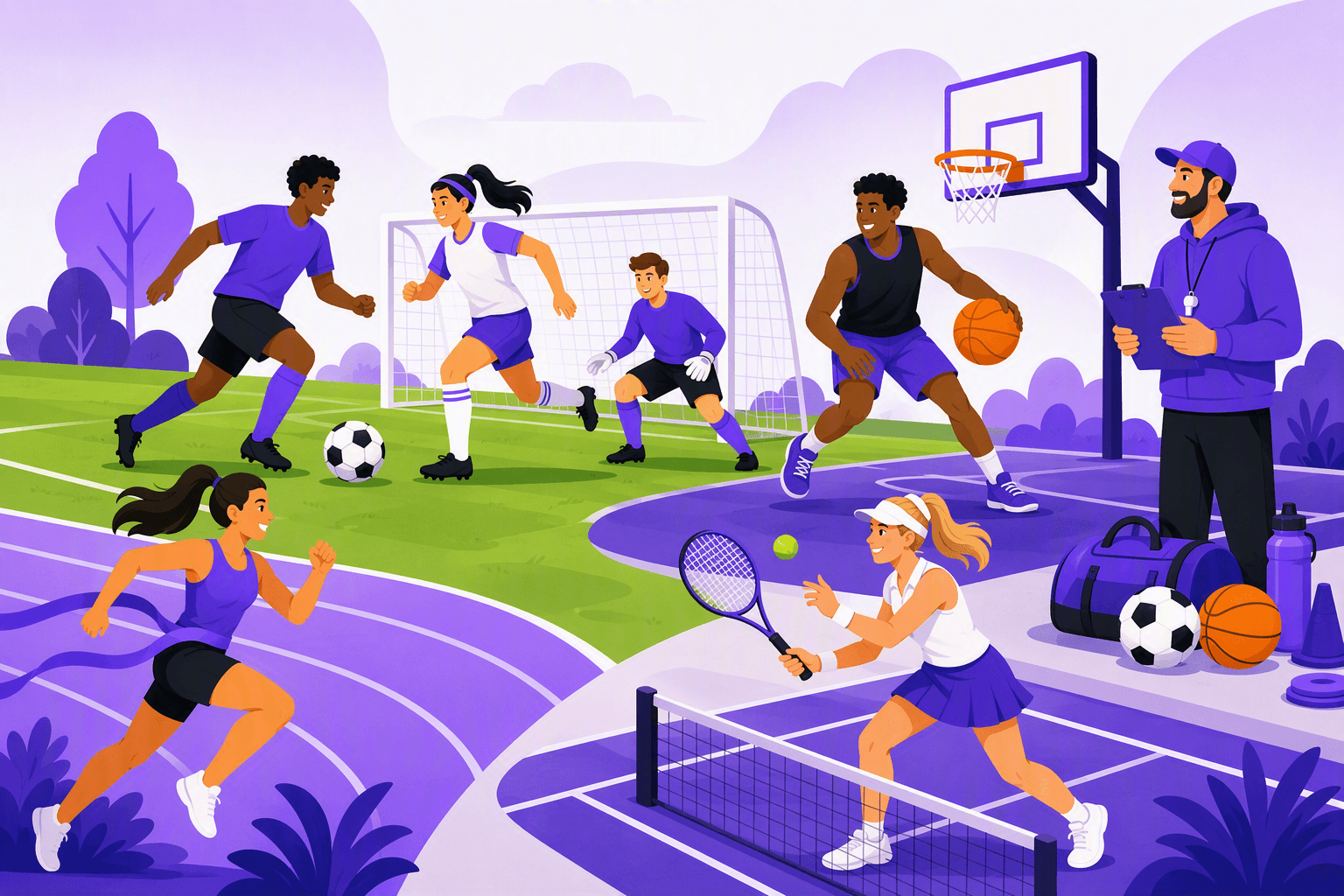
The essential words for any sport
The broad term deporte /deˈpoɾte/ covers sport as an activity, while deportes /deˈpoɾtes/ means sports in general. To say you play sports or exercise, use hacer deporte /aˈseɾ deˈpoɾte/, literally to do sport.
A person who participates is a deportista /depoɾˈtista/. This is especially useful because it is gender-neutral, unlike jugador /xuɣaˈðoɾ/ and jugadora /xuɣaˈðoɾa/, which mean male and female player.
A partido /paɾˈtiðo/ is a match or game. You might hear el partido de hoy /el paɾˈtiðo de oj/, the game today, or ver el partido /beɾ el paɾˈtiðo/, to watch the match.
The Real Academia Española records both competición /kompetiˈθjon/ and competencia /kompeˈtenθja/ for competition. In much of Latin America, competencia is particularly frequent, while competición is widely heard in Spain and formal sports reporting.
Fútbol
Fútbol /ˈfutβol/ is football in nearly all Spanish-speaking countries, and it is the sport with the richest shared vocabulary. FIFA has 211 member associations, which helps explain why football terminology travels so easily across borders, even when local fan culture differs.
In US Spanish, soccer /ˈsokeɾ/ is common, especially in media and among bilingual speakers. Use fútbol americano /ˈfutβol ameɾiˈkano/ for American football.
| English | Spanish | Pronunciation | Note |
|---|---|---|---|
| football or soccer | fútbol | FOOT-bol | Soccer is also common in US Spanish. |
| goal | gol | GOHL | The score and the netted goal. |
| goalkeeper | portero / portera | por-TEH-roh / por-TEH-rah | Arquero is common in South America. |
| defender | defensa | deh-FEHN-sah | Same form for men and women. |
| midfielder | centrocampista | sehn-troh-kahm-PEES-tah | Also mediocampista. |
| forward or striker | delantero / delantera | deh-lahn-TEH-roh / deh-lahn-TEH-rah | Atacante is another broad option. |
| penalty kick | penalti | peh-NAHL-tee | Also penalty, especially in Latin America. |
| offside | fuera de juego | FWEH-rah deh HWEH-goh | Literally outside of play. |
| corner kick | saque de esquina | SAH-keh deh ehs-KEE-nah | Córner is also widely used. |
| yellow card | tarjeta amarilla | tar-HEH-tah ah-mah-REE-yah | Yellow card caution. |
| red card | tarjeta roja | tar-HEH-tah ROH-hah | Usually means dismissal. |
| extra time | prórroga | PROH-rroh-gah | Extra time after a draw. |
A gol /ɡol/ is a goal, and marcar un gol /maɾˈkaɾ uŋ ɡol/ means to score one. In everyday speech, fans may also shout ¡gol! /ɡol/ on its own, holding the vowel for dramatic effect.
The goalkeeper is a portero /poɾˈteɾo/ or portera /poɾˈteɾa/ in Spain. In Argentina, Chile, Colombia, Peru, and several other countries, arquero /aɾˈkeɾo/ is very common. Both are safe choices, though using the local term helps you sound more connected to the region.
A football field is commonly a campo /ˈkampo/ or a cancha /ˈkantʃa/. Cancha is especially widespread across Latin America and can refer to the playing surface for many sports, not only football.
🌍 Football vocabulary changes by region
In Spain, a football commentator may say equipo, portero, córner, and prórroga. In much of Latin America, you may hear cuadro for team, arquero for goalkeeper, tiro de esquina for corner kick, and tiempo extra for extra time. These are regional preferences, not right-versus-wrong forms.
The style of sports reporting is part of the appeal. FundéuRAE regularly publishes guidance on sports language because headlines favor compact, energetic nouns and verbs. A commentator may say remate /reˈmate/, shot, atajada /ataˈxada/, save, and contraataque /kontɾaaˈtake/, counterattack, in rapid succession.
Baloncesto
Baloncesto /balonˈθesto/ is basketball. In Spain, this is the standard word, while básquet /ˈbasket/ and basquetbol /basketˈβol/ are particularly common in Latin America.
| English | Spanish | Pronunciation | Note |
|---|---|---|---|
| basketball | baloncesto | bah-lohn-SEHS-toh | Básquet is common in Latin America. |
| basket or hoop | canasta | kah-NAHS-tah | Also means basket in daily life. |
| three-pointer | triple | TREE-pleh | A three-point shot. |
| free throw | tiro libre | TEE-roh LEE-breh | Basketball free throw. |
| rebound | rebote | reh-BOH-teh | Also used in other ball sports. |
| tennis | tenis | TEH-nees | Stress falls on the first syllable. |
| racket | raqueta | rah-KEH-tah | For tennis, padel, squash, and more. |
| serve | saque | SAH-keh | The noun; sacar is the verb. |
| volleyball | voleibol | voh-lay-ee-BOL | Vóley is a common short form. |
| set | set | SEHT | Used in tennis and volleyball. |
| point | punto | POON-toh | A point in a score. |
| court | cancha | KAHN-chah | Also playing surface generally. |
In basketball, canasta /kaˈnasta/ can mean both a basket as an object and a successful basket in a game. Encestar /enθesˈtaɾ/ means to score a basket, while tirar a canasta /tiˈɾaɾ a kaˈnasta/ means to shoot.
For tennis, saque /ˈsake/ is a serve, raqueta /raˈketa/ is a racket, and pelota /peˈlota/ is a ball. A tennis court is a pista /ˈpista/ in many contexts, whereas cancha /ˈkantʃa/ remains broadly understood.
The borrowed word set /set/ is standard in both tennis and volleyball. Spanish often adapts English sports terms selectively, but it also creates its own transparent terms, such as tiro libre /ˈtiɾo ˈliβɾe/ for free throw.
Atletismo
Atletismo /atleˈtismo/ refers to track and field. Do not confuse it with the English use of athletics as a general label for sport: in Spanish, atletismo usually points specifically to running, jumping, throwing, and related track-and-field events.
| English | Spanish | Pronunciation | Note |
|---|---|---|---|
| athletics or track and field | atletismo | aht-leh-TEES-moh | Track, field, jumps, and throws. |
| running | correr | koh-RREHR | Verb: to run. |
| race | carrera | kah-RREH-rah | Also means career. |
| marathon | maratón | mah-rah-TON | Stress on the final syllable. |
| swimming | natación | nah-tah-SYON | The sport of swimming. |
| swimming pool | piscina | pee-SEE-nah | Pileta is common in parts of South America. |
| gym | gimnasio | heem-NAH-syoh | Also shortened to gym in casual speech. |
| workout or training | entrenamiento | ehn-treh-nah-MYEN-toh | From entrenar, to train. |
| strength | fuerza | FWEHR-sah | Useful in fitness and sport. |
| endurance | resistencia | rreh-sees-TEN-syah | Physical stamina or resistance. |
| stretch | estirar | eh-stee-RAHR | Verb: to stretch. |
| warm up | calentar | kah-lehn-TAHR | Verb: to warm up. |
To talk about an exercise routine, use entrenamiento /entɾenaˈmjento/, training or workout. The verb is entrenar /entɾeˈnaɾ/, to train. You can say entreno tres veces por semana /enˈtɾeno tɾes ˈβeses poɾ seˈmana/, I train three times a week.
For a runner, carrera /kaˈreɾa/ is a race, maratón /maɾaˈton/ is a marathon, and resistencia /resisˈtenθja/ is endurance. Remember that carrera also means career, so context matters: una carrera de diez kilómetros /una kaˈreɾa de ðjes kiˈlometɾos/ clearly means a ten-kilometer race.
Swimming is natación /nataˈθjon/, and a swimming pool is a piscina /pisˈθina/. In Argentina and Uruguay, you may hear pileta /piˈleta/ for pool. That regional range is a normal feature of Spanish, not a barrier to communication.
Francisco Moreno Fernández's work on Spanish varieties emphasizes that shared Spanish coexists with regional vocabulary and pronunciation patterns. Sport is a clear example: the activity is recognizable everywhere, but the preferred label may shift from one country to another.
Ganar
Ganar /ɡaˈnaɾ/ means to win. It is one of the first verbs you need when discussing scores, teams, or competitions.
Use ganar un partido /ɡaˈnaɾ um paɾˈtiðo/ for to win a game. The opposite is perder /peɾˈdeɾ/, to lose: perdimos el partido /peɾˈðimos el paɾˈtiðo/ means we lost the match.
Other useful result words include empatar /empaˈtaɾ/, to tie or draw, and empate /emˈpate/, a tie. In football, if a knockout match is tied, it may go to prórroga /ˈpɾoroɣa/, extra time, and then possibly penaltis /peˈnaltis/, penalty kicks.
Useful sentences for fans
- ¿Quién juega hoy? /kjen ˈxweɣa oj/ means Who is playing today?
- ¿A qué hora empieza el partido? /a ke ˈoɾa emˈpjeθa el paɾˈtiðo/ means What time does the match start?
- Mi equipo ganó. /mi eˈkipo ɣaˈno/ means My team won.
- Fue un partido muy reñido. /fwe um paɾˈtiðo muj reˈɲiðo/ means It was a very close match.
- Vamos a ver el partido. /ˈbamos a beɾ el paɾˈtiðo/ means We are going to watch the game.
- ¡Qué golazo! /ke ɣoˈlaso/ means What an amazing goal!
A golazo /ɡoˈlaso/ adds the suffix -azo /ˈaso/ to gol /ɡol/. It signals that a goal was especially impressive, powerful, or beautiful. María Moliner's Diccionario de uso del español is useful here because it documents how suffixes add emotional force and evaluation, not just literal size.
🌍 The fan meaning of vamos
Vamos /ˈbamos/ literally means we go, but supporters use it as an encouragement similar to come on. You may hear ¡vamos, equipo! /ˈbamos eˈkipo/ at any level of competition. It is energetic but not rude, and it works for friends as well as professional teams.
How to learn sports Spanish from real clips
Sports words become easier to remember when you hear them attached to visible action. Watch a short highlight and identify the event first: a goal, a save, a foul, a sprint, or a celebration. Then replay the commentary and listen for the Spanish word that labels what you just saw.
Start with clips that have a predictable structure. Football highlights repeat gol /ɡol/, pase /ˈpase/, pass, tiro /ˈtiɾo/, shot, and falta /ˈfalta/, foul, often enough that you can connect sound and meaning quickly.
For conversation, practice short reactions rather than long monologues. Say qué partido /ke paɾˈtiðo/, what a game, after a tense match, or jugó muy bien /xuˈɣo muj βjen/, he or she played very well, after a strong performance.
If you are preparing for a Spanish-speaking trip, pair these words with our Spanish travel phrases guide. A casual sports chat can be an easy opening with locals, especially when a major match is on.
💡 Learn verbs with a sport
Memorize verbs as small combinations: jugar al fútbol, practicar natación, hacer ejercicio, entrenar en el gimnasio, and ver un partido. Learning the noun alone is useful, but these combinations are what you will actually say.
A final note on speaking naturally
Sports Spanish is expressive, fast, and regional. Begin with the shared words, such as equipo /eˈkipo/, partido /paɾˈtiðo/, ganar /ɡaˈnaɾ/, and perder /peɾˈdeɾ/, then notice the local alternatives used by the commentators and fans you follow.
A greeting can open the conversation before the sports talk begins, so review how to say hello in Spanish. When the match ends, you can also use natural Spanish goodbyes instead of relying on one basic farewell.
Frequently Asked Questions
What is sport in Spanish?
What do Spanish speakers call football?
Is partido a game or a match in Spanish?
What is the difference between cancha and campo in Spanish?
How do I say I play sports in Spanish?
Sources & References
- Instituto Cervantes, El español: una lengua viva, 2025
- Real Academia Española, Diccionario de la lengua española, accessed 2026
- FundéuRAE, recomendaciones sobre lenguaje deportivo, accessed 2026
- FIFA, Laws of the Game 2025/26
- Francisco Moreno Fernández, Variedades de la lengua española, Routledge
Start learning with Wordy
Watch real movie clips and build your vocabulary as you go. Free to download.


