Quick Answer
Spanish school vocabulary includes la escuela for school, el aula for classroom, el profesor for teacher, and la tarea for homework. Learn these essential words by category so you can understand classroom instructions, discuss subjects, and talk naturally about school life.
Spanish school vocabulary gives you the words to identify people, classroom objects, subjects, and everyday routines: la escuela /la esˈkwela/ means school, el aula /el ˈawla/ means classroom, el profesor /el pɾofeˈsoɾ/ means teacher, and la tarea /la ˈtaɾea/ means homework. Start with these high-frequency terms, then learn useful instructions such as abre el libro /ˈaβɾe el ˈliβɾo/, open the book, and levanta la mano /leˈβanta la ˈmano/, raise your hand.
Spanish is spoken by more than 600 million potential speakers worldwide according to Instituto Cervantes, and it is an official language in 20 sovereign countries. That range matters in school vocabulary: colegio /koˈlexjo/ can mean school in many places, but local systems and labels vary. For a strong foundation, pair the words below with the everyday greetings in our guide to saying hello in Spanish.
| English | Spanish | Pronunciation | Note |
|---|---|---|---|
| school | la escuela | lah es-KWEH-lah | A general word for school. |
| classroom | el aula | el OW-lah | Often used for a physical classroom. |
| class | la clase | lah KLAH-seh | Can mean a lesson or a class group. |
| student | el estudiante | el es-too-dee-AHN-teh | Works for students of any gender with la estudiante. |
| teacher | el profesor | el proh-feh-SOR | Use la profesora for a female teacher. |
| principal | el director | el dee-rek-TOR | Use la directora for a female principal. |
| schoolmate | el compañero de clase | el kohm-pahn-YEH-roh deh KLAH-seh | Use la compañera for a female classmate. |
| school year | el año escolar | el AHN-yoh es-koh-LAR | Academic year. |
| grade level | el curso | el KOOR-soh | Meaning differs slightly by country. |
| schedule | el horario | el oh-RAH-ryoh | A timetable or daily schedule. |
| recess | el recreo | el reh-kreh-EH-oh | Break time between lessons. |
| cafeteria | la cafetería | lah kah-feh-teh-REE-ah | Also a cafe in many contexts. |
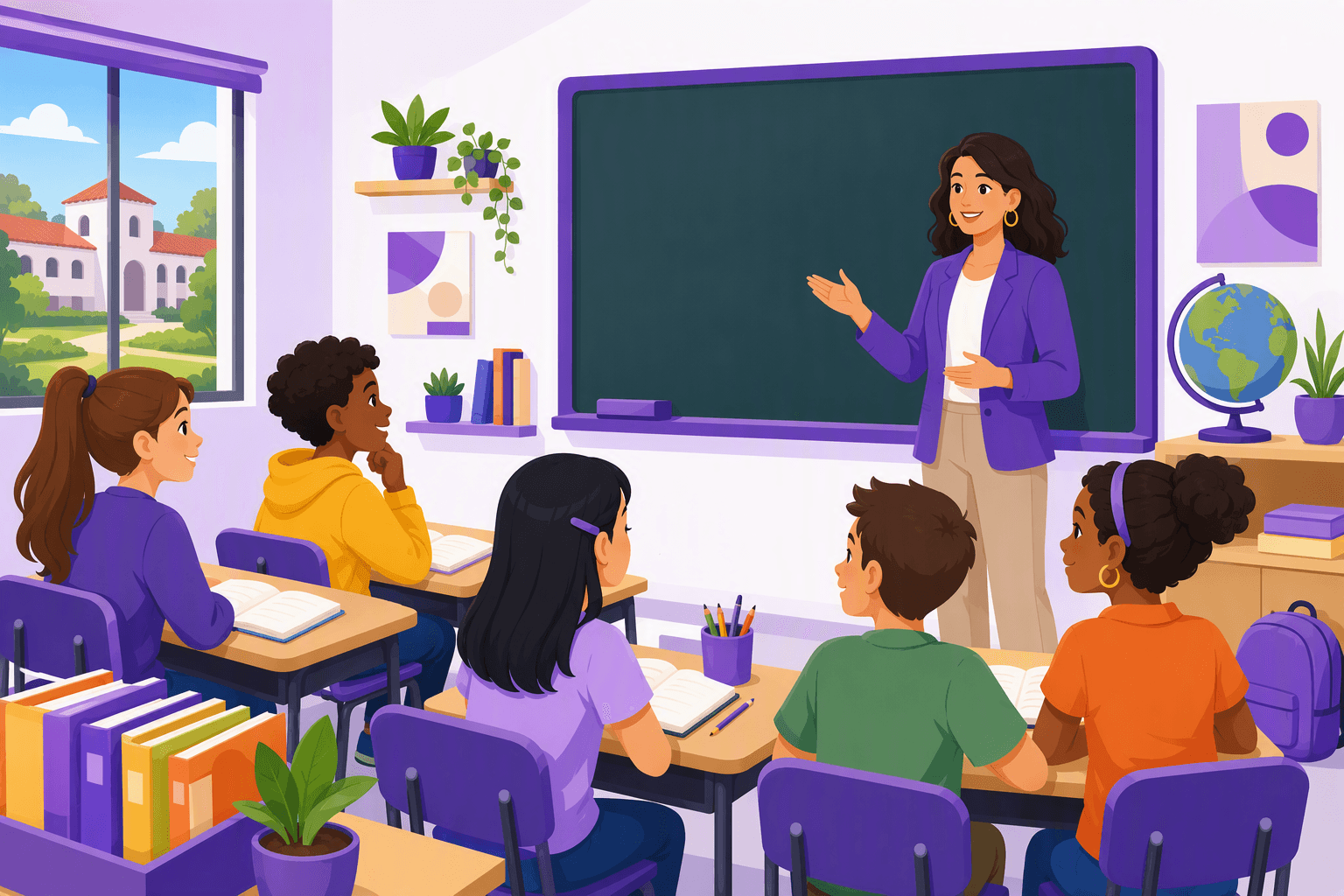
Core school words and regional differences
A Spanish speaker will understand escuela /esˈkwela/ almost everywhere. Yet the name of a particular institution often changes by region. Colegio /koˈlexjo/ is especially common for school in Colombia, Peru, Chile, and other Latin American countries.
In Spain, instituto /instiˈtuto/ frequently refers to a public secondary school, while colegio /koˈlexjo/ often refers to primary education or a private school. The Asociación de Academias de la Lengua Española records these regional meanings in its Diccionario de americanismos, a useful reminder that vocabulary reflects local institutions as well as language.
At university, you will hear la facultad /la fakulˈtað/, faculty or department, and la carrera /la kaˈreɾa/, degree program or major. Do not confuse carrera with a simple race: in education, it often describes the full course of study leading to a profession.
Gender is part of the word
Spanish nouns have grammatical gender, so learn the article with each word: el libro /el ˈliβɾo/, the book, and la libreta /la liˈβɾeta/, the notebook. Articles also help you build sentences correctly: Tengo un libro /ˈteŋɡo un ˈliβɾo/, I have a book.
For people, endings often change: el alumno /el aˈlumno/ and la alumna /la aˈlumna/. However, el estudiante /el estuˈðjante/ and la estudiante /la estuˈðjante/ keep the same noun form, changing only the article.
People at school
| English | Spanish | Pronunciation | Note |
|---|---|---|---|
| pupil or student | el alumno | el ah-LOOM-noh | Use la alumna for a female pupil. |
| student | el estudiante | el es-too-dee-AHN-teh | Same form for all genders. |
| teacher | el maestro | el my-ES-troh | Common especially for primary-school teachers. |
| teacher | el profesor | el proh-feh-SOR | Often used in secondary school or university. |
| classmate | el compañero | el kohm-pahn-YEH-roh | Use la compañera for a female classmate. |
| principal | el director | el dee-rek-TOR | Use la directora for a female principal. |
| counselor | el orientador | el oh-ryen-tah-DOR | Use la orientadora for a female counselor. |
| librarian | el bibliotecario | el bee-blyoh-teh-KAH-ryoh | Use la bibliotecaria for a female librarian. |
| parent | el padre | el PAH-dreh | Use la madre for mother. |
| parents | los padres | lohs PAH-drehs | Can refer to parents collectively. |
| class representative | el delegado | el deh-leh-GAH-doh | Use la delegada for a female representative. |
| graduate | el graduado | el grah-doo-AH-doh | Use la graduada for a female graduate. |
Maestro /maˈestɾo/ and profesor /pɾofeˈsoɾ/ both translate as teacher, but they can suggest different settings. A maestro is strongly associated with younger children and primary education, while profesor is common in secondary school, college, and specialist subjects.
The Real Academia Española dictionary recognizes both words and their gendered forms. In real conversation, use the title a school itself uses. Addressing a teacher as profe /ˈpɾofe/ is a common friendly shortening in many Spanish-speaking communities, but it is less formal than profesor /pɾofeˈsoɾ/.
Classroom objects and school supplies
| English | Spanish | Pronunciation | Note |
|---|---|---|---|
| book | el libro | el LEE-broh | A textbook is often el libro de texto. |
| notebook | el cuaderno | el kwah-DEHR-noh | A bound notebook. |
| notebook | la libreta | lah lee-BREH-tah | Common in many Latin American countries. |
| pencil | el lápiz | el LAH-pees | Plural: los lápices. |
| pen | el bolígrafo | el boh-LEE-grah-foh | Also called la pluma in some regions. |
| eraser | la goma | lah GOH-mah | In Spain, goma de borrar is especially clear. |
| ruler | la regla | lah REH-glah | Also means rule. |
| scissors | las tijeras | lahs tee-HEH-rahs | Usually plural. |
| backpack | la mochila | lah moh-CHEE-lah | A very common word across regions. |
| desk | el pupitre | el poo-PEE-treh | A student's desk, especially in school. |
| whiteboard | la pizarra | lah pee-SAH-rrah | Can also refer to a blackboard. |
| marker | el rotulador | el roh-too-lah-DOR | Common in Spain; marcador is common elsewhere. |
| computer | la computadora | lah kohm-poo-tah-DOH-rah | Ordenador is widely used in Spain. |
| worksheet | la hoja de trabajo | lah OH-hah deh trah-BAH-hoh | Literally a work sheet. |
A few supply words reveal regional variety immediately. Ordenador /oɾðenaˈðoɾ/ is the usual word for computer in Spain, while computadora /komputaˈðoɾa/ is widespread in Latin America. Similarly, a marker may be rotulador /rotulaˈðoɾ/ in Spain and marcador /maɾkaˈðoɾ/ in many other places.
These are not mistakes or competing standards. They are normal regional choices, just as English speakers may say notebook, exercise book, or copybook depending on where they live. Our Latin American vs Spain Spanish guide explains more of these practical differences.
💡 Learn words in visible groups
Put labels on a few real objects around your study space: el libro /el ˈliβɾo/, la mochila /la moˈtʃila/, el lápiz /el ˈlapis/, and la computadora /la komputaˈðoɾa/. Seeing the object while recalling the word creates a clearer memory than translating from a disconnected list.
Subjects, assignments, and assessment
| English | Spanish | Pronunciation | Note |
|---|---|---|---|
| math | las matemáticas | lahs mah-teh-MAH-tee-kahs | Often shortened to mates in Spain. |
| science | las ciencias | lahs SYEN-syahs | A broad school-subject term. |
| history | la historia | lah ees-TOH-ryah | History as a subject. |
| geography | la geografía | lah heh-oh-grah-FEE-ah | Stress falls on FEE. |
| language | la lengua | lah LENG-gwah | Can mean language or tongue. |
| Spanish class | el español | el es-pah-NYOL | The language and the subject share the name. |
| English class | el inglés | el een-GLEHS | A language subject. |
| physical education | la educación física | lah eh-doo-kah-SYON FEE-see-kah | Often shortened to educación física. |
| art | el arte | el AR-teh | Masculine in the singular. |
| music | la música | lah MOO-see-kah | A common school subject. |
| homework | la tarea | lah tah-REH-ah | Usually singular for homework as a whole. |
| assignment | el trabajo | el trah-BAH-hoh | Can mean task, assignment, or work. |
| exam | el examen | el ek-SAH-men | Plural: los exámenes. |
| test | la prueba | lah PRWEH-bah | A test, trial, or assessment. |
| grade | la nota | lah NOH-tah | A mark or grade. |
| to pass | aprobar | ah-proh-BAR | To pass an exam or class. |
| to fail | suspender | soos-pen-DEHR | Commonly used in Spain for failing an exam. |
| to study | estudiar | es-too-dee-AR | A regular -ar verb. |
A useful sentence is Tengo un examen mañana /ˈteŋɡo un ekˈsamen maˈɲana/, I have an exam tomorrow. To say you passed, use Aprobé el examen /apɾoˈβe el ekˈsamen/. In Spain, suspender un examen /suspenˈdeɾ un ekˈsamen/ is the usual opposite, to fail an exam.
The word nota /ˈnota/ can be confusing for English speakers because it means a grade in school, but it can also mean a note or musical note. Context normally makes the meaning clear: ¿Qué nota sacaste? /ke ˈnota saˈkaste/, what grade did you get?
Michael Lewis, in The Lexical Approach, argues for learning vocabulary as meaningful chunks rather than isolated dictionary entries. For school Spanish, that means remembering hacer la tarea /aˈseɾ la taˈɾea/, do homework, and sacar una buena nota /saˈkaɾ ˈuna ˈβwena ˈnota/, get a good grade, as complete units.
Classroom actions and instructions
Teachers rarely speak only in single nouns. The following classroom verbs help you follow what is happening in a lesson and form your own questions.
| Spanish instruction | IPA | Meaning |
|---|---|---|
| Escucha | /esˈkutʃa/ | Listen |
| Mira la pizarra | /ˈmiɾa la piˈsaɾa/ | Look at the board |
| Lee el texto | /ˈlee el ˈteksto/ | Read the text |
| Escribe tu nombre | /esˈkɾiβe tu ˈnomβɾe/ | Write your name |
| Abre el libro | /ˈaβɾe el ˈliβɾo/ | Open the book |
| Cierra la puerta | /ˈsjera la ˈpweɾta/ | Close the door |
| Levanta la mano | /leˈβanta la ˈmano/ | Raise your hand |
| Trabajen en grupos | /tɾaˈβaxen en ˈɡɾupos/ | Work in groups |
| Entreguen la tarea | /entɾeˈɣen la taˈɾea/ | Hand in the homework |
| Repitan después de mí | /reˈpitan desˈpwes de ˈmi/ | Repeat after me |
The singular commands, such as escucha /esˈkutʃa/ and escribe /esˈkɾiβe/, are for one familiar person. Teachers addressing an entire class usually use plural commands: escuchen /esˈkutʃen/, escriban /esˈkɾiβan/, and lean /ˈlean/.
Norbert Schmitt's Vocabulary in Language Teaching emphasizes that knowing a word includes knowing how it behaves with other words. Learning mano /ˈmano/, hand, is useful. Learning levantar la mano /leβanˈtaɾ la ˈmano/ gives you an immediately usable classroom action.
🌍 Politeness in Spanish-speaking classrooms
Classroom formality varies by country, age group, and school culture. Students may call a teacher profesor, profesora, maestro, maestra, or the shortened profe. When speaking to a teacher for the first time, use a polite greeting such as Buenos días /ˈbwenos ˈðias/ and follow the terms classmates use.
How to practice Spanish school vocabulary
First, choose 10 words connected to your own routine. For example, name the objects you use, the subjects you study, and one action you take before class. Say a short sentence for each: Necesito mi cuaderno /neseˈsito mi kwaˈðeɾno/, I need my notebook.
Second, learn words through scenes rather than only flashcards. A classroom scene in a Spanish-language film or series gives you faces, gestures, objects, and tone at the same time. This contextual exposure helps you notice how profe /ˈpɾofe/, tarea /taˈɾea/, and examen /ekˈsamen/ appear in natural speech. For more listening-focused strategies, see our guide to Spanish listening practice.
Third, make short exchanges. Ask ¿Cuál es tu materia favorita? /kwal es tu maˈteɾja faβoˈɾita/, what is your favorite subject? Answer Mi materia favorita es la historia /mi maˈteɾja faβoˈɾita es la isˈtoɾja/, my favorite subject is history. These small patterns turn vocabulary into conversation.
Finally, learn a natural exit phrase for the end of the school day. Hasta mañana /ˈasta maˈɲana/, see you tomorrow, is one of the most useful. You can find more options in our guide to saying goodbye in Spanish.
Frequently Asked Questions
What is school vocabulary in Spanish?
How do you say school in Spanish?
What are common Spanish classroom commands?
Is colegio the same as escuela in Spanish?
How can I remember Spanish school vocabulary?
Sources & References
- Instituto Cervantes, El español: una lengua viva, accessed 2026
- Real Academia Española, Diccionario de la lengua española, accessed 2026
- Asociación de Academias de la Lengua Española, Diccionario de americanismos, accessed 2026
- Ethnologue, Languages of the World, 27th edition, 2024
Start learning with Wordy
Watch real movie clips and build your vocabulary as you go. Free to download.


