Quick Answer
To ask for directions in Spanish, say ¿Dónde está...? for Where is...?, or ¿Cómo llego a...? for How do I get to...? Learn key responses such as siga recto, gire a la izquierda, and está cerca so you can understand answers as well as ask the question.
To ask for directions in Spanish, use ¿Dónde está...? /ˈdonde esˈta/ for “Where is...?” and ¿Cómo llego a...? /ˈkomo ˈʝeɣo a/ for “How do I get to...?” Then listen for essentials like siga recto /ˈsiɣa ˈrekto/ “go straight,” gire a la izquierda /ˈxiɾe a la isˈkjeɾða/ “turn left,” and está cerca /esˈta ˈseɾka/ “it is nearby.” These phrases work across the Spanish-speaking world, whether you are looking for a metro stop in Madrid, a bus terminal in Mexico City, or a beach in Colombia.
Spanish is an official language in 21 countries, and the Instituto Cervantes reported nearly 600 million potential Spanish users worldwide in its 2024 language report. That reach makes a small set of navigation phrases unusually useful. Before you travel, pair them with the Spanish greetings you need first, because a polite opening makes asking a stranger much easier.
| English | Spanish | Pronunciation | Formality |
|---|---|---|---|
| Excuse me, where is...? | Disculpe, ¿dónde está...? | dees-KOOL-peh, DOHN-deh es-TAH | polite |
| How do I get to...? | ¿Cómo llego a...? | KOH-moh YEH-goh ah | polite |
| Could you help me? | ¿Podría ayudarme? | poh-DREE-ah ah-yoo-DAR-meh | formal |
| Go straight ahead | Siga recto | SEE-gah REHK-toh | polite |
| Turn left | Gire a la izquierda | HEE-reh ah lah ees-KYEHR-dah | polite |
| Turn right | Gire a la derecha | HEE-reh ah lah deh-REH-chah | polite |
| It is nearby | Está cerca | es-TAH SEHR-kah | casual |
| It is far away | Está lejos | es-TAH LEH-hohs | casual |
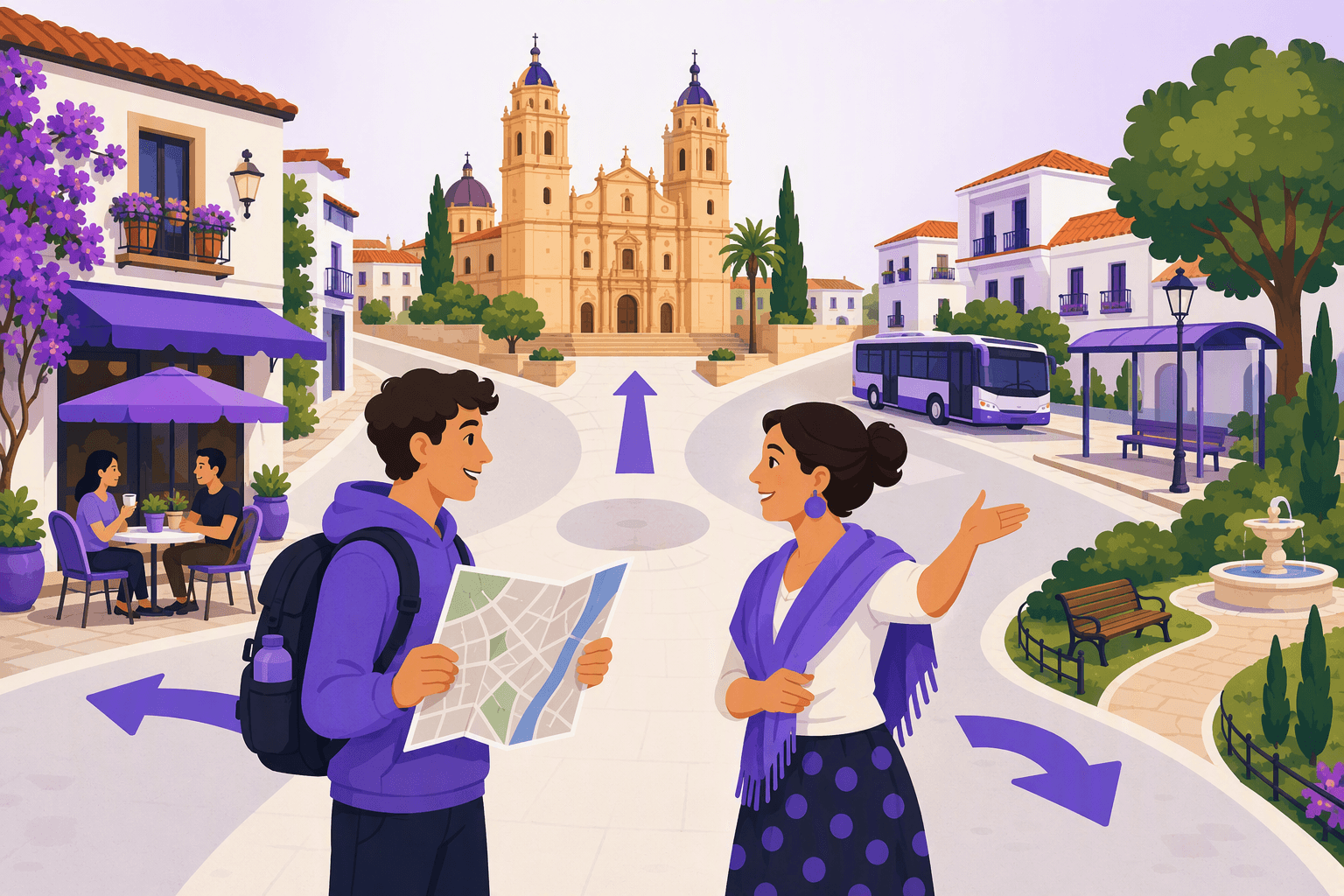
Start politely before asking
A direct question is grammatically fine, but adding a brief apology or greeting sounds more considerate. This matters when you stop someone on a busy street, enter a shop, or speak to an employee who is working.
Spanish politeness is not identical everywhere. Linguist Francisco Moreno Fernández documents substantial regional variation in Spanish, including pronoun choices and everyday vocabulary. Still, disculpe /disˈkulpe/ and perdone /peɾˈdone/ are dependable in Spain and Latin America.
Disculpe
Disculpe /disˈkulpe/ means “excuse me.” Use it to get someone’s attention before a request. It comes from the formal usted /usˈteð/ verb form, but you do not need to say usted itself.
/dees-KOOL-peh, DOHN-deh es-TAH lah es-tah-SYOHN/
Literal meaning: Excuse me, where is the station?
“Disculpe, ¿dónde está la estación de metro?”
Excuse me, where is the metro station?
A natural opener for strangers, staff, and older people throughout the Spanish-speaking world.
Perdón
Perdón /peɾˈðon/ also means “excuse me” or “sorry.” It is shorter and useful when you need to briefly interrupt someone, squeeze past people, or ask a quick question.
Say perdón, una pregunta /peɾˈðon ˈuna pɾeˈɣunta/, meaning “excuse me, a question,” before asking. In a loud market or crowded transit station, that small introduction signals your intention immediately.
¿Podría ayudarme?
¿Podría ayudarme? /poˈðɾia aʝuˈðaɾme/ means “Could you help me?” It is one of the safest formal requests because podría /poˈðɾia/ softens the demand.
Henk Haverkate’s work on Spanish verbal politeness explains why conditional forms such as podría are valuable: they reduce pressure on the listener. Use this phrase when your next question is complicated, such as finding a specific neighborhood, clinic, government office, or platform.
💡 A simple polite formula
Start with Hola, disculpe /ˈola disˈkulpe/, ask your question, then finish with gracias /ˈɡɾasjas/. This three-part pattern is clear, friendly, and appropriate almost everywhere.
Ask where a place is
The most practical structure is ¿Dónde está...? /ˈdonde esˈta/, literally “Where is...?” Add the destination after it. Spanish generally uses the definite article with public places, so you will often say la estación /la estaˈsjon/ or el museo /el muˈseo/.
¿Dónde está...?
Use ¿Dónde está...? for one place. The final word changes based on what you need, not based on how formal the conversation is.
/DOHN-deh es-TAH el BAH-nyoh/
Literal meaning: Where is the bathroom?
“Disculpe, ¿dónde está el baño?”
Excuse me, where is the bathroom?
Baño is widely understood. In public places, servicios is also common in Spain, while baño is especially common across Latin America.
For plural destinations, use ¿Dónde están...? /ˈdonde esˈtan/. For example, ¿Dónde están los taxis? /ˈdonde esˈtan los ˈtaksis/ means “Where are the taxis?”
¿Cómo llego a...?
¿Cómo llego a...? /ˈkomo ˈʝeɣo a/ means “How do I get to...?” This is better than ¿dónde está...? when you need route instructions, rather than simply a location.
/KOH-moh YEH-goh al SEHN-troh/
Literal meaning: How do I arrive at the center?
“¿Cómo llego al centro en autobús?”
How do I get to the city center by bus?
Centro can mean downtown or the central district. In larger cities, people may give you a bus line, metro line, or landmark rather than a street-by-street route.
The contraction al /al/ means a el /a el/, “to the.” Use it before masculine singular places: al hotel /al oˈtel/, al mercado /al meɾˈkaðo/, al aeropuerto /al aeɾopuˈeɾto/.
¿Está lejos?
¿Está lejos? /esˈta ˈlexos/ means “Is it far?” Use it after identifying a place. It helps you decide whether to walk, take public transit, or call a taxi.
Someone may answer no, está cerca /no esˈta ˈseɾka/, “no, it is close,” or queda lejos /ˈkeða ˈlexos/, “it is far away.” The verb quedar /keˈðaɾ/ often describes where something is located or how far away it feels.
Understand the directions you hear
Knowing how to ask is only half the task. Street directions can arrive quickly, often with gestures, neighborhood names, and local references. Focus first on the action verb, then the landmark.
Siga recto
Siga recto /ˈsiɣa ˈrekto/ means “continue straight ahead.” It is a formal command, which is why strangers use it naturally when giving you directions.
You may hear todo recto /ˈtoðo ˈrekto/ in Spain. It means “straight ahead all the way.” In casual Latin American speech, sigue derecho /ˈsiɣe deˈɾetʃo/ is also common, especially in Mexico and parts of Central America.
Gire
Gire /ˈxiɾe/ means “turn,” in the formal command form. The two key combinations are gire a la izquierda /ˈxiɾe a la isˈkjeɾða/ and gire a la derecha /ˈxiɾe a la deˈɾetʃa/.
/HEE-reh ah lah deh-REH-chah en el BAHN-koh/
Literal meaning: Turn to the right at the bank
“Gire a la derecha en el banco y siga recto.”
Turn right at the bank and continue straight ahead.
En can mean at, on, or by a landmark in route instructions. The exact location is often clarified with a hand gesture.
Spanish speakers may use doblar /doˈblaɾ/, “to turn,” instead. Doble a la izquierda /ˈðoβle a la isˈkjeɾða/ is polite and widely understood. In informal speech, someone might say dobla /ˈdoβla/ to a friend.
Cruce
Cruce /ˈkɾuse/ means “cross.” You may hear cruce la calle /ˈkɾuse la ˈkaʎe/, “cross the street,” or cruce la plaza /ˈkɾuse la ˈplasa/, “cross the square.”
The Real Academia Española dictionary records cruzar /kɾuˈsaɾ/ as the standard verb for passing from one side to another. In real instructions, do not expect traffic rules to be explained. Cross only at safe points and follow local signals.
Está enfrente de
Está enfrente de /esˈta eɱˈfɾente ðe/ means “it is opposite” or “it is across from.” This is useful because many directions rely on visible landmarks rather than numbered addresses.
For example, está enfrente del supermercado /esˈta eɱˈfɾente ðel supeɾmeɾˈkaðo/ means “it is across from the supermarket.” The form del /ðel/ combines de /ðe/ and el /el/.
Essential landmark and transport vocabulary
| English | Spanish | Pronunciation | Note |
|---|---|---|---|
| street | la calle | lah KAH-yeh | A road or city street. |
| corner | la esquina | lah es-KEE-nah | Often used with en, meaning at the corner. |
| traffic light | el semáforo | el seh-MAH-foh-roh | A frequent landmark in spoken directions. |
| square | la plaza | lah PLAH-sah | A public square, often a central meeting point. |
| block | la cuadra | lah KWAH-drah | Common in Latin America for a city block. |
| metro station | la estación de metro | lah es-tah-SYOHN deh MEH-troh | Metro is widely understood in major cities. |
| bus stop | la parada de autobús | lah pah-RAH-dah deh ow-toh-BOOS | Parada is also used for other public transport stops. |
| intersection | el cruce | el KROO-seh | Where streets meet or cross. |
In Latin America, cuadra /ˈkwaðɾa/ commonly means a city block. If someone says a dos cuadras /a dos ˈkwaðɾas/, they mean “two blocks away.” In Spain, you are more likely to hear an estimate in meters or a reference to the next street.
Autobús /awtoˈβus/ is standard, but public transport vocabulary varies sharply. Bus /bus/ is widespread, camión /kaˈmjon/ can mean bus in Mexico, and guagua /ˈɣwaɣwa/ means bus in places such as Cuba, the Dominican Republic, the Canary Islands, and Chile. Moreno Fernández’s research on Spanish varieties is a useful reminder that local words can change even when the grammar stays familiar.
🌍 Addresses are not always the best reference
In many Spanish-speaking cities, people give directions through landmarks: a church, plaza, pharmacy, market, or well-known restaurant. This is especially common when street numbering is irregular, long avenues change names, or a destination sits inside a large transport hub. Listen for visible nouns, not only street names.
Ask someone to repeat or slow down
It is normal to miss the first explanation. Street names, bus numbers, and rapid instructions are difficult even for intermediate learners. Ask for clarification immediately rather than pretending to understand.
¿Puede repetirlo?
¿Puede repetirlo? /ˈpweðe repeˈtiɾlo/ means “Can you repeat that?” The lo /lo/ refers to the explanation. It is polite, brief, and useful after any set of directions.
You can be more specific with ¿Puede repetir la calle? /ˈpweðe repeˈtiɾ la ˈkaʎe/, “Can you repeat the street?” This keeps the conversation focused on the one detail you missed.
Más despacio, por favor
Más despacio, por favor /mas desˈpasjo poɾ faˈβoɾ/ means “More slowly, please.” It is more natural than asking someone to speak “slow,” because despacio /desˈpasjo/ describes the pace of speech.
For a fuller request, say ¿Puede hablar más despacio, por favor? /ˈpweðe aˈβlaɾ mas desˈpasjo poɾ faˈβoɾ/. If you are learning travel Spanish, this belongs alongside phrases for asking someone to repeat themselves in Spanish.
¿Me lo puede mostrar en el mapa?
¿Me lo puede mostrar en el mapa? /me lo ˈpweðe mosˈtɾaɾ en el ˈmapa/ means “Can you show it to me on the map?” This is an excellent solution when pronunciation, accents, or unfamiliar street names make verbal directions hard.
Showing your phone map is practical, but ask before placing it directly in someone’s hands. A local may point, type the destination, or recommend a safer route that the map does not prioritize.
A realistic mini-conversation
Here is a short exchange you can use as a model:
You: Hola, disculpe, ¿cómo llego al museo?
/ˈola disˈkulpe ˈkomo ˈʝeɣo al muˈseo/
Local: Siga recto dos cuadras y gire a la izquierda en la plaza.
/ˈsiɣa ˈrekto dos ˈkwaðɾas i ˈxiɾe a la isˈkjeɾða en la ˈplasa/
You: ¿Está lejos?
/esˈta ˈlexos/
Local: No, está a cinco minutos a pie.
/no esˈta a ˈsiŋko miˈnutos a pje/
You: Muchas gracias.
/ˈmutʃas ˈɣɾasjas/
The answer a cinco minutos a pie /a ˈsiŋko miˈnutos a pje/ means “five minutes on foot.” Directions measured in walking minutes are common, but treat them as estimates. Hills, crowds, heat, and traffic can make a supposedly short walk much longer.
⚠️ Do not rely only on gestures
Pointing is useful, but it can be ambiguous at multi-lane intersections or in dense historic centers. Repeat the key detail back: ¿A la izquierda en la plaza? /a la isˈkjeɾða en la ˈplasa/ This confirms the route and gives the other person a chance to correct you.
Practice directions through real Spanish
Memorizing one list helps, but you need to hear these phrases at natural speed. In Spanish films and series, directions often appear in taxi scenes, police scenes, travel episodes, meetups, and missed-connection plots.
Listen for the action first: siga /ˈsiɣa/, gire /ˈxiɾe/, cruce /ˈkɾuse/, or baje /ˈbaxe/, “go down” or “get off.” Then replay the clip and identify the landmark. This trains you to understand the practical chunks rather than translating each word separately.
For more travel-ready vocabulary, see these essential Spanish travel phrases. When you are ready to leave the conversation naturally, use one of these ways to say goodbye in Spanish.
The best direction question is the one you can say clearly, politely, and without hesitation: Disculpe, ¿cómo llego a...? /disˈkulpe ˈkomo ˈʝeɣo a/ Learn that sentence, recognize siga recto /ˈsiɣa ˈrekto/, and you can manage most everyday navigation problems in Spanish.
Frequently Asked Questions
How do I ask where something is in Spanish?
What is the most polite way to ask for directions in Spanish?
What does siga recto mean in Spanish?
How do Spanish speakers say turn left and turn right?
Do I need to use usted when asking directions in Spanish?
Sources & References
- Instituto Cervantes, El español: una lengua viva, 2024
- Real Academia Española, Diccionario de la lengua española, accessed 2026
- FundéuRAE, recommendations on geographic and mobility language, accessed 2026
- Moreno Fernández, Variedades de la lengua española, Routledge
- Haverkate, La cortesía verbal en español, Gredos
Start learning with Wordy
Watch real movie clips and build your vocabulary as you go. Free to download.


