Quick Answer
The four seasons in Spanish are la primavera, el verano, el otoño, and el invierno. Learn their pronunciation, gender, common weather words, and natural phrases so you can talk about the calendar, travel, and daily weather naturally.
The four seasons in Spanish are la primavera /la pɾimaˈβeɾa/, el verano /el βeˈɾano/, el otoño /el oˈtoɲo/, and el invierno /el imˈbjeɾno/. Learn these four names first, then add weather phrases such as hace calor /ˈase kaˈloɾ/ and hace frío /ˈase ˈfɾio/ to describe what each season actually feels like.
Spanish is spoken by roughly 600 million potential speakers worldwide according to Instituto Cervantes figures, across 20 sovereign countries where it is an official language. That range matters: a snowy invierno /imˈbjeɾno/ in Spain and a humid summer in Colombia can require very different vocabulary, even when the basic season names stay the same.
If you are building foundational vocabulary, pair these words with everyday greetings from our guide on how to say hello in Spanish. Seasons come up constantly in small talk, travel plans, school schedules, clothing choices, and weather forecasts.
| English | Spanish | Pronunciation | Note |
|---|---|---|---|
| spring | la primavera | lah pree-mah-BEH-rah | Feminine noun. Usually lowercase. |
| summer | el verano | el beh-RAH-noh | Masculine noun. |
| fall / autumn | el otoño | el oh-TOH-nyoh | Masculine noun. The ñ is essential. |
| winter | el invierno | el een-BYEHR-noh | Masculine noun. |
| season | la estación | lah es-tah-SYOHN | Use estación del año for a season of the year. |
| the seasons of the year | las estaciones del año | lahs es-tah-SYOH-nehs del ah-NYOH | Common school and calendar phrase. |
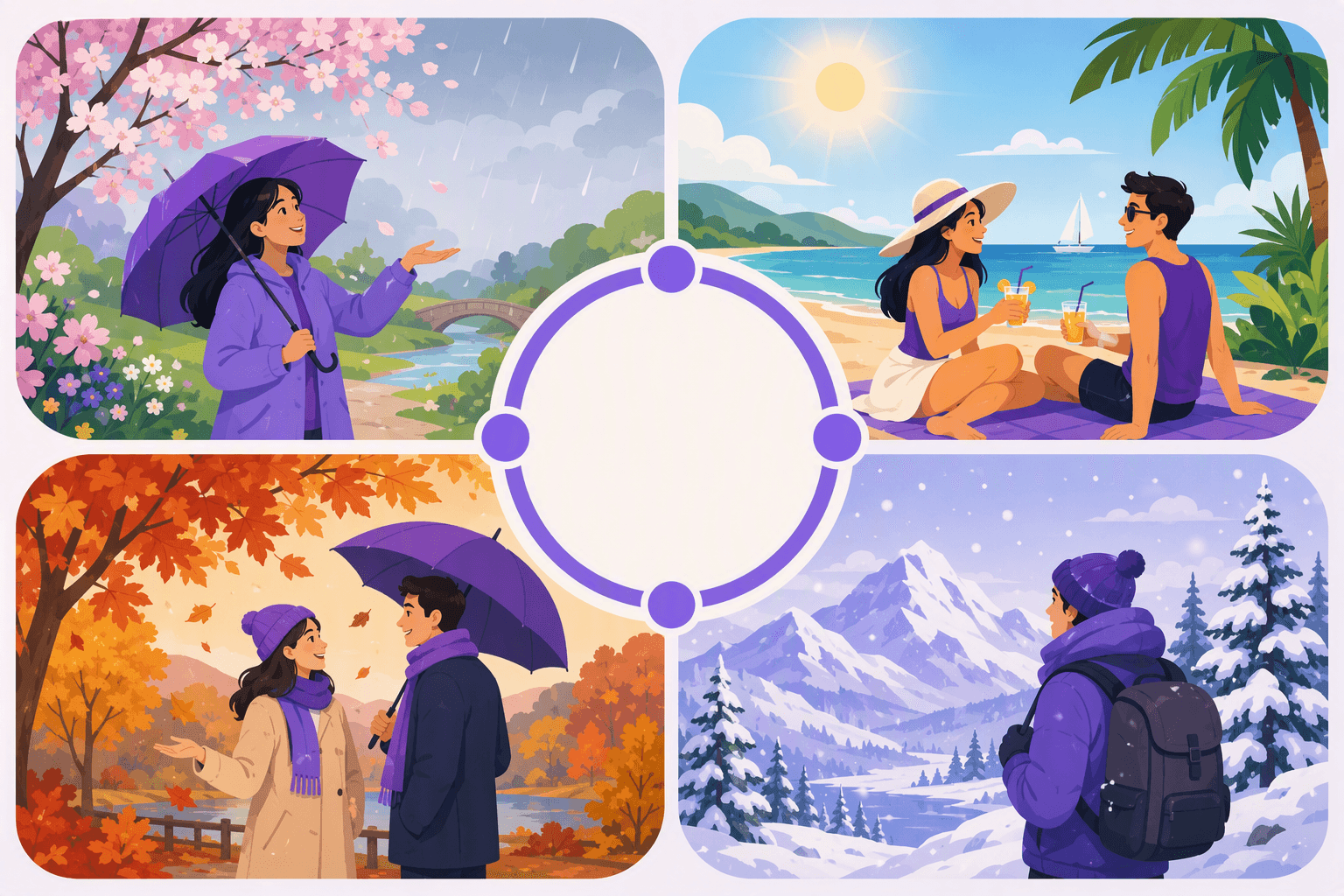
The grammar you need for seasons in Spanish
Spanish season names are nouns, so they have grammatical gender. Use la /la/ with primavera /pɾimaˈβeɾa/ and el /el/ with the other three seasons.
The normal pattern is:
- en primavera /em pɾimaˈβeɾa/, in spring
- en verano /em βeˈɾano/, in summer
- en otoño /en oˈtoɲo/, in fall
- en invierno /en imˈbjeɾno/, in winter
Notice that Spanish normally uses en /en/, not a direct translation of English during. You can say Viajo en verano /ˈbjaxo em βeˈɾano/, I travel in summer, without adding an article.
Primavera
Primavera /pɾimaˈβeɾa/ means spring. It is feminine, so say la primavera /la pɾimaˈβeɾa/ and una primavera lluviosa /ˈuna pɾimaˈβeɾa ʝuˈβjosa/, a rainy spring.
In much of Spain, spring brings changing temperatures and frequent rain. Spanish speakers often associate it with las flores /las ˈfloɾes/, flowers, el polen /el poˈlen/, pollen, and las alergias /las aleɾˈxjas/, allergies.
A very common phrase is La primavera es mi estación favorita /la pɾimaˈβeɾa es mi estaˈsjon faβoˈɾita/, meaning spring is my favorite season. The adjective favorita /faβoˈɾita/ agrees with the feminine noun estación /estaˈsjon/, not directly with spring.
Verano
Verano /βeˈɾano/ means summer. It is masculine: el verano /el βeˈɾano/, un verano caluroso /um βeˈɾano kaluˈɾoso/, a hot summer.
In Spain, las vacaciones de verano /las βakaˈsjones de βeˈɾano/, summer holidays, are a major annual reference point. Many schools close for a long break, and coastal towns fill with visitors in July and August.
When talking about heat, Spanish commonly uses hacer /aˈseɾ/, to make or do:
- Hace calor /ˈase kaˈloɾ/, it is hot.
- Hace mucho calor /ˈase ˈmutʃo kaˈloɾ/, it is very hot.
- Hace un calor horrible /ˈase uŋ kaˈloɾ oˈriβle/, the heat is awful.
You may also hear qué calor /ke kaˈloɾ/, what heat, as an exclamation when someone walks outside into intense sun.
Otoño
Otoño /oˈtoɲo/ means fall or autumn. It is masculine, and the letter ñ /eɲe/ is not an ordinary n. Say otoño /oˈtoɲo/ with the palatal sound heard in Spanish niño /ˈniɲo/, child.
Common autumn associations include las hojas /las ˈoxas/, leaves, la lluvia /la ˈʝuβja/, rain, and el viento /el ˈbjento/, wind. In many places, people describe the season as fresco /ˈfɾesko/, cool, rather than truly cold.
Spanish does not use a separate common word equivalent to English fall. Otoño /oˈtoɲo/ is the standard word in Spain and Latin America, whether you are talking about school, fashion, travel, or forecasts.
Invierno
Invierno /imˈbjeɾno/ means winter. It is masculine: el invierno /el imˈbjeɾno/ and un invierno frío /un imˈbjeɾno ˈfɾio/, a cold winter.
For cold weather, use hace frío /ˈase ˈfɾio/. Do not translate English word for word as es frío /es ˈfɾio/ when you mean the temperature outside. Es frío /es ˈfɾio/ can describe something that is cold by nature, such as a cold climate or a cold object.
Winter vocabulary changes sharply by region. Madrid may have frosty mornings, while high-altitude areas of Mexico, Colombia, Ecuador, Peru, Bolivia, Chile, and Argentina can have very cold conditions. In tropical lowland areas, la temporada de lluvias /la tempoˈɾada de ˈʝuβjas/, the rainy season, may be more useful than invierno /imˈbjeɾno/.
Essential weather words for every season
Knowing the names of the seasons is useful, but real conversations need weather language. The Real Academia Española dictionary records the broad everyday meanings of these weather terms, while their exact intensity depends heavily on local climate and context.
| English | Spanish | Pronunciation | Note |
|---|---|---|---|
| sun | el sol | el sohl | Use hace sol for sunny weather. |
| rain | la lluvia | lah YOO-byah | Use llueve for it is raining. |
| wind | el viento | el BYEHN-toh | Use hace viento for windy weather. |
| snow | la nieve | lah NYEH-beh | Use nieva for it is snowing. |
| heat | el calor | el kah-LOR | Use hace calor. |
| cold | el frío | el FREE-oh | Use hace frío. |
| storm | la tormenta | lah tohr-MEN-tah | Often used with hay, there is. |
| cloud | la nube | lah NOO-beh | Nublado means cloudy. |
| humidity | la humedad | lah oo-meh-DAHD | Common in coastal and tropical climates. |
| forecast | el pronóstico | el proh-NOHS-tee-koh | Also el tiempo is used for weather. |
Here are the weather structures worth memorizing:
| English idea | Natural Spanish | IPA |
|---|---|---|
| It is sunny | Hace sol | /ˈase sol/ |
| It is hot | Hace calor | /ˈase kaˈloɾ/ |
| It is cold | Hace frío | /ˈase ˈfɾio/ |
| It is windy | Hace viento | /ˈase ˈbjento/ |
| It is raining | Llueve | /ˈʝweβe/ |
| It is snowing | Nieva | /ˈnjeβa/ |
| It is cloudy | Está nublado | /esˈta nuˈblaðo/ |
| There is a storm | Hay tormenta | /ai toɾˈmenta/ |
The pattern is not fully predictable, so learn each phrase as a complete chunk. You say hace sol /ˈase sol/, literally it makes sun, but llueve /ˈʝweβe/, literally it rains. This is more effective than trying to force every Spanish forecast into English grammar.
💡 Use el tiempo for weather
El tiempo /el ˈtjempo/ can mean time, but it also means weather. Ask ¿Qué tiempo hace? /ke ˈtjempo ˈase/ to ask what the weather is like. Context makes the intended meaning clear.
Natural phrases for talking about seasons
These phrases help you move beyond simply naming a season. They are useful in conversation, captions, travel planning, and classroom writing.
/kwahl es too es-tah-SYOHN fah-boh-REE-tah/
Literal meaning: Which is your favorite season?
“¿Cuál es tu estación favorita? A mí me gusta el otoño.”
What is your favorite season? I like fall.
This is a neutral, natural question for friends, classmates, and everyday conversation.
/en beh-RAH-noh AH-seh MOO-choh kah-LOR/
Literal meaning: In summer it makes much heat.
“En verano hace mucho calor en Sevilla.”
In summer, it is very hot in Seville.
Use hacer with heat, cold, sun, and wind. This is one of the most common weather patterns in Spanish.
/meh en-KAHN-tah lah pree-mah-BEH-rah/
Literal meaning: Spring delights me.
“Me encanta la primavera porque hay muchas flores.”
I love spring because there are many flowers.
Me encanta sounds enthusiastic but is entirely normal in everyday Spanish. For more affectionate language, see our guide to [saying I love you in Spanish](/blog/how-to-say-i-love-you-in-spanish).
/en een-BYEHR-noh SWEH-leh yoh-BEHR/
Literal meaning: In winter it usually tends to rain.
“En invierno suele llover bastante aquí.”
It usually rains quite a lot here in winter.
Soler plus an infinitive expresses a usual habit. It is especially useful for describing seasonal weather patterns.
Capital letters, articles, and common mistakes
Spanish season names are usually lowercase: primavera /pɾimaˈβeɾa/, verano /βeˈɾano/, otoño /oˈtoɲo/, and invierno /imˈbjeɾno/. FundéuRAE’s capitalization guidance follows the general Spanish convention that common nouns are not capitalized simply because English capitalizes them in some contexts.
Write Me gusta el verano /me ˈɣusta el βeˈɾano/, I like summer, with the article el /el/. But after en /en/, omit it in most ordinary phrases: en verano /em βeˈɾano/, in summer.
A frequent beginner mistake is saying soy caliente /soi kaˈljente/ to mean I am hot from the weather. That phrase can imply sexual arousal. Say tengo calor /ˈteŋɡo kaˈloɾ/, I am hot, for your physical sensation, and hace calor /ˈase kaˈloɾ/ for the weather.
⚠️ Do not translate 'I am cold' word for word
Say tengo frío /ˈteŋɡo ˈfɾio/ for I am cold. Soy frío /soi ˈfɾio/ describes a person as emotionally cold or distant, not physically chilly.
Seasons differ across the Spanish-speaking world
The Spanish language spans climates from Caribbean coastlines to the Andes and Patagonia. Francisco Moreno Fernández, in Variedades de la lengua española, emphasizes that Spanish is a pluricentric language shaped by its many regional communities. Seasonal vocabulary is a clear example: the same core grammar works everywhere, but what people notice and talk about varies dramatically.
In Spain, the four seasons are central to everyday calendars and travel. El otoño /el oˈtoɲo/ may bring cooler weather and rain, while el verano /el βeˈɾano/ is strongly connected with holidays, beaches, late dinners, and intense heat in inland cities.
In many equatorial or tropical regions, speakers may focus on la temporada seca /la tempoˈɾada ˈseka/, the dry season, and la temporada de lluvias /la tempoˈɾada de ˈʝuβjas/, the rainy season. Both phrases are practical additions to your vocabulary if you travel in Central America, the Caribbean, or tropical parts of South America.
🌍 Northern and Southern Hemisphere calendars
Argentina, Chile, Uruguay, Paraguay, and much of southern South America experience seasons opposite to those in Spain, Mexico, and the United States. When it is July in Buenos Aires, it is winter, invierno /imˈbjeɾno/, not summer. Always connect the season to the country instead of assuming a universal calendar.
Practice seasons with real Spanish
A useful way to retain this vocabulary is to watch or listen for weather scenes. Pause when a character comments on rain, heat, coats, holidays, or a changing landscape, then repeat the full line aloud. A weather phrase has more staying power when you associate it with a scene rather than an isolated flashcard.
Start by making four short sentences about your own year:
- En primavera, me gustan las flores /em pɾimaˈβeɾa me ˈɣustan las ˈfloɾes/.
- En verano, tengo calor /em βeˈɾano ˈteŋɡo kaˈloɾ/.
- En otoño, llueve mucho /en oˈtoɲo ˈʝweβe ˈmutʃo/.
- En invierno, hace frío /en imˈbjeɾno ˈase ˈfɾio/.
Then turn them into conversation starters. You might ask ¿Prefieres el verano o el invierno? /pɾeˈfjeɾes el βeˈɾano o el imˈbjeɾno/, do you prefer summer or winter? This kind of low-pressure question works well after an initial greeting and before a natural Spanish goodbye.
For more foundational words to combine with this topic, review the 100 most common Spanish words and use seasonal scenes from films or shows to hear the phrases in context.
Frequently Asked Questions
What are the four seasons in Spanish?
Is fall called otoño or otoño?
Do Spanish seasons have gender?
How do you say it is summer in Spanish?
Are the seasons the same in every Spanish-speaking country?
Sources & References
- Instituto Cervantes, El español en el mundo 2024
- Real Academia Española, Diccionario de la lengua española, accessed 2026
- FundéuRAE, recommendations on capitalization in Spanish, accessed 2026
- Francisco Moreno Fernández, Variedades de la lengua española, Routledge
Start learning with Wordy
Watch real movie clips and build your vocabulary as you go. Free to download.


