Merry Christmas in German: Frohe Weihnachten, Pronunciation, and What Germans Actually Say
Quick Answer
The most common way to say Merry Christmas in German is 'Frohe Weihnachten' (FROH-uh VY-nahkh-ten). It works in Germany, Austria, and Switzerland and fits both spoken greetings and cards. You will also hear 'Schöne Weihnachten' and, around New Year, 'Guten Rutsch' and 'Frohes neues Jahr'.
| English | German | Pronunciation | Formality |
|---|---|---|---|
| Merry Christmas! | Frohe Weihnachten! | FROH-uh VY-nahkh-ten | polite |
| Merry Christmas! | Fröhliche Weihnachten! | FRUR-lickh-uh VY-nahkh-ten | polite |
| Happy holidays! | Schöne Feiertage! | SHUR-nuh FY-er-tah-guh | polite |
| Happy holidays! | Frohe Feiertage! | FROH-uh FY-er-tah-guh | polite |
| Have a nice Christmas! | Schöne Weihnachten! | SHUR-nuh VY-nahkh-ten | casual |
| Have a good start into the New Year! | Guten Rutsch! | GOO-ten ROOTCH | casual |
| Happy New Year! | Frohes neues Jahr! | FROH-uhs NOY-uhs YAHR | polite |
| Merry Christmas and a Happy New Year! | Frohe Weihnachten und ein glückliches neues Jahr! | FROH-uh VY-nahkh-ten oont ayn GLUEK-lickh-uhs NOY-uhs YAHR | formal |
The most common way to say Merry Christmas in German is Frohe Weihnachten (FROH-uh VY-nahkh-ten). It works across Germany, Austria, and German-speaking Switzerland, and it fits both quick spoken greetings and what you write in a card.
German is spoken by about 90 million native speakers and roughly 132 million total speakers worldwide (Ethnologue, 27th edition, 2024). That spread matters because Christmas language is fairly consistent across the DACH region (Germany, Austria, Switzerland), but the timing and tone of greetings can feel different depending on where you are and who you are talking to.
If you are also building your everyday basics, pair this with how to say hello in German so your greetings sound natural year-round.
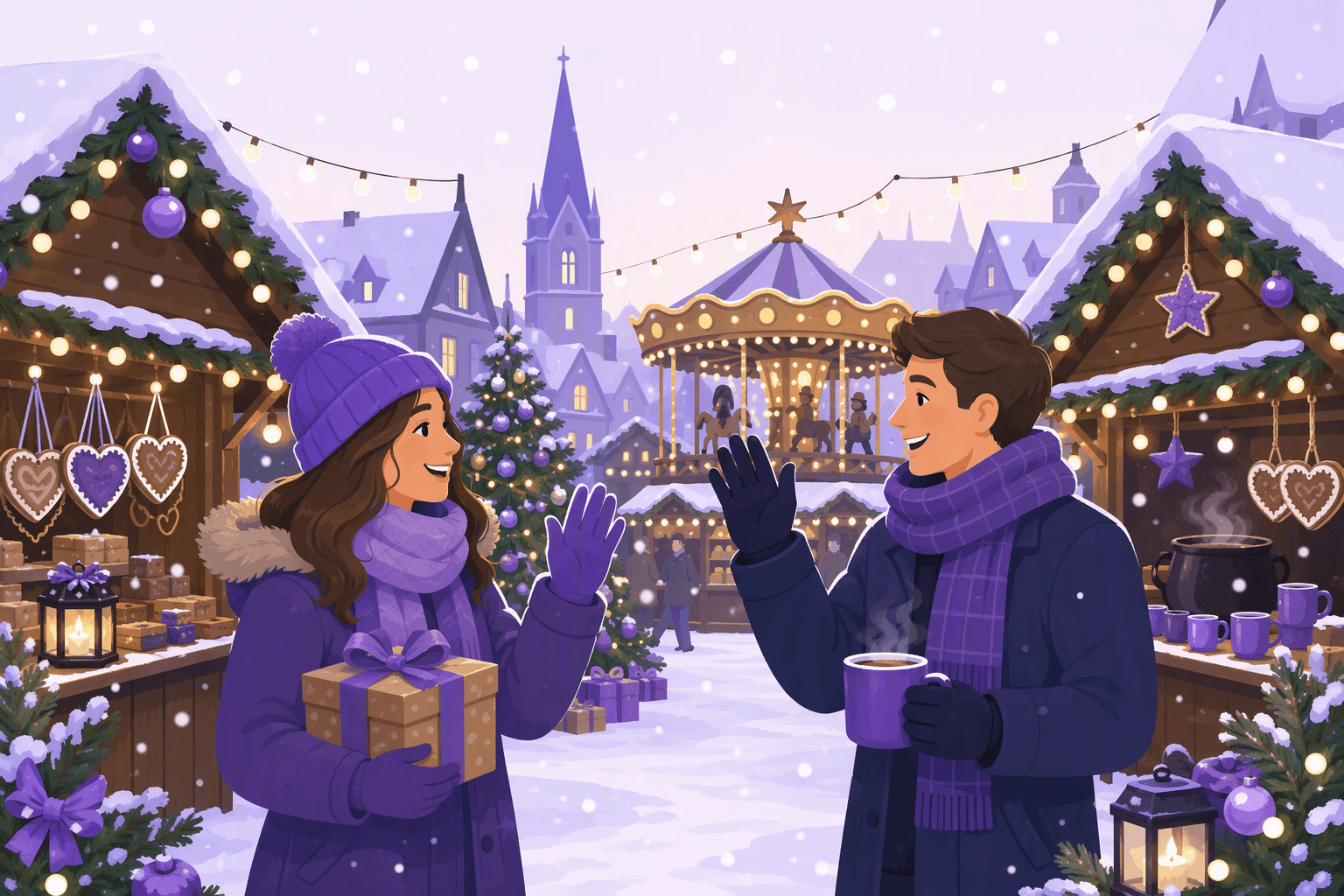
When Germans actually say Christmas greetings
In many English-speaking contexts, people start saying “Merry Christmas” weeks in advance. In German-speaking countries, the main Christmas moment is December 24, not December 25.
December 24 matters (Heiligabend)
December 24 is Heiligabend (HY-likh-AH-bent), the evening when many families exchange gifts and have their main celebration. So “Frohe Weihnachten” often arrives right before you part ways for the holidays, or on the 24th.
If you say it too early to someone you will definitely see again before the 24th, it can sound slightly premature. Not rude, just a bit off.
Advent is its own season
The four weeks before Christmas are Advent (AH-dvent). You will hear seasonal wishes like “Schöne Adventszeit” more than “Frohe Weihnachten” in early December, especially in workplaces.
This is one reason German holiday language feels “later” than English: the calendar rhythm is different, and the greetings follow it.
💡 A simple timing rule
If you will not see someone again before December 24, say "Frohe Weihnachten" when you say goodbye. If you will see them again, "Schöne Adventszeit" or "Schöne Feiertage" often fits better.
Frohe Weihnachten vs Fröhliche Weihnachten
Both are correct, but they do not feel identical.
Frohe Weihnachten
Frohe Weihnachten (FROH-uh VY-nahkh-ten) is the most common, most neutral, and easiest to use. It sounds natural in a shop, in an email sign-off, and in a card.
Duden treats Weihnachten as a fixed holiday noun, and in real usage you will see “Frohe Weihnachten” constantly in public signage and greetings (Duden, accessed 2026).
Fröhliche Weihnachten
Fröhliche Weihnachten (FRUR-lickh-uh VY-nahkh-ten) is also standard. It can feel a touch more “cheerful” because fröhlich is “joyful,” but the difference is subtle.
Many native speakers still choose “Frohe” because it is shorter and snappier. In fast speech, shorter often wins.
Weihnachten pronunciation: the part learners usually miss
The tricky bit is the ch in Weihnachten. In many accents it is a soft, back-throat sound, not an English “k.”
A practical learner target is: VY-nahkh-ten, with a gentle “kh” in the middle. Do not over-push it, clarity matters more than harshness.
Happy Holidays in German (and when to use it)
If you want something closer to “Happy Holidays,” German has a clean equivalent:
Schöne Feiertage
Schöne Feiertage (SHUR-nuh FY-er-tah-guh) literally means “nice holidays.” It is common in customer service, workplaces, and any context where you want to be warm without assuming Christmas.
It is also useful if you are talking to someone you do not know well, or if your office has international colleagues.
Frohe Feiertage
Frohe Feiertage (FROH-uh FY-er-tah-guh) is similar, just slightly more “greeting-like.” Both are fine.
If you are writing a professional email, “Frohe Feiertage” can read as a tidy seasonal sign-off.
🌍 Why 'Feiertage' feels natural in German
German-speaking countries have a dense calendar of public holidays, and the word "Feiertag" is used constantly in everyday planning. So "Feiertage" does not feel like a forced translation, it feels like normal calendar language.
Guten Rutsch: the New Year phrase you will hear everywhere
If you are in Germany in late December, you will hear:
Guten Rutsch
Guten Rutsch! (GOO-ten ROOTCH) is said in the days leading up to New Year’s Eve. It means “have a good start into the New Year.”
Learners often assume it is about sliding on ice. In everyday use, it is just a fixed seasonal wish.
You can combine it with Christmas:
- Frohe Weihnachten und einen guten Rutsch! (FROH-uh VY-nahkh-ten oont EYE-nen GOO-ten ROOTCH)
That combined line is extremely common because it covers the whole holiday break.
Christmas greetings by situation (what to say, and why)
The words are easy. The social choice is what makes you sound local.
In a shop, hotel, or restaurant
Use something short and polite:
- Frohe Weihnachten!
- Schöne Feiertage!
If you want to add a polite extra, you can say Danke, ebenso! (DAHN-kuh, EH-ben-zoh), meaning “Thanks, you too.”
If you want more everyday German for service interactions, how to say goodbye in German pairs well with holiday greetings because most of these are used as send-offs.
At work (formal email sign-off)
For a more formal tone, German often uses pronouns like Ihnen (EE-nen) to mark respect:
- Frohe Weihnachten und ein glückliches neues Jahr!
- Frohe Weihnachten Ihnen und Ihrer Familie.
In professional contexts, this “to you” structure can feel more appropriate than a casual exclamation alone.
With friends (text message)
Shorter is better:
- Frohe Weihnachten!
- Schöne Weihnachten!
- Guten Rutsch!
If you want to sound affectionate without being overly intense, you can add:
- Frohe Weihnachten, ich denk an dich. (FROH-uh VY-nahkh-ten, ikh denk ahn dikh)
“Merry Christmas, I’m thinking of you.”
With your partner
German has multiple “I love you” options, and Christmas is a common moment for them. If you want that side of the language, see how to say I love you in German.
A warm, natural holiday message is:
- Frohe Weihnachten, mein Schatz. (FROH-uh VY-nahkh-ten, myn SHAHTS)
“Merry Christmas, my darling.”
What to write in a German Christmas card (templates)
German card writing tends to be direct and structured. You state the wish, then add a personal line.
Classic and safe
Frohe Weihnachten und ein glückliches neues Jahr!
(FROH-uh VY-nahkh-ten oont ayn GLUEK-lickh-uhs NOY-uhs YAHR)
This is the default “covers everything” line.
Formal (neighbors, clients, teachers)
Wir wünschen Ihnen frohe Weihnachten und ein gesundes neues Jahr.
(veer VUEN-shen EE-nen FROH-uh VY-nahkh-ten oont ayn guh-ZOONT-uhs NOY-uhs YAHR)
“Gesund” (healthy) is a common German New Year wish, and it reads sincere rather than dramatic.
Friendly but not intimate
Frohe Weihnachten! Ich hoffe, du hast ein paar ruhige Tage.
(FROH-uh VY-nahkh-ten! ikh HOH-fuh, doo hahst ayn paar ROO-ee-guh TAH-guh)
“Ruhige Tage” (quiet days) matches the way many people actually want the break to feel.
For families with kids
Frohe Weihnachten und viel Spaß beim Auspacken!
(FROH-uh VY-nahkh-ten oont feel SHPAHSS bym OWS-pah-ken)
“Beim Auspacken” is “while unwrapping,” a very Christmas-specific detail that feels personal.
⚠️ Capitalization in cards
In German, nouns are capitalized: Weihnachten, Feiertage, Jahr, Familie. Getting this right in a card matters more than perfect grammar, because it is visually obvious to native readers.
Regional notes: Germany, Austria, Switzerland
Across the German-speaking region, the core greetings are the same. The differences are more about surrounding culture and vocabulary than the greeting itself.
Germany
Germany is the largest German-speaking country, with about 84 million people. Christmas markets (Weihnachtsmärkte) are a major seasonal feature, and you will see “Frohe Weihnachten” everywhere in public-facing contexts.
Deutsche Welle’s explainers on Christmas vocabulary highlight how central Advent and Heiligabend are in everyday language (DW, accessed 2026).
Austria
In Austria, you will still say Frohe Weihnachten, but you may hear more local flavor in food and traditions around the season. The greeting itself stays stable.
Switzerland (German-speaking)
Swiss German (Schweizerdeutsch) is widely spoken in daily life, but Standard German is still the safe choice for writing and for many formal interactions. “Frohe Weihnachten” in Standard German is absolutely normal.
If you are learning German for travel, the Goethe-Institut’s descriptions of standard usage are a useful anchor for what is understood across regions (Goethe-Institut, accessed 2026).
Pronunciation mini-guide: the sounds inside the greetings
German pronunciation is consistent once you know what to listen for. For Christmas phrases, three sounds matter most.
The W in Weihnachten
German w is closer to an English v. That is why the approximation is VY-nahkh-ten, not “why.”
The ch sound
German has more than one “ch.” In Weihnachten, many speakers use a back-of-the-throat sound (like in ach), especially because it follows a.
You do not need to perfect it immediately. Aim for a soft “kh” that does not become a hard “k.”
The ö in fröhlich
The ö is like “er” in British “her,” but with rounded lips. That is why FRUR-lickh-uh is a decent learner approximation.
If you say “FROH-lickh,” people will still understand you. The umlaut just makes it cleaner.
Common mistakes (and how to avoid them)
Saying it too early
If you greet colleagues with “Frohe Weihnachten” in early December, it can sound like you are signing off for the year. Use Schöne Adventszeit or Schöne Feiertage until the last workdays.
Mixing up singular and plural holiday words
- Weihnachten is treated as a fixed holiday name.
- Feiertage is plural and broader.
If you want “Happy Holidays,” choose Feiertage. If you want “Merry Christmas,” choose Weihnachten.
Over-formality with friends
German has a reputation for formality, but among friends, short and warm is normal. A simple “Frohe Weihnachten!” is enough.
If you want to sound more casual in general German, learning everyday informal language helps, but keep it appropriate. If you are curious about what not to say in polite company, see our guide to German swear words.
Christmas culture notes that explain the language
Language sticks better when you know what it is attached to.
The gift moment shapes the greeting
Because gifts often happen on Heiligabend, the greeting “Frohe Weihnachten” is tied to a specific social moment: the last goodbye before family time, or the greeting when you arrive.
That is why the phrase feels like a “threshold” greeting, not a month-long slogan.
Christmas markets create public-script German
In December, you hear repeated, scripted interactions: ordering food, paying, wishing people well. This is a perfect time to train your ear because the phrases repeat with small variations.
If you learn with film and TV clips, you can treat holiday scenes like a listening lab: the same greeting appears with different intonation, speed, and politeness markers.
A practical way to learn these phrases from real scenes
Memorizing “Frohe Weihnachten” is easy. The harder part is recognizing it when it is mumbled quickly, or when it is embedded in a longer sentence.
Use a three-step loop:
- Hear it in context: a shop goodbye, a family arrival, a phone call.
- Repeat the whole chunk: not just the greeting, but the rhythm around it.
- Swap one variable: Weihnachten vs Feiertage, or add Guten Rutsch.
For more listening-first methods, start at the Wordy blog index and pick a topic that matches what you actually watch.
Phrase cards: the core greetings with real examples
Frohe Weihnachten!
/FROH-uh VY-nahkh-ten/
Literal meaning: Frohe = 'happy/joyful' Weihnachten = 'Christmas'
“Frohe Weihnachten! Wir sehen uns nächstes Jahr.”
Merry Christmas! See you next year.
A standard greeting and also a common goodbye line right before the holiday break, especially if you will not see the person again before December 24.
Schöne Feiertage!
/SHUR-nuh FY-er-tah-guh/
Literal meaning: Schöne = 'nice/pleasant' Feiertage = 'holidays'
“Schöne Feiertage und gute Erholung!”
Happy holidays, and enjoy the rest!
A neutral seasonal wish used in workplaces and customer service. It is useful when you want to be warm without assuming Christmas.
Guten Rutsch!
/GOO-ten ROOTCH/
Literal meaning: A fixed New Year wish meaning 'good start'
“Guten Rutsch! Bis nächstes Jahr!”
Have a good start into the New Year! See you next year!
Used in the last days of December through New Year's Eve. Often paired with Christmas wishes in the final workdays before the break.
Frohes neues Jahr!
/FROH-uhs NOY-uhs YAHR/
Literal meaning: Frohes = 'happy' neues = 'new' Jahr = 'year'
“Frohes neues Jahr! Wie war dein Urlaub?”
Happy New Year! How was your vacation?
Common from New Year's Eve through the first week of January. In many offices, you will hear it repeatedly on the first day back.
Wrap-up: the one line to remember
If you remember only one phrase, make it Frohe Weihnachten (FROH-uh VY-nahkh-ten). Add Schöne Feiertage when you want a neutral “Happy Holidays,” and Guten Rutsch when New Year is close.
To keep these phrases from staying “textbook,” practice them with real dialogue. Wordy’s clip-based approach is built for that: you hear the greeting, copy the rhythm, and reuse it the same day.
Frequently Asked Questions
What is the correct way to say Merry Christmas in German?
Is 'Fröhliche Weihnachten' also correct?
How do you say Happy Holidays in German?
What do Germans say before Christmas, like 'Merry Christmas' early?
What do you write in a German Christmas card?
What does 'Guten Rutsch' mean, and is it about slipping?
Sources & References
- Duden, 'Weihnachten' and greeting usage notes, accessed 2026
- Goethe-Institut, German language overview and learning resources, accessed 2026
- Ethnologue: Languages of the World, German language entry (27th edition, 2024)
- Deutsche Welle (DW), German Christmas traditions and vocabulary explainer, accessed 2026
- Institut für Deutsche Sprache (IDS), resources on contemporary German usage, accessed 2026
Start learning with Wordy
Watch real movie clips and build your vocabulary as you go. Free to download.


