Quick Answer
Children learn languages best through frequent, meaningful exposure they can understand and enjoy, not through long grammar lessons. Build a routine around play, conversation, stories, songs, and age-appropriate video, then keep the pressure low and participation high.
Language learning for kids works best when it feels like part of everyday life: shared stories, games, songs, routines, conversations, and short clips they can understand. Start early if you can, but do not chase perfect pronunciation or formal grammar drills. The durable goal is frequent, enjoyable contact with a language and real reasons for a child to use it.
Children do not need to sit through an hour-long lesson to make progress. They need repeated language that connects to something visible, useful, funny, or personally important. A parent reading the same picture book each week can create more learning than a stressful worksheet completed once.
English is especially useful because it is used by an estimated 1.5 billion people worldwide, according to the British Council. Yet the best method is not limited to English. The same principles help children acquire Spanish, Korean, French, Japanese, or any language supported by meaningful interaction.
For families focusing on English, begin with practical words children can hear and use immediately. Our guide to English numbers is a helpful place to build counting into games, meals, and daily routines.
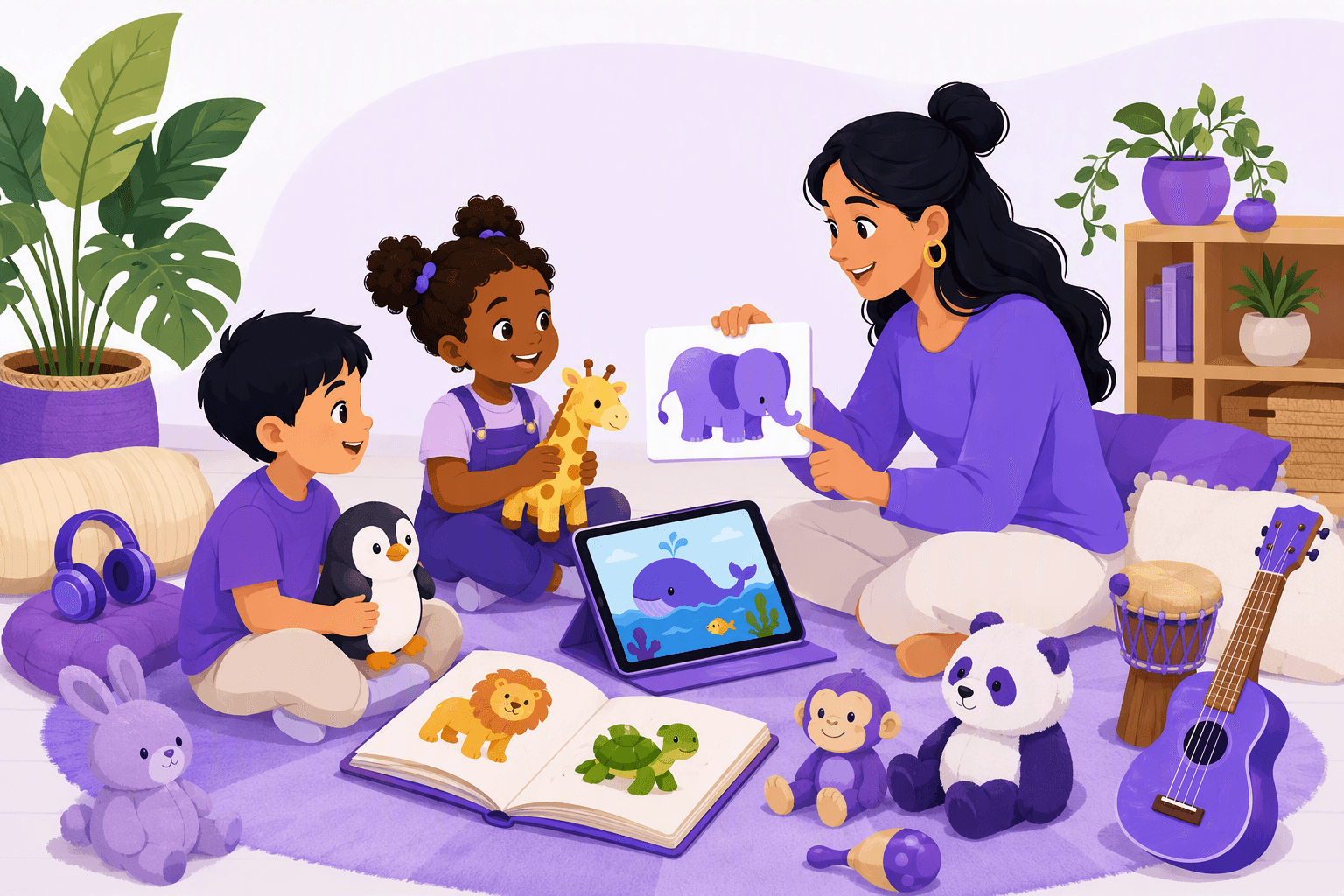
Why children learn languages differently from adults
Children are skilled pattern finders. They listen to thousands of examples, notice what tends to occur together, test words in conversation, and gradually adjust. They do not need an explanation of subject pronouns before they can say a sentence such as “I want more juice.”
Patricia K. Kuhl’s research on infant speech perception shows that early experience tunes children toward the sound patterns of the languages around them. That does not mean older learners cannot succeed. It means children benefit greatly from hearing a language used naturally and often.
Erika Hoff, in Language Development, emphasizes that both the quantity and quality of input matter. A television show playing unnoticed in the background is not the same as a parent and child watching a short scene, laughing together, and talking about what happened.
What children need most
A successful home language environment has four ingredients:
- Understandable input: The child can work out the meaning from pictures, actions, tone, or context.
- Repetition with variety: The same useful words return in new stories and situations.
- Interaction: Someone responds when the child points, answers, asks, or makes a mistake.
- Positive emotion: Curiosity, humor, belonging, and play make a child more willing to keep trying.
The Council of Europe’s CEFR framework treats language as action, not a list of isolated rules. For children, this means learning language to greet someone, choose a snack, describe a dinosaur, join a game, or tell a story.
Set a realistic family goal first
Before choosing an app, tutor, or curriculum, decide what success means for your child right now. A four-year-old may only need to understand familiar phrases and join in with songs. A ten-year-old may want to follow a movie plot or chat with relatives.
Avoid vague targets such as “be fluent by summer.” Use observable goals instead.
| Child's goal | A practical sign of progress |
|---|---|
| Understand everyday speech | Follows simple instructions without translation |
| Build confidence speaking | Uses short phrases voluntarily during play |
| Read in the language | Recognizes familiar words in books and captions |
| Connect with family | Can greet relatives and answer predictable questions |
| Prepare for school | Understands classroom routines and common instructions |
A child does not need to progress evenly in listening, speaking, reading, and writing. Listening usually develops first. A quiet child may understand much more than they can comfortably say.
💡 Measure participation, not perfection
Notice whether your child chooses the target language activity, recognizes a phrase from last week, or tries a new word without being prompted. These are stronger early signals than flawless grammar.
Match the method to your child's age
Ages 0 to 3: routines, gestures, and warm voices
Babies and toddlers learn through direct social interaction. Use the target language during predictable moments: getting dressed, bath time, meals, tidy-up, and bedtime. Keep phrases short and pair them with actions.
For example, say “Shoes on,” “More milk?” “All done,” or “Where is your teddy?” in the target language every day. Repetition is useful because the situation explains the meaning without a translation.
Songs and finger plays are excellent at this age because rhythm makes phrases memorable. Do not worry if the child responds in another language. Understanding comes before speaking for many children.
Ages 3 to 6: pretend play and picture books
Preschoolers learn fastest when language is attached to imagination. A toy shop, doctor’s clinic, restaurant, superhero rescue, or animal safari gives words a purpose.
Read picture books repeatedly rather than constantly buying new ones. On the first reading, point and name objects. On the second, pause for the child to fill in a word. On later readings, ask simple questions about what a character wants or feels.
This age is also ideal for call-and-response phrases. Use a puppet who only understands the target language, or make a simple ritual such as asking for fruit, choosing a bedtime book, or greeting a stuffed animal.
Ages 6 to 9: stories, games, and small projects
School-age children can begin to notice patterns, but grammar should serve communication. If they repeatedly hear “I have,” “you have,” and “she has,” a quick explanation may help, followed by a game where they describe objects in a backpack.
Board games, scavenger hunts, cooking projects, and simple crafts create natural repetition. A child who has to ask for “two red buttons” or explain where a clue is located has a reason to retrieve vocabulary.
This is also a good age for beginner-friendly comics and short video scenes. If English is the target, use captions carefully and choose content your child would watch even without the language-learning goal.
Ages 10 to 13: interests and independent choice
Older children often resist activities that feel designed for younger learners. Let their interests lead: football, animation, science, gaming, fashion, music, mysteries, or comedy.
They can handle short grammar notes, vocabulary notebooks, and subtitles, but they still need exposure that is enjoyable. A child who loves fantasy may learn more from discussing one favorite scene than from memorizing 30 unrelated word cards.
Age-appropriate films can add real voices, facial expressions, and cultural context. Use our list of movies to learn English to find material, then watch short sections rather than demanding that a child understand an entire film immediately.
Build a weekly routine that survives busy life
A sustainable routine beats an ambitious schedule that disappears after two weeks. Begin with four or five short sessions per week and add language to activities you already do.
Here is a realistic example for a child learning English:
| Day | Activity | Time |
|---|---|---|
| Monday | Read one familiar picture book together | 10 minutes |
| Tuesday | Play a movement game using action words | 10 minutes |
| Wednesday | Watch one short clip and talk about it | 15 minutes |
| Thursday | Use English during a snack or cooking task | 10 minutes |
| Friday | Play a vocabulary game or sing a favorite song | 15 minutes |
| Weekend | Choose a fun family activity in English | 20 minutes |
The target language does not need to occupy every moment. It needs a stable place in family life. A predictable “English pancake breakfast” or “Spanish story night” can become an event a child anticipates.
🌍 Keep the language connected to people
A language becomes more meaningful when it connects a child to a real person, place, story, or community. If your family has heritage ties, include recipes, holiday traditions, family photos, and calls with relatives. If not, explore age-appropriate books, music, and creators from communities that use the language.
Use screens actively, not passively
Screens are not automatically harmful or helpful. The American Academy of Pediatrics stresses the importance of content quality, context, and adult involvement. A short, well-chosen video can be useful when it leads to talk, play, and repetition afterward.
Use a simple three-step method:
- Watch: Choose a clip with a clear situation and visual story.
- Replay: Watch a short section again and notice two or three useful phrases.
- Use: Act out the scene, draw it, retell it, or use one phrase during the day.
For a child learning English, a funny scene can teach tone as well as vocabulary. A character’s raised eyebrows, hesitation, and response reveal whether “Really?” expresses surprise, doubt, excitement, or annoyance.
Be selective with informal language. Older children will encounter slang online, but they need context before repeating it. Explain that phrases in our English slang guide can be region-specific, age-specific, or inappropriate at school. Likewise, clearly label swear words as language to recognize for safety and understanding, not language to copy. Our English swear words guide can help adults explain strength and context responsibly.
Make speaking low-pressure
Many children stop speaking when every sentence becomes a correction opportunity. If a child says “Yesterday I go park,” respond naturally with the correct form: “Yes, you went to the park yesterday. What did you do there?” The child hears the model and stays in the conversation.
Correct directly only when the mistake blocks meaning, involves a key word you are practicing, or the child asks for help. For pronunciation, reward effort first, then model the word slowly in a friendly tone.
Do not force a shy child to perform for guests. Instead, create low-risk options: talking to a toy, sending a voice note to a relative, reading one line from a comic, or ordering pretend food in a game.
Code-switching is normal
Bilingual children may combine languages in a sentence, such as “Can I have the rojo one?” This can happen because a word arrives faster in one language, because both speakers understand both languages, or because the child has not yet learned the target word.
Answer in the language you are using and supply the missing word naturally. “Yes, you can have the red one.” This supports learning without treating bilingual speech as a failure.
Common mistakes parents can avoid
Treating language as a test
Constant quizzes can turn a pleasant activity into a performance. Instead of asking “What is this called?” ten times, say “I see a yellow truck. Can you find another yellow thing?”
Buying too many resources
A shelf of unused books and five apps do not create exposure. Pick one core routine, a few favorite books, and one source of engaging audio or video. Repeat them enough for the language to become familiar.
Translating every sentence
Translation has a place, especially with older children, but it should not carry the whole lesson. Use objects, actions, pictures, and tone first. A child who understands from context is building direct links between meaning and the new language.
Expecting instant speech
Some children spend weeks listening before they speak much. This silent period can be productive. Keep inviting participation, but accept gestures, pointing, and one-word answers as valid communication.
Ignoring literacy in the home language
A strong first language supports learning overall. Keep reading, telling stories, and having rich conversations in the language your family uses most comfortably. Adding a language should not mean weakening the child’s strongest connection to family communication.
How to know the plan is working
Look for small, concrete changes over time. Your child may sing part of a song without prompting, understand a request before you gesture, recognize a word in a book, or use a phrase while playing.
Keep a simple monthly record with three categories: words understood, phrases used, and activities enjoyed. This gives you evidence of progress when learning feels slow.
If your child seems frustrated for several weeks, reduce the difficulty before increasing the workload. Choose easier material, shorten the activity, and return to a familiar game or story. Confidence creates the willingness to take risks, and risk-taking is necessary for language growth.
A practical final plan
For most families, the strongest approach is simple: choose one language, create a small daily ritual, use stories and play, add carefully selected media, and let the child’s interests shape the content. Speak imperfectly if you are still learning too. A parent who is curious and consistent teaches that languages are for real life, not just school exercises.
Use entertainment as a shared activity rather than background noise, and keep every session connected to something a child enjoys. Over time, the child will associate the language with laughter, stories, people, and capability, which is the foundation that keeps learning going.
Frequently Asked Questions
What is the best age for a child to start learning a second language?
Can children become bilingual if parents do not speak the target language fluently?
How much daily language exposure does a child need?
Will learning two languages confuse my child?
Should children use language-learning apps?
Sources & References
- British Council, The English Effect Report
- Council of Europe, Common European Framework of Reference for Languages: Companion Volume, 2020
- American Academy of Pediatrics, Media and Young Minds
- Patricia K. Kuhl, The Linguistic Genius of Babies
- Erika Hoff, Language Development
Start learning with Wordy
Watch real movie clips and build your vocabulary as you go. Free to download.


