Korean Idioms and Expressions: 25 Sayings You’ll Actually Hear (With Pronunciation)
Quick Answer
Korean idioms and expressions are short, memorable phrases that Koreans use to react, tease, encourage, or describe situations quickly. This guide teaches 25 natural sayings with pronunciation, when they sound friendly vs rude, and how they show up in real dialogue like K-dramas and everyday conversation.
Korean idioms and expressions are short, fixed sayings that Koreans use to describe people and situations quickly, often with humor, exaggeration, or a vivid image, and learning a core set of them will make your listening and speaking sound far more natural in real conversations.
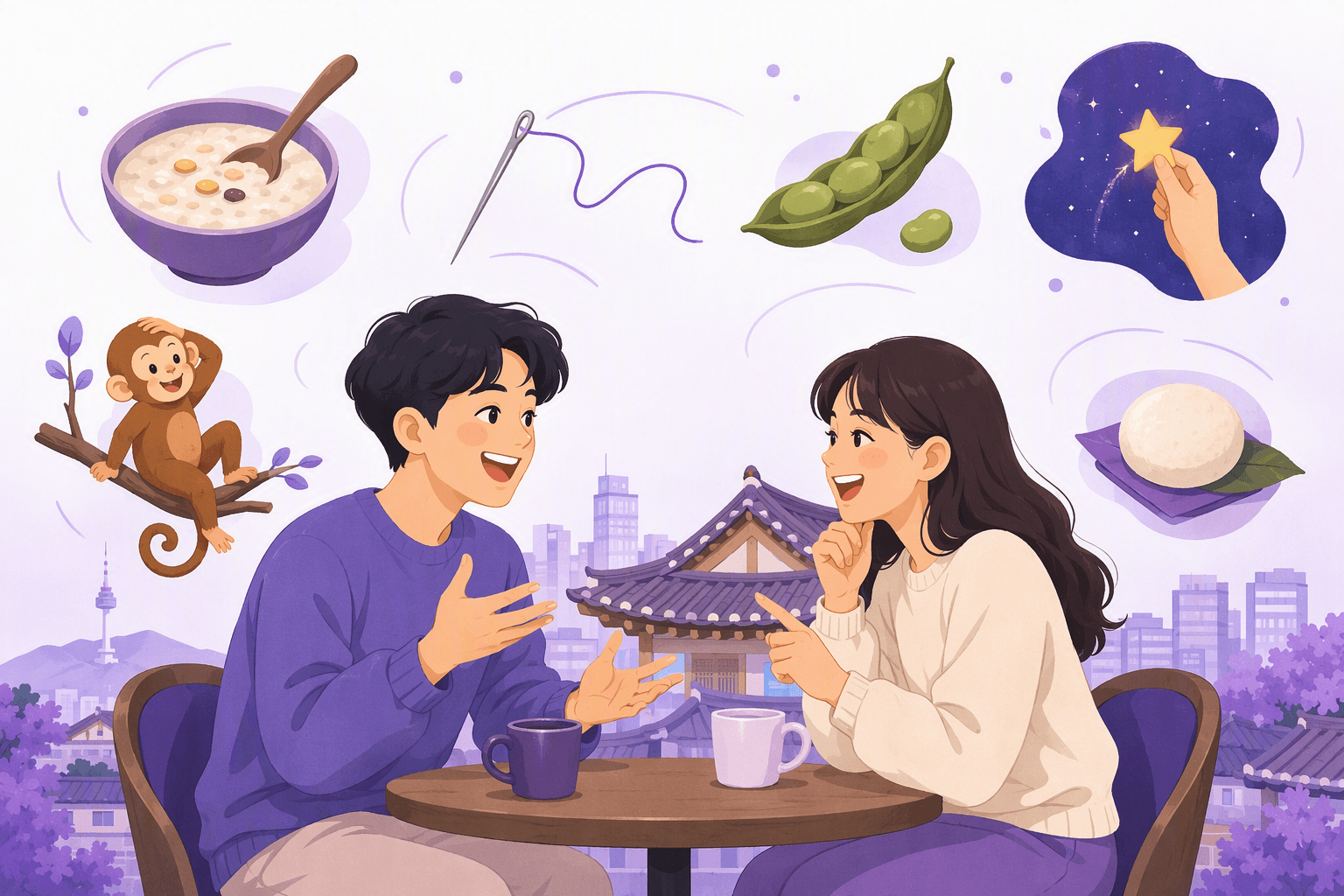
Korean is spoken by roughly 82 million people worldwide (Ethnologue, 27th edition, 2024), and a lot of what you hear in Seoul, Busan, and Korean media is not textbook grammar, it is set phrases. If you already know basic greetings like those in our how to say hello in Korean guide, idioms are the next step toward understanding the punchlines, the teasing, and the emotional subtext.
💡 How to use this guide
Treat each expression as a single chunk. Learn the situation it fits, then practice swapping only the subject or noun. This is closer to how Koreans actually speak, and it aligns with chunk-based learning approaches discussed in applied linguistics, including work by Michael Lewis in The Lexical Approach.
What counts as an idiom in Korean (and why it matters)
In Korean, you will see terms like 관용구 (idiom), 속담 (proverb), and 사자성어 (four-character idioms of classical origin). In real life, people mix all three categories, and learners mostly need one skill: recognizing that a phrase is fixed and should not be translated word-for-word.
The National Institute of Korean Language (국립국어원) is the main authority that documents standard forms and meanings, including many idioms in the 표준국어대사전 (accessed 2026). When you learn the standard form, you can still adapt it to speech levels, which is where many learners go wrong.
Speech levels: the hidden switch behind many expressions
Most idioms are neutral in meaning, but the ending you attach can change the social feel. You can say 말도 안 돼요 (polite) or 말도 안 돼 (casual). The idiom stays the same, but the relationship changes.
If you are still building that foundation, skim our how to say goodbye in Korean guide and notice how often Korean encodes relationship in the verb ending, not in extra words.
25 Korean idioms and expressions you will actually hear
Below are expressions that show up constantly in everyday talk, variety shows, and K-dramas. Each one includes a pronunciation approximation and a natural example.
⚠️ A quick safety note
Some idioms are used to vent anger. If you pair them with strong swear words, the tone can escalate fast. If you want to understand that register without using it, see our guide to Korean swear words.
식은 죽 먹기
Meaning: Something is very easy, like eating cold porridge.
Pronunciation: SHEE-geun jook meok-kee
Use it when you want to sound confident without bragging too hard. It is common in friendly encouragement.
/SHEE-geun jook meok-kee-yah/
Literal meaning: Eating cold porridge.
“그 정도는 식은 죽 먹기야.”
That level of difficulty is a piece of cake.
죽 (porridge) is a familiar comfort food in Korea. The image of 'cold porridge' suggests zero effort, so the idiom feels everyday and not overly formal.
눈코 뜰 새 없다
Meaning: To be extremely busy, no time to open your eyes and nose.
Pronunciation: noon-koh tteul seh eop-ttah
This is a very Korean style of exaggeration. It is vivid, but not rude.
/noon-koh tteul seh eop-suh-ssuh/
Literal meaning: No time to open eyes and nose.
“요즘 일이 너무 많아서 눈코 뜰 새 없어.”
These days I have so much work that I'm swamped.
You will hear this in office talk and school talk. It is a safe, natural way to say you are busy without sounding dramatic.
발이 넓다
Meaning: To have a wide network, to know many people.
Pronunciation: bah-ree neolb-ttah
This is useful when talking about someone who is well-connected. It can be praise or mild teasing.
/bah-ree jin-jjah neolb-ttah/
Literal meaning: Your feet are wide.
“너 발이 넓어서 이런 정보도 다 아네.”
You know everyone, you even know information like this.
In Korea, introductions and connections matter in many settings. This idiom often appears when someone seems to have a contact for everything.
손이 크다
Meaning: To be generous, often by giving a lot of food or portions.
Pronunciation: soh-nee keu-dah
You will hear this at family meals and gatherings. It is usually a compliment.
/uh-muh, soh-nee keu-shee-neh-yoh/
Literal meaning: Your hands are big.
“이렇게 많이 준비하셨어요? 손이 크시네요.”
You prepared this much? You're so generous.
Food generosity is a major social signal. Calling someone 손이 크다 often praises hospitality, especially for older relatives or hosts.
입이 무겁다
Meaning: To be discreet, to keep secrets well.
Pronunciation: ee-bee moo-geop-ttah
This is a high-value compliment in Korean social life. It implies trustworthiness.
/jyeh-neun ee-bee moo-geh-woh/
Literal meaning: Their mouth is heavy.
“걱정 마, 나는 입이 무거워.”
Don't worry, I can keep a secret.
Because group harmony matters, being able to hold private information is socially respected. This idiom is common in friend groups and workplaces.
입이 가볍다
Meaning: To be a blabbermouth, to leak secrets.
Pronunciation: ee-bee gah-byeop-ttah
This is the opposite of 입이 무겁다. It is often used jokingly, but it can sting.
/nuh ee-bee nuh-moo gah-byeo-woh/
Literal meaning: Your mouth is light.
“그 얘기 아무한테도 하지 마. 쟤 입이 가벼워.”
Don't tell that to anyone. They can't keep secrets.
Korean groups can be tight-knit, so gossip spreads fast. This idiom is a social warning, even when said with a laugh.
귀가 얇다
Meaning: To be easily influenced, to believe what you hear.
Pronunciation: gwee-gah yahlb-ttah
You will hear it when someone buys a trending product or changes their opinion quickly.
/nuh gwee-gah yahlb-ttah/
Literal meaning: Your ears are thin.
“또 샀어? 너 진짜 귀가 얇다.”
You bought it again? You're really easily influenced.
This comes up a lot with trends, beauty products, and social recommendations. It can be affectionate teasing among friends.
눈이 높다
Meaning: To have high standards, to be picky (often about dating or taste).
Pronunciation: noo-nee noh-ptah
This is extremely common in dating talk and shopping talk. Tone depends on context.
/noo-nee nuh-moo noh-bah/
Literal meaning: Your eyes are high.
“소개팅이 마음에 안 든다고? 너 눈이 높다.”
You didn't like your blind date? You have high standards.
You will hear this in conversations about partners, apartments, and brands. It can be playful, but it can also criticize someone as too picky.
눈이 빠지게 기다리다
Meaning: To wait so long your eyes might fall out.
Pronunciation: noo-nee ppah-jji-geh kee-dah-ree-dah
This is dramatic in a funny way, so it fits texting and joking complaints.
/noo ppah-jji-geh kee-dah-ryeot-jjah-nah/
Literal meaning: Wait until your eyes fall out.
“너무 늦었어. 나 눈 빠지게 기다렸어.”
You're so late. I've been waiting forever.
Korean uses vivid body imagery for emphasis. This one is common in couple talk and friend talk, especially in messages.
말도 안 돼
Meaning: No way, that makes no sense.
Pronunciation: mahl-doh ahn dweh
This is one of the most useful reaction lines in Korean. Make it polite with 말도 안 돼요.
/mahl-doh ahn dweh/
Literal meaning: It doesn't even become words.
“그 사람이 너한테 고백했다고? 말도 안 돼.”
He confessed to you? No way.
You will hear this constantly in dramas. It can express disbelief, annoyance, or playful shock, depending on intonation.
어쩔 수 없어
Meaning: It can't be helped.
Pronunciation: uh-jjeol soo eop-suh
A very Korean-feeling phrase because it accepts constraints and moves on. It can sound resigned, not cold.
/uh-jjeol soo eop-suh/
Literal meaning: There is no way to do anything.
“비가 오네. 어쩔 수 없지.”
It's raining. It can't be helped.
This is common when plans change. It can also be used to gently end an argument by acknowledging reality.
다행이다
Meaning: What a relief, fortunately.
Pronunciation: dah-haeng-ee-dah
This is a safe, high-frequency expression that works in polite speech too: 다행이에요.
/dah-haeng-ee-dah/
Literal meaning: It is fortunate.
“큰일 날 뻔했네. 다행이다.”
That was almost a big problem. What a relief.
Koreans often mark relief explicitly in conversation. It is a small empathy signal, especially when someone shares bad news that turned out okay.
속이 시원하다
Meaning: To feel relieved, refreshed inside, like your stomach is cool.
Pronunciation: soh-gee shee-won-hah-dah
This is used after saying what you needed to say, or after a problem is solved.
/ee-jeh soh-gee shee-won-hah-dah/
Literal meaning: My insides feel cool.
“할 말 다 했더니 속이 시원해.”
After saying everything I needed to say, I feel relieved.
Korean often maps emotions onto the body. This one is common after confronting someone or finishing a stressful task.
속이 타다
Meaning: To burn inside with worry or impatience.
Pronunciation: soh-gee tah-dah
This is a strong emotional idiom, but not vulgar. It is common in family talk.
/soh-gee tah-suh jahm-ee ahn wah/
Literal meaning: My insides are burning.
“연락이 없으니까 속이 탄다.”
Because there's no contact, I'm burning with worry.
Parents say this about kids, and partners say it about silence. It communicates anxious impatience more than anger.
가슴이 철렁하다
Meaning: Your heart drops, you get a sudden scare.
Pronunciation: gah-seu-mee cheol-leong-hah-dah
You will hear this after near-misses, surprise calls, or sudden bad news.
/gah-seu-mee cheol-leong-hae-ssuh/
Literal meaning: My chest clunked.
“갑자기 이름 부르길래 가슴이 철렁했어.”
When they suddenly called my name, my heart dropped.
철렁 is an onomatopoeic sound of something heavy dropping. Korean uses sound-symbolic words often, and they add vividness to everyday speech.
뚜껑 열리다
Meaning: To lose your temper, to have your lid pop open.
Pronunciation: ttoo-kkeong yeol-ree-dah
This is common, but it signals real anger. Use carefully.
/nah ttoo-kkeong yeol-ryeo-ssuh/
Literal meaning: My lid opened.
“그 말 듣고 뚜껑 열릴 뻔했어.”
After hearing that, I almost lost it.
The 'lid' image is widely understood in Korea. It is often used to describe anger that suddenly spikes, especially in unfair situations.
열 받다
Meaning: To get heated, to get annoyed or angry.
Pronunciation: yeol bahd-ttah
This is very common in casual speech. It can be mild or strong depending on tone.
/geu-guh ttae-moon-eh yeol bahd-ah-ssuh/
Literal meaning: I received heat.
“댓글 보고 열 받았어.”
I got heated after reading the comments.
열 (heat) is a common metaphor for anger in Korean. You will hear this in everyday complaining, especially online contexts.
콩깍지가 씌다
Meaning: To be blinded by love, to see someone through rose-colored glasses.
Pronunciation: kong-kkahk-jjee-gah sswee-dah
This is a classic teasing line about couples. It is playful, not formal.
/kong-kkahk-jjee-gah sswee-eot-neh/
Literal meaning: A bean pod shell is covering you.
“단점이 안 보인다고? 콩깍지가 씌었네.”
You can't see their flaws? You're blinded by love.
The image is that a shell covers your eyes. It is common in family teasing, especially toward someone newly dating.
김칫국부터 마시다
Meaning: To count your chickens before they hatch, to assume success too early.
Pronunciation: gim-chee-gook-boo-tuh mah-shee-dah
This is a very Korean idiom with a food reference. It is used to tease premature celebration.
/gim-chee-gook-boo-tuh mah-shee-jee mah/
Literal meaning: Don't drink the kimchi soup first.
“아직 합격한 거 아니야. 김칫국부터 마시지 마.”
You haven't passed yet. Don't get ahead of yourself.
Kimchi soup is imagined as part of a celebratory meal. The idiom warns against acting like the party already started.
그림의 떡
Meaning: Something you want but cannot have, like a rice cake in a picture.
Pronunciation: geu-rim-eh tteok
This is common when talking about expensive things, time, or opportunities.
/nah-hahn-ten geu-rim-eh tteok-ee-yah/
Literal meaning: A rice cake in a picture.
“그 집은 너무 비싸서 나한텐 그림의 떡이야.”
That house is so expensive that it's out of reach for me.
떡 (rice cake) is a familiar treat. A picture of it is tempting but useless, so the idiom feels intuitive to Koreans.
고생 끝에 낙이 온다
Meaning: After hardship comes happiness.
Pronunciation: goh-saeng kkeut-eh nah-gee ohn-dah
This is closer to a proverb, and you will hear it from older speakers and in motivational talk.
/goh-saeng kkeut-eh nah-gee ohn-dah/
Literal meaning: After hardship, pleasure comes.
“지금 힘들어도 고생 끝에 낙이 온다.”
Even if it's hard now, it'll be worth it in the end.
This fits exam culture and career talk. It is often said to juniors, and it can sound supportive rather than sentimental.
하늘의 별 따기
Meaning: Extremely difficult, like picking a star from the sky.
Pronunciation: hah-neul-eh byeol ttah-gee
A dramatic but common way to say something is nearly impossible.
/geu-geon hah-neul-eh byeol ttah-gee-yah/
Literal meaning: Picking a star from the sky.
“요즘 그 가격에 집 구하는 건 하늘의 별 따기야.”
These days, finding a house at that price is almost impossible.
You will hear this in housing and job talk. It is a vivid idiom that feels natural in complaints about 현실 (reality).
바늘 가는 데 실 간다
Meaning: Needle goes, thread follows, two things always come together.
Pronunciation: bah-neul gah-neun-deh seel gahn-dah
This is used when two people are inseparable, or when one thing naturally implies another.
/bah-neul gah-neun-deh seel gah-jee/
Literal meaning: Where the needle goes, the thread goes.
“걔네는 바늘 가는 데 실 가듯이 항상 같이 다녀.”
Those two always go together like needle and thread.
This proverb is common across generations. It can be affectionate, but it can also imply someone never acts independently.
원숭이도 나무에서 떨어진다
Meaning: Even experts make mistakes.
Pronunciation: won-soong-ee-doh nah-moo-eh-suh tteol-luh-jin-dah
This is a gentle way to comfort someone after a mistake, including yourself.
/won-soong-ee-doh nah-moo-eh-suh tteol-luh-jin-dah/
Literal meaning: Even monkeys fall from trees.
“실수할 수도 있지. 원숭이도 나무에서 떨어진다잖아.”
You can make mistakes. They say even monkeys fall from trees.
Korean proverbs often use animals for everyday wisdom. This one is widely understood and rarely sounds awkward when used appropriately.
일석이조
Meaning: Two birds with one stone, one action with two benefits.
Pronunciation: eel-seok-ee-joh
This is a 사자성어 that still feels modern. You will see it in ads and headlines too.
/eel-seok-ee-joh-neh/
Literal meaning: One stone, two birds.
“운동도 하고 친구도 만나고, 일석이조네.”
You work out and meet a friend, two birds with one stone.
Four-character idioms often feel slightly 'educated', but 일석이조 is so common that it works in casual speech, especially as a punchy summary.
금상첨화
Meaning: Icing on the cake, adding flowers on brocade.
Pronunciation: geum-sahng-cheom-hwa
This is another 사자성어, used when something good becomes even better.
/ee-geon geum-sahng-cheom-hwa-jee/
Literal meaning: Adding flowers on brocade.
“맛도 좋은데 가격도 싸? 금상첨화네.”
It tastes good and it's cheap? That's the icing on the cake.
You will hear this in reviews and compliments. It can sound slightly formal, but it is common enough to be used playfully.
새옹지마
Meaning: Good luck and bad luck can switch, you never know.
Pronunciation: seh-ong-jee-mah
This is a well-known classical idiom. It appears in news, essays, and sometimes in reflective conversation.
/een-saeng-eun seh-ong-jee-mah-yah/
Literal meaning: The old man at the frontier's horse.
“지금은 힘들어도 인생은 새옹지마야.”
Even if it's hard now, you never know what will happen in life.
This is more literary than daily slang, but many Koreans recognize it. It fits reflective scenes in dramas and serious conversations.
How these expressions show up in real Korean dialogue
Korean dialogue often uses idioms as emotional shortcuts. Instead of explaining a whole situation, a speaker drops one phrase and expects the listener to infer the rest.
This is one reason K-drama Korean can feel fast even when the grammar is simple. If you are training your ear, pair idioms with high-frequency core words, like the ones in our 100 most common Korean words list, so you can catch both the fixed phrase and the surrounding glue words.
The three patterns you will hear most
- Reaction line: 말도 안 돼, 다행이다, 어쩔 수 없어.
- Labeling a person: 발이 넓다, 귀가 얇다, 입이 무겁다.
- Emotional body metaphor: 속이 타다, 속이 시원하다, 가슴이 철렁하다.

If you learn one from each pattern, your listening improves quickly because you start predicting what comes next.
Common learner mistakes (and how to avoid them)
Mistake 1: Using an idiom with the wrong speech level
The idiom itself is fixed, but the ending is not. You can say 눈코 뜰 새 없어요 (polite) or 눈코 뜰 새 없어 (casual). If you say a casual ending to a senior colleague, the idiom is not the problem, the relationship marker is.
If you want a fast refresher on polite vs casual openings and closings, revisit how to say hello in Korean and how to say goodbye in Korean.
Mistake 2: Treating proverbs like everyday small talk
Proverbs like 고생 끝에 낙이 온다 can sound heavy if you drop them into a light chat. Use them when the conversation is already serious, or when you are explicitly encouraging someone.
A good rule is: if you would not say it in English to a close friend in a casual text, do not force it in Korean either.
Mistake 3: Copying dramatic anger lines from dramas
Expressions like 뚜껑 열리다 and 열 받다 are real, but dramas amplify emotion. If you say them too early as a learner, you can sound harsher than you intend.
Understanding that register is useful, but if you want to map the boundaries, compare with the stronger language in Korean swear words so you can hear the difference between frustration and insult.
A practical way to learn idioms with movie and TV clips
Idioms stick best when you attach them to a scene, a relationship, and a tone of voice. That is also how Koreans learn them, through repetition in family talk, school talk, and media.
Claire Kramsch, in Language and Culture, emphasizes that meaning is not only in words but in social context and interpretation. Idioms are exactly that: a compact cultural cue that only makes full sense when you know who is speaking and why.
If you want to build this skill systematically, use short clips where you can replay the same line and shadow the intonation. Wordy’s clip-based practice is designed for this kind of chunk learning, especially for reaction lines like 말도 안 돼 and emotional idioms like 가슴이 철렁하다.
💡 Mini practice routine (10 minutes)
- Listen once without subtitles, and guess the emotion.
- Read the subtitle and identify the fixed chunk.
- Repeat the chunk 10 times, keeping the same rhythm.
- Say one new sentence with the same chunk, changing only the noun or topic.
When idioms overlap with romance language
Some idioms show up a lot in couple talk, especially teasing ones like 콩깍지가 씌다 and waiting complaints like 눈 빠지게 기다리다. If you are learning romantic Korean, connect these to more direct affection phrases from our how to say I love you in Korean guide, so you can balance teasing with warmth.
A common pattern in Korean couples is: playful complaint plus softening. The softening can be a cute tone, a nickname, or a quick affectionate line after the complaint.
Wrap-up: the fastest set to learn first
If you only learn five expressions from this guide, start with these because they are frequent and socially safe:
- 말도 안 돼 (mahl-doh ahn dweh)
- 다행이다 (dah-haeng-ee-dah)
- 어쩔 수 없어 (uh-jjeol soo eop-suh)
- 눈코 뜰 새 없다 (noon-koh tteul seh eop-ttah)
- 가슴이 철렁하다 (gah-seu-mee cheol-leong-hah-dah)
Then add one person-labeling idiom (입이 무겁다) and one romance-teasing idiom (콩깍지가 씌다). That mix covers daily reactions, empathy, busyness, trust, and relationship talk, which is most of what you hear in modern Korean media.
If you want more structured listening practice, start with greetings and leave-taking in hello in Korean and goodbye in Korean, then come back and plug these idioms into the same scenes.
Frequently Asked Questions
What is the difference between a Korean idiom and a Korean expression?
Are Korean idioms used in formal situations?
Do Koreans really use 사자성어 in daily conversation?
How can I learn Korean expressions from K-dramas without copying rude lines?
What are the safest Korean expressions for beginners to use?
Sources & References
- Ethnologue, Korean (kor), 27th edition, 2024
- National Institute of Korean Language (국립국어원), Standard Korean Language Dictionary (표준국어대사전), accessed 2026
- National Institute of Korean Language (국립국어원), Korean Language and Culture resources, accessed 2026
- King Sejong Institute Foundation, Korean learning resources, accessed 2026
Start learning with Wordy
Watch real movie clips and build your vocabulary as you go. Free to download.


