Quick Answer
Korean food culture is built around shared dishes, respect for age and hierarchy, and a rhythm of small courtesies: waiting to start, using polite phrases, and pouring drinks for others. If you learn a handful of restaurant phrases plus a few etiquette rules (especially with elders), you can eat confidently in Korea and in Korean restaurants worldwide.
Korean food culture is a shared-table culture where politeness and group harmony matter as much as taste: you usually eat banchan together, wait for elders to begin, and use a small set of respectful phrases that instantly make you sound more natural in restaurants and at home.
If you are also learning everyday greetings, pair this with How to Say Hello in Korean so your first impression matches your table manners.
| English | Korean | Pronunciation | Formality |
|---|---|---|---|
| Excuse me (to get attention) | 저기요 | juh-gee-YOH | polite |
| Please give me this | 이거 주세요 | ee-guh JOO-seh-yoh | polite |
| One more, please | 하나 더 주세요 | hah-nah duh JOO-seh-yoh | polite |
| It's delicious | 맛있어요 | mah-shee-SSUH-yoh | polite |
| Thank you for the meal (before eating) | 잘 먹겠습니다 | jahl meok-geh-SSUM-nee-dah | formal |
| Thank you for the meal (after eating) | 잘 먹었습니다 | jahl meok-uh-SSUM-nee-dah | formal |
| Please bring the check | 계산서 주세요 | geh-sahn-suh JOO-seh-yoh | polite |
| I'm full | 배불러요 | beh-bool-luh-YOH | polite |
Why Korean food culture feels different (and why it matters for learners)
Korean is spoken by tens of millions of people worldwide, and South Korea’s food has become globally familiar through K-dramas, K-pop, and Korean restaurants in major cities. Ethnologue (27th edition, 2024) estimates roughly 82 million speakers of Korean worldwide, so the odds are high you will use these norms outside Korea too.
Food is also one of the fastest ways to hear real Korean rhythm and politeness levels. In Korean, social hierarchy shows up in small choices, like which request ending you use, and who you serve first.
Linguist Ho-min Sohn, in The Korean Language (Cambridge University Press), describes Korean honorifics as a core system, not a “bonus” layer. Dining is one of the most visible places that system shows up, even for beginners.
The core idea: Korean meals are built for sharing
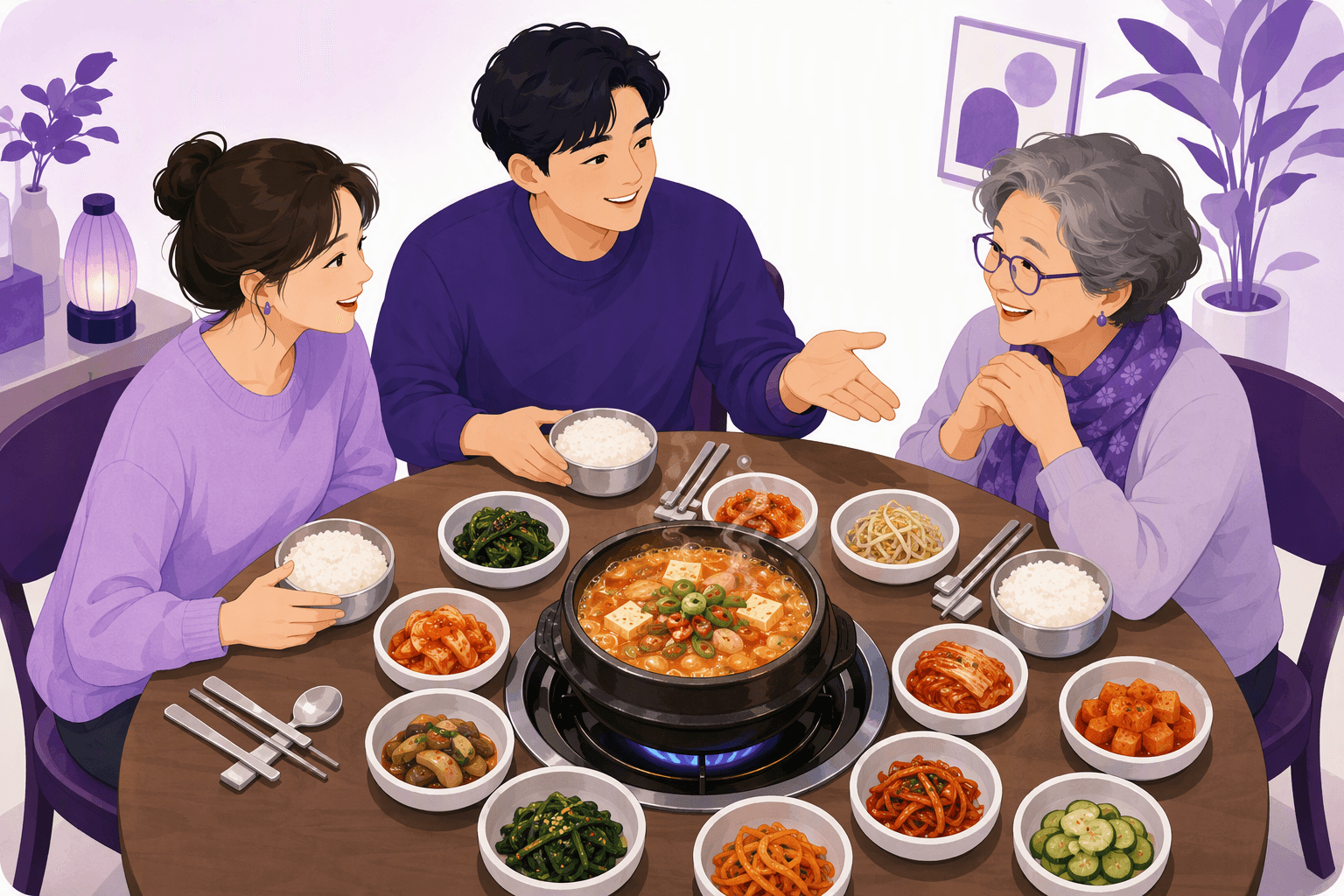
Banchan and the “center of the table” logic
In many meals, banchan (반찬, side dishes) are placed in the middle and shared. That changes your default behavior if you come from a “my plate, my food” culture.
If you are with people you do not know well, take small portions and avoid “digging around” for the best pieces. It reads as considerate, and it also keeps the table tidy.
Communal dishes and “one pot” meals
Stews like 김치찌개 (kimchi jjigae) and 된장찌개 (doenjang jjigae) are often served as a shared pot. You usually eat from your own bowl, but the pot is communal.
In some casual settings, people may eat directly from the pot with their spoon. If you are unsure, follow the group’s lead.
🌍 A practical rule that keeps you safe
If the group is older or more formal, serve yourself into your bowl first. If the group is close friends, the rules loosen.
The must-know etiquette rules (without overthinking)
Wait for elders, then match the pace
A common guideline is to wait until the oldest person starts eating. This is especially true in family meals, work dinners, and any situation where age hierarchy is clear.
Once the meal starts, match the pace of the table. Eating extremely fast can feel like you are rushing, and eating extremely slowly can make others wait.
Chopsticks and spoon: what’s normal
Korean table settings often include both chopsticks (젓가락) and a spoon (숟가락). The spoon is used a lot, especially for rice and soup.
Avoid sticking chopsticks upright in rice. In East Asia this can resemble funeral offerings, and it can feel unsettling at the table.
Don’t “self-serve” drinks first in formal settings
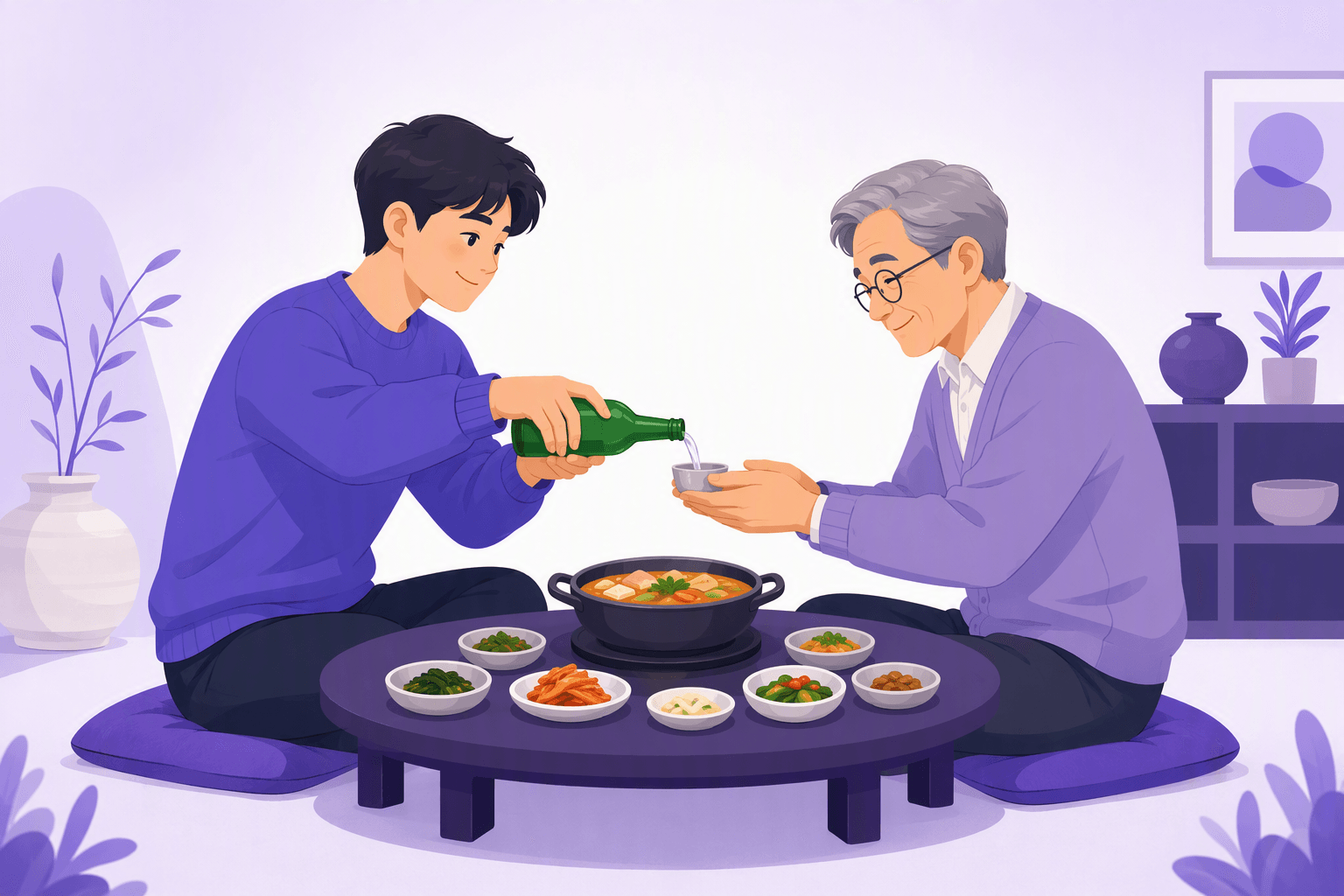
At dinners with alcohol, pouring for others is a classic politeness move. You will often see younger people pour for older people, and coworkers pour for each other.
If someone offers to pour you a drink, accept with a small gesture of thanks, and consider holding your glass with two hands in more formal contexts.
💡 Two-hand cue
Using two hands to receive a drink, or to pour for an elder, is a simple nonverbal sign of respect. You do not need to make it theatrical, just natural.
Restaurant flow in Korea: what to expect
Ordering is often fast and direct
Korean restaurants can be efficient. Staff may assume you know what you want, especially in busy places.
That is why one polite attention-getter plus one request pattern goes a long way.
Call buttons are common
Many restaurants have a call button at the table. If it exists, use it. It is normal and it reduces the need to wave or call out.
If there is no button, 저기요 (juh-gee-YOH) is the safest way to get attention.
Paying: who pays, and how
In friend groups, one person often pays and others send money later. In work settings, the senior person may pay, or the team may rotate.
Tipping is not a default expectation in South Korea. If you want to show appreciation, a sincere “맛있어요” and “감사합니다” is culturally cleaner than leaving cash.
The phrases you actually need, with pronunciation and when to use them
Below are the phrases that cover 80% of real restaurant interactions. They are short, repeatable, and they map well to what you hear in K-dramas.
저기요
Pronunciation: juh-gee-YOH
저기요 is “excuse me” for getting someone’s attention. It is common in restaurants, cafes, and shops.
Use it once, clearly, and then wait. Repeating it rapidly can sound impatient.
/juh-gee-YOH/
Literal meaning: A polite attention-getter, similar to 'excuse me'
“저기요, 주문할게요.”
Excuse me, I'd like to order.
Very common in restaurants. If there is a call button, using the button is even more normal than calling out.
이거 주세요
Pronunciation: ee-guh JOO-seh-yoh
이거 주세요 means “please give me this.” It is perfect when you are pointing at a menu item, a photo menu, or food someone else ordered.
It is polite without being stiff, and it avoids complex grammar.
/ee-guh JOO-seh-yoh/
Literal meaning: This + please give
“이거 주세요, 하나요.”
This one, please, just one.
Great for beginners because you can point. It works in restaurants, bakeries, and street food stalls.
하나 더 주세요
Pronunciation: hah-nah duh JOO-seh-yoh
하나 더 주세요 means “one more, please.” It is used for refills, extra side dishes, or another order of the same item.
In many places, banchan refills are normal, but not always free. Asking politely is still the right move.
맛있어요
Pronunciation: mah-shee-SSUH-yoh
맛있어요 means “it’s delicious.” It is one of the best compliments you can give, and it is used constantly.
You can say it to your friend who cooked, to a host, or even to staff if you want to be warm.
🌍 Compliments in Korean meals
In many Korean households, praising the food is part of being a good guest. A simple 맛있어요 can do more social work than a long explanation.
잘 먹겠습니다
Pronunciation: jahl meok-geh-SSUM-nee-dah
잘 먹겠습니다 is said before eating. It signals gratitude and good manners, especially if someone is treating you or cooking for you.
It is also common before a work lunch when someone higher-ranking is paying.
/jahl meok-geh-SSUM-nee-dah/
Literal meaning: I will eat well
“오늘도 잘 먹겠습니다.”
I'll enjoy the meal today as well.
A standard pre-meal phrase in Korea. It is safe in restaurants and homes, and it fits formal situations well.
잘 먹었습니다
Pronunciation: jahl meok-uh-SSUM-nee-dah
잘 먹었습니다 is said after eating. It thanks the person who paid, cooked, or hosted.
If you are leaving a restaurant with Korean friends, saying this as you stand up is a nice finishing touch.
계산서 주세요
Pronunciation: geh-sahn-suh JOO-seh-yoh
계산서 주세요 means “please give me the check.” In some places you pay at the counter, but asking is still normal.
If you are with someone older or treating others, you might say it quietly and move first, because “who pays” can be a social negotiation.
Drinking culture basics (so you do not get blindsided)
Alcohol is not required to participate socially, but it is common in certain work and friend contexts. The key is to understand the rituals so you can opt in or opt out politely.
Pouring rules in one minute
If you are younger, you may be expected to pour for older people. If you are peers, people pour for each other.
If someone’s glass is empty, it can be polite to offer. If you do not want more, keep your glass less empty and decline verbally.
How to decline without making it awkward
You can keep it simple and polite. A short refusal plus a reason is often accepted.
Examples you will hear:
- “오늘은 괜찮아요” (oh-neul-eun gwen-CHAH-nah-yoh), “I’m okay today.”
- “내일 일찍 일어나야 해요” (neh-il eel-jjik eel-uh-nah-yah heh-YOH), “I have to get up early tomorrow.”
If you want more survival phrases for social situations, learn greetings and exits too, because leaving politely matters. See How to Say Goodbye in Korean.
Home meals and invitations: what guests usually do
Bringing something small is common
If you are invited to someone’s home, bringing fruit, dessert, or a small gift is common. It does not need to be expensive.
The gesture matters more than the object, especially if you are a student or a visitor.
Seating and serving: follow the host
In many homes, the host will guide seating. If there are elders, they may sit first or in a preferred spot.
If you want to help, ask once. If the host declines, accept it and do not insist repeatedly.
The kimchi factor: why it is cultural, not just food
Kimchi is not only a side dish, it is a symbol of household identity and seasonal preparation. UNESCO lists Kimjang, the making and sharing of kimchi, as Intangible Cultural Heritage, emphasizing community cooperation and sharing.
That matters for learners because you will hear kimchi referenced as a baseline, like “of course we have it,” not as a special item.
Ordering Korean food outside Korea: what changes, what stays
Outside Korea, menus may be adapted, portions may be larger, and banchan may be limited. But the politeness patterns and the “shared table” logic often stay.
If you are in a Korean restaurant abroad, using Korean phrases can be appreciated, but keep it light. One or two phrases is friendly, a full performance can feel forced.
⚠️ A quick language safety note
Avoid using swear words or aggressive slang to sound 'authentic'. Korean profanity is highly context-sensitive and can damage relationships fast. If you are curious, read our guide to Korean swear words for understanding, not for casual use.
The language behind the culture: why politeness shows up at meals
Korean has multiple speech levels, and meals are a place where you constantly choose between casual and polite endings. The National Institute of Korean Language (국립국어원) provides standard usage guidance that reflects how these endings function in real life, not just textbooks.
From a culture-and-language perspective, anthropologist Edward T. Hall’s work on high-context communication is often used to explain why “reading the room” matters in some societies. Korean dining often relies on that: you watch who starts, who pours, and how directly people request things, then you match it.
If you want a simple entry point, start with polite forms in restaurants. You can be casual later when you have real relationships.
Mini scripts you can reuse (restaurant and home)
Script 1: Ordering without stress
- 저기요.
- 이거 주세요.
- 하나 더 주세요.
- 감사합니다. (gahm-SAH-hahm-nee-dah)
This is enough for a full meal in many places.
Script 2: Being a good guest
Before eating: 잘 먹겠습니다.
During: 맛있어요.
After: 잘 먹었습니다.
You will sound respectful even if your grammar is basic.
Learn Korean food culture faster with real clips
Korean dining language is repetitive, which is good news for learners. The same requests, compliments, and polite closings appear across shows, street food scenes, and family dinner scenes.
If you learn with short scenes, you can hear how intonation softens requests and how quickly people actually say common phrases. For more Korean listening practice through real TV and movie moments, explore Wordy’s Korean path at Learn Korean, and keep a separate set of “restaurant phrases” you review weekly.
Also, if you are building your base vocabulary, pair this with the 100 most common Korean words so menus and subtitles stop feeling like noise.
A quick checklist before your next Korean meal
- Wait for elders to start, especially in formal groups.
- Use 저기요 once, then your request.
- Expect sharing: banchan and many mains are communal.
- Compliment simply: 맛있어요.
- Close the meal politely: 잘 먹었습니다.
- Skip tipping in Korea, gratitude is verbal and behavioral.
If you want your social Korean to feel warmer beyond the table, add a few relationship phrases too, like the ones in How to Say I Love You in Korean, because Korean often expresses closeness through small, consistent lines rather than big speeches.
Frequently Asked Questions
Do you have to share food in Korea?
Is it rude to start eating before others in Korea?
What should I say before and after eating in Korean?
How do I call a server politely in a Korean restaurant?
Do Koreans tip at restaurants?
Sources & References
- Korean Tourism Organization, Dining Etiquette and Food Culture (accessed 2026)
- National Institute of Korean Language (국립국어원), Standard Korean Language and Usage Resources (accessed 2026)
- UNESCO, Kimjang: Making and Sharing Kimchi, Intangible Cultural Heritage (accessed 2026)
- Ethnologue, 27th edition, 2024
- Sohn, Ho-min, The Korean Language, Cambridge University Press
Start learning with Wordy
Watch real movie clips and build your vocabulary as you go. Free to download.


