Quick Answer
English jokes often depend on wordplay, surprising endings, and shared cultural references. Start with short puns, knock-knock jokes, and self-contained question-and-answer jokes, then focus on timing rather than trying to explain why the joke is funny.
English jokes are easiest to understand when you know their structure: a setup creates an expectation, then a punchline changes the meaning unexpectedly. For learners, start with short question-and-answer jokes, puns, and knock-knock jokes because they repeat familiar patterns and use everyday vocabulary.
Humor is challenging because understanding a joke means doing more than translating words. You need to notice sound, rhythm, social context, and the moment when a speaker deliberately breaks your expectation. That challenge is also why jokes are excellent listening practice.
English has about 1.5 billion total speakers worldwide, according to Ethnologue's 27th edition. With so many speakers using English across different countries, humor varies greatly. A joke that works in a US sitcom may be unfamiliar in Singapore, Nigeria, India, the UK, or Australia.
If you are building everyday vocabulary first, start with the 100 most common English words. Then use short jokes to see how ordinary words can gain a second meaning.
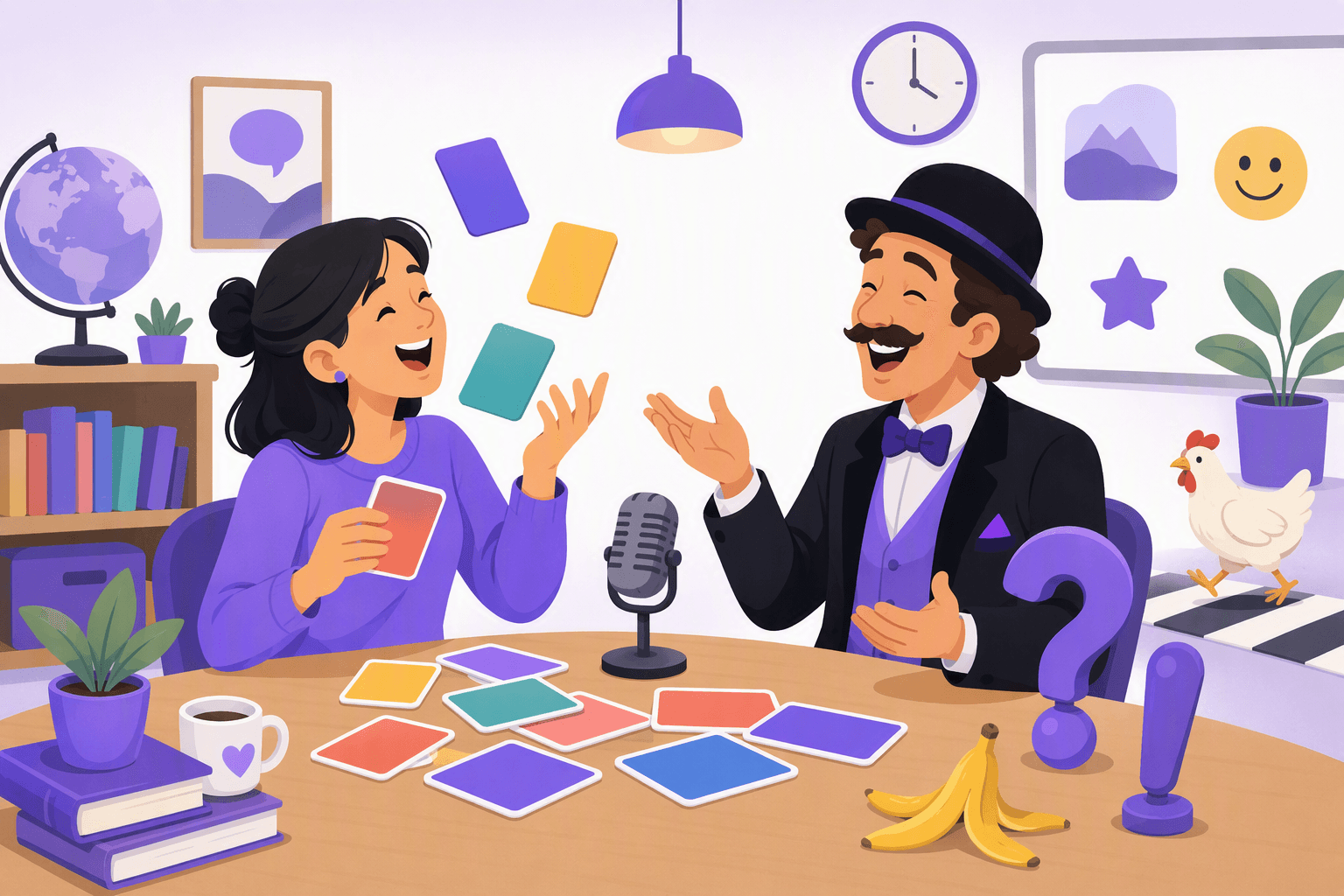
How English jokes work
Most jokes contain a setup and a punchline. The setup guides the listener toward one assumption. The punchline quickly reveals that the speaker meant something else.
For example:
Why did the scarecrow win an award?
Because he was outstanding in his field.
At first, outstanding in his field sounds like praise for professional skill. Then field changes from a professional area to the literal field where a scarecrow stands. That sudden switch is the joke.
Victor Raskin's Semantic Mechanisms of Humor examines humor through competing interpretations. In a successful verbal joke, the listener can connect the final line to two different scripts or situations. One interpretation arrives first, then the punchline forces a quick reinterpretation.
Salvatore Attardo, in Linguistic Theories of Humor, also treats language structure as central to many jokes. For an English learner, that means a joke is a compact language puzzle, not a test of whether you are naturally funny.
Timing matters more than acting
Tell the setup clearly, then pause briefly before the punchline. The pause gives your listener time to form the expected meaning.
Do not rush to explain the joke. If someone laughs, smile and continue. If they look confused, you can explain the vocabulary afterward, but the moment may simply not be the right one for that particular joke.
Context decides whether a joke lands
A joke among close friends can be more playful than one at work, in class, or with a stranger. British and American humor both use irony, understatement, absurdity, and teasing, but individual preferences matter more than national stereotypes.
Use jokes to create warmth, not to pressure someone to laugh. A gentle, short joke is usually safer than sarcasm when you are still learning the social rules of English.
🌍 Humor is not a vocabulary test
If you do not understand a joke immediately, that is normal. Native speakers also miss references, regional accents, fast delivery, and unfamiliar wordplay. Ask, "What does that mean?" or "Is that a pun?" and treat it as useful listening practice.
Easy question-and-answer jokes
Question-and-answer jokes are useful because you can memorize the full pattern. The listener knows a punchline is coming, so you do not need to create a long story.
Scarecrow
/WHY did thuh SKAIR-kroh win an uh-WORD?/
Literal meaning: A question about a scarecrow receiving a prize.
“Why did the scarecrow win an award? Because he was outstanding in his field.”
Why did the scarecrow win an award? Because he was outstanding in his field.
A classic English pun. 'Outstanding in his field' can mean excellent at a job, but a scarecrow literally stands outside in a field.
The key sound is not difficult, but the two meanings are. Outstanding means excellent, while standing out can also be physical. The joke depends on the literal image arriving after the professional compliment.
Calendar
/WHY wuz thuh KAL-en-der NER-vus?/
Literal meaning: A question about a calendar having an emotion.
“Why was the calendar nervous? Its days were numbered.”
Why was the calendar nervous? Its days were numbered.
The phrase 'someone's days are numbered' means they will soon lose power or face an ending. A calendar also literally has numbered days.
Its days were numbered /ɪts deɪz wɚ ˈnʌmbɚd/ sounds serious in normal conversation. In the joke, the calendar makes the phrase literal. This is a good example of why English numbers appear in more than counting contexts.
Orange
/WHY did thee OR-inj stop haf-WAY?/
Literal meaning: A question about an orange stopping before reaching a destination.
“Why did the orange stop halfway? Because it ran out of juice.”
Why did the orange stop halfway? Because it ran out of juice.
To 'run out of juice' can mean to have no energy left. An orange also contains juice, so the punchline combines a human expression with a literal fruit.
The idiom run out of juice /rʌn aʊt əv dʒus/ can describe a phone battery, a machine, or a tired person. It is informal and common enough to recognize in conversation.
English puns and sound-alike words
A pun /pʌn/ is a joke based on words with multiple meanings or words that sound similar. Puns are everywhere in newspaper headlines, café signs, greeting cards, sitcom dialogue, and social media captions.
They can be frustrating for learners because the joke may disappear in translation. That is not a failure. It simply means the humor belongs to a particular sound system and set of cultural associations.
Flour and flower
What do you call a happy flower?
A blooming idiot.
This joke mixes blooming as a flower's natural action with blooming as an informal intensifier in British English. The phrase blooming idiot is a mild insult, roughly meaning a very silly person.
A simpler sound-based example is:
What did the flower say after it told a joke?
I was just pollen your leg.
Pollen /ˈpɑlən/ sounds like pulling. The expression pulling your leg /ˈpʊlɪŋ jɚ lɛɡ/ means teasing or joking with someone.
Fish and scale
Why are fish so smart?
Because they live in schools.
A school can be an educational institution or a large group of fish. The humor comes from using the same noun in two unrelated contexts.
What do fish use to weigh themselves?
Scales.
A scale can be a device for measuring weight or one of the small plates covering a fish. Notice that scales /skeɪlz/ has the same pronunciation in both meanings.
The danger of explaining a pun
Puns usually work only when the listener hears the word connection quickly. Explaining one is useful for learning, but it changes the social effect.
Think of it as two separate goals. During a conversation, let the joke pass quickly. During study time, pause the clip, identify the double meaning, and repeat the line aloud.
For more language that changes meaning by context, see our guide to English slang. Slang and puns are not the same, but both depend heavily on tone and shared knowledge.
Knock-knock jokes
Knock-knock jokes use a fixed dialogue. They are especially common in English-speaking childhood culture, but adults often tell them for intentionally silly humor.
Here is the pattern:
| Speaker | Line |
|---|---|
| Teller | Knock, knock. |
| Listener | Who's there? |
| Teller | A name or phrase. |
| Listener | A name or phrase who? |
| Teller | The punchline. |
Lettuce
/NOK nok. HOOZ thair? LET-us./
Literal meaning: A knock-knock joke using the word 'lettuce'.
“Lettuce who? Lettuce in, it's cold out here!”
Lettuce who? Lettuce in, it's cold out here!
The word 'lettuce' sounds close to 'let us.' The joke turns a vegetable name into a request to be allowed inside.
The final line means let us in. The lettuce spelling is only there to create the setup. This is a sound joke, so hearing it matters more than seeing it written.
Cow says
Knock, knock.
Who's there?
Cow says.
Cow says who?
No, a cow says moo!
This one is funny because the listener automatically says cow says who? The teller corrects the expected phrase with an obvious animal sound. It is playful rather than clever, which is exactly the point.
Interrupting cow
Knock, knock.
Who's there?
Interrupting cow.
Interrupting cow wh...
MOO!
The joke interrupts the listener while they are saying the expected line. When telling it, you must say MOO! before the other person finishes. Timing is the entire joke.
🌍 Why children love knock-knock jokes
Knock-knock jokes give children control over a familiar script. The listener must follow predictable lines, while the teller gets to surprise them at the end. For English learners, this same repetition makes the format a low-pressure speaking exercise.
Short jokes for everyday English practice
These jokes are short enough to memorize, repeat, and use as pronunciation practice.
Computer
Why did the computer go to the doctor?
Because it had a virus.
A virus can be a biological infection or malicious computer software. This double meaning is widely understood because both uses are common in everyday English.
Pencil
Why was the pencil late?
Because it had no point.
Point /pɔɪnt/ can mean a sharp end, a purpose, or an important idea. A pencil without a point cannot write properly, while a person with no point has nothing meaningful to say.
Book
Why did the book join the police?
It wanted to go undercover.
A book can have a cover, and an undercover police officer works secretly. The phrase go undercover /ɡoʊ ˌʌndɚˈkʌvɚ/ is common in crime films and detective shows.
Movies are especially useful for hearing this kind of compact wordplay with facial expression and timing. Try watching scenes from our best movies to learn English with English subtitles first, then replay a funny exchange without subtitles.
How to tell a joke naturally
You do not need a perfect accent to tell an English joke. Clear pacing and confidence matter more.
Learn the full rhythm
Memorize the setup and punchline together. If you only memorize the last line, you may lose the wording that creates the expectation.
Say the joke slowly at first. Then make the setup sound natural and leave a brief pause before the final word or phrase.
Stress the important word
In the scarecrow joke, stress outstanding and field. In the orange joke, stress juice. The listener needs to hear which word carries the double meaning.
English stress also helps jokes sound intentional rather than accidental. For focused practice, our English pronunciation guide explains how stress and rhythm shape clear speech.
Choose safe humor
Avoid jokes that target a person's body, nationality, religion, age, job, or language ability. Even common jokes can feel unkind when they make someone the object of the laugh.
Also be careful with profanity. A mild swear word in a movie can be funny because of the characters and scene, but repeating it without that context may sound aggressive. Read our guide to English swear words before copying expressions from comedy shows.
💡 A simple practice routine
Choose one joke with a clear pun. Listen to it, mark the stressed words, tell it aloud three times, and record yourself once. Then explain the double meaning in one sentence. This trains listening, pronunciation, vocabulary, and pragmatic awareness at the same time.
The best way to learn humor in English
Treat jokes as cultural listening practice, not material you must perform immediately. Watch how speakers pause, smile, change their voice, or react when a joke does not land.
Start with wordplay you can explain. Then notice humor in sitcoms, animated films, interviews, and casual conversations. Over time, you will recognize patterns such as exaggeration, irony, repetition, misunderstandings, and deliberate nonsense.
The goal is not to become a stand-up comedian. It is to understand when English speakers are playing with language, and to enjoy joining in when the moment feels right.
Frequently Asked Questions
What are the easiest jokes to tell in English?
Why are English puns difficult for learners?
Are knock-knock jokes still common in English?
Can I use jokes in an English conversation class?
What should I avoid when telling jokes in English?
Sources & References
- Oxford English Dictionary, 'joke' entry, accessed 2026
- Ethnologue, 27th edition, 2024
- Victor Raskin, Semantic Mechanisms of Humor, D. Reidel
- Salvatore Attardo, Linguistic Theories of Humor, Mouton de Gruyter
- Encyclopaedia Britannica, 'humor', accessed 2026
Start learning with Wordy
Watch real movie clips and build your vocabulary as you go. Free to download.


