Quick Answer
Italian verb conjugation is mainly about recognizing three verb groups (-are, -ere, -ire) and mastering a small set of high-frequency tenses: present, passato prossimo, imperfetto, future, and conditional. Once you learn the regular endings and the most common irregulars (essere, avere, andare, fare, dire, venire), you can understand and produce most everyday Italian, especially in spoken contexts.
Italian verb conjugation becomes manageable once you focus on the three verb families (-are, -ere, -ire) and the handful of tenses Italians use constantly in speech: present, passato prossimo, imperfetto, future, and conditional. Learn the regular endings, then memorize a short list of high-frequency irregular verbs, and you can follow most everyday dialogue in films, TV, and real conversations.

| English | Italian | Pronunciation | Formality |
|---|---|---|---|
| To be | essere | EHS-seh-reh | neutral |
| To have | avere | ah-VEH-reh | neutral |
| To go | andare | ahn-DAH-reh | neutral |
| To do/make | fare | FAH-reh | neutral |
| To say/tell | dire | DEE-reh | neutral |
| To come | venire | veh-NEE-reh | neutral |
Why Italian verb conjugation matters (and how big Italian really is)
Italian is not a niche language. Ethnologue estimates about 64 million L1 speakers, plus millions of L2 speakers worldwide, and it is an official language in Italy, Switzerland, San Marino, and Vatican City.
Verb forms carry a lot of meaning in Italian. A single ending can tell you who is acting (io vs noi), when it happened (present vs past), and sometimes the speaker’s attitude (certainty vs doubt).
If you are learning greetings and set phrases, conjugation still shows up immediately. Even simple lines like "Come stai?" depend on a verb form, and you will see that fast if you practice with dialogue-heavy clips in Wordy, after learning basics like how to say hello in Italian.
"Verb morphology is where Italian compresses information: person, number, tense, and mood are often all encoded in a single ending, which is why learners feel overwhelmed at first but improve rapidly once patterns click."
Professor Anna M. Thornton, Italian linguist (morphology), University of L'Aquila
The three conjugations: -are, -ere, -ire (your main shortcut)
Italian infinitives usually end in -are, -ere, or -ire. That ending tells you which set of patterns to use for most tenses.
Pronunciation tip: Italian vowels are steady. -are sounds like "AH-reh", -ere like "EH-reh", and -ire like "EE-reh".
Regular present tense endings (the ones you will hear all day)
The present tense is the highest priority because it is used for now, habits, near future, and even storytelling. In spoken Italian, it often replaces more complex forms when context is clear.
Here are the regular present endings:
| Person | -are (parlare, "par-LAH-reh") | -ere (prendere, "PREHN-deh-reh") | -ire (dormire, "dor-MEE-reh") |
|---|---|---|---|
| io | -o | -o | -o |
| tu | -i | -i | -i |
| lui/lei | -a | -e | -e |
| noi | -iamo | -iamo | -iamo |
| voi | -ate | -ete | -ite |
| loro | -ano | -ono | -ono |
A practical listening trick: the noi form almost always contains -iamo. When you hear "andiamo" or "facciamo", you can often tag it as "we" instantly.
Regular present examples in full tables
| Person | parlare (to speak) | prendere (to take) | dormire (to sleep) |
|---|---|---|---|
| io | parlo | prendo | dormo |
| tu | parli | prendi | dormi |
| lui/lei | parla | prende | dorme |
| noi | parliamo | prendiamo | dormiamo |
| voi | parlate | prendete | dormite |
| loro | parlano | prendono | dormono |
The two auxiliary verbs: avere and essere (and why they change everything)
To talk about the past in everyday Italian, you will use an auxiliary verb plus a past participle. The auxiliary is usually avere ("ah-VEH-reh") or essere ("EHS-seh-reh").
This is the core of passato prossimo, the most common spoken past tense across Italy.
Passato prossimo: the everyday past
Passato prossimo is used for completed actions. Think "I watched", "we ate", "she arrived".
Structure:
| Part | Example |
|---|---|
| auxiliary in present | ho / sono |
| past participle | mangiato / andato |
Examples you will hear in real dialogue:
- Ho visto ("oh VEE-stoh"), I saw / I watched.
- Abbiamo finito ("ahb-BYAH-moh fee-NEE-toh"), we finished.
- Sono arrivata ("SOH-noh ah-ree-VAH-tah"), I arrived (female speaker).
Choosing avere vs essere (a reliable rule of thumb)
Most transitive verbs (verbs that take a direct object) use avere:
- Ho mangiato la pizza.
- Hai visto il film?
Many intransitive verbs of movement or change of state use essere:
- Sono andato a casa.
- È diventato famoso.
💡 A fast test you can do
If you can naturally add "qualcosa" (something) after the verb, it usually takes avere: "ho fatto qualcosa", "ho detto qualcosa". If the verb is more about movement or becoming, it often takes essere: "sono partito", "è nato".
Agreement with essere (the detail that makes Italian feel hard)
With essere, the past participle agrees with the subject:
| Subject | Example |
|---|---|
| lui | è andato |
| lei | è andata |
| loro (m.) | sono andati |
| loro (f.) | sono andate |
With avere, you usually do not change the participle:
- Ho mangiato.
- Abbiamo parlato.
Imperfetto: the "background" past Italians love
Imperfetto is used for ongoing past situations, habits, and descriptions. It is the tense of "when I was a kid", "it was raining", "we used to go".
It is also extremely common in film scenes that set atmosphere: weather, emotions, routines, and context.
Imperfetto endings (surprisingly regular)
Imperfetto endings are stable across -are, -ere, -ire:
| Person | Ending |
|---|---|
| io | -avo / -evo / -ivo |
| tu | -avi / -evi / -ivi |
| lui/lei | -ava / -eva / -iva |
| noi | -avamo / -evamo / -ivamo |
| voi | -avate / -evate / -ivate |
| loro | -avano / -evano / -ivano |
Examples:
- parlavo ("par-LAH-voh"), I was speaking / I used to speak
- prendevo ("PREHN-deh-voh"), I was taking
- dormivo ("dor-MEE-voh"), I was sleeping
Passato prossimo vs imperfetto (a movie-scene way to remember)
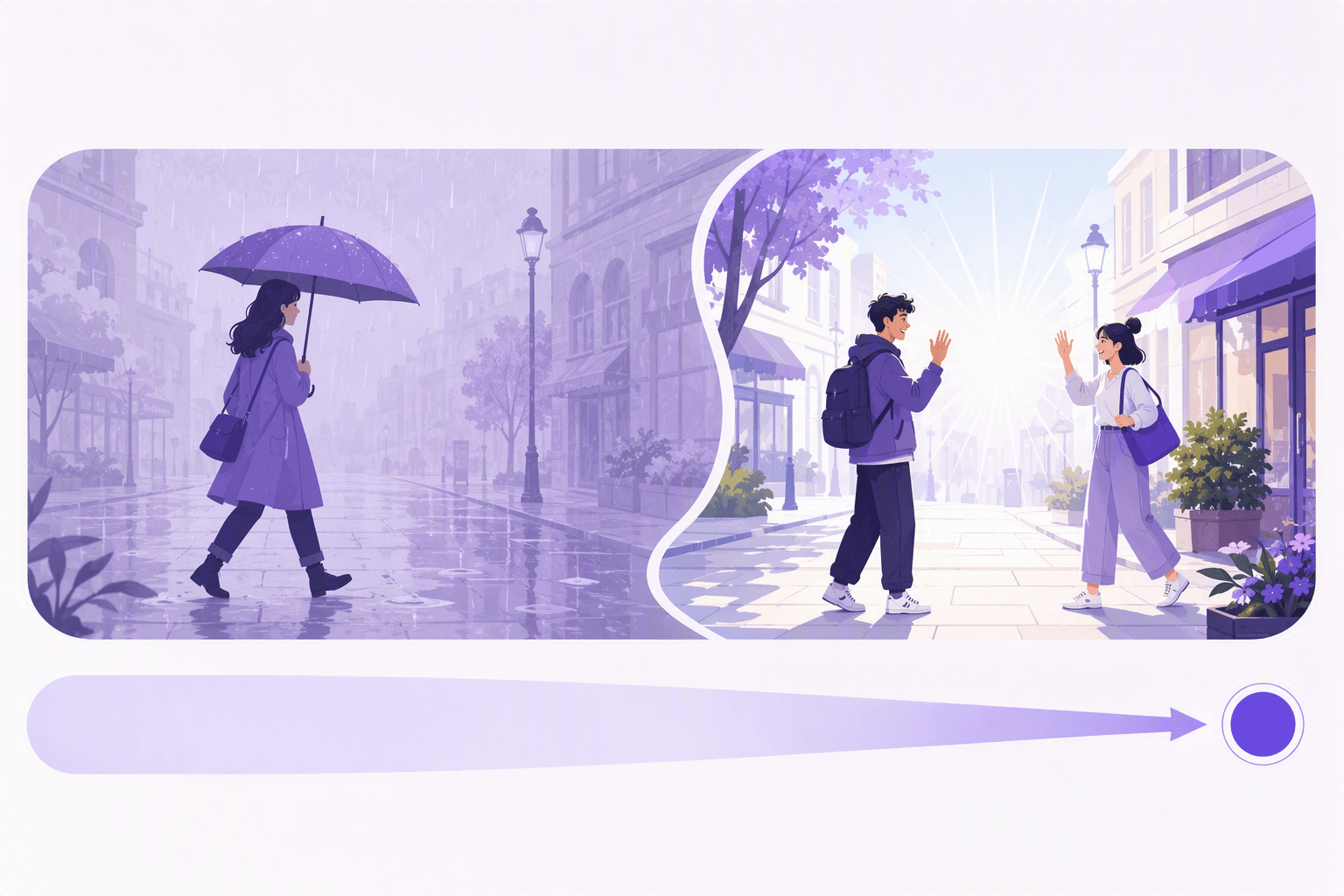
Use passato prossimo for the event that moves the plot. Use imperfetto for what was already happening.
| Scene | Italian |
|---|---|
| Background | Pioveva e io camminavo. |
| Plot event | Poi ho visto Marco. |
In many Italian scripts, this contrast is how tension is built: the imperfetto paints the room, then passato prossimo drops the action.
Future and conditional: polite, realistic Italian
You can communicate without these at first, but they show up constantly in plans, promises, and polite requests.
Futuro semplice (simple future)
Regular future endings are similar across verb groups, with small spelling changes for some verbs.
| Person | parlare | prendere | dormire |
|---|---|---|---|
| io | parlerò | prenderò | dormirò |
| tu | parlerai | prenderai | dormirai |
| lui/lei | parlerà | prenderà | dormirà |
| noi | parleremo | prenderemo | dormiremo |
| voi | parlerete | prenderete | dormirete |
| loro | parleranno | prenderanno | dormiranno |
Pronunciation tip: the final stress is strong in io and lui/lei forms, like "par-leh-ROH", "par-leh-RAH".
Condizionale presente (present conditional)
This is the tense of "I would like" and "could you". It is also a politeness tool in shops, hotels, and workplace Italian.
| Person | parlare | prendere | dormire |
|---|---|---|---|
| io | parlerei | prenderei | dormirei |
| tu | parleresti | prenderesti | dormiresti |
| lui/lei | parlerebbe | prenderebbe | dormirebbe |
| noi | parleremmo | prenderemmo | dormiremmo |
| voi | parlereste | prendereste | dormireste |
| loro | parlerebbero | prenderebbero | dormirebbero |
Common real-life line:
- Vorrei ("vohr-RAY"), I would like.
If you want to sound natural fast, prioritize "vorrei" plus an infinitive. It is one of the most useful spoken patterns in Italy.
The essential irregular verbs (learn these early)
Italian has many irregular verbs, but the good news is that a small set covers a huge share of everyday speech. If you learn these, you will recognize a large portion of dialogue, including emotional scenes like how to say I love you in Italian, where essere and avere show up constantly.
essere
Pronunciation: "EHS-seh-reh"
Present:
| Person | Form |
|---|---|
| io | sono |
| tu | sei |
| lui/lei | è |
| noi | siamo |
| voi | siete |
| loro | sono |
Imperfetto:
- ero, eri, era, eravamo, eravate, erano
Passato prossimo:
- sono stato / sono stata
avere
Pronunciation: "ah-VEH-reh"
Present:
| Person | Form |
|---|---|
| io | ho |
| tu | hai |
| lui/lei | ha |
| noi | abbiamo |
| voi | avete |
| loro | hanno |
Imperfetto:
- avevo, avevi, aveva, avevamo, avevate, avevano
Past participle:
- avuto
andare
Pronunciation: "ahn-DAH-reh"
Present:
- vado, vai, va, andiamo, andate, vanno
Passato prossimo:
- sono andato / sono andata
fare
Pronunciation: "FAH-reh"
Present:
- faccio ("FAH-choh"), fai, fa, facciamo, fate, fanno
Past participle:
- fatto
dire
Pronunciation: "DEE-reh"
Present:
- dico, dici, dice, diciamo, dite, dicono
Past participle:
- detto
venire
Pronunciation: "veh-NEE-reh"
Present:
- vengo, vieni, viene, veniamo, venite, vengono
Passato prossimo:
- sono venuto / sono venuta
⚠️ Common learner mistake
Do not overuse "io" and "tu". Italian is a pro-drop language, so the verb ending usually carries the subject. "Vado" is more natural than "Io vado" unless you are emphasizing contrast.
Mood matters: indicativo vs congiuntivo (without panic)
Italian grammar talks about "moods" (modi). The two you will notice most are indicativo (facts) and congiuntivo (opinions, doubt, emotion, uncertainty).
You do not need to master congiuntivo to start speaking, but you should recognize it early because it appears in educated speech and in many TV scripts.
Congiuntivo presente (recognition-first)
A common trigger is "penso che" (I think that), "è possibile che" (it’s possible that), "spero che" (I hope that).
Example:
- Penso che sia vero. ("PEHN-soh keh SEE-ah VEH-roh")
Here "sia" is congiuntivo of essere. You will hear it often in arguments, negotiations, and dramatic dialogue.
🌍 Why Italians care about congiuntivo
In Italy, congiuntivo is tied to schooling and social perception. Using it well can signal precision and formality, while avoiding it can sound casual or, in some contexts, careless. Many modern speakers simplify it in fast conversation, but in interviews, news, and courtroom dramas it stays strong.
A practical study order (what to learn first for real conversations)
If your goal is understanding movies and speaking confidently, sequence matters more than completeness.
- Present tense regular endings (-are, -ere, -ire)
- Essere and avere in present and imperfetto
- Passato prossimo with avere, then with essere and agreement
- Imperfetto
- Future and conditional (especially vorrei)
- High-frequency irregulars (andare, fare, dire, venire, potere, dovere, volere)
This order matches how often these forms appear in everyday speech and subtitles. It also supports travel basics, like the phrases in how to say goodbye in Italian, where present and near-future forms are common.
Conjugation patterns you will hear in Italian TV and film
Authentic dialogue has habits that textbooks underemphasize. If you learn these, subtitles become easier.
The "stare + gerundio" progressive
Italian can express "I am doing" with stare + gerundio, especially for emphasis.
Structure:
- sto + -ando / -endo
Examples:
- Sto andando. ("stoh ahn-DAHN-doh"), I’m going.
- Stiamo aspettando. ("STYAH-moh ah-speh-TAHN-doh"), we’re waiting.
The polite conditional in service encounters
In cafes, hotels, and shops, conditional is a politeness default:
- Vorrei un caffè.
- Potrebbe aiutarmi? ("poh-TREH-beh ah-yoo-TAR-mee"), could you help me?
The clipped spoken forms and fast auxiliaries
In real speech, auxiliaries are often reduced in rhythm:
- "Ho" can sound like a quick "oh".
- "Sono" can compress to "so-no" with light vowels.
This is why training with short clips helps. You learn the sound of function words, not just the written form.
If you want more everyday Italian beyond grammar, pair this guide with how to say hello in Italian and then practice hearing those verbs inside greetings and small talk.
Mini reference: spelling changes that affect conjugation
Italian spelling is phonetic, but conjugation can force spelling tweaks to keep sounds consistent.
| Pattern | Why | Example |
|---|---|---|
| -care / -gare add "h" | keeps hard "k/g" sound before e/i | cercare: cerco, cerchi |
| -ciare / -giare drop "i" sometimes | avoids double i | mangiare: mangio, mangi |
| -ire with -isc- | some verbs insert -isc- in present | finire: finisco, finisci |
💡 Do not memorize every -isc- verb
Learn the most common ones (finire, capire, preferire) and treat the rest as vocabulary. In listening, -isc- is a strong clue for io/tu/lui forms.
How Wordy helps you internalize conjugation (without drilling lists)
Conjugation sticks when you see it attached to meaning, emotion, and context. Movie and TV clips provide that context, and they also repeat high-frequency verbs constantly.
A practical workflow:
- Watch a clip with Italian subtitles.
- Tap the verb form you do not recognize.
- Save it, then review it with spaced repetition.
- Rewatch the same clip later to hear the form again in context.
This is also where cultural tone becomes obvious. A character choosing conditional ("vorrei") vs direct imperative can signal social distance, status, or sarcasm, even when the vocabulary is simple.
For a different kind of "tone grammar", see how insults and taboo language play with verb choices in Italian swear words. Even there, the auxiliary and mood choices can change how harsh a line feels.
Key takeaways (what to remember after reading)
- Italian verbs mostly follow three patterns: -are, -ere, -ire.
- Present, passato prossimo, and imperfetto cover a large share of real conversation.
- Avere vs essere is the main past-tense decision, and essere triggers agreement.
- Learn a small set of irregular verbs early, especially essere and avere.
- Recognize congiuntivo in listening, then add it to speaking later.
If you want to keep building a practical base, combine this grammar with everyday phrases from how to say goodbye in Italian and then reinforce them with real dialogue practice on Italian learning clips.
Frequently Asked Questions
What is the easiest way to learn Italian verb conjugation?
How many tenses do you actually need for everyday Italian?
When do Italians use passato prossimo vs imperfetto?
Why do some Italian verbs use essere instead of avere in the past?
Do Italians really use the subjunctive (congiuntivo) in speech?
Sources & References
- Treccani, Enciclopedia dell'Italiano: 'Verbo' and 'Coniugazione', 2011-
- Accademia della Crusca, Consulenza linguistica: uso dei tempi verbali e congiuntivo, 2010-
- Ethnologue (27th ed.), Italian, 2024
- Lo Duca, M.G. (a cura di), Grammatica dell'italiano, Carocci, 2006
- Lepschy, A. & Lepschy, G., The Italian Language Today, Routledge, 1998
Start learning with Wordy
Watch real movie clips and build your vocabulary as you go. Free to download.


