Quick Answer
To pronounce Italian clearly, keep every vowel distinct, lengthen double consonants, pronounce the final vowels, and use steady syllable timing. Focus first on Italian's five vowel sounds, the rolled or tapped R, and spelling patterns such as gli and gn.
Italian pronunciation becomes much clearer when you pronounce every written vowel, keep vowels clean rather than turning them into English-style diphthongs, and make double consonants noticeably longer. The most useful Italian pronunciation tips are to master the five vowel letters, distinguish single and doubled consonants, use a light tongue tap or trill for /r/, and copy the steady rhythm of real Italian speech.
Italian is spoken by roughly 67.9 million people worldwide according to Ethnologue, 27th edition, 2024. It is the national language of Italy and San Marino, one of Switzerland's four national languages, and an important language in communities across Europe, the Americas, Australia, and Africa.
That wide geographic spread means there is no single accent to imitate. A speaker from Milan, Rome, Naples, or Sicily may use different vowel qualities and melody. Still, the core sound system remains stable enough that a learner who follows these rules will be understood throughout Italy.
For useful everyday phrases to practise alongside these sounds, start with how to say hello in Italian. Greeting words are short, frequent, and excellent for building a reliable accent.
Start with Italian rhythm, not an English accent
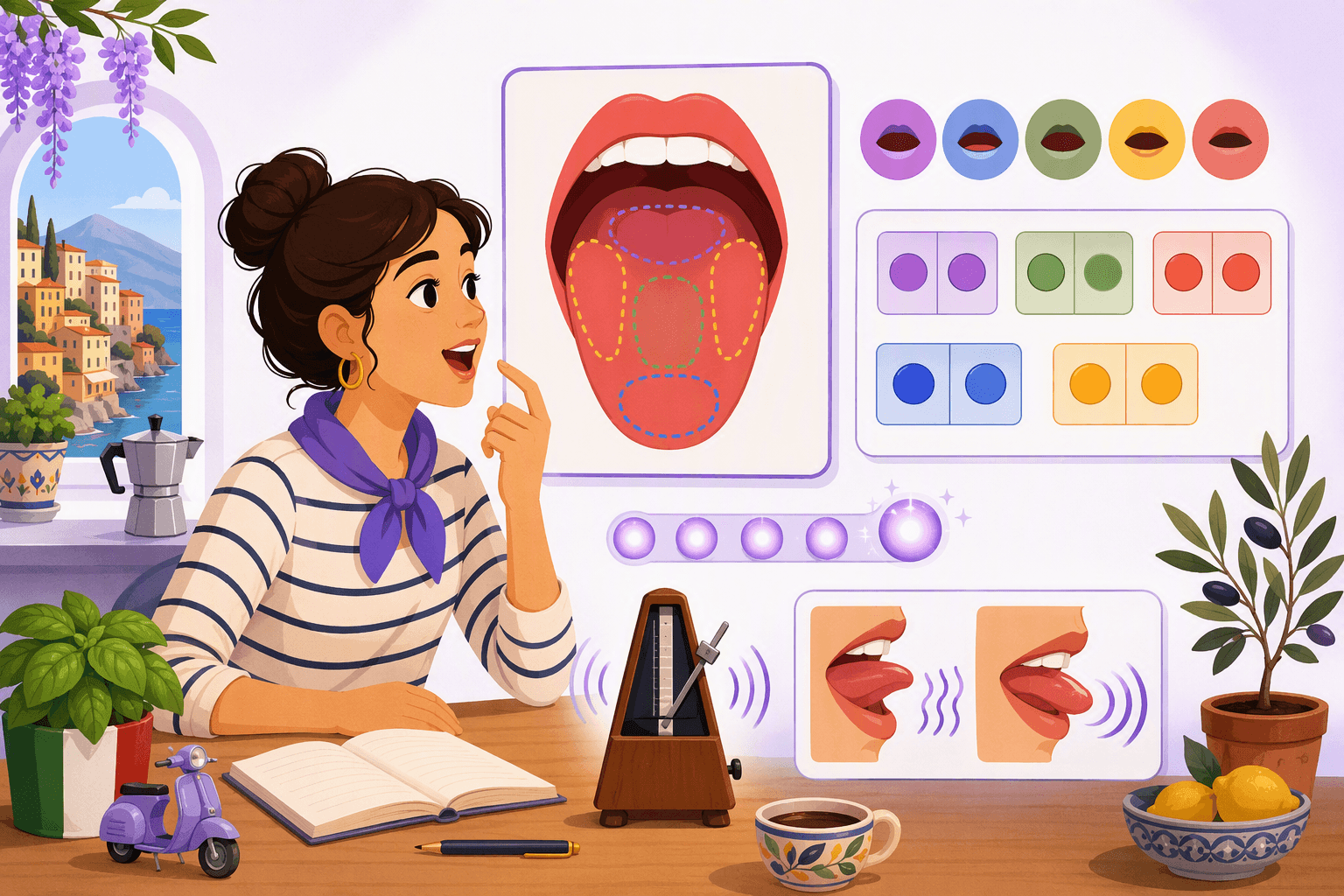
Italian is often described as syllable-timed. In practical terms, each syllable tends to receive a more even amount of time than in English. English frequently reduces unstressed vowels, while Italian usually keeps them audible.
Compare the word famiglia /faˈmiʎʎa/. Each part has a presence: /fa/ + /mi/ + /ʎʎa/. Do not compress it into something like “fuh-MEEL-yuh,” with weak first and last vowels.
Luciano Canepari's Manuale di pronuncia italiana treats Italian pronunciation as a system of precise, connected sounds rather than a set of approximate spellings. That is a useful learner mindset: aim for clean sounds in sequence, not an exaggerated imitation of a movie stereotype.
The practical rhythm rule
Say every vowel you see, including word-final vowels:
- casa /ˈkaːza/, house
- bene /ˈbɛːne/, well
- vino /ˈviːno/, wine
- tutto /ˈtutto/, everything
- amico /aˈmiːko/, friend
The colon in IPA marks a longer sound in careful pronunciation. You do not need to count milliseconds. Instead, avoid swallowing the final /a/, /e/, /i/, or /o/.
💡 A better first goal
Do not try to sound dramatic or musical. Aim for audible vowels, firm consonants, and a relaxed pace. Clear Italian almost always sounds more natural than rushed Italian.
Keep the five vowel letters clean
Italian spelling uses five vowel letters: a /a/, e /e/ or /ɛ/, i /i/, o /o/ or /ɔ/, and u /u/. Unlike English, these vowels do not normally slide from one sound into another.
For example, no /no/ should be a clean /o/, not the English diphthong in “no.” Likewise, mai /mai/ has two vowel elements, /a/ and /i/, rather than one vague English-like sound.
A
The letter a /a/ is open and stable. It resembles the vowel in “father” for many English speakers, but shorter and cleaner.
Practise:
- casa /ˈkaːza/, house
- pasta /ˈpaːsta/, pasta
- parla /ˈparla/, he or she speaks
Avoid turning /a/ into the weak vowel /ə/. In pasta /ˈpaːsta/, both /a/ vowels should remain clear.
E
The letter e can be closed /e/ or open /ɛ/ when stressed. This distinction exists in standard Italian, though regional use varies and learners do not need perfection on day one.
Examples include:
- perché /perˈke/, because
- bene /ˈbɛːne/, well
- sera /ˈseːra/, evening
The key habit is not guessing open versus closed /e/ from English. Listen to whole words and store their sound with their spelling.
I
The letter i /i/ is similar to the vowel in “machine.” It stays clear even when unstressed.
Practise:
- vino /ˈviːno/, wine
- Italia /iˈtaːlja/, Italy
- piccolo /ˈpikkolo/, small
In combinations such as ciao /ˈtʃaːo/, the i changes the preceding consonant rather than creating a separate vowel sound. More on that pattern comes later.
O
Like e, the letter o can be closed /o/ or open /ɔ/. You will hear regional differences, especially between northern and central or southern speech.
Examples:
- Roma /ˈroːma/, Rome
- cosa /ˈkɔːza/, thing
- sole /ˈsoːle/, sun
Do not turn Italian /o/ into an English glide. Keep your lips rounded and hold one stable sound.
U
The letter u /u/ is like the vowel in “food,” but without a trailing /w/ sound.
Practise:
- tu /tu/, you
- luna /ˈluːna/, moon
- buono /ˈbwɔːno/, good
In buono /ˈbwɔːno/, the letters buo form /bwɔ/. Say it smoothly, while still allowing the /w/ element to be heard.
Treat double consonants as a real sound contrast
One of the biggest pronunciation differences between Italian and English is consonant length. Italian double consonants, called consonanti doppie /konsoˈnanti ˈdoppje/, are not decorative spelling. They can change meaning.
| Single consonant | Meaning | Double consonant | Meaning |
|---|---|---|---|
| pala /ˈpaːla/ | shovel | palla /ˈpalla/ | ball |
| sete /ˈseːte/ | thirst | sette /ˈsette/ | seven |
| copia /ˈkɔːpja/ | copy | coppia /ˈkoppja/ | couple |
| fato /ˈfaːto/ | fate | fatto /ˈfatto/ | done, fact |
To make a double consonant, briefly hold the airflow or tongue position before releasing the consonant. Think of it as a tiny pause inside the word.
For palla /ˈpalla/, say /pa/ then hold your tongue against the ridge behind your teeth before the /l/. The result should feel like /pal-la/, not a louder version of /pala/.
Martin Maiden and Cecilia Robustelli, in A Reference Grammar of Modern Italian, show how spelling, stress, and sound patterns work together in standard Italian. Double consonants are a prime example: written form gives valuable information about how long a sound should last.
⚠️ Do not skip the hold
If you pronounce anno /ˈanno/, year, like ano /ˈaːno/, anus, you may create an unintended and embarrassing meaning. Pause briefly before doubled consonants, especially in common words.
Learn the consonant patterns that confuse beginners
Italian has a relatively consistent spelling system, but several letter groups require deliberate practice. Learn them as whole patterns rather than trying to apply English reading rules.
C and G
Before e /e/ or i /i/, c is usually /tʃ/ and g is usually /dʒ/.
- cena /ˈtʃeːna/, dinner
- cinema /ˈtʃiːnema/, cinema
- gelato /dʒeˈlaːto/, ice cream
- giro /ˈdʒiːro/, turn
Before a /a/, o /o/, or u /u/, they are hard:
- casa /ˈkaːza/, house
- cosa /ˈkɔːza/, thing
- gatto /ˈɡatto/, cat
- gusto /ˈɡusto/, taste
To keep the hard sound before e or i, Italian adds h /akka/. Thus che /ke/ means what, while chi /ki/ means who.
Gli
Gli /ʎʎi/ is a famous Italian challenge. It appears in famiglia /faˈmiʎʎa/, family, and figlio /ˈfiʎʎo/, son.
The sound /ʎ/ is made with the middle of the tongue raised toward the hard palate. English has no exact match, although the sound in the middle of “million” can be a rough starting point for some speakers.
Do not pronounce gli /ʎʎi/ as /ɡli/. Start slowly with figlio /ˈfiʎʎo/, then say it in a phrase: mio figlio /ˈmiːo ˈfiʎʎo/, my son.
Gn
The pattern gn /ɲ/ resembles the sound in the middle of “canyon” for many English speakers. It is one joined sound, not /g/ plus /n/.
- signore /siɲˈɲoːre/, sir
- lasagna /laˈzaɲɲa/, lasagna
- ogni /ˈoɲɲi/, every
The doubled sound in lasagna /laˈzaɲɲa/ is especially important. Hold the /ɲ/ briefly before releasing it.
Sc
Before e /e/ and i /i/, sc is normally /ʃ/, like English “sh.”
- scena /ˈʃeːna/, scene
- scienza /ˈʃɛntsa/, science
- pesce /ˈpeʃʃe/, fish
Before a /a/, o /o/, and u /u/, sc is /sk/:
- scala /ˈskaːla/, stairs
- scuola /ˈskwɔːla/, school
Build a natural Italian R
Italian r /r/ is usually a tap or trill made with the tongue near the alveolar ridge. It is not the English /ɹ/, which is formed farther back in the mouth.
A single r /r/ can be a fast tap:
- caro /ˈkaːro/, dear
- Roma /ˈroːma/, Rome
- sera /ˈseːra/, evening
A double rr /rr/ is longer and may be more strongly trilled:
- carro /ˈkarro/, cart
- terra /ˈtɛrra/, earth
- correre /ˈkorrere/, to run
If a full trill is difficult, do not force it. Start by making a quick /d/-like tap with the tongue. A light Italian-style tap is far closer to the target than an English /ɹ/.
Put stress in the right place
Italian word stress is not always shown in spelling. When it appears on the final vowel, an accent mark is written: perché /perˈke/, because, and città /tʃitˈta/, city.
Most words are stressed on the second-to-last syllable:
- ragazzo /raˈɡattso/, boy
- amica /aˈmiːka/, female friend
- Italiano /itaˈljaːno/, Italian
Others are stressed earlier:
- telefono /teˈlɛːfono/, telephone
- sabato /ˈsaːbato/, Saturday
- tavolo /ˈtaːvolo/, table
Treccani's language reference materials emphasize that standard Italian pronunciation includes regular stress patterns but also lexical exceptions. The best approach is to learn stress together with a new word, not after you already know its spelling.
Listen for stress in connected speech
Stress makes one syllable slightly more prominent, but Italian does not reduce the other vowels as aggressively as English. In telefono /teˈlɛːfono/, the /lɛ/ syllable stands out, while /te/, /fo/, and /no/ still remain audible.
This is why copying full lines from films works so well. You learn stress, linked speech, and emotional tone at the same time. Our guide to learning Italian with movies can help you find material with dialogue worth repeating.
Pronounce the final vowel, especially in greetings
Final vowels carry grammar in Italian. They can signal gender, number, verb form, or politeness. Dropping them makes speech less clear.
For example:
- ciao /ˈtʃaːo/, hello or goodbye
- buongiorno /bwɔnˈdʒorno/, good morning or good day
- arrivederci /arriveˈdertʃi/, goodbye
- grazie /ˈɡrattsje/, thank you
The word grazie /ˈɡrattsje/ ends with /e/, not an English /z/ sound. The word ciao /ˈtʃaːo/ has two vowel sounds, /a/ and /o/.
Practise greetings with a recording, then compare your version to native speech. The phrases in our Italian goodbye guide offer useful contexts, from informal farewells to polite departures.
🌍 Clarity matters more than regional imitation
Italian speakers often recognize regional accents immediately, but learners do not need to copy one. A neutral, clear pronunciation with distinct vowels and accurate consonant length is appropriate in every region. Choose a speaker whose voice you enjoy and imitate their rhythm gradually.
Use a five-minute daily pronunciation routine
A short routine works better than an occasional long session because pronunciation is physical coordination. Your tongue, lips, jaw, and ear need frequent low-pressure repetition.
Minute 1: Read vowels aloud
Say a /a/, e /e/, i /i/, o /o/, u /u/ slowly. Then read casa /ˈkaːza/, bene /ˈbɛːne/, vino /ˈviːno/, Roma /ˈroːma/, and luna /ˈluːna/.
Minute 2: Contrast single and double consonants
Repeat pairs such as pala /ˈpaːla/ and palla /ˈpalla/, then sete /ˈseːte/ and sette /ˈsette/. Make the internal pause physical and noticeable.
Minute 3: Train difficult patterns
Repeat famiglia /faˈmiʎʎa/, lasagna /laˈzaɲɲa/, scena /ˈʃeːna/, and che /ke/. Record one attempt and listen for any English-style vowel reduction.
Minute 4: Shadow a real sentence
Choose one subtitle line from a show or film. Listen, pause, copy the speaker, then repeat with the original audio. Keep the sentence short enough that you can notice rhythm.
Minute 5: Speak freely
Describe your day in two or three sentences. Use words you know rather than reading a script. This step exposes which sounds disappear when you focus on meaning.
If you are practising affectionate speech, how to say I love you in Italian gives you natural phrases where vowel clarity and tone matter as much as vocabulary.
The pronunciation habits that produce fast results
The most effective Italian pronunciation practice is specific. Do not say that you need to improve your accent in general. Pick one sound contrast, listen to it, imitate it, record it, and repeat it in several words.
Prioritize these habits:
- Keep every final vowel audible.
- Hold double consonants briefly.
- Replace the English /ɹ/ with an Italian tap or light trill.
- Learn gli /ʎʎi/, gn /ɲ/, and sc /ʃ/ as single patterns.
- Copy sentence rhythm from real dialogue, not only individual vocabulary recordings.
- Learn each new word with stress and IPA, not spelling alone.
Italian pronunciation rewards careful listening because its spelling system gives you strong clues. Once you stop reducing vowels and start hearing consonant length, Italian dialogue becomes easier to follow and your own speech sounds more confident, precise, and natural.
Frequently Asked Questions
Is Italian pronunciation difficult for English speakers?
Do I need to roll my R in Italian?
Why are double consonants important in Italian?
Are Italian vowels always pronounced the same way?
How can I improve Italian pronunciation with movies and TV shows?
Sources & References
- Accademia della Crusca, Consulenze linguistiche, accessed 2026
- Treccani, Enciclopedia dell'Italiano, accessed 2026
- Luciano Canepari, Manuale di pronuncia italiana, Zanichelli
- Martin Maiden and Cecilia Robustelli, A Reference Grammar of Modern Italian, Routledge
- Ethnologue, 27th edition, 2024
Start learning with Wordy
Watch real movie clips and build your vocabulary as you go. Free to download.


