Quick Answer
Italian pronouns replace nouns, but their form and position change according to their job in the sentence. Learn the essential subject, object, reflexive, stressed, and combined pronouns, plus the word-order rules that make Italian sound natural.
Italian pronouns are words that stand in for people, things, or ideas, and they are essential because Italian often places them before the verb or attaches them to it. To use Italian pronouns correctly, first identify whether the pronoun is the subject, direct object, indirect object, reflexive object, or an emphatic form. Then choose its position based on the verb form.
Italian has roughly 67 million first-language speakers worldwide, according to Ethnologue, and it is an official language in Italy, San Marino, Switzerland, and Vatican City. Pronouns vary somewhat by region and formality, but the core system is shared across standard Italian.
If you already know basic greetings such as how to say hello in Italian, pronouns are one of the fastest ways to move from memorized phrases to real sentences. They also explain why Italian dialogue can sound so compact: a whole noun phrase may become a tiny word before the verb.
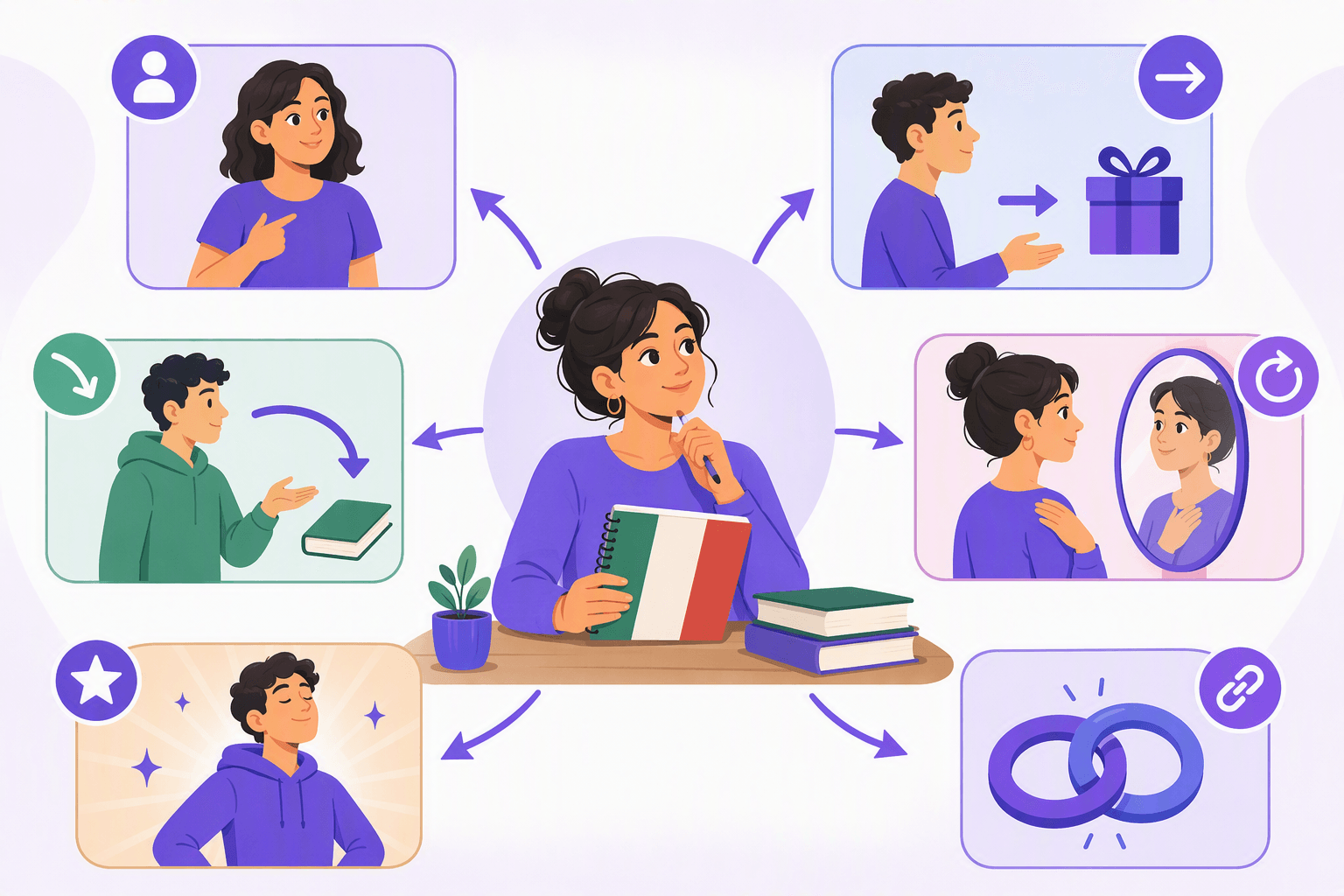
Why Italian pronouns feel difficult
English generally keeps pronouns in a fixed spot: “I see him” or “She gave it to me.” Italian uses a more flexible system. The pronoun can come before a conjugated verb, attach to an infinitive, or join another pronoun in a single cluster.
For example, vedo Marco /ˈveːdo ˈmarko/ means “I see Marco.” Replace Marco /ˈmarko/ with “him,” and you get lo vedo /lo ˈveːdo/, literally “him I see.”
Italian also allows speakers to omit subject pronouns because its verb endings carry substantial information. Parlo /ˈparlo/ already means “I speak,” so io parlo /ˈi.o ˈparlo/ is usually used only when “I” needs emphasis.
Luca Serianni’s Grammatica italiana treats pronouns as a central link between syntax and real usage: their form depends not simply on meaning, but on the role they play with a particular verb. This is why memorizing translations alone is not enough.
Italian subject pronouns
Subject pronouns identify who does the action. You will recognize them quickly, but you should not force them into every sentence.
| English | Italian pronoun | IPA | Main use |
|---|---|---|---|
| I | io | /ˈi.o/ | first-person singular |
| you, informal singular | tu | /tu/ | one friend, child, peer |
| he | lui | /lui/ | masculine singular |
| she | lei | /lɛi/ | feminine singular |
| you, formal singular | Lei | /lɛi/ | polite singular address |
| we | noi | /noi/ | first-person plural |
| you, plural | voi | /voi/ | plural address |
| they | loro | /ˈlo.ro/ | third-person plural |
Subject pronouns are usually optional
The ending of parlare /parˈlaːre/, “to speak,” makes the subject clear.
| Person | Form of parlare | English |
|---|---|---|
| io /ˈi.o/ | parlo /ˈparlo/ | I speak |
| tu /tu/ | parli /ˈparli/ | you speak |
| lui, lei, Lei /lui lɛi lɛi/ | parla /ˈparla/ | he, she, formal you speak |
| noi /noi/ | parliamo /parˈljaːmo/ | we speak |
| voi /voi/ | parlate /parˈlaːte/ | you all speak |
| loro /ˈlo.ro/ | parlano /ˈparlano/ | they speak |
You can simply say parlo italiano /ˈparlo itaˈljaːno/, “I speak Italian.” Adding io /ˈi.o/ is natural when contrasting yourself with another person: io parlo italiano, lui parla francese /ˈi.o ˈparlo itaˈljaːno lui ˈparla franˈtʃeːze/.
Lei
The formal pronoun Lei /lɛi/ is capitalized in careful writing when it means “you,” although capitalization is less consistent in casual digital messages. It takes third-person singular verbs: Lei parla inglese? /lɛi ˈparla iŋˈɡleːze/, “Do you speak English?”
This is not a feminine-only form. You can use Lei /lɛi/ with a man, woman, or nonbinary person in formal settings. It is common with strangers, older adults, clients, officials, and customer-service staff.
🌍 Formality is social, not automatic
In much of Italy, people may switch from Lei /lɛi/ to tu /tu/ after a short conversation, especially among colleagues or younger adults. Wait for the other person to suggest diamoci del tu /ˈdjaːmotʃi del tu/, meaning that you can use the informal form with each other.
Direct object pronouns
A direct object receives the action directly. Ask “whom?” or “what?” after the verb.
In mangio la pizza /ˈmandʒo la ˈpittsa/, “I eat the pizza,” la pizza /la ˈpittsa/ is the direct object. To avoid repeating it, use la /la/: la mangio /la ˈmandʒo/, “I eat it.”
| English | Italian | IPA | Example |
|---|---|---|---|
| me | mi | /mi/ | mi vede /mi ˈveːde/, he sees me |
| you, informal | ti | /ti/ | ti chiamo /ti ˈkjaːmo/, I call you |
| him, it masculine | lo | /lo/ | lo conosco /lo koˈnosko/, I know him |
| her, it feminine | la | /la/ | la conosco /la koˈnosko/, I know her |
| us | ci | /tʃi/ | ci aspetta /tʃi aˈspetta/, he waits for us |
| you plural | vi | /vi/ | vi vedo /vi ˈveːdo/, I see you all |
| them masculine | li | /li/ | li invito /li imˈviːto/, I invite them |
| them feminine | le | /le/ | le invito /le imˈviːto/, I invite them |
Lo and la before vowels
Before a vowel or a silent h /akka/, lo /lo/ and la /la/ usually shorten to l’ /l/. Write l’ho visto /lo ˈvisto/, “I saw him or it,” and l’ho vista /lo ˈvista/, “I saw her or it.”
The past participle often agrees in gender and number with a preceding direct object pronoun. Thus, l’ho visto /lo ˈvisto/ refers to a masculine person or noun, while l’ho vista /lo ˈvista/ refers to a feminine one.
This agreement is a reliable feature of standard written Italian. In rapid informal speech, you may hear less careful agreement, but learners should produce the standard form.
Indirect object pronouns
Indirect objects usually answer “to whom?” or “for whom?” They commonly appear with verbs such as dare /ˈdaːre/, “to give,” dire /ˈdiːre/, “to say,” scrivere /ˈskriːvere/, “to write,” and telefonare /telefoˈnaːre/, “to call.”
| English | Italian | IPA | Example |
|---|---|---|---|
| to me | mi | /mi/ | mi scrive /mi ˈskriːve/, she writes to me |
| to you, informal | ti | /ti/ | ti rispondo /ti riˈspondo/, I reply to you |
| to him | gli | /ʎi/ | gli telefono /ʎi teleˈfɔːno/, I call him |
| to her | le | /le/ | le telefono /le teleˈfɔːno/, I call her |
| to us | ci | /tʃi/ | ci parla /tʃi ˈparla/, he speaks to us |
| to you plural | vi | /vi/ | vi mando un messaggio /vi ˈmando un mesˈsaddʒo/, I send you a message |
| to them | gli | /ʎi/ | gli scrivo /ʎi ˈskriːvo/, I write to them |
The last row deserves attention. Traditional grammar distinguishes loro /ˈlo.ro/, placed after the verb, from gli /ʎi/, used for “to him.” For example: scrivo loro /ˈskriːvo ˈlo.ro/, “I write to them.”
In modern standard speech, however, gli /ʎi/ is widely used for “to them” too: gli scrivo /ʎi ˈskriːvo/. The Accademia della Crusca recognizes this as widespread usage, while formal writing may still prefer loro /ˈlo.ro/ where ambiguity matters.
Do not translate English word by word
English says “I call him,” but Italian uses an indirect-object structure: gli telefono /ʎi teleˈfɔːno/, literally “I telephone to him.” Saying lo telefono /lo teleˈfɔːno/ is incorrect in standard Italian.
This is a good example of why pronouns must be learned with their verb. Keep a note of the full pattern, not just a standalone pronoun. For more high-frequency verb patterns, see our Italian present tense guide.
Reflexive pronouns
Reflexive pronouns show that the subject acts on themselves. They are required with reflexive verbs such as svegliarsi /zveʎˈʎarsi/, “to wake up,” and chiamarsi /kjaˈmarsi/, “to be called.”
| English | Italian reflexive pronoun | IPA |
|---|---|---|
| myself | mi | /mi/ |
| yourself | ti | /ti/ |
| himself, herself, yourself formal | si | /si/ |
| ourselves | ci | /tʃi/ |
| yourselves | vi | /vi/ |
| themselves | si | /si/ |
Compare these sentences:
- mi chiamo Anna /mi ˈkjaːmo ˈanna/, “My name is Anna.”
- ti svegli presto /ti ˈzveʎʎi ˈpresto/, “You wake up early.”
- si veste /si ˈveste/, “He or she gets dressed.”
- ci vediamo domani /tʃi veˈdjaːmo doˈmaːni/, “See you tomorrow,” literally “we see each other tomorrow.”
The phrase ci vediamo /tʃi veˈdjaːmo/ is especially useful because Italian often uses reciprocal reflexive forms where English uses a different construction. It is a natural alternative to a literal farewell, alongside expressions in our guide to saying goodbye in Italian.
Stressed pronouns
Stressed pronouns are used after prepositions, for emphasis, comparison, or contrast. They are longer forms, and they can stand alone.
| English | Italian stressed pronoun | IPA |
|---|---|---|
| me | me | /me/ |
| you, informal | te | /te/ |
| him | lui | /lui/ |
| her | lei | /lɛi/ |
| us | noi | /noi/ |
| you plural | voi | /voi/ |
| them | loro | /ˈlo.ro/ |
| oneself | sé | /se/ |
Use them after a preposition:
- con me /kon me/, “with me”
- per te /per te/, “for you”
- da lui /da lui/, “from him”
- senza di noi /ˈsenttsa di noi/, “without us”
The accent in sé /se/ distinguishes “oneself” from se /se/, “if.” You will often see se stesso /se ˈstesso/, “himself or herself,” but careful writing uses sé stesso /se ˈstesso/ when the meaning is reflexive.
Anna Laura Lepschy and Giulio Lepschy, in The Italian Language Today, describe Italian as a language where grammatical choices often signal relationships between speakers. Choosing tu /tu/, Lei /lɛi/, or an emphatic stressed form can alter the social tone of an otherwise simple sentence.
Combined pronouns
Combined pronouns appear when a sentence has both an indirect and a direct object. Instead of saying “I give the book to her,” Italian can replace both nouns: glielo do /ʎeˈlo dɔ/, “I give it to her.”
The indirect pronoun changes form before the direct object pronoun.
| Meaning | Italian | IPA |
|---|---|---|
| it to me | me lo | /me lo/ |
| it to you | te lo | /te lo/ |
| it to him, her, them | glielo | /ʎeˈlo/ |
| it to us | ce lo | /tʃe lo/ |
| it to you all | ve lo | /ve lo/ |
| them to him, her, them | glieli or gliele | /ʎeˈli/ or /ʎeˈle/ |
The direct object changes for gender and number:
- glielo do /ʎeˈlo dɔ/, “I give it to him, her, or them,” masculine singular.
- gliela do /ʎeˈla dɔ/, feminine singular.
- glieli do /ʎeˈli dɔ/, masculine plural.
- gliele do /ʎeˈle dɔ/, feminine plural.
At first, these clusters look intimidating. Treat them as meaningful units rather than trying to translate every letter during conversation. Me lo dici? /me lo ˈdiːtʃi/ simply means “Will you tell me?”
💡 Learn the most useful combined form first
Start with me lo /me lo/, te lo /te lo/, and glielo /ʎeˈlo/. These three cover many everyday requests, explanations, and conversations. Add plural and feminine forms once you can recognize the core pattern quickly.
Pronoun position: before, after, or attached
With a normal conjugated verb, object and reflexive pronouns come before it:
- ti capisco /ti kaˈpisko/, “I understand you.”
- lo compro /lo ˈkompro/, “I buy it.”
- ci alziamo /tʃi alˈtsjaːmo/, “We get up.”
With an infinitive, the pronoun may attach to the end:
- voglio vederlo /ˈvɔʎʎo veˈderlo/, “I want to see him.”
- devo chiamarla /ˈdeːvo kjamˈmarla/, “I have to call her.”
- preferisco restare con te /prefeˈrisko reˈstaːre kon te/, “I prefer to stay with you.”
With a gerund, attach it:
- sto cercandolo /sto tʃerˈkandolo/, “I am looking for it.”
- mi sto preparando /mi sto prepaˈrando/, “I am getting ready.”
With affirmative commands, attach the pronoun:
- dimmi /ˈdimmi/, “tell me”
- guardalo /ˈɡwardalo/, “look at it”
- scrivimi /ˈskriːvimi/, “write to me”
- dammi il libro /ˈdammi il ˈliːbro/, “give me the book”
Negative informal commands place the pronoun before or after the infinitive form:
- non mi dire /non mi ˈdiːre/, “do not tell me”
- non dirmi /non ˈdirmi/, “do not tell me”
Common mistakes English speakers make
Repeating subject pronouns too often
Italian does not need io /ˈi.o/ before every first-person verb. Use io /ˈi.o/ when you mean “I, specifically,” not as an automatic translation of English “I.”
Using direct pronouns with indirect-object verbs
Learn verb patterns. Aiutare /ajuˈtaːre/, “to help,” takes a direct object: ti aiuto /ti aˈjuːto/, “I help you.” Telefonare /telefoˈnaːre/ takes an indirect object: ti telefono /ti teleˈfɔːno/, “I call you.”
Confusing ci
Ci /tʃi/ can mean “us,” “there,” or part of certain fixed expressions. In ci vediamo /tʃi veˈdjaːmo/, it is reciprocal, “each other.” In ci sono /tʃi ˈsono/, it means “there are.”
Avoiding pronoun clusters forever
You do not need to master every combination on day one, but me lo /me lo/ and glielo /ʎeˈlo/ occur constantly in films, series, and everyday speech. Notice them in context when watching Italian content, then repeat the whole line.
🌍 Pronouns reveal relationship and tone
Italian dialogue often leaves subjects unspoken but makes social distance audible through pronouns and verb forms. A character switching from Lei /lɛi/ to tu /tu/ can mark growing familiarity, conflict, irony, or a deliberate breach of etiquette. This is one reason pronouns matter when interpreting Italian movies and TV scenes.
A practical way to learn Italian pronouns
Learn pronouns through short patterns, not isolated lists. Make one sentence for each pronoun with a familiar verb: mi chiami /mi ˈkjaːmi/, “you call me,” ti vedo /ti ˈveːdo/, “I see you,” and gli scrivo /ʎi ˈskriːvo/, “I write to him.”
Then listen for the same shapes in real dialogue. Romantic scenes are especially useful for ti /ti/, mi /mi/, and ci /tʃi/, including expressions beyond the literal ti amo /ti ˈaːmo/. Our guide to saying I love you in Italian shows how these pronouns appear in affectionate speech.
Focus first on subject omission, direct objects, indirect objects, and reflexive forms. Once those are automatic, combined pronouns stop feeling like a grammar puzzle and start sounding like ordinary Italian.
Frequently Asked Questions
Do Italians use subject pronouns in every sentence?
What is the difference between lo and gli in Italian?
Where do Italian object pronouns go in a sentence?
Why does Italian use Lei for formal you?
What are combined pronouns in Italian?
Sources & References
- Accademia della Crusca, Consulenza linguistica: pronomi personali, accessed 2026
- Treccani, Enciclopedia dell'Italiano: pronome personale, accessed 2026
- Ethnologue, Italian, 27th edition, 2024
- Luca Serianni, Grammatica italiana, UTET
- Anna Laura Lepschy and Giulio Lepschy, The Italian Language Today, Routledge
Start learning with Wordy
Watch real movie clips and build your vocabulary as you go. Free to download.


