Quick Answer
Italian prepositions are short words like di, a, da, in, con, su, per, and tra/fra that show relationships such as possession, direction, location, and time. The key is choosing the right base preposition, then using articulated forms (del, al, nel, sul) when the next word has a definite article. This guide gives practical rules, pronunciation, and high-frequency examples you actually hear.
Italian prepositions are the small words (di, a, da, in, con, su, per, tra/fra) that make your sentences sound correct by showing relationships like where you are, where you are going, who owns what, and when something happens. To use them well, you need two skills: pick the right base preposition, and know when to merge it with a definite article (del, al, nel, sul) in articulated prepositions.
Italian is spoken by tens of millions of people, mainly in Italy and across Italian-speaking communities worldwide. Ethnologue (27th edition, 2024) estimates about 64 million native speakers, plus many second-language speakers, which is why getting these high-frequency grammar words right pays off quickly.
If you want more everyday context, pair this guide with a greeting routine like how to say hello in Italian and how to say goodbye in Italian, because prepositions show up constantly in introductions, invitations, and plans.
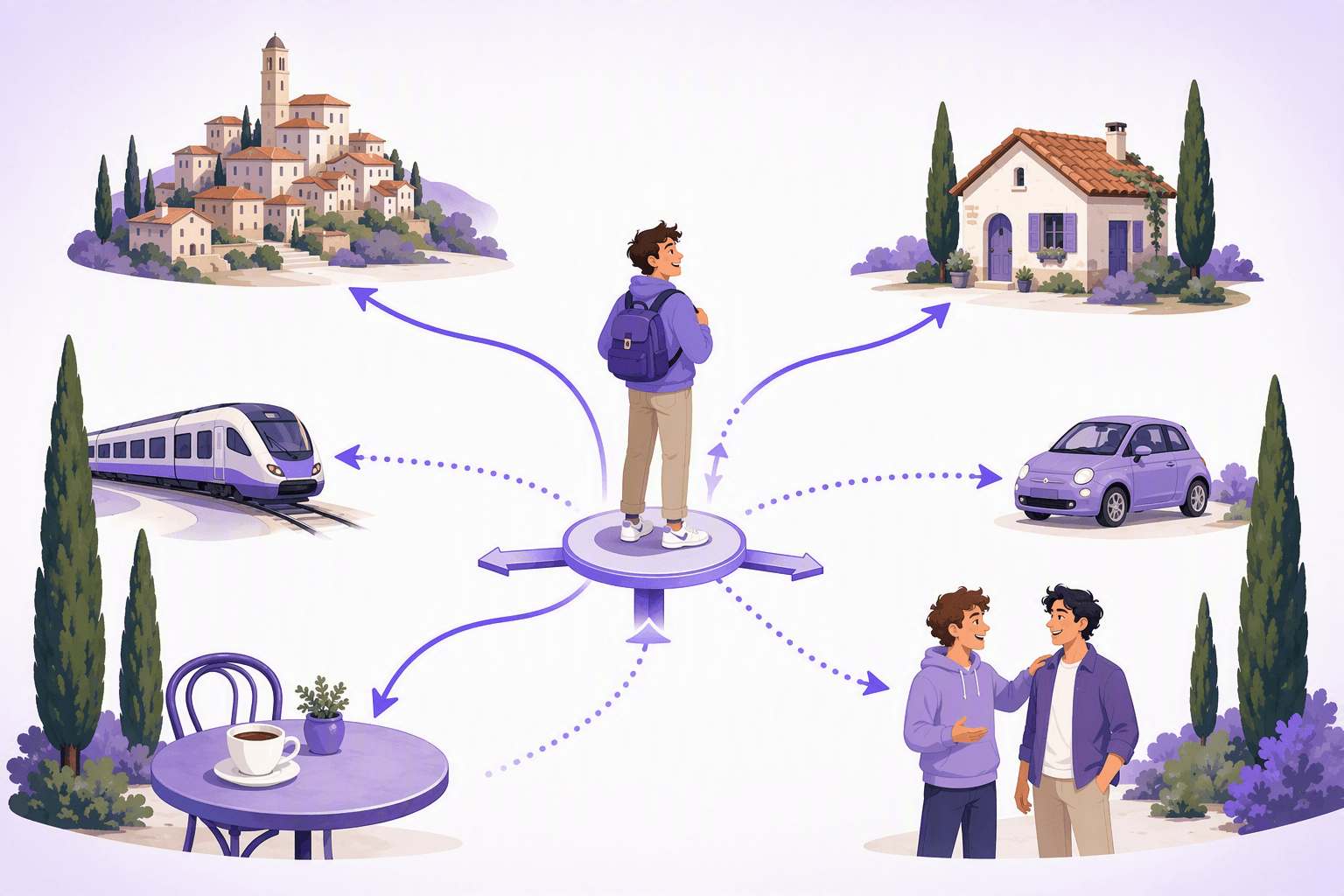
The 8 core Italian prepositions (what they do)
Italian grammar labels these as preposizioni semplici. They are short, but they carry a lot of meaning.
- di (dee): of, from, about
- a (ah): to, at
- da (dah): from, by, since, at someone’s place
- in (een): in, to (many places)
- con (kohn): with
- su (soo): on, about
- per (pehr): for, through, in order to
- tra / fra (trah / frah): between, among, in (time)
A practical way to think about them is: prepositions are not “translated words”, they are “relationship choices”. Italian often chooses a different relationship than English does.
The big upgrade: articulated prepositions (del, al, nel, sul)
Articulated prepositions (preposizioni articolate) are a hallmark of Italian. Treccani and Accademia della Crusca both treat them as standard, productive combinations: a preposition plus a definite article fused into one form.
Here are the most useful patterns:
| Base | + il | + lo | + la | + l' | + i | + gli | + le |
|---|---|---|---|---|---|---|---|
| di | del | dello | della | dell' | dei | degli | delle |
| a | al | allo | alla | all' | ai | agli | alle |
| da | dal | dallo | dalla | dall' | dai | dagli | dalle |
| in | nel | nello | nella | nell' | nei | negli | nelle |
| su | sul | sullo | sulla | sull' | sui | sugli | sulle |
Con and per can combine in older or formal styles (col, coi, pel), but in modern standard Italian you can safely use con il, con i, per il, per i in everyday writing and speech.
💡 The fastest rule that prevents 50% of mistakes
If the next noun normally takes a definite article in that context, you usually need an articulated preposition: parlo del film, vado al lavoro, sono nella stanza. If the noun is used generically or as a name without an article, you often do not: parlo di cinema, vado in Italia.
di (dee): possession, material, topic, and “of” relationships
Possession and “belonging to”
- il libro di Marco: Marco’s book
- la macchina di mia sorella: my sister’s car
Italian uses di where English often uses apostrophe-s.
Material and content
- una tazza di vetro: a glass cup
- un bicchiere d'acqua: a glass of water
Note the apostrophe in d'acqua (di + acqua). This is common before vowels.
Topic: “about”
- parliamo di lavoro: we’re talking about work
- un film di guerra: a war movie
This “topic di” is extremely frequent in conversation, especially when you discuss plans, gossip, or opinions.
Articulated di: del, della, degli...
Use it when the noun is specific and takes a definite article:
- parlo del film: I’m talking about the movie
- la fine della storia: the end of the story
a (ah): direction, point location, and fixed destinations
Going to a point: cities and many “point-like” places
- vado a Roma: I’m going to Rome
- sono a Milano: I’m in Milan
- torno a casa: I’m going home (CHAH-zah)
Cities are the cleanest rule: a + city.
Common fixed expressions with a
Many daily destinations prefer a even though English might say “in”:
- a scuola: at school
- a lavoro: at work (also al lavoro when specific)
- a letto: in bed
You will also hear in ufficio and in classe, so do not force one rule onto every place. Learn the chunk you actually hear.
Articulated a: al, alla, allo...
- vado al bar: I’m going to the cafe/bar
- sono alla stazione: I’m at the station
da (dah): origin, starting point, “at someone’s place”, and agent
Origin: where you come from
- vengo da Napoli: I come from Naples
- sono da Milano: I’m from Milan
English “from” can be da (origin) or di (some source/topic uses), but for people’s origin, da is the default.
Starting point in time and space
- da lunedì: since Monday
- da qui: from here
At someone’s place (very Italian, very useful)
- sono dal dentista: I’m at the dentist’s
- andiamo da Luca: we’re going to Luca’s place
This is a cultural pattern worth copying because it is natural and efficient.
Agent in passive constructions
- è stato scritto da lei: it was written by her
If you later study formal writing, this da becomes a key signal of passive voice.
in (een): inside, in-to, and “category places”
Countries, regions, and big areas
- in Italia: in Italy
- in Toscana: in Tuscany
- in Europa: in Europe
This is one of the most stable rules in Italian.
Many enclosed or institutional places
- in ufficio: in the office
- in banca: at the bank
- in ospedale: in the hospital
Some of these can vary by region and nuance, but in is a safe default for “inside an institution”.
Transport: by car, by train
- in macchina: by car
- in treno: by train
This is a classic Italian pattern: you are “in” the vehicle.
con (kohn): accompaniment and tools
With a person
- con me: with me
- con te: with you
- con i miei amici: with my friends
With an instrument or method
- scrivo con la penna: I write with a pen
- taglio con il coltello: I cut with a knife
In real speech, con is one of the most stable prepositions. The main learner error is forgetting it and using “e” (and) instead.
su (soo): on a surface, about a topic, and “up on”
Physical surface
- sul tavolo: on the table
- sulla sedia: on the chair
Topic “about” (similar to di, but not identical)
- un libro sulla storia d'Italia: a book about the history of Italy
A practical distinction: di is the default “about”, while su often feels like “on the subject of” and is common in titles, school topics, and more formal descriptions.
per (pehr): purpose, destination, duration, and “through”
Purpose: for, in order to
- studio per l'esame: I’m studying for the exam
- sono qui per aiutarti: I’m here to help you
Destination: leaving for somewhere
- parto per Firenze: I’m leaving for Florence
This is a high-frequency travel pattern. If you learned greetings first, this is the next step for making plans.
Duration (common, but nuanced)
- per due ore: for two hours
Italian also uses da for “since”, so time expressions split by viewpoint:
- da due ore: for two hours (and still ongoing, literally “since two hours”)
- per due ore: for two hours (planned or bounded)
tra / fra (trah / frah): between, among, and “in (time)”
Tra and fra are interchangeable in meaning. Speakers often choose based on sound to avoid repetition (fra fratelli sounds awkward).
Space and groups
- tra Roma e Napoli: between Rome and Naples
- fra amici: among friends
Time from now
- tra cinque minuti: in five minutes
- fra due settimane: in two weeks
This is one of the cleanest “in the future” markers in Italian.
The place problem: a vs in vs da (and why learners get stuck)
Places are where prepositions stop feeling like logic and start feeling like usage. This is normal, and linguists who study usage-based learning, like Joan Bybee in her work on frequency and patterns, emphasize that repeated chunks become your real grammar.
Here is a practical cheat sheet that matches what you hear most often:
Cities vs countries
- a + city: a Roma, a Torino
- in + country/region: in Italia, in Sicilia
Home and people
- a casa: at home / homeward
- da + person: da Luca, dal medico
Work and school
- a scuola is extremely common.
- a lavoro exists, but al lavoro is often preferred when you mean “at work” as a specific state.
- in ufficio is common for “in the office”.
⚠️ Avoid the 'one English word = one Italian preposition' trap
English “in” can map to a, in, or su depending on the relationship. English “to” can map to a, in, or per. Train yourself to ask: is this a point destination, an enclosed place, a surface, or a purpose?
When to use the article (and when not to)
A lot of preposition errors are really article errors. If you are unsure about articles, bookmark an article list like 100 most common Italian words and notice how often il, lo, la, i, gli, le appear in real sentences.
Usually no article
- with most cities: a Venezia
- with many countries: in Italia (but: negli Stati Uniti)
- with professions after essere: sono medico (not a preposition, but same “no article” instinct)
Often with an article
- specific places and institutions: al cinema, in biblioteca, alla posta
- topics that are specific: del lavoro, della politica
- body parts and many everyday nouns: con la mano, sul tavolo
Italian uses articles more than English. This is why articulated prepositions feel like they are everywhere.
High-frequency mini patterns you can copy from movies
Because Wordy teaches through real clips, it helps to learn prepositions as “lines you can reuse”. These are short, repeatable, and show the correct preposition automatically.
“I’m going to…”
- Vado a casa. (VAH-doh ah CHAH-zah)
- Vado al bar. (VAH-doh ahl bahr)
- Vado in Italia. (VAH-doh een ee-TAH-lyah)
“I’m coming from…”
- Vengo da Milano. (VEHN-goh dah mee-LAH-noh)
“I’m with…”
- Sono con te. (SOH-noh kohn teh)
“We’ll see each other in…”
- Ci vediamo tra cinque minuti. (chee veh-DYAH-moh trah CHEEN-kweh mee-NOO-tee)
If you want to keep building conversational building blocks, add a romance-friendly set like how to say I love you in Italian, because it naturally introduces di and per in compliments and explanations.
Common mistakes (and the correction that fixes them)
Mistake 1: using di for “to”
Wrong: vado di Roma
Right: vado a Roma
Mistake 2: forgetting articulated forms
Wrong: parlo di il film
Right: parlo del film
Mistake 3: mixing a and in with countries
Wrong: a Italia
Right: in Italia
Mistake 4: using per when you mean “at someone’s place”
Wrong: sono per il dentista
Right: sono dal dentista
Mistake 5: translating “for” automatically to per
English “for” can be per, da, a, or even di depending on meaning:
- un regalo per te: a gift for you
- da due anni: for two years (ongoing, “since”)
- una tazza da tè: a teacup (purpose, “for tea”)
- il rispetto di sé: self-respect (different relationship)
A cultural note: prepositions signal how Italians frame situations
Italian everyday speech often frames actions through places and social roles, which is why da + professional is so common (dal medico, dal parrucchiere). It is not just grammar, it is a social map: you go “to the person” as much as “to the building”.
You can hear the same social framing in greetings and leave-takings. A simple hello in Italian is often followed by where you are headed, and that is immediately preposition-heavy: a casa, al lavoro, dal nonno.
🌍 Why 'dal dentista' feels natural
In Italian, many services are conceptualized as going to someone’s practice, not to an abstract service location. That is why da is productive here, and why it stays even when the place is obvious from context.
A simple practice routine that actually sticks
Paul Nation’s work on vocabulary learning highlights that high-frequency function words need repeated, meaningful encounters, not isolated memorization. Prepositions are exactly that kind of word.
Use this three-step loop for a week:
- Pick one preposition per day (di Monday, a Tuesday, etc.).
- Collect 10 real sentences from subtitles, songs, or a clip-based app.
- Replace one noun in each sentence to make it yours (Roma to Milano, bar to cinema).
Do not aim for perfection. Aim for volume with feedback.
💡 One-line self-test
If you can say these three lines fast and correctly, your prepositions are improving: vado a Roma, vado in Italia, sono dal medico.
How this connects to the Italian you actually hear
Prepositions are among the most frequent words in Italian, so they show up in every genre: comedy, crime shows, romance, and even arguments. If you are curious how informal speech bends rules, be careful with what you copy from aggressive dialogue, especially if you are also exploring taboo language like Italian swear words. Swearing often comes with clipped grammar, dropped articles, and regional shortcuts.
For a learner, the goal is: understand everything, but speak in clean, widely accepted patterns first.
Final checklist: what to memorize vs what to absorb
Memorize these:
- a + city, in + country/region
- da + person/professional (dal medico)
- articulated prepositions table (at least di/a/in/su + articles)
Absorb through examples:
- a vs in for specific institutions (a scuola vs in ufficio)
- di vs su for “about”
- per vs da for durations
If you want a steady stream of real examples, start from everyday scenes: greetings, goodbyes, and plans. Pair this guide with how to say goodbye in Italian and listen for al, dal, nel, and sul, because they are doing grammar work every few seconds.
At that point, prepositions stop being “rules” and start being “the way Italian sounds”, which is when your speaking becomes faster and more confident.
Frequently Asked Questions
What are the main Italian prepositions?
What are articulated prepositions in Italian?
How do I choose between a and in for places?
What is the difference between di and da?
Do Italians always use con me or can they say me con?
Sources & References
- Treccani, Enciclopedia dell'Italiano: 'Preposizioni' (accessed 2026)
- Accademia della Crusca, Consulenza linguistica on preposizioni articolate (accessed 2026)
- Ethnologue, 27th edition, 2024
- Lo Zingarelli, voce 'preposizione' (accessed 2026)
- ISTAT, dati su popolazione e lingua italiana in Italia (accessed 2026)
Start learning with Wordy
Watch real movie clips and build your vocabulary as you go. Free to download.


