Italian Past Tense (Passato): Passato Prossimo vs Imperfetto, Clearly Explained
Quick Answer
Italian past tense is mainly expressed with two forms: passato prossimo for completed events (often with a clear result or time frame) and imperfetto for background, habits, and ongoing past situations. Mastering the choice is less about 'near vs far past' and more about viewpoint: finished event vs ongoing scene.
Italian past tense is mainly built on passato prossimo (completed events) and imperfetto (ongoing background, habits, descriptions), and the real skill is choosing the tense that matches the speaker’s viewpoint, not memorizing a “recent vs distant past” rule.
Italian is spoken by over 60 million people worldwide (Ethnologue, 27th ed., 2024), so these two past tenses are the backbone of everyday stories, from casual chats to movie dialogue. If you can hear the difference between “what happened” and “what was going on,” you can pick the right tense most of the time.
If you want more everyday Italian to pair with grammar, start with greetings like how to say hello in Italian and how to say goodbye in Italian, then come back to past tense and notice it in context.
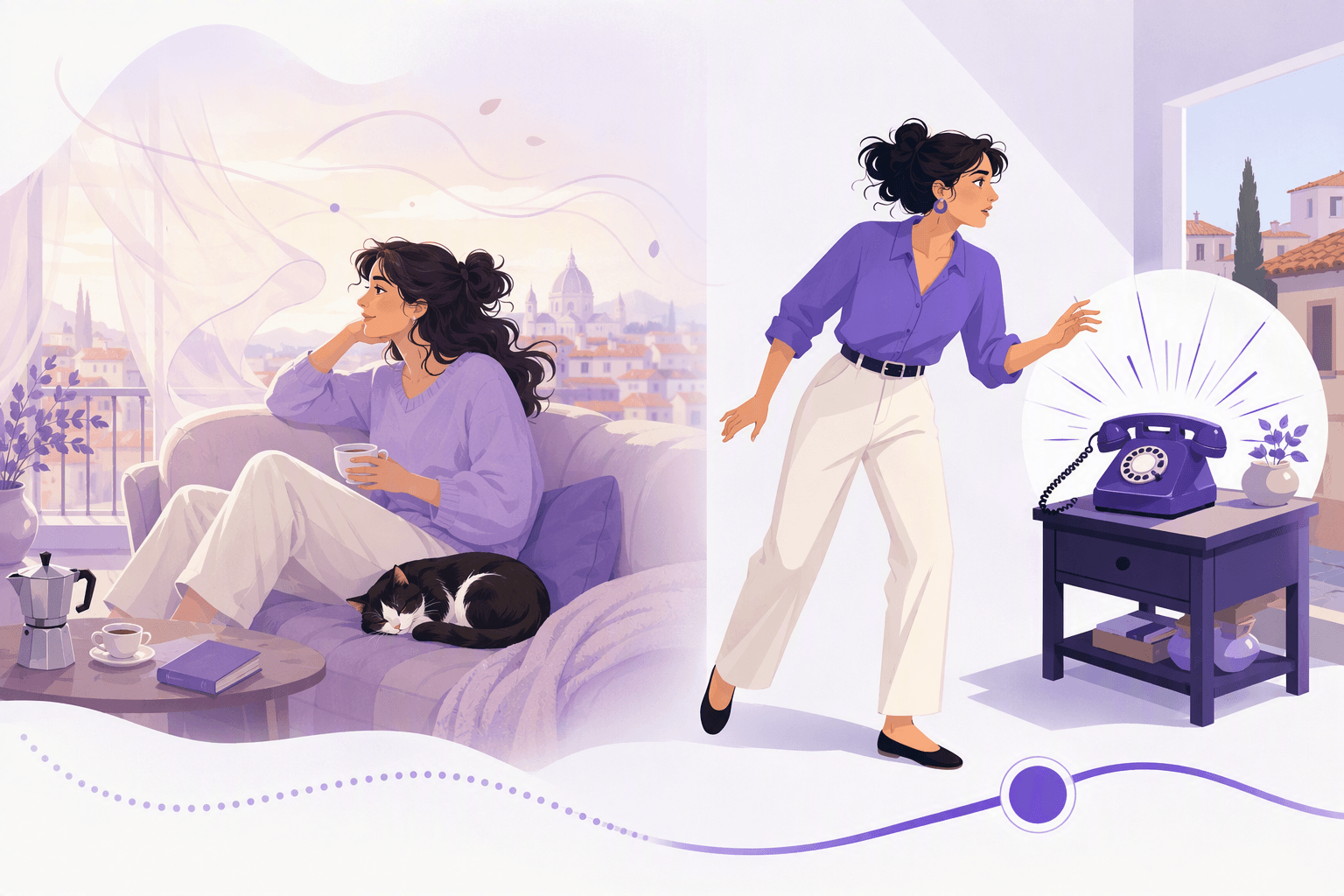
The core idea: completed event vs ongoing scene
A practical way to think about Italian past tense is foreground vs background.
Passato prossimo pushes the story forward: a finished event, a change, a result.
Imperfetto sets the scene: what was happening, what used to happen, how things were.
This aligns with how many linguists describe tense and aspect in Italian, including work by Pier Marco Bertinetto on the interaction of time and aspect in the verb system, and how Italian teaching grammars frame “event” vs “state” choices. You are not just choosing a verb form, you are choosing a camera angle.
Passato prossimo: what it is and when to use it
Passato prossimo is the default tense for completed actions in spoken Italian across much of the country.
Use passato prossimo for finished actions (with a result)
If the action is “done,” and you present it as a whole, you are in passato prossimo.
- Ho finito. (I finished.)
- Abbiamo visto il film. (We watched the movie.)
Even if the time is not stated, the speaker is packaging the event as complete.
Use passato prossimo for actions in a defined time frame
If you mention a time window that feels closed, passato prossimo is natural:
- Ieri ho lavorato tutto il giorno. (Yesterday I worked all day.)
- Stamattina ho bevuto due caffè. (This morning I drank two coffees.)
In everyday speech, “stamattina” can behave like a closed period once the morning is over.
Use passato prossimo for “one-time” events in a story
When you list events, passato prossimo often carries the timeline:
- Siamo usciti, abbiamo cenato e poi siamo tornati a casa.
(We went out, had dinner, and then came home.)
How to form passato prossimo (step-by-step)
Passato prossimo = auxiliary (essere/avere) in present + past participle.
Avere: the most common auxiliary
Most verbs use avere.
- parlare: ho parlato (oh par-LAH-toh)
- mangiare: ho mangiato (oh mahn-JAH-toh)
Pronunciation note: ho is pronounced like “oh” (the H is silent).
Essere: movement, change of state, reflexives
Many intransitive verbs use essere, especially movement and change-of-state verbs:
- andare: sono andato/a (SOH-noh ahn-DAH-toh/DAH-tah)
- arrivare: sono arrivato/a (SOH-noh ah-ree-VAH-toh/VAH-tah)
- nascere: sono nato/a (SOH-noh NAH-toh/NAH-tah)
- diventare: sono diventato/a (SOH-noh dee-ven-TAH-toh/TAH-tah)
All reflexive verbs take essere:
- svegliarsi: mi sono svegliato/a (mee SOH-noh zveh-LYAH-toh/LYAH-tah)
💡 A quick learner rule for essere
If the verb answers “what happened to the subject?” (arrived, left, became, was born), essere is common. If the verb answers “what did the subject do to something?” (watched, ate, bought), avere is common.

Past participle agreement with essere
With essere, the past participle agrees with the subject:
- Marco è andato. (MAHR-koh eh ahn-DAH-toh)
- Giulia è andata. (JOO-lyah eh ahn-DAH-tah)
- Marco e Giulia sono andati. (… ahn-DAH-tee)
- Marco e Giulia sono andate. (… ahn-DAH-teh, all-female group)
With avere, the participle usually stays masculine singular:
- Giulia ha mangiato. (JOO-lyah ah mahn-JAH-toh)
Irregular past participles you actually need
Some participles are irregular and extremely frequent:
- fare: ho fatto (oh FAHT-toh)
- dire: ho detto (oh DEHT-toh)
- vedere: ho visto (oh VEES-toh)
- prendere: ho preso (oh PREH-zoh)
- scrivere: ho scritto (oh SKREET-toh)
- mettere: ho messo (oh MEHS-soh)
- aprire: ho aperto (oh ah-PEHR-toh)
- chiudere: ho chiuso (oh KYOO-zoh)
- leggere: ho letto (oh LEHT-toh)
- bere: ho bevuto (oh beh-VOO-toh)
Imperfetto: what it is and when to use it
Imperfetto is the tense of ongoing past: what was happening, what used to happen, what things were like.
Use imperfetto for background descriptions
You use imperfetto to paint the scene:
- Era tardi e faceva freddo.
(It was late and it was cold.)
This is the “camera is rolling” tense.
Use imperfetto for habitual actions in the past
If it happened repeatedly:
- Da bambino andavo al mare ogni estate.
(As a child, I used to go to the sea every summer.)
Use imperfetto for ongoing actions (was doing)
Imperfetto often corresponds to English “was doing”:
- Studiavo quando mi hai chiamato.
(I was studying when you called me.)
Imperfetto for age, time, and states
Common imperfetto verbs in conversation:
- Avevo vent’anni. (I was 20.)
- Erano le otto. (It was eight o’clock.)
- Non sapevo. (I didn’t know.)
Maria Grossmann and other Italian grammar descriptions often highlight how states and descriptions naturally attract imperfetto because they are not presented as bounded events.
How to form imperfetto (and why it feels easier)
Imperfetto endings are regular for most verbs:
-are: parlavo (par-LAH-voh), parlavi, parlava, parlavamo, parlavate, parlavano
-ere: prendevo (pren-DEH-voh), prendevi, prendeva, prendevamo, prendevate, prendevano
-ire: dormivo (dor-MEE-voh), dormivi, dormiva, dormivamo, dormivate, dormivano
A few high-frequency verbs are irregular:
- essere: ero, eri, era, eravamo, eravate, erano
- fare: facevo, facevi, faceva, facevamo, facevate, facevano
- dire: dicevo, dicevi, diceva, dicevamo, dicevate, dicevano
Passato prossimo vs imperfetto: the decision rules that work
Forget “recent vs distant” as your main rule. Regional usage varies, and speakers use these tenses to shape meaning.
Here are the rules that hold up in real dialogue.
Rule 1: event (completed) vs situation (ongoing)
- Ho letto il libro. (I read it, finished.)
- Leggevo il libro. (I was reading it, ongoing, not necessarily finished.)
Rule 2: storyline vs background
- Camminavo per strada quando ho visto Luca.
(I was walking down the street when I saw Luca.)
Imperfetto sets the scene, passato prossimo delivers the key event.
Rule 3: “how many times?” is a strong clue
If you can count it as a single whole event, passato prossimo is likely:
- Ho chiamato due volte. (I called twice.)
If it is a repeated pattern, imperfetto is likely:
- Chiamavo sempre la sera. (I used to call in the evening.)
Rule 4: time expressions that push you toward one tense
Often imperfetto:
- sempre (always)
- spesso (often)
- di solito (usually)
- ogni giorno (every day)
Often passato prossimo:
- ieri (yesterday)
- stamattina (this morning, if the morning is “over” in context)
- una volta (once)
- all’improvviso (suddenly)
These are tendencies, not laws, but they are reliable.
The classic storytelling pattern (and why movies use it)
In Italian dialogue, you will constantly hear this rhythm:
- Imperfetto: scene, mood, ongoing action
- Passato prossimo: the event that changes things
Example:
- Eravamo a casa, guardavamo la TV, e poi è suonato il telefono.
(We were at home, we were watching TV, and then the phone rang.)
This is one reason learning through clips works well: you hear tense choice as a storytelling tool, not as an isolated exercise. If you are building listening skills, pair this with everyday phrases like how to say I love you in Italian and notice how often Italians keep stories “alive” with imperfetto before landing the punchline in passato prossimo.
Common mistakes (and the fixes that sound natural)
Mistake 1: using imperfetto for a completed event
Learner sentence:
- Ieri andavo al cinema.
Natural fix:
- Ieri sono andato/a al cinema.
(Yesterday I went to the cinema.)
Imperfetto would suggest “I was going” as an ongoing action, or a repeated habit in the past.
Mistake 2: using passato prossimo for background description
Learner sentence:
- Ho avuto vent’anni.
Natural fix:
- Avevo vent’anni.
(I was 20.)
Age is a state, so imperfetto is the default framing.
Mistake 3: forgetting agreement with essere
Learner sentence:
- Maria è andato.
Natural fix:
- Maria è andata.
Mistake 4: overthinking “how long ago”
In many regions, people say:
- Ho visto quel film da piccolo.
(I saw that movie when I was little.)
Even though it was long ago, it is presented as a completed event.
⚠️ Do not rely on the 'near past' label
Textbooks sometimes gloss passato prossimo as “present perfect” or “recent past.” That can mislead you. In real Italian, it often functions as the default completed-past tense in speech, and the choice vs imperfetto is mainly about completed event vs ongoing background.
A note on passato remoto (so you are not surprised)
You will see passato remoto in books, history, fairy tales, and sometimes in regional speech. It is not the focus of this guide, but recognizing it helps your listening.
Common forms you will meet:
- essere: fu (foo)
- avere: ebbe (EHB-beh)
- fare: fece (FEH-cheh)
- dire: disse (DEES-seh)
- vedere: vide (VEE-deh)
Treccani’s reference entries are useful when you want to check forms and usage labels (accessed 2026). For learners, the priority is still passato prossimo plus imperfetto, because that combination covers the majority of everyday conversation.
Mini “grammar to real life” examples you can reuse
Talking about your day
- Stamattina ho lavorato e poi ho fatto la spesa.
(This morning I worked and then I did the grocery shopping.) - Mentre facevo la spesa, incontravo sempre la stessa signora.
(While I was shopping, I always ran into the same lady.)
Notice how “did the shopping” can be a completed event, but “always ran into” is habitual.
Childhood memories
- Da piccolo vivevo in un paese.
(As a kid I lived in a town.) - Un giorno ho incontrato un attore famoso.
(One day I met a famous actor.)
Imperfetto gives the long-term background, passato prossimo marks the memorable event.
Relationship stories (very common in TV dialogue)
- All’inizio mi piaceva, ma poi ho capito che non era la persona giusta.
(At first I liked them, but then I realized they weren’t the right person.)
“Mi piaceva” is a past state, “ho capito” is the turning point.
If you want to understand emotional dialogue better, combine this with Italian swear words carefully, not to copy insults, but to recognize tone shifts when characters switch from neutral narration to heated reactions.
A cultural insight: tense choice is also “how you frame the story”
In Italian conversation, imperfetto can do more than describe the past. It can soften, distance, or set a polite frame, especially in service contexts or when recounting something awkward.
For example, you may hear imperfetto used to make a request feel less direct (a common pragmatic effect across languages, discussed in pragmatics and politeness research such as Brown and Levinson’s work on face and mitigation, even though Italian has its own patterns):
- Volevo chiederle una cosa.
(I wanted to ask you something.)
It is past tense, but it functions like a polite “preface” in the present interaction.
Accademia della Crusca’s public language guidance often addresses how usage and register shape what sounds natural (accessed 2026). This is a good reminder that tense is not only “time,” it is also social positioning.
A simple practice plan that actually sticks
Step 1: learn the two-sentence template
Memorize this pattern and swap verbs:
- Imperfetto + quando + passato prossimo
Stavo cucinando quando è arrivato.
(I was cooking when he arrived.)
Step 2: write 5 lines about yesterday (events only)
Use only passato prossimo:
- Ieri ho…
- Poi ho…
- Dopo ho…
Step 3: write 5 lines about your childhood (background only)
Use only imperfetto:
- Da piccolo…
- Di solito…
- Sempre…
Step 4: listen for “scene vs event” in clips
When you watch Italian scenes, pause and label each past verb as:
- scene/background (imperfetto)
- event/turning point (passato prossimo)
That single habit trains your ear faster than doing more conjugation drills.
Wrap-up: the one-sentence rule to remember
If you remember only one rule, make it this: use imperfetto for what was going on, and passato prossimo for what happened (as a completed event).
When you are ready to hear these tenses in fast, natural speech, use short dialogue clips and repeat them out loud, then connect them to real-life openers like how to say hello in Italian and closers like how to say goodbye in Italian. The grammar will start to feel like storytelling, not math.
Frequently Asked Questions
Is passato prossimo always the 'recent past' in Italian?
How do I choose between imperfetto and passato prossimo in one sentence?
When do I use essere vs avere in passato prossimo?
Do I need to learn passato remoto to understand Italian movies and TV?
Why do Italians sometimes switch tenses in the same story?
Sources & References
- Accademia della Crusca, Consulenze linguistiche (accessed 2026)
- Treccani, Enciclopedia e Vocabolario online: voci su tempi verbali e ausiliari (accessed 2026)
- Ethnologue, 27th edition, 2024
- Lo Duca, M.G., Manuale di linguistica italiana, Carocci
- Bertinetto, P.M., Tempo, aspetto e azione nel verbo italiano, Accademia della Crusca
Start learning with Wordy
Watch real movie clips and build your vocabulary as you go. Free to download.


