Quick Answer
To tell time in French, you typically use Il est + the hour, then add minutes (Il est deux heures dix), or common shortcuts like et quart, et demie, and moins le quart. In daily life, France often uses the 24-hour clock for schedules, while casual conversation may use the 12-hour clock with context.
To tell time in French, use Il est + hour (Il est deux heures, eel eh duh uhr), then add minutes (Il est deux heures dix, eel eh duh uhr deess) or the common shortcuts et quart, et demie, and moins le quart. In France and much of the Francophone world, schedules typically use the 24-hour clock, while everyday conversation often stays closer to a 12-hour style with context.

| English | French | Pronunciation | Formality |
|---|---|---|---|
| What time is it? | Quelle heure est-il ? | KEL uhr eh-TEEL | polite |
| What time is it? (casual) | Il est quelle heure ? | eel eh KEL uhr | casual |
| It's 3 o'clock. | Il est trois heures. | eel eh trwah uhr | neutral |
| It's 3:15. | Il est trois heures et quart. | eel eh trwah uhr eh kar | neutral |
| It's 3:30. | Il est trois heures et demie. | eel eh trwah uhr eh duh-MEE | neutral |
| It's 3:45. | Il est quatre heures moins le quart. | eel eh katr uhr mwahn luh kar | neutral |
| At 6:00. | À six heures. | ah seess uhr | neutral |
| Around 6:00. | Vers six heures. | vair seess uhr | casual |
French is a global language with over 300 million French speakers worldwide according to the OIF, and it has official status in dozens of countries across Europe, Africa, the Americas, and the Pacific. If you travel, study, or work in French, time talk shows up immediately: train platforms, dinner plans, office meetings, and appointment reminders.
For more everyday French you will actually hear in films and series, pair this with greetings like in our how to say hello in French guide.
The core pattern: "Il est" + the time
French time-telling starts with Il est (eel eh), literally "it is."
You can also say C'est (say) in casual speech, but Il est is the standard for clock time.
Il est
Il est (eel eh) is the default opener for telling time.
Examples you will hear:
- Il est huit heures. (eel eh weet uhr), "It’s 8:00."
- Il est huit heures cinq. (eel eh weet uhr sank), "It’s 8:05."
💡 A fast pronunciation win
In French, the final consonant in "est" is usually silent: "Il est" sounds like "eel eh". Keep it light and quick, it will instantly sound more natural.
Asking the time naturally (and politely)
In real life, you will hear two main questions.
Quelle heure est-il ?
Quelle heure est-il ? (KEL uhr eh-TEEL) is the classic, polite form.
It is perfect with strangers, staff, and anyone you want to sound respectful with.
Il est quelle heure ?
Il est quelle heure ? (eel eh KEL uhr) is extremely common in everyday speech.
It is not rude, it just sounds more casual, like "What time is it?" rather than "What time is it, please?"
🌍 Why French often sounds 'inverted'
French has multiple question styles: inversion (Quelle heure est-il ?), intonation (Il est quelle heure ?), and "est-ce que". Movies and TV lean heavily on intonation questions because they are quick and conversational.
Hours in French: singular vs plural, and the special cases
French is strict about one hour vs multiple hours, and it has special words for noon and midnight.
| English | French | Pronunciation | Note |
|---|---|---|---|
| hour | une heure | ewn uhr | Singular, used for 1:00. |
| hours | deux heures | duh uhr | Plural from 2:00 onward. |
| noon | midi | mee-DEE | Often used instead of 'douze heures'. |
| midnight | minuit | mee-NWEE | Often used instead of 'zéro heure'. |
| morning | du matin | dew mah-TAN | Adds clarity in 12-hour style. |
| afternoon | de l'après-midi | duh lah-preh mee-DEE | Common for appointments. |
| evening | du soir | dew swahr | For evening plans. |
| at night | de la nuit | duh lah nwee | Used for late hours. |
Une heure
Une heure (ewn uhr) is "one o'clock."
You say: Il est une heure. (eel eh ewn uhr)
Midi
Midi (mee-DEE) is noon.
You say: Il est midi. (eel eh mee-DEE)
Minuit
Minuit (mee-NWEE) is midnight.
You say: Il est minuit. (eel eh mee-NWEE)
⚠️ The common learner mistake with 1:00
Do not say "Il est un heure". "Heure" is feminine, so it is "une": "Il est une heure" (eel eh ewn uhr).
Minutes: the two main styles (and when to use each)
French has two equally correct ways to say minutes, and the choice is mostly about context.
- Digital style: hour + minutes, like reading a phone screen.
- Relative style: quarter past, half past, quarter to, and "minus" minutes.
Digital style: "Il est 14 h 20"
In schedules, announcements, and anything official, French often uses the 24-hour clock.
You will see and hear formats like:
- 14 h 20 (katorz uhr van), "14:20"
- 18 h 05 (deez-weet uhr sank), "18:05"
When spoken, many people say quatorze heures vingt (kah-TORZ uhr van) rather than reading the "h."
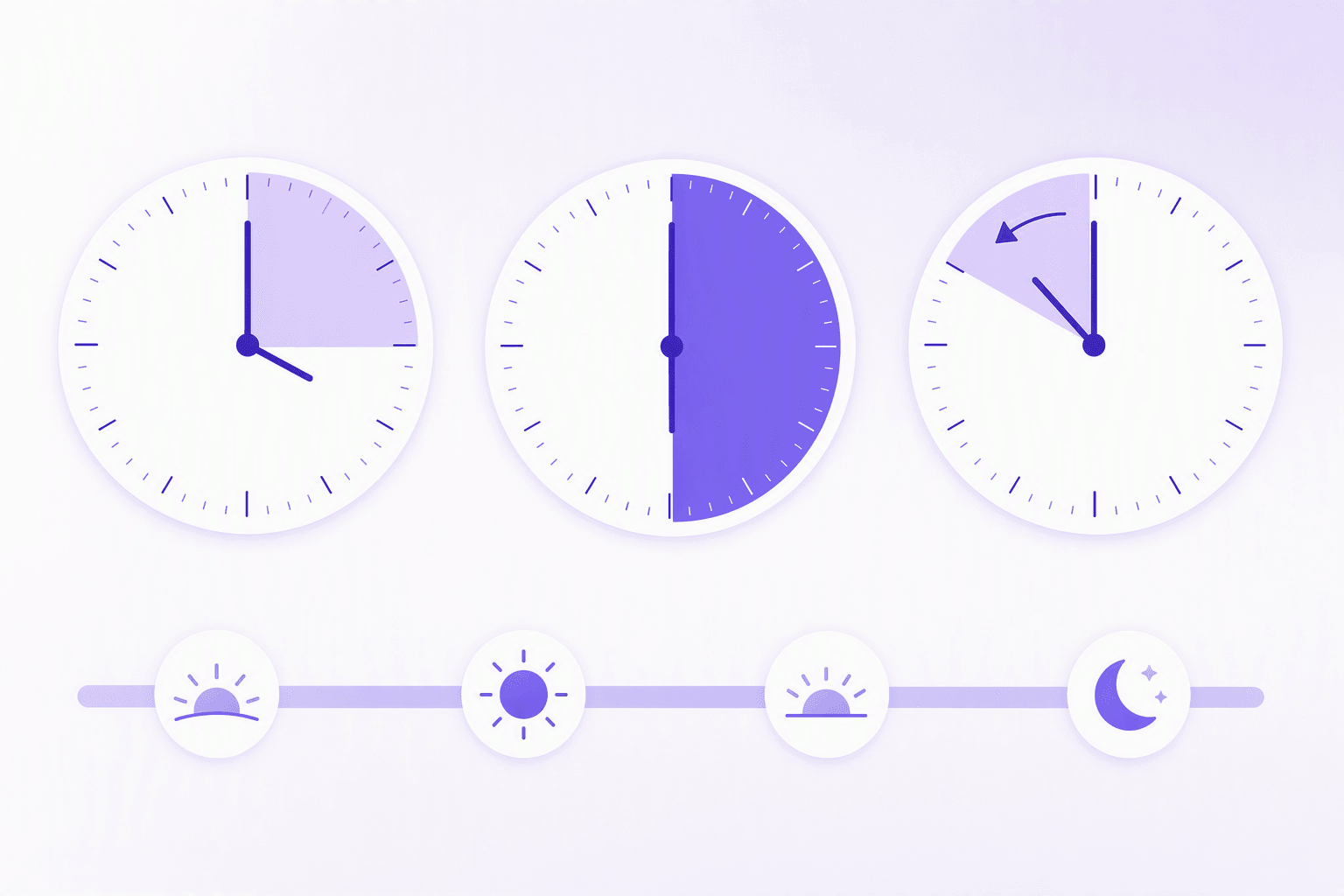
Relative style: "et quart", "et demie", "moins le quart"
In conversation, relative time is very common, especially around quarters and halves.
This is where French starts to feel different from English, because "7:45" often becomes "8:00 minus a quarter."
The essential time phrases (with pronunciation)
These are the phrases that carry you through most daily situations, from meeting friends to catching a train.
/eel eh duh uhr deess/
Literal meaning: It is two hours ten
“Il est deux heures dix, on y va.”
It's 2:10, let's go.
Common in both France and Francophone countries, especially when being precise.
/eel eh duh uhr eh kar/
Literal meaning: It is two hours and a quarter
“Rendez-vous à deux heures et quart.”
Appointment at 2:15.
Very common for appointments and meetups.
/eel eh duh uhr eh duh-MEE/
Literal meaning: It is two hours and a half
“Le film commence à deux heures et demie.”
The movie starts at 2:30.
A default, natural way to say :30.
/eel eh trwah uhr mwahn luh kar/
Literal meaning: It is three hours minus the quarter
“On se retrouve à trois heures moins le quart.”
Let's meet at 2:45.
Especially common in spoken French, and very frequent in older speakers and formal settings.
12-hour vs 24-hour time in France: the practical rule
If you learn one cultural rule, make it this:
- Public information uses 24-hour time: trains, flights, work schedules, TV listings.
- Conversation often uses 12-hour time: friends, family, small talk, quick planning.
So you might see 19 h 30 on a ticket, but hear sept heures et demie (set uhr eh duh-MEE) when someone says it out loud.
🌍 A very French scheduling habit: 'vers' and flexible timing
In France, it is common to propose a time with "vers" (around) and refine later, especially for social plans. You will hear "vers 20 heures" for dinner plans, even when the actual arrival window is 20:00 to 20:30. This is not lateness, it is a conversational norm that signals flexibility.
"At" a time: à, vers, and pour
English uses "at" for many time meanings. French splits that job across a few words.
À
Use à (ah) for a specific time.
Examples:
- à huit heures (ah weet uhr), at 8:00
- à 8 h 10 (ah weet uhr deess), at 8:10
Vers
Use vers (vair) for "around."
Examples:
- vers midi (vair mee-DEE), around noon
- vers 17 heures (vair deez-set uhr), around 5 PM
Pour
Use pour (poor) when you mean a deadline, closer to "by."
Example:
- C'est pour quand ? Pour demain midi. (say poor kahn, poor duh-MAN mee-DEE), "When is it due? By tomorrow at noon."
Common real-life contexts (what you will hear in movies and TV)
Time phrases show up in predictable scenes: rushing, planning, waiting, and apologizing.
Here are high-frequency patterns worth memorizing.
On se retrouve à...
On se retrouve à... (on suh ruh-TROOV ah) means "Let’s meet at..."
Examples:
- On se retrouve à 19 h ? (on suh ruh-TROOV ah deez-neuf uhr), "Meet at 7?"
- On se retrouve à sept heures. (on suh ruh-TROOV ah set uhr), "Meet at 7."
Ça commence à...
Ça commence à... (sah koh-MAHNS ah) means "It starts at..."
Example:
- Ça commence à 20 h 30. (sah koh-MAHNS ah van uhr trahnt), "It starts at 8:30 PM."
Je suis en retard
Je suis en retard (zhuh swee ahn ruh-TAR) means "I’m late."
A very French add-on is the softener:
- Je suis un peu en retard. (zhuh swee uhn puh ahn ruh-TAR), "I’m a bit late."
If you want more everyday exits and endings, see how to say goodbye in French.
A clear cheat sheet: minutes in French
Use this table to convert quickly between what you see (digital) and what you might say (relative).
| Digital time | Common spoken French | Pronunciation |
|---|---|---|
| 7:05 | sept heures cinq | set uhr sank |
| 7:10 | sept heures dix | set uhr deess |
| 7:15 | sept heures et quart | set uhr eh kar |
| 7:20 | sept heures vingt | set uhr van |
| 7:25 | sept heures vingt-cinq | set uhr van-sank |
| 7:30 | sept heures et demie | set uhr eh duh-MEE |
| 7:35 | huit heures moins vingt-cinq | weet uhr mwahn van-sank |
| 7:40 | huit heures moins vingt | weet uhr mwahn van |
| 7:45 | huit heures moins le quart | weet uhr mwahn luh kar |
| 7:50 | huit heures moins dix | weet uhr mwahn deess |
| 7:55 | huit heures moins cinq | weet uhr mwahn sank |
💡 When to use 'moins'
If you are close to the next hour, French often switches to "moins" (minus). It is especially natural from :35 onward, and almost automatic at :45 with "moins le quart".
Expert insight: why time phrases are cultural, not just grammatical
Time expressions are a classic example of pragmatics: the grammar is simple, but the social meaning changes with context.
"Ways of speaking encode ways of thinking about social relations. Even apparently simple expressions, like those used for time, are shaped by cultural expectations about precision, politeness, and shared context."
(Anna Wierzbicka, Cross-Cultural Pragmatics, Mouton de Gruyter, 1991)
In practice, this is why vers (around) can sound friendly, why à 19 h 03 can sound overly rigid in a social plan, and why schedules stick to the 24-hour clock to avoid ambiguity.
Regional and Francophone notes (what changes outside France)
French is spoken across multiple continents, and time-telling stays mostly consistent.
Still, you will notice small differences in preference:
- In some places, people may favor digital style more often, especially in professional contexts.
- In casual speech, midi and minuit are widely understood everywhere.
- The 24-hour clock is common across Francophone Europe and in many formal settings globally, but conversational habits vary by community.
Ethnologue and the OIF both emphasize French’s global spread, which is exactly why you should learn the standard forms first. They travel well.
Practice: mini-dialogues you can copy
Short dialogues help you sound like a real speaker quickly.
At a train station
- Pardon, quelle heure est-il ? (par-DON, KEL uhr eh-TEEL)
- Il est dix-sept heures vingt. (eel eh deez-set uhr van)
Planning dinner
- On mange à quelle heure ? (on mahzh ah KEL uhr)
- Vers vingt heures, ça te va ? (vair van uhr, sah tuh vah)
Running late
- Tu arrives à quelle heure ? (tew ah-REEV ah KEL uhr)
- Je suis en retard, j'arrive vers huit heures moins le quart. (zhuh swee ahn ruh-TAR, zhah-REEV vair weet uhr mwahn luh kar)
Learn time phrases faster with movie clips
Time phrases are short, high-frequency, and often repeated in the same scenes, which makes them ideal for clip-based learning.
If you are building a broader base, combine this with a core vocabulary list like 100 most common French words, then reinforce it with real dialogue practice on French learning on Wordy.
Near the end of a conversation, you will also hear emotional time pressure, teasing, and relationship talk. If you are learning romantic French too, see how to say I love you in French for phrases that show up constantly in films.
⚠️ One last etiquette note
French profanity can show up in stressful "we're late!" scenes, especially in comedies. If you want to recognize it without copying it, read our guide to French swear words and focus on comprehension first.
Summary: the 5 rules that make you sound natural
- Start with Il est (eel eh) for clock time.
- Use une heure for 1:00, and plural heures from 2:00 onward.
- Prefer midi and minuit instead of "12:00" and "0:00" in speech.
- Use et quart, et demie, moins le quart for the most natural spoken rhythm.
- In schedules, expect the 24-hour clock, and say it as X heures Y when speaking.
Frequently Asked Questions
How do you ask 'What time is it?' in French?
Do French people use AM and PM?
How do you say 7:15 and 7:45 in French?
What is the difference between 'heure' and 'fois'?
How do you say 'at' a specific time in French?
Sources & References
- Organisation internationale de la Francophonie (OIF), La langue française dans le monde, 2022
- Ethnologue: Languages of the World, French language entry (27th ed., 2024)
- CNRTL (Centre National de Ressources Textuelles et Lexicales), entries for 'heure', 'midi', 'minuit'
- Académie française, Dire, Ne pas dire (usage notes on time expressions), ongoing
- Wierzbicka, A. (1991). Cross-Cultural Pragmatics. Mouton de Gruyter.
Start learning with Wordy
Watch real movie clips and build your vocabulary as you go. Free to download.


