Quick Answer
The standard way to say cheers in Spanish is ¡Salud!, pronounced /saˈluð/. It literally means health and works in Spain and Latin America. You can also use ¡Chin chin! in Spain, ¡Brindemos! for a more intentional toast, and longer playful cheers among friends.
The usual way to say cheers in Spanish is ¡Salud! /saˈluð/. It literally means “health,” and it is the safest toast in Spain, Mexico, Colombia, Argentina, and the rest of the Spanish-speaking world. Raise your glass, make brief eye contact when appropriate, say ¡Salud!, and take a sip.
Spanish is spoken by roughly 559 million people worldwide according to Ethnologue, and it has official status in 20 sovereign countries. That reach means toast customs and favorite expressions differ by region, but ¡Salud! is understood almost everywhere.
If you are meeting people for drinks, learn a few Spanish greetings first. A friendly hello, followed by a well-timed toast, makes a much better first impression than memorizing a long speech you never use.
| English | Spanish | Pronunciation | Formality |
|---|---|---|---|
| Cheers! | ¡Salud! | sah-LOOD | polite |
| Cheers! | ¡Chin chin! | cheen CHEEN | casual |
| Let's make a toast! | ¡Brindemos! | breen-DEH-mohs | formal |
| To us! | ¡Por nosotros! | por noh-SOH-trohs | casual |
| Up, down, to the center, inside! | ¡Arriba, abajo, al centro, pa' dentro! | ah-REE-bah, ah-BAH-hoh, ahl SEN-troh, pah DEN-troh | slang |
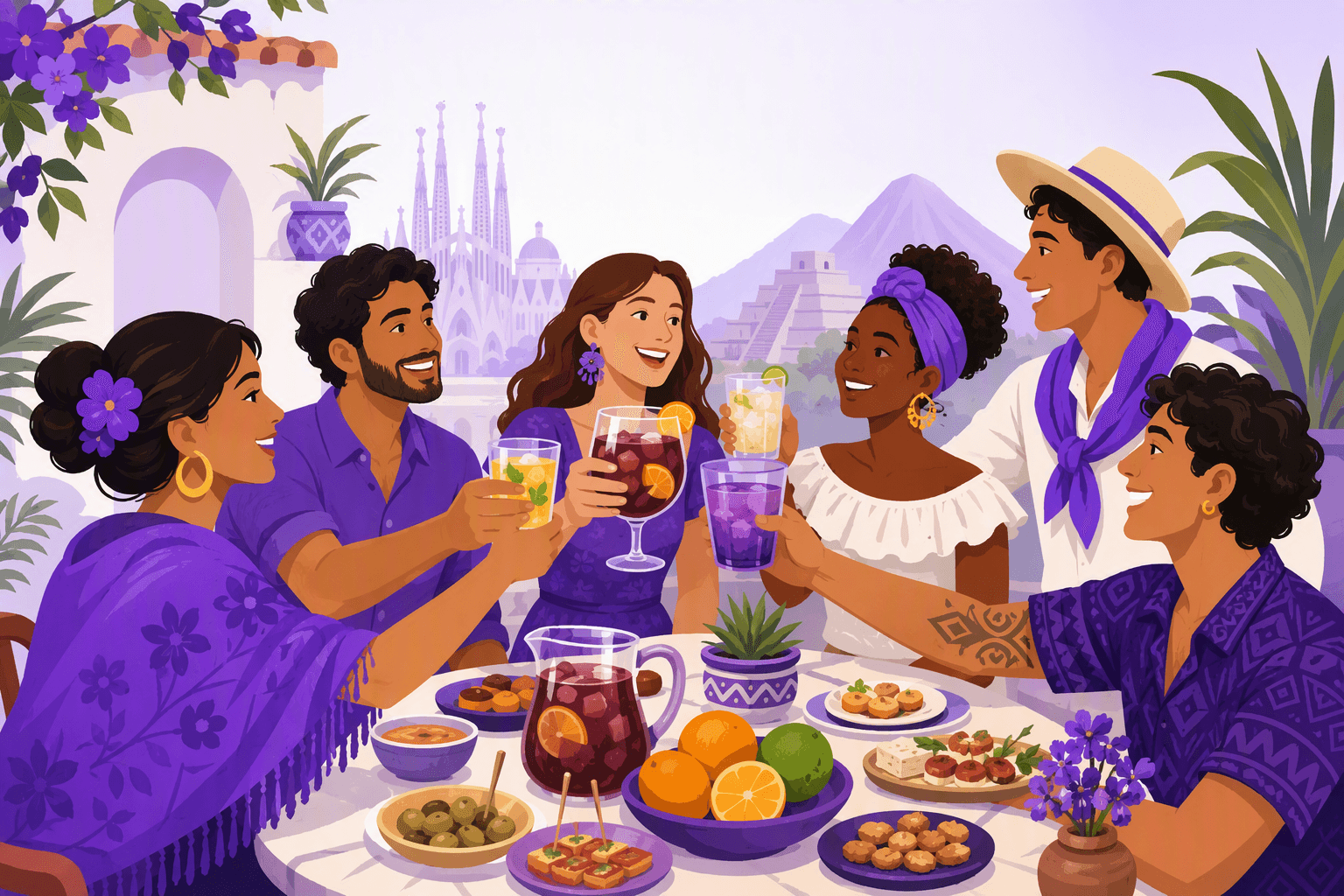
The essential Spanish word for cheers
Salud
¡Salud! /saˈluð/ is the core toast to learn. The noun salud /saˈluð/ means health, so the toast is a brief wish for everyone’s health and well-being.
Use it before drinking wine at dinner, opening beers with friends, celebrating a birthday, or sharing coffee in a casual setting. It does not require a special occasion. A simple raised glass and ¡Salud! is natural.
/sah-LOOD/
Literal meaning: Health!
“¡Salud por tu nuevo trabajo!”
Cheers to your new job!
This is the standard toast throughout the Spanish-speaking world. It works at relaxed gatherings and at most polite social occasions.
The final consonant in salud /saˈluð/ may sound softer than an English d, especially in much of Spain and Latin America. Do not worry about producing that perfectly at first. Stress the second syllable clearly: sa-LUD.
You may hear salud /saˈluð/ after a sneeze in some regions as well. The shared meaning is still a wish for health. At a table with raised glasses, however, nobody will mistake it for anything other than “cheers.”
Other ways to say cheers in Spanish
Chin chin
In Spain, ¡Chin chin! /tʃin ˈtʃin/ is a cheerful, informal toast. It is especially common among friends, at bars, and in lively family celebrations.
/cheen CHEEN/
Literal meaning: A playful toast sound
“¡Chin chin! Por una noche estupenda.”
Cheers! To a great night.
Common in Spain and recognisable elsewhere, but less universal than salud. Use it with friends rather than at a serious business meal.
The expression may remind English speakers of the sound glasses make when they touch, but it is not simply a sound effect. It functions as a real spoken toast. Still, when you are outside Spain, ¡Salud! /saˈluð/ is the more dependable choice.
Avoid confusing Spanish chin chin /tʃin ˈtʃin/ with a word you assume has the same tone everywhere. Toasts travel across languages, but their social range does not always travel with them. Regional awareness matters more than finding the most colorful phrase.
Brindemos
¡Brindemos! /bɾinˈðemos/ means “let’s make a toast” or “let’s toast.” It comes from brindar /bɾinˈðaɾ/, the verb “to toast.”
Use it when you want to invite the group to raise their glasses. It sounds more deliberate than ¡Salud! /saˈluð/, which is usually the final word said at the moment of drinking.
/breen-DEH-mohs/
Literal meaning: Let's toast!
“Brindemos por los amigos y la familia.”
Let's toast to friends and family.
Useful when starting a short toast at a dinner, wedding, graduation, or work celebration. It can also be warm and casual among close friends.
A natural sequence is Quisiera brindar por... /kiˈsjɛɾa bɾinˈðaɾ poɾ/, “I would like to toast to...,” followed by the reason for gathering. Then close with ¡Salud! /saˈluð/.
For example: Quisiera brindar por los novios. ¡Salud! /kiˈsjɛɾa bɾinˈðaɾ poɾ los ˈnoβjos saˈluð/, “I would like to toast the newlyweds. Cheers!”
Por nosotros
¡Por nosotros! /poɾ noˈsotɾos/ means “to us!” It is a short, personal toast for friends, couples, teammates, or family members.
You can replace nosotros /noˈsotɾos/ with the person or idea you want to celebrate. For instance, ¡Por ti! /poɾ ti/ means “to you!” and ¡Por el futuro! /poɾ el fuˈtuɾo/ means “to the future!”
/por noh-SOH-trohs/
Literal meaning: For us!
“Por nosotros y por todos los buenos recuerdos.”
To us and to all the good memories.
A warm toast for close relationships. In a romantic setting, por nosotros can feel affectionate without being overly dramatic.
For a romantic celebration, ¡Por nosotros! /poɾ noˈsotɾos/ can be more natural than immediately saying an intense declaration. If you do want romantic vocabulary, see ways to say I love you in Spanish.
Arriba, abajo, al centro, pa' dentro
The playful chant ¡Arriba, abajo, al centro, pa' dentro! /aˈriβa aˈβaxo al ˈsentɾo pa ˈðentɾo/ is common in many Spanish-speaking social circles. It means, roughly, “up, down, to the center, down the hatch!”
People often move their glasses upward, downward, inward, then drink. The shortened pa' /pa/ is casual spoken Spanish, from para /ˈpaɾa/.
/ah-REE-bah, ah-BAH-hoh, ahl SEN-troh, pah DEN-troh/
Literal meaning: Up, down, to the center, inside!
“¡Arriba, abajo, al centro, pa' dentro! ¡Salud!”
Up, down, to the center, down the hatch! Cheers!
Use this only in a relaxed, energetic group. It is unsuitable for formal work events, solemn dinners, or a first meeting with senior relatives.
Versions vary. Some groups add extra lines, repeat the motions, or use a local rhyme. That flexibility is part of the fun, not a sign that one version is wrong.
How to make a toast in Spanish
A full Spanish toast does not have to be long. In fact, a brief, sincere message usually sounds better than a speech that feels memorized.
Use this simple structure:
| Step | Spanish | IPA | Meaning |
|---|---|---|---|
| Get attention | Quisiera decir unas palabras | /kiˈsjɛɾa deˈsiɾ ˈunas paˈlaβɾas/ | I would like to say a few words |
| Introduce the toast | Quisiera brindar por... | /kiˈsjɛɾa bɾinˈðaɾ poɾ/ | I would like to toast to... |
| Name the reason | Por nuestra amistad | /poɾ ˈnwestɾa amistad/ | To our friendship |
| Invite the group | ¡Brindemos! | /bɾinˈðemos/ | Let's toast! |
| Close | ¡Salud! | /saˈluð/ | Cheers! |
Here is a complete birthday example:
Quisiera brindar por Ana, por su felicidad y por todo lo bueno que viene. ¡Salud! /kiˈsjɛɾa bɾinˈðaɾ poɾ ˈana poɾ su felisiˈðað i poɾ ˈtoðo lo ˈβweno ke ˈβjene saˈluð/
It means: “I would like to toast Ana, her happiness, and all the good things ahead. Cheers!”
For a wedding, say ¡Por los novios! /poɾ los ˈnoβjos/, “to the newlyweds!” For a graduation, ¡Por tu éxito! /poɾ tu ˈeksito/, “to your success!” is warm and straightforward.
Toast etiquette in Spain and Latin America
There is no single Spanish-speaking drinking culture. A dinner in Madrid, a wedding in Mexico City, a family barbecue in Buenos Aires, and a work event in Bogotá can all have different rhythms and expectations.
Francisco Moreno Fernández’s work on varieties of Spanish is useful here: Spanish is a shared language with meaningful regional social norms, not one uniform culture. Learn the common phrase, then watch what the people around you do.
Let the host set the pace
At a formal dinner, wait until the host or organizer begins the toast. Do not start drinking before a ceremonial toast if everyone is clearly waiting for one.
A host may say Bienvenidos /bjembeˈniðos/, “welcome,” offer a few words, and raise a glass. Your role is simple: raise yours, listen, say ¡Salud! /saˈluð/ with the group, and drink.
Clinking is common, not compulsory
Many friends clink glasses while saying ¡Salud! /saˈluð/. Others simply lift their drink toward the group. Neither choice is rude.
If you do clink, use a light touch. Large wine glasses and delicate stemware can break, and a forceful clink can look more performative than friendly.
Alcohol is never required
You can toast with sparkling water, juice, soda, coffee, or a non-alcoholic beer. The social act is the shared good wish, not the alcohol.
Say ¡Salud! /saˈluð/ with whatever is in your glass. If you are declining alcohol, a polite No, gracias /no ˈɣɾasjas/ is usually enough. For more useful replies, read our guide to yes and no in Spanish.
🌍 A toast is a small act of connection
Spanish toasts often focus on relationships: family, friendship, a new beginning, or collective good fortune. Brown and Levinson’s work on politeness explains why these short rituals matter: they publicly recognize the people gathered together and reinforce goodwill.
Common mistakes when saying cheers in Spanish
Saying salud like an English word
The stress belongs at the end: sa-LUD. The IPA /saˈluð/ shows that the vowel sounds are clear and short, unlike the broad vowel changes that English speakers may expect.
Using chin chin everywhere
¡Chin chin! /tʃin ˈtʃin/ is valid Spanish, but it has a stronger association with Spain. If you do not know the regional preference, say ¡Salud! /saˈluð/.
Giving a long toast without a reason
A toast should fit the moment. At a casual dinner, ¡Por nosotros! /poɾ noˈsotɾos/ or ¡Salud! /saˈluð/ is enough. Reserve a longer Quisiera brindar por... /kiˈsjɛɾa bɾinˈðaɾ poɾ/ statement for a milestone.
Treating every gathering like a party
A raised glass can mark a birthday, farewell, promotion, engagement, reunion, or a quiet family meal. Match your tone to the event. You can learn suitable closing language in our guide to saying goodbye in Spanish.
💡 The one phrase to remember
If you only memorize one Spanish toast, choose ¡Salud! /saˈluð/. It is short, polite, widely understood, and appropriate with almost any drink.
Practice cheers with real Spanish dialogue
The best way to make ¡Salud! /saˈluð/ feel automatic is to hear it in context. Watch for it in restaurant scenes, birthday gatherings, family reunions, and scenes set in bars.
Listen once for the situation, then replay the line and copy the timing. Notice whether speakers use a quiet ¡Salud! /saˈluð/, an enthusiastic ¡Chin chin! /tʃin ˈtʃin/, or a longer toast introduced with brindemos /bɾinˈðemos/.
Movie and TV dialogue also teaches the details a phrasebook cannot: who starts the toast, when people drink, and whether the mood is affectionate, formal, ironic, or celebratory. Try learning Spanish through scenes on the Spanish learning page, then use your new toast at the next real celebration.
The key is simple: raise your glass, smile, and say ¡Salud! /saˈluð/.
Frequently Asked Questions
What is the most common way to say cheers in Spanish?
Do people say chin chin in Spanish?
Is salud only used for drinking in Spanish?
What do you say before a formal toast in Spanish?
Do you have to clink glasses when saying salud?
Sources & References
- Real Academia Española, Diccionario de la lengua española: salud and brindar, accessed 2026
- Instituto Cervantes, El español: una lengua viva, 2024
- Ethnologue, Spanish, 27th edition, 2024
- Francisco Moreno Fernández, Variedades de la lengua española, Routledge
- Penelope Brown and Stephen C. Levinson, Politeness: Some Universals in Language Usage, Cambridge University Press
Start learning with Wordy
Watch real movie clips and build your vocabulary as you go. Free to download.


