Quick Answer
The standard way to say cheers in French is santé, pronounced /sɑ̃.te/. Say it just before drinking, usually while making eye contact and gently clinking glasses. For a more polite toast, use à votre santé, while tchin-tchin is a friendly, playful option.
The most natural way to say cheers in French is santé ! /sɑ̃.te/. Say it as you raise your glass before taking a drink. For a friendly party, you can also say tchin-tchin ! /tʃɛ̃.tʃɛ̃/, while à votre santé ! /a vɔtʁ sɑ̃.te/ is warmer and more formal, especially when addressing people you do not know well.
French is spoken by more than 320 million people worldwide, according to the Organisation internationale de la Francophonie, and drinking customs vary across the many places where French is used. Still, santé ! /sɑ̃.te/ is understood throughout France, Belgium, Switzerland, Quebec, and much of francophone Africa.
| English | French | Pronunciation | Formality |
|---|---|---|---|
| Cheers! | Santé ! | sahn-TEH | polite |
| To your health! | À votre santé ! | ah VOT-ruh sahn-TEH | formal |
| Cheers, everyone! | Santé à tous ! | sahn-TEH ah TOOS | casual |
| Cheers! | Tchin-tchin ! | cheen-CHEEN | slang |
| Let's raise a toast to... | Portons un toast à... | por-TOHN uhn tohst ah | formal |
| Here's to us! | À nous ! | ah NOO | casual |
The words matter, but the timing and gesture matter too. A French toast is a small social ritual: raise your glass, acknowledge the people present, say the phrase, and drink. If you are learning everyday social French, pair this guide with our practical French hello guide, since greetings and toasts often open the same social moment.
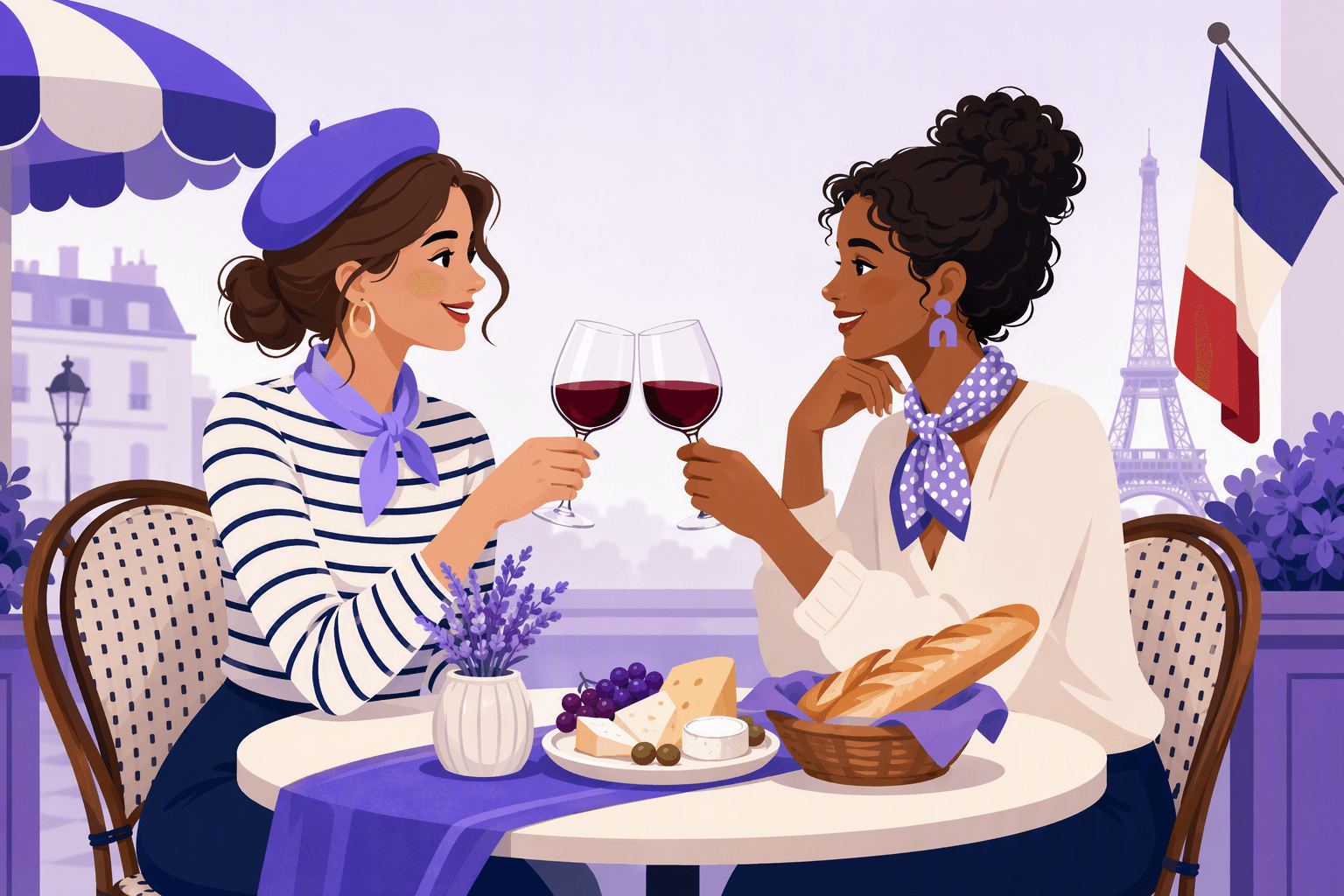
The essential French word for cheers
Santé
Santé ! /sɑ̃.te/ literally means “health.” The phrase is an abbreviated toast, with the fuller idea being to your health. It is the French equivalent of saying cheers in English, though the literal imagery is closer to “health!”
The final vowel is clear and stressed lightly: /sɑ̃.te/. The first vowel is nasal, so air passes through both the mouth and nose. Avoid pronouncing it as two separate sounds such as “san-tee.” French speakers produce one nasal vowel in /sɑ̃/.
/sahn-TEH/
Literal meaning: Health!
“Santé, tout le monde !”
Cheers, everyone!
The default toast in French. It is appropriate at a family dinner, café, work celebration, or casual gathering.
Use santé ! /sɑ̃.te/ with friends, colleagues, relatives, and people you have just met. It is neither stiff nor overly intimate. That broad usefulness makes it the best phrase to learn first.
The Académie française dictionary records santé as the French word for health, while the CNRTL notes its established use in drinking formulas. In daily speech, it is short because the moment is short: people normally say it just before the first sip, not halfway through a meal.
The polite and celebratory versions
À votre santé
À votre santé ! /a vɔtʁ sɑ̃.te/ means “to your health!” It is a complete, gracious toast and is especially useful when you are speaking to someone older, a group you address with vous /vu/, or guests at a dinner.
/ah VOT-ruh sahn-TEH/
Literal meaning: To your health!
“À votre santé, et merci d'être venus !”
To your health, and thank you for coming!
A considerate option when hosting, congratulating someone, or making a toast to guests.
The possessive votre /vɔtʁ/ is used for one person you address formally or for multiple people. If you are toasting one close friend, you can say à ta santé ! /a ta sɑ̃.te/, “to your health,” using informal ta /ta/.
À ta santé
À ta santé ! /a ta sɑ̃.te/ is affectionate and direct. It works for a close friend, sibling, partner, or someone your age whom you already address with tu /ty/.
Do not use it with a manager, client, professor, or older stranger unless they have clearly invited informal speech. The distinction between tu /ty/ and vous /vu/ remains socially meaningful in French, even in relaxed settings. For a fuller explanation of this kind of social calibration, read our guide to French farewells, where formal and informal choices also shape the tone.
À nous
À nous ! /a nu/ means “here’s to us!” It is short, upbeat, and often used when friends celebrate a shared success, a reunion, or a good night out.
/ah NOO/
Literal meaning: To us!
“On a fini le projet, à nous !”
We finished the project, here's to us!
Common among friends, teammates, or colleagues marking a shared achievement.
Because it celebrates the group rather than an individual, à nous ! /a nu/ can sound more natural than a long speech at an informal table. It is also a phrase you may hear in French films when characters celebrate a plan, an escape, or an unlikely victory.
The casual alternative you will hear at parties
Tchin-tchin
Tchin-tchin ! /tʃɛ̃.tʃɛ̃/ is a playful, informal equivalent of cheers. It is common in lively settings, particularly among friends, although santé ! /sɑ̃.te/ remains more neutral and more broadly useful.
/cheen-CHEEN/
Literal meaning: A playful toast
“Tchin-tchin, on fête ça !”
Cheers, we're celebrating this!
Best for relaxed parties and close social groups. It can sound overly cute at a formal dinner or business event.
The CNRTL connects tchin-tchin /tʃɛ̃.tʃɛ̃/ to an older toast formula that entered French through contact with Chinese expressions used in social drinking. Today, most speakers use it without thinking about its history.
Use it with people you already know, at a birthday party, or in a casual bar. Avoid opening a wedding speech, corporate dinner, or solemn family event with it unless the atmosphere is obviously playful.
🌍 Choose santé when in doubt
If you are unsure whether the occasion is casual enough for tchin-tchin /tʃɛ̃.tʃɛ̃/, say santé /sɑ̃.te/. It is natural in nearly every setting and never sounds childish or overly formal.
How to make a longer French toast
A longer toast often begins with portons un toast à... /pɔʁ.tɔ̃ œ̃ tost a/, meaning “let’s raise a toast to...” Then you name a person, achievement, group, or occasion.
Portons un toast à
Portons un toast à... /pɔʁ.tɔ̃ œ̃ tost a/ is the phrase to use when you are actually proposing a toast rather than simply responding to one. It is suitable for dinner speeches, weddings, retirement parties, birthdays, and formal celebrations.
/por-TOHN uhn tohst ah NOT-ruh ah-mee-tyeh/
Literal meaning: Let us raise a toast to our friendship.
“Portons un toast à la réussite de Camille !”
Let's raise a toast to Camille's success!
Use this when you have the floor and want everyone to join a specific toast.
After à /a/, use a noun or name:
- à Marie /a ma.ʁi/, to Marie
- à votre bonheur /a vɔtʁ bɔ.nœʁ/, to your happiness
- à notre amitié /a nɔtʁ a.mi.tje/, to our friendship
- à la réussite /a la ʁe.y.sit/, to success
- aux vacances ! /o va.kɑ̃s/, to the holidays
For a wedding, aux mariés ! /o ma.ʁje/ means “to the newlyweds!” It is brief, celebratory, and easy for guests to repeat.
Félicitations
Félicitations ! /fe.li.si.ta.sjɔ̃/ means congratulations. It is not itself a direct equivalent of cheers, but it frequently accompanies a celebratory toast. You might say félicitations, et à votre santé ! /fe.li.si.ta.sjɔ̃ e a vɔtʁ sɑ̃.te/ at an engagement, graduation, or promotion dinner.
For romantic celebrations, vocabulary changes with the relationship and occasion. Our guide to saying I love you in French can help you choose a phrase that sounds sincere rather than overly dramatic.
French toast etiquette that actually matters
The ritual around santé ! /sɑ̃.te/ is usually simple. French speakers do not follow one rigid national rulebook, but a few habits are widespread enough to know.
Make brief eye contact
When you say santé ! /sɑ̃.te/, look at the person whose glass you are clinking with. In a small group, many people make eye contact with each person in turn. This communicates attention and inclusion.
Catherine Kerbrat-Orecchioni’s work on verbal interaction explains why these small conversational rituals carry social weight: words, gaze, timing, and gesture operate together. A toast is therefore not just vocabulary. It is a compact act of recognition.
Clink gently and practically
Raise your glass enough to meet another person’s glass, but do not swing it across a crowded table. In a large group, you may simply lift your drink and say santé ! /sɑ̃.te/ without physically clinking with everyone.
If glasses are delicate, people may touch them very lightly. The aim is shared participation, not a loud impact. When seated at a restaurant, wait until drinks have arrived for everyone before beginning the toast.
Do not drink before the toast
If someone says attendez, on trinque ! /a.tɑ̃.de ɔ̃ tʁɛ̃k/, meaning “wait, let’s make a toast,” pause before sipping. The verb trinquer /tʁɛ̃.ke/ means to clink glasses or share a toast.
Then raise your glass, say santé ! /sɑ̃.te/, and drink. This is especially common at birthdays and family meals, where the first drink marks the official start of the celebration.
🌍 A toast does not require alcohol
You can say santé /sɑ̃.te/ with sparkling water, juice, or a soft drink. French social etiquette treats the shared gesture as the important part. Declining alcohol does not mean declining the toast.
Regional and francophone context
French has official status in 29 countries and is used across several continents. That scale means local drinking traditions, preferred beverages, and social rules differ greatly, even when the core toast is santé ! /sɑ̃.te/.
In Quebec, à la vôtre ! /a la votʁ/ can be heard as a warm “to yours!” In Belgium and Switzerland, santé ! /sɑ̃.te/ is also immediately understood. In many African francophone settings, French may be used alongside local languages, and a host’s lead is the best guide for the exact toast ritual.
The linguistic form stays stable because santé is an everyday French noun, but the social setting does not. Stephen Hugh-Jones, in The Social Significance of Drinking, treats shared drinking as a practice that creates and displays social ties. That is why matching the warmth and pace of the group matters more than delivering a flawless speech.
Common mistakes when saying cheers in French
Saying bon appétit instead
Bon appétit ! /bɔ̃ na.pe.ti/ means “enjoy your meal,” not cheers. Say it before people begin eating, not when glasses are raised.
You may hear both at the same meal. First, someone may say bon appétit ! /bɔ̃ na.pe.ti/ when food arrives. Later, when drinks are poured, the group says santé ! /sɑ̃.te/.
Using chin chin with English pronunciation
The French spelling is tchin-tchin /tʃɛ̃.tʃɛ̃/. The vowel is nasal, unlike the English word “chin.” A listener will still understand an approximate attempt, but a closer pronunciation sounds more natural.
Overusing a long toast
You do not need à votre santé ! /a vɔtʁ sɑ̃.te/ every time you lift a glass. At a casual dinner, a quick santé ! /sɑ̃.te/ is exactly right. Save longer wording for a genuine announcement or special occasion.
Forgetting the social context
A formal toast can sound too serious at a noisy bar, while tchin-tchin ! /tʃɛ̃.tʃɛ̃/ can feel too playful in a business setting. Listen to the first toast from the host or group and mirror that level of formality.
💡 A simple toast you can use today
At any French meal or gathering, raise your glass, make brief eye contact, smile, and say santé /sɑ̃.te/. This one-word toast is natural, polite, and useful across the French-speaking world.
Practice cheers with real French dialogue
A single translation is easy to memorize, but real listening teaches you when people say it quickly, softly, jokingly, or over the noise of a crowded table. Watch French scenes involving family dinners, celebrations, cafés, and nightlife, then pause and repeat the toast with the speaker’s rhythm.
Start with santé ! /sɑ̃.te/, then listen for à nous ! /a nu/, à votre santé ! /a vɔtʁ sɑ̃.te/, and tchin-tchin ! /tʃɛ̃.tʃɛ̃/. When you can recognize the social setting, choosing the right expression becomes far easier than memorizing a list in isolation.
For more useful everyday phrases, explore French greetings for every situation and our French swear words guide, which explains which expressions are genuinely risky to repeat after a late-night toast.
Frequently Asked Questions
What is the most common way to say cheers in French?
Do French people say tchin-tchin?
Should you make eye contact when saying cheers in France?
How do you say cheers in French for a special occasion?
Is santé only used with alcohol in French?
Sources & References
- Organisation internationale de la Francophonie, La langue française dans le monde, accessed 2026
- Académie française, Dictionnaire de l'Académie française: santé, accessed 2026
- CNRTL, Trésor de la langue française informatisé: santé and tchin-tchin, accessed 2026
- Catherine Kerbrat-Orecchioni, Les interactions verbales, Armand Colin
- Stephen Hugh-Jones, The Social Significance of Drinking, Routledge
Start learning with Wordy
Watch real movie clips and build your vocabulary as you go. Free to download.


