Quick Answer
You can practice speaking English alone by describing your surroundings, answering prompts out loud, shadowing short clips, recording yourself, and role-playing real situations. The key is to speak in short daily sessions, notice one problem at a time, and repeat useful phrases until they become automatic.
You can practice speaking English alone effectively by speaking out loud every day, not just thinking in English or completing exercises silently. Use short activities such as describing what you see, retelling a clip, role-playing a real situation, and recording a one-minute answer. The goal is not perfect grammar on the first try. It is building the ability to find words, form sentences, and keep talking when nobody is there to help.
English has roughly 1.5 billion total speakers worldwide according to Ethnologue, but many learners still get very little speaking time in class or at work. Practicing alone closes that gap. It gives you repetition without social pressure, so you can make mistakes, pause, restart, and try again.
If speaking feels harder than reading or listening, that is normal. Speaking requires you to choose an idea, find vocabulary, build grammar, pronounce the words, and monitor the listener's reaction at almost the same time. Willem J. M. Levelt's work on speech production explains why this process is demanding: speaking is a rapid chain of planning and articulation, not simply recalling a list of words.
For more ways to make English part of your routine, see our guide to learning English with movies.
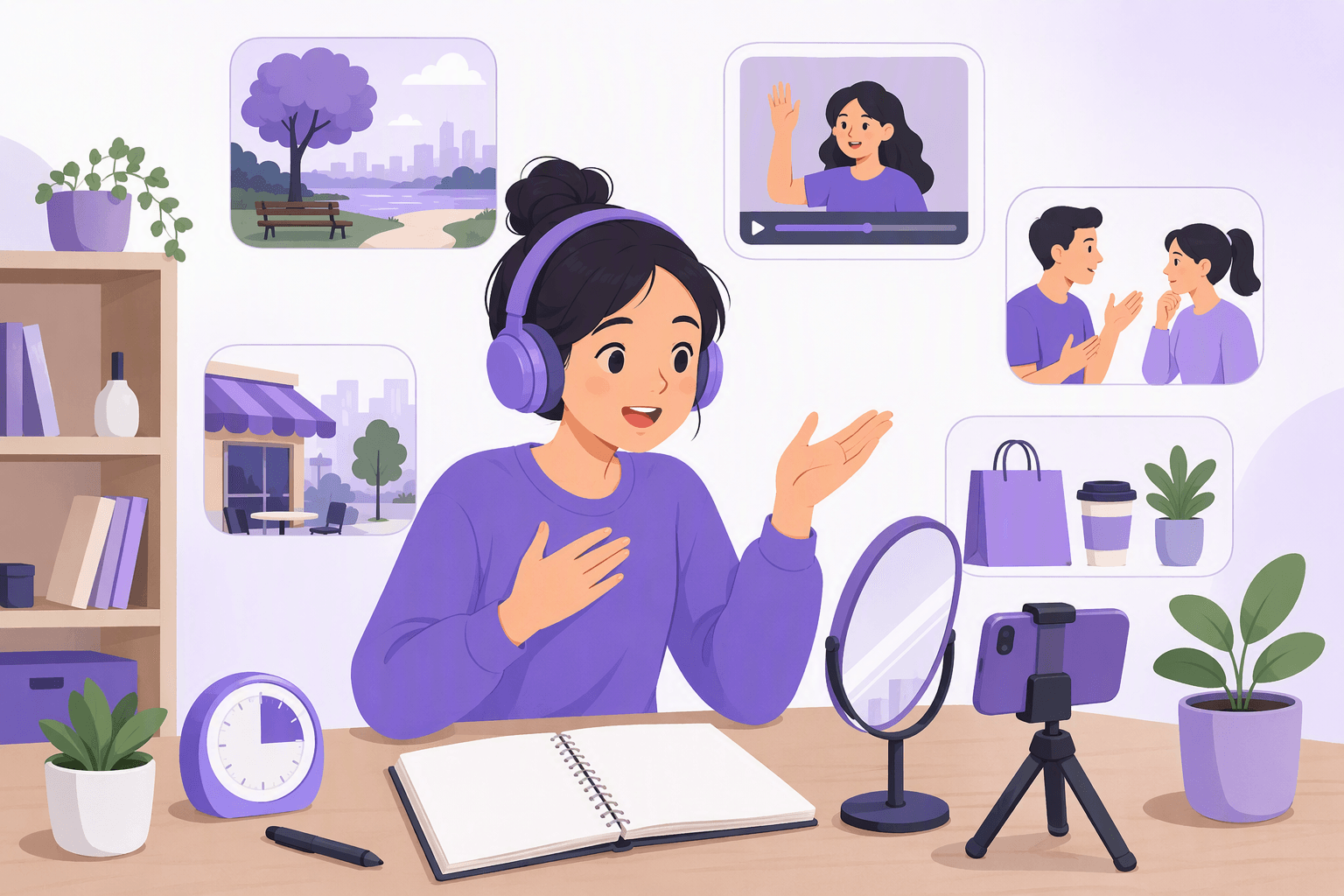
Why speaking alone works
Speaking alone is not a replacement for conversation. You do not get spontaneous questions, interruptions, different accents, or feedback from another person. But it solves one major problem: many learners know more English than they can access quickly.
When you speak privately, you can train retrieval. Instead of recognizing appointment in a text, you practice saying: “I need to make an appointment for next Tuesday” /aɪ niːd tə meɪk ən əˈpɔɪntmənt fər nekst ˈtuːzdeɪ/.
Merrill Swain's Output Hypothesis argues that producing language can make learners notice gaps in what they can say. You may understand a video about travel perfectly, then discover you cannot explain a delayed flight without stopping. That discovery is useful because it tells you exactly what to practice.
The CEFR also treats spoken production and spoken interaction as related but distinct skills. A learner can give a prepared description alone before they can comfortably manage an unpredictable conversation. Solo practice develops the first skill and makes the second less intimidating.
The rule that makes solo speaking useful
Do not wait until you can speak perfectly before speaking out loud. Start with language you can already control, then make it slightly more detailed.
A productive practice cycle has four steps:
- Choose one small topic.
- Speak for a fixed amount of time.
- Notice one recurring problem.
- Repeat the task with one improvement.
For example, speak about your morning for one minute. You may notice that you keep using then. On your second attempt, add after that, later, meanwhile, and finally. This is more effective than trying to correct every grammar mistake at once.
💡 Use a timer, not inspiration
Set a timer for one, two, or five minutes. A timer gives your speaking practice a clear finish line and prevents the common habit of stopping after one sentence.
12 ways to practice speaking English alone
1. Narrate your daily actions
Describe what you are doing while you do it. This is one of the easiest ways to turn ordinary life into speaking practice.
Say sentences such as: “I am making coffee” /aɪ æm ˈmeɪkɪŋ ˈkɔfi/, “I need to wash the dishes” /aɪ niːd tə wɑʃ ðə ˈdɪʃɪz/, or “I am looking for my keys” /aɪ æm ˈlʊkɪŋ fər maɪ kiːz/.
Use the present continuous for actions happening now. Start with simple sentences, then add reasons, opinions, and predictions: “I am making coffee because I did not sleep well. I think I will need another cup later.”
2. Give a one-minute daily recap
At the end of the day, summarize what happened. This gives you repeated practice with past tense verbs and time expressions.
Use a simple structure:
- What did I do today?
- Who did I talk to?
- What was easy or difficult?
- What will I do tomorrow?
If you cannot remember a word, explain it another way instead of switching languages. This is a vital conversation skill. For example, if you forget umbrella, say: “the thing you use when it rains.”
3. Answer real conversation questions
Choose one question and answer it for 60 seconds. Do not write a script first. Your goal is to think and speak at the same time.
Good prompts include:
- What is a movie you watched recently?
- What would you change about your city?
- What food do you want to learn to cook?
- What is something you are looking forward to?
- Should people work from home more often?
Afterward, answer the same question again. The second version will usually be smoother because your brain has already organized the main ideas.
4. Use the 3-2-1 fluency exercise
Choose a familiar topic, such as your favorite restaurant or a recent weekend. Speak about it for three minutes, then explain the same topic in two minutes, then in one minute.
This activity forces you to prioritize. You learn which details matter, which phrases you need, and how to speak more directly. It also reduces long pauses because repeated content becomes easier to retrieve.
5. Shadow short movie or TV clips
Shadowing means listening to a short line and repeating it immediately, copying its rhythm, stress, and connected speech. It is especially useful because English pronunciation depends heavily on sentence stress and reductions, not only individual sounds.
Pick a clip that is five to 15 seconds long. Listen once for meaning, then replay it line by line. Speak with the actor, then speak alone after the audio ends.
Choose clips with everyday language rather than dramatic monologues. A natural exchange such as “Do you want to grab lunch later?” /du ju wɑnt tə ɡræb lʌntʃ ˈleɪtər/ teaches useful rhythm, contractions, and turn-taking.
Our dual subtitles guide explains how to use subtitles without becoming dependent on them.
6. Retell a scene in your own words
After watching a short scene, close the subtitles and explain what happened. Do not try to repeat every line. Focus on the main events, emotions, and outcome.
You might say: “A woman arrives late to the meeting. Her boss is upset, but she explains that her train stopped. In the end, they decide to start without the missing client.”
Retelling trains past tenses, linking words, and paraphrasing. It also bridges passive viewing and active speaking, which is why it is stronger than watching a show repeatedly without producing language.
7. Role-play practical situations
Pretend you are in a situation where English matters. Speak both sides of the conversation if needed.
Try these scenarios:
- Checking into a hotel
- Returning an item to a store
- Calling a doctor's office
- Introducing yourself at a work event
- Ordering food and asking about ingredients
- Explaining a problem with your phone
Make the situation slightly difficult. A waiter does not understand your order. A hotel room has a problem. You need to politely ask someone to repeat themselves. Practicing these moments alone makes them far less stressful in real life.
8. Record, listen, and re-record
Recording yourself is one of the fastest ways to notice habits that remain invisible while you speak. You may hear rushed endings, repeated fillers, unclear word stress, or a sentence pattern you rely on too often.
Keep the process narrow. Record a 60-second answer, listen once, and select one target. Then make a second recording with that target in mind.
Do not judge your voice by whether it sounds like a native speaker. Aim for clarity, steady pacing, and understandable pronunciation. Your recording is evidence of progress, not an audition.
🌍 Your recorded voice will sound unfamiliar
Most people dislike hearing recordings of themselves because recorded sound reaches the ear differently from the voice heard inside the body. The discomfort is normal and fades with repetition. Treat the recording as language data, not as a verdict on your voice.
9. Practice repair phrases
Fluent speakers do not avoid every mistake. They know how to continue after a mistake, buy time, or correct themselves calmly.
Practice useful repair phrases aloud:
- “Let me think for a second” /lɛt mi θɪŋk fər ə ˈsɛkənd/.
- “What I mean is...” /wʌt aɪ miːn ɪz/.
- “I am not sure how to say it, but...” /aɪ æm nɑt ʃʊr haʊ tə seɪ ɪt bʌt/.
- “Sorry, let me say that again” /ˈsɑri lɛt mi seɪ ðæt əˈɡɛn/.
These phrases are not signs of weak English. They are tools that keep a conversation moving. Learning them can make you sound more confident immediately.
10. Talk from pictures, objects, and maps
Choose a photo from your phone, an object on your desk, or a map of a place you know. Describe it in detail.
With a photo, explain who is there, where they are, what happened before the picture, and what may happen next. With an object, explain what it is for, how often you use it, and why you like or dislike it.
This method works because the visual prompt removes the pressure of inventing a topic. It also builds descriptive vocabulary naturally.
11. Read aloud, then speak freely
Reading aloud can help you practice pronunciation and rhythm, but it is not the same as spontaneous speaking. Use it as a warm-up, then close the text and explain the main idea in your own words.
Read a short news paragraph, a movie review, or a page from a graded reader. Then answer: What was the point? Do I agree? What would I tell a friend about it?
This transition matters. Reading trains your mouth to produce English, while free speaking trains your mind to create it.
12. Build a personal phrase bank
Keep a small list of phrases you genuinely need. Do not collect rare expressions that you will never use.
Your list may include phrases for work, school, travel, hobbies, or online conversations. If you enjoy informal English, compare everyday expressions with the language in our English slang guide, but use new slang carefully until you understand its tone and audience.
Review five phrases, then make a short spoken story using all five. Reusing phrases in your own context helps them become available when you need them.
A realistic 15-minute daily routine
You do not need an hour of private speaking practice. Consistency matters more than duration, especially at the beginning.
| Time | Activity | Goal |
|---|---|---|
| 2 minutes | Warm up by narrating your surroundings | Start speaking without pressure |
| 4 minutes | Answer one question or describe a photo | Build spontaneous speech |
| 4 minutes | Shadow a short clip | Improve rhythm and pronunciation |
| 3 minutes | Record a recap or role-play | Notice one issue |
| 2 minutes | Repeat one difficult section | Turn feedback into improvement |
Follow this plan five days per week for a month. At the end of each week, listen to your first and newest recordings. You will likely notice fewer pauses, more detailed sentences, and faster access to familiar vocabulary.
Zoltán Dörnyei's work on language learner psychology emphasizes the role of specific, manageable goals. “Speak English more” is vague. “Record a one-minute restaurant role-play every Tuesday” is a behavior you can complete and measure.
What to do when you get stuck
Getting stuck is not proof that you are failing. It usually means one of three things: the topic is too difficult, you are trying to speak too fast, or you need a phrase rather than a single word.
Make the task easier first. Speak for 30 seconds instead of three minutes. Describe a familiar object instead of debating a complex issue. Use notes with three keywords rather than a full script.
Then learn the missing language in chunks. If you repeatedly cannot explain numbers, dates, or prices, practice that specific area with our English numbers guide. Targeted practice is much more useful than randomly memorizing vocabulary lists.
⚠️ Do not memorize full speeches
A fully memorized speech can sound smooth, but it does not train quick responses. Use a few keywords or a simple outline instead. Leave room to choose your words in the moment, make small mistakes, and recover naturally.
How to move from solo practice to real conversations
Solo practice prepares your speaking system, but real communication adds another layer: responding to another person. Once you can speak alone for two minutes on familiar topics, add low-pressure interaction.
Send a voice message to a language partner. Join an online conversation group. Ask a tutor for a five-minute discussion rather than a full formal lesson. Start a short chat before or after a class.
Use the same topics you practiced alone. If you have already retold a movie scene, described your weekend, and rehearsed a restaurant role-play, you have material ready for a real person.
The best transition is not waiting until you feel completely confident. It is using solo practice to make the first conversations easier, then using conversations to discover what to practice alone next.
Final takeaway
To practice speaking alone, create short daily moments where you must produce English out loud. Narrate your day, answer timed questions, shadow real clips, role-play useful situations, and record yourself without trying to fix everything at once.
Speak for a few minutes today, choose one detail to improve tomorrow, and repeat. That steady cycle turns English from something you recognize into something you can use.
Frequently Asked Questions
Can I really improve my English speaking by practicing alone?
How long should I practice speaking English alone each day?
What should I talk about when I practice English alone?
Is talking to myself in English strange or ineffective?
Should I record myself speaking English?
Sources & References
- Ethnologue, English, 27th edition, 2024
- Council of Europe, Common European Framework of Reference for Languages: Companion Volume
- Merrill Swain, The Output Hypothesis: Theory and Research
- Willem J. M. Levelt, Speaking: From Intention to Articulation
- Zoltán Dörnyei, The Psychology of the Language Learner, Routledge
Start learning with Wordy
Watch real movie clips and build your vocabulary as you go. Free to download.


