Quick Answer
To learn pronunciation online, combine focused sound practice, regular listening, recording yourself, and feedback from real speech. Start with the sounds that affect understanding most, then train word stress, sentence rhythm, and connected speech through short daily sessions.
You can learn pronunciation online effectively by practicing short pieces of real speech every day: listen, notice one feature, copy it aloud, record yourself, and compare. Prioritize sounds and rhythm that affect understanding, not the unrealistic goal of removing every trace of your first-language accent. For English learners, 20 focused minutes a day can produce more useful progress than occasional hours of passive listening.
English is used by about 1.5 billion people worldwide when first- and second-language speakers are counted, according to Ethnologue. That scale means there is no single perfect English accent. Clear communication across accents matters more than sounding exactly like a particular actor, presenter, or influencer.
Online learning gives you access to dictionaries with audio, video clips, speech recording tools, language exchanges, and English spoken in many settings. The challenge is choosing a routine that turns all that material into deliberate practice. If you are building your foundation, pair this guide with an English pronunciation guide for a clearer map of sounds, stress, and rhythm.
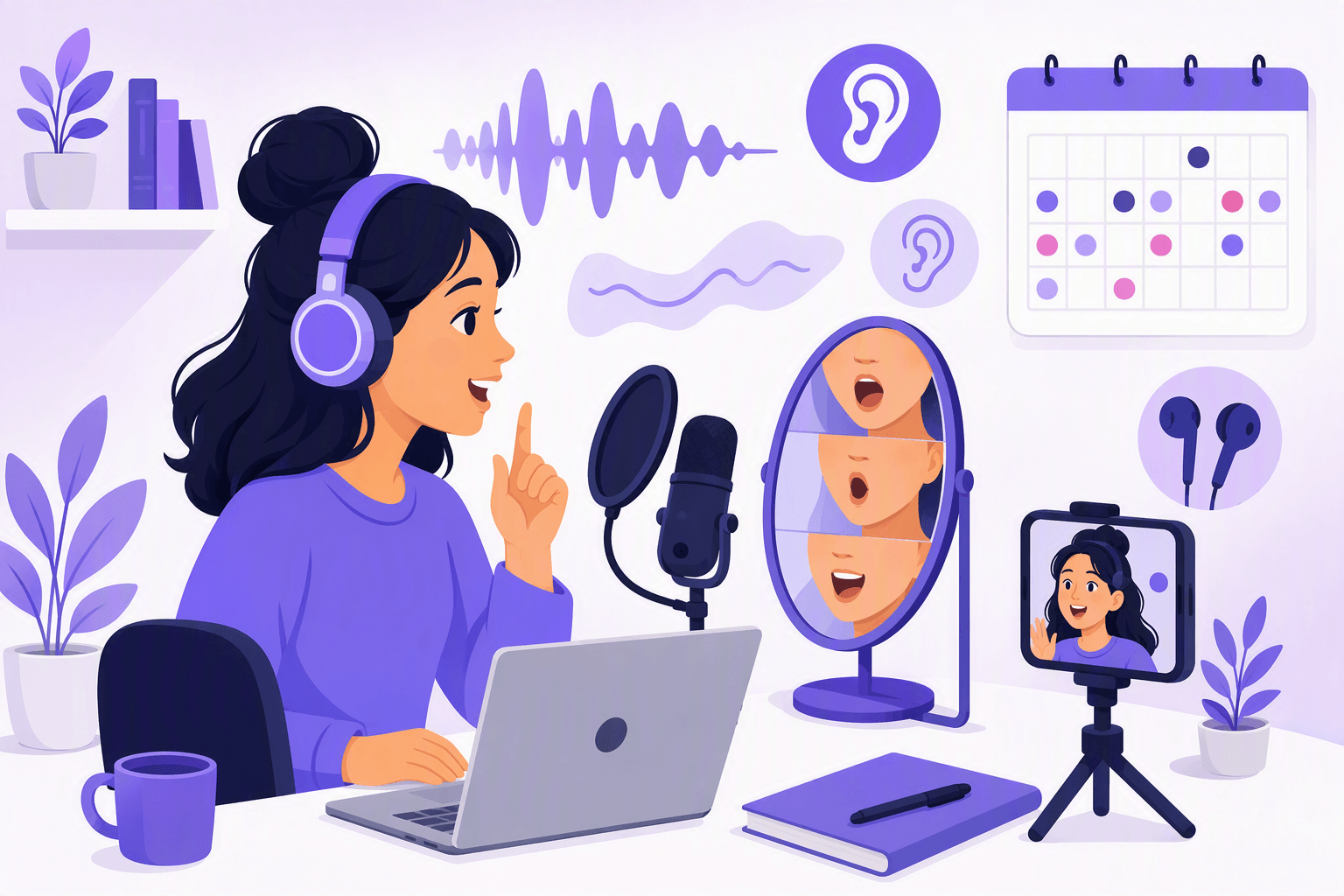
Set the right pronunciation goal
Your goal is intelligibility: being understood easily by listeners without making them work hard to decode your words. Accent and intelligibility overlap, but they are not the same thing.
A person may have a noticeable Brazilian, Korean, Arabic, Polish, or Spanish accent and still be completely clear. Conversely, a learner with relatively accurate individual vowels may be hard to follow if they stress the wrong syllables, omit word endings, or speak in an even, word-by-word rhythm.
Researchers Tracey Derwing and Murray Munro distinguish between accentedness, comprehensibility, and intelligibility in their work on second-language pronunciation. That distinction is useful online: do not judge every recording by whether you sound native. Judge it by whether the message is clear, comfortable to follow, and appropriate for the situation.
Choose a reference variety
Choose a main model, usually General American or a standard British variety, based on the English you expect to use. This helps you make consistent choices for common words such as water, can't, schedule, and tomato.
Do not treat other varieties as mistakes. English is official or widely used across dozens of countries, and international conversations regularly include mixed accents. Listening broadly is a practical skill, not a distraction.
💡 A useful target
Aim to speak clearly enough that a listener understands you on the first attempt. Keep your own voice and identity while improving the features that carry meaning.
Build your online pronunciation toolkit
You do not need expensive software to begin. You need trustworthy audio, a way to record yourself, and material short enough to repeat many times.
Use dictionaries for single words
Online learner dictionaries are ideal for checking a word before you practice it. Look for an IPA transcription, audio in more than one accent, syllable stress, and example sentences.
For example, the word record changes stress depending on its grammatical role:
- Noun: record /ˈɹɛk.ɚd/
- Verb: record /ɹɪˈkɔɹd/
If you only memorize spelling, you may miss the stress shift. The International Phonetic Alphabet gives you a consistent way to see sounds beyond English spelling, which often behaves unpredictably.
English spelling has roughly 26 letters but far more distinct speech sounds, depending on the accent. That is why words such as though /ðoʊ/, through /θɹuː/, thought /θɔt/, and tough /tʌf/ cannot be pronounced reliably from spelling alone.
Use video for real rhythm
Video teaches features that a dictionary cannot: speed, facial movement, emotion, turn-taking, reductions, and pauses. Choose clips of five to fifteen seconds, not full episodes at first.
A useful source has clear audio, captions you can verify, and a context you understand. Films and television are especially good for observing how speakers soften function words and emphasize key information. Start with the recommendations in best movies to learn English, then extract one short line instead of trying to imitate an entire scene.
Use recording as your feedback loop
Your phone's voice recorder is one of the strongest free pronunciation tools. Record your voice before and after practice, then listen with headphones.
Do not rely only on how speech feels in your mouth. Learners often believe they made a clear contrast when the recording shows that both words still sound alike. Listening back makes vague impressions specific.
Use speech recognition carefully
Speech-to-text can help test whether a device recognizes your sentence, but it is not a pronunciation teacher. A tool may understand an unclear recording because it predicts likely words from context, and it may fail with a clear regional accent.
Treat recognition as one clue. Compare your recording to a human model and, when possible, ask a conversation partner whether your meaning was immediately clear.
Start with the sounds that change meaning
Many learners spend months trying to perfect every sound equally. A faster approach is to identify a small number of contrasts that cause misunderstanding for you.
A contrast is two sounds that can make different words. If a listener hears the wrong sound, they may hear a different word.
Consonant contrasts
English has sound pairs that many languages do not distinguish. Common examples include:
| Contrast | Example words | What to notice |
|---|---|---|
| /ɪ/ and /iː/ | ship /ʃɪp/, sheep /ʃiːp/ | The second vowel is longer and tenser. |
| /ɛ/ and /æ/ | bed /bɛd/, bad /bæd/ | Open the jaw more for /æ/. |
| /θ/ and /s/ | think /θɪŋk/, sink /sɪŋk/ | /θ/ places the tongue lightly between the teeth. |
| /ð/ and /d/ | they /ðeɪ/, day /deɪ/ | Voice continues during /ð/. |
| /ɹ/ and /l/ | right /ɹaɪt/, light /laɪt/ | Curl the tongue slightly back for /ɹ/ in American English. |
| final consonants | cap /kæp/, cab /kæb/ | Release or hold the final sound clearly. |
Do not practice these in a random list. First listen to the pair, then say each word slowly, then put both into a meaningful sentence: I saw a sheep on the ship. Record the sentence and listen for the contrast.
Final sounds deserve extra attention
In fast speech, many learners weaken or drop endings such as /t/, /d/, /s/, /z/, /k/, and /p/. This can erase grammar and change meaning.
Compare I work /aɪ wɝk/ with I worked /aɪ wɝkt/, or book /bʊk/ with books /bʊks/. You do not need an exaggerated release of every final consonant, but the listener needs enough acoustic information to hear the word boundary and grammatical ending.
⚠️ Do not practice sounds in isolation forever
Individual drills help you build a new movement, but conversation happens in phrases. Move from sounds to words, from words to sentences, and from sentences to spontaneous speech within the same practice session.
Learn word stress before chasing a perfect accent
English word stress is one of the highest-value skills for online learners. A stressed syllable is generally longer, louder, clearer, and often higher in pitch than surrounding syllables.
Consider these words:
- PHOtograph /ˈfoʊ.t̬ə.ɡɹæf/
- phoTOGraphy /fəˈtɑ.ɡɹə.fi/
- PREsent /ˈpɹɛz.ənt/
- preSENT /pɹɪˈzɛnt/
If stress moves, the word can sound unfamiliar even when every vowel and consonant is close. Mark the stressed syllable when you learn a new word, then say it in a short phrase.
This matters strongly with numbers, dates, and names, where a single unclear syllable can create real confusion. Practice practical items with English numbers, including dates, decimals, prices, and phone numbers.
The schwa makes English sound connected
The schwa /ə/ is the relaxed vowel in many unstressed syllables. It appears in words such as about /əˈbaʊt/, support /səˈpɔɹt/, and banana /bəˈnæ.nə/.
Learners often pronounce every written vowel with equal strength. That can make speech sound slow and overly segmented. Instead, reduce unstressed syllables while making the important word or syllable stand out.
Celce-Murcia, Brinton, Goodwin, and Griner emphasize the connection between pronunciation teaching and communicative use. In practical terms, train stress within messages: I said Tuesday, not Thursday. The main contrast receives the strongest emphasis.
Practice sentence rhythm and connected speech
English is often described as stress-timed, meaning important words tend to receive beats while grammar words compress between them. Real speech is not a metronome, but this pattern helps listeners locate the message.
In the sentence I need to send the report by Friday, the words need, send, report, and Friday carry most of the information. Words such as to, the, and by are usually shorter and less prominent.
Try this method:
- Read the sentence slowly and mark the important words.
- Listen to a natural model once without speaking.
- Tap the stressed beats while listening again.
- Shadow the speaker, copying timing rather than just individual sounds.
- Record yourself, then compare your stressed words and pauses.
Shadow short clips, not entire scenes
Shadowing means speaking along with or immediately after an audio model. It works best when the clip is short enough that you can repeat it five to ten times without losing attention.
Choose dialogue with a clear purpose: greeting someone, declining an invitation, reacting to a problem, or making a request. Casual films and shows also teach reduced speech, which textbooks often underrepresent.
For example, What are you doing? /wʌt ɑɹ ju ˈdu.ɪŋ/ may sound closer to /wʌɾɚ jə ˈdu.ɪŋ/ in fast General American speech. Learn to recognize this reduction, but do not force it immediately. First make the full sentence clear, then gradually copy the natural connection.
A guide to English slang can also help you recognize informal wording in clips. Slang changes quickly, so focus first on pronunciation patterns that remain useful across formal and casual settings.
Follow a 20-minute online routine
A short routine is easier to repeat than a huge weekly plan. Use the same structure for at least two weeks before changing it.
| Time | Task | Example |
|---|---|---|
| 3 minutes | Listen and notice | Hear a short clip twice without speaking. |
| 5 minutes | Sound or stress drill | Contrast ship /ʃɪp/ and sheep /ʃiːp/. |
| 5 minutes | Shadowing | Copy one sentence in short chunks. |
| 4 minutes | Record and compare | Record the line two or three times. |
| 3 minutes | Free speaking | Explain the clip's meaning in your own words. |
Keep one notebook or digital document for recurring errors. Write the word, its IPA, the difficult feature, and one sentence you can use in real life.
For example, if you often say comfortable with stress in the wrong place, note comfortable /ˈkʌm.fɚ.t̬ə.bəl/. Then practice: This chair is comfortable enough for work.
Get feedback without becoming dependent on it
Feedback is valuable, but it should be specific. Asking someone whether your pronunciation is good usually produces an unhelpful answer. Ask about one target instead.
Try questions such as:
- Did you hear fifteen /ˌfɪfˈtiːn/ or fifty /ˈfɪf.ti/?
- Is the final /s/ clear in works /wɝks/?
- Which word sounded stressed in my sentence?
- Did my question sound friendly, neutral, or impatient?
Language exchanges, online tutors, and speaking communities can all work when you bring a short recording and a narrow goal. One precise correction that you repeat over several days is more useful than ten unrelated corrections.
🌍 Clarity is also social
Pronunciation includes how your tone is received. In English, a falling tone often signals completion or certainty, while a rising tone can signal a check, surprise, or invitation to respond. Copying the emotional intention of a film or interview clip helps you avoid speech that is technically accurate but socially flat.
Measure progress in a realistic way
Do not judge improvement only by listening to yourself day to day. Your voice will always sound familiar, and progress is often gradual.
Make a baseline recording today: introduce yourself, describe your day, and read a short paragraph. Repeat the same task after four weeks. Listen for clearer final sounds, stronger stress, smoother pacing, and fewer long pauses.
You can also test intelligibility with a listener who has not seen your script. If they can accurately write down what you said or summarize your message, your practice is working.
English pronunciation is not limited to polished textbook phrases. You will hear strong emotions, joking, and taboo language in real media too. Recognizing it is useful, but use it carefully. Our guide to English swear words explains why tone, relationship, and setting matter as much as literal meaning.
A practical next step
Choose one sound contrast and one ten-second clip today. Listen five times, mark the stressed words, shadow it five times, and make two recordings. Then say the same idea in your own words.
That cycle builds the listening accuracy, muscle memory, and confidence that online pronunciation practice needs. Repeat it consistently, and your speech will become clearer long before it feels perfect.
Frequently Asked Questions
Can I improve English pronunciation online without a teacher?
How long does it take to improve English pronunciation?
Should I learn British or American English pronunciation?
What is the best online method for difficult English sounds?
Why do I know English words but still sound hard to understand?
Sources & References
- International Phonetic Association, Handbook of the International Phonetic Association, Cambridge University Press
- Ethnologue, English language profile, 27th edition, 2024
- British Council, TeachingEnglish: Pronunciation resources, accessed 2026
- Celce-Murcia, Brinton, Goodwin and Griner, Teaching Pronunciation, Cambridge University Press
- Derwing and Munro, Pronunciation Fundamentals: Evidence-based Perspectives for L2 Teaching and Research, John Benjamins
Start learning with Wordy
Watch real movie clips and build your vocabulary as you go. Free to download.