Quick Answer
There are roughly 7,000 living languages in the world, but no single number is final. Counts change because linguists disagree on where a language ends and a dialect begins, because communities shift identities, and because documentation improves. This guide explains the best estimates, how they are calculated, and what the numbers miss.
There are about 7,000 living languages in the world, with Ethnologue’s widely cited 2024 count at 7,164, but the number is not fixed because language boundaries, documentation, and community identities keep changing.
| English | English | Pronunciation | Formality |
|---|---|---|---|
| Best single-number estimate | About 7,000 living languages | uh-BOWT SEV-en THOW-zund | formal |
| Ethnologue (2024) count | 7,164 living languages | SEV-en THOW-zund wun HUN-dred sik-stee-FOR | formal |
| Key reason it changes | Language vs dialect is not purely technical | LANG-gwij vs DIE-uh-lekt | formal |
| Most languages have few speakers | Half have under 10,000 speakers | HAF hav UN-der ten THOW-zund | formal |
| What counts as a 'language' | A mix of intelligibility and identity | in-tel-ih-juh-BIL-ih-tee and eye-DEN-tih-tee | formal |
The best current answer: "about 7,000"
If you need a single number for a report, classroom, or trivia night, use "about 7,000 living languages." It is accurate enough for most contexts, and it matches the range used by major linguistic databases.
If you need a citable figure, Ethnologue’s 27th edition (2024) lists 7,164 living languages worldwide. Glottolog, another major reference, tracks languages and dialects with a different classification philosophy, so its totals differ, but it supports the same big picture: thousands of distinct speech communities exist today.
Why the number is not fixed
Counting languages is not like counting countries. Languages do not have official borders in nature, and many speech varieties sit on a continuum where neighbors understand each other but distant villages do not.
The language vs dialect problem
A classic rule of thumb is mutual intelligibility: if two groups understand each other without study, they are dialects; if they cannot, they are different languages. In reality, intelligibility is gradual, and social factors matter.
For example, Scandinavian varieties can be partially mutually intelligible, yet they are treated as separate national languages in education and media. On the other hand, varieties grouped under labels like "Arabic" can be hard to understand across regions, yet share a standard written form that unifies them in public life.
Politics and identity change the count
Communities sometimes push for recognition of their variety as a separate language, often tied to schooling, broadcasting, or legal rights. The reverse also happens: governments or institutions may promote a single standard language label for unity.
This is why language counts can shift even without any change in how people speak. The classification changes because the social reality changes.
Better documentation adds languages, and sometimes merges them
In under-documented regions, especially parts of New Guinea, the Amazon, and Central Africa, fieldwork can reveal varieties that were previously unknown to global databases. At the same time, new evidence can show that two previously listed "languages" are actually the same variety under different names, leading to a merge.
So the total can go up or down between editions, even if the global trend of language endangerment continues.
How linguists and databases decide what "a language" is
Ethnologue and Glottolog are both authoritative, but they have different goals. Ethnologue is widely used for speaker estimates and country-by-country listings, while Glottolog focuses on bibliographic coverage and fine-grained classification.
Both rely on:
- Descriptions of sound systems (phonology)
- Grammar patterns (morphology and syntax)
- Core vocabulary comparisons
- Historical relationships (language families)
- Sociolinguistic realities (identity, education, standardization)
A useful mental model is that "language" is a category with fuzzy edges. It is still a meaningful category, but it is not always cleanly measurable.
"A language is a dialect with an army and navy."
Max Weinreich, linguist (widely cited in sociolinguistics)
The point is not that linguistics is arbitrary. The point is that social power can turn one variety into "the language" and another into "just a dialect," even when the linguistic distance is similar.
Key statistics that explain the world’s languages
The headline number is interesting, but the distribution is the real story.
Most languages have small speaker populations
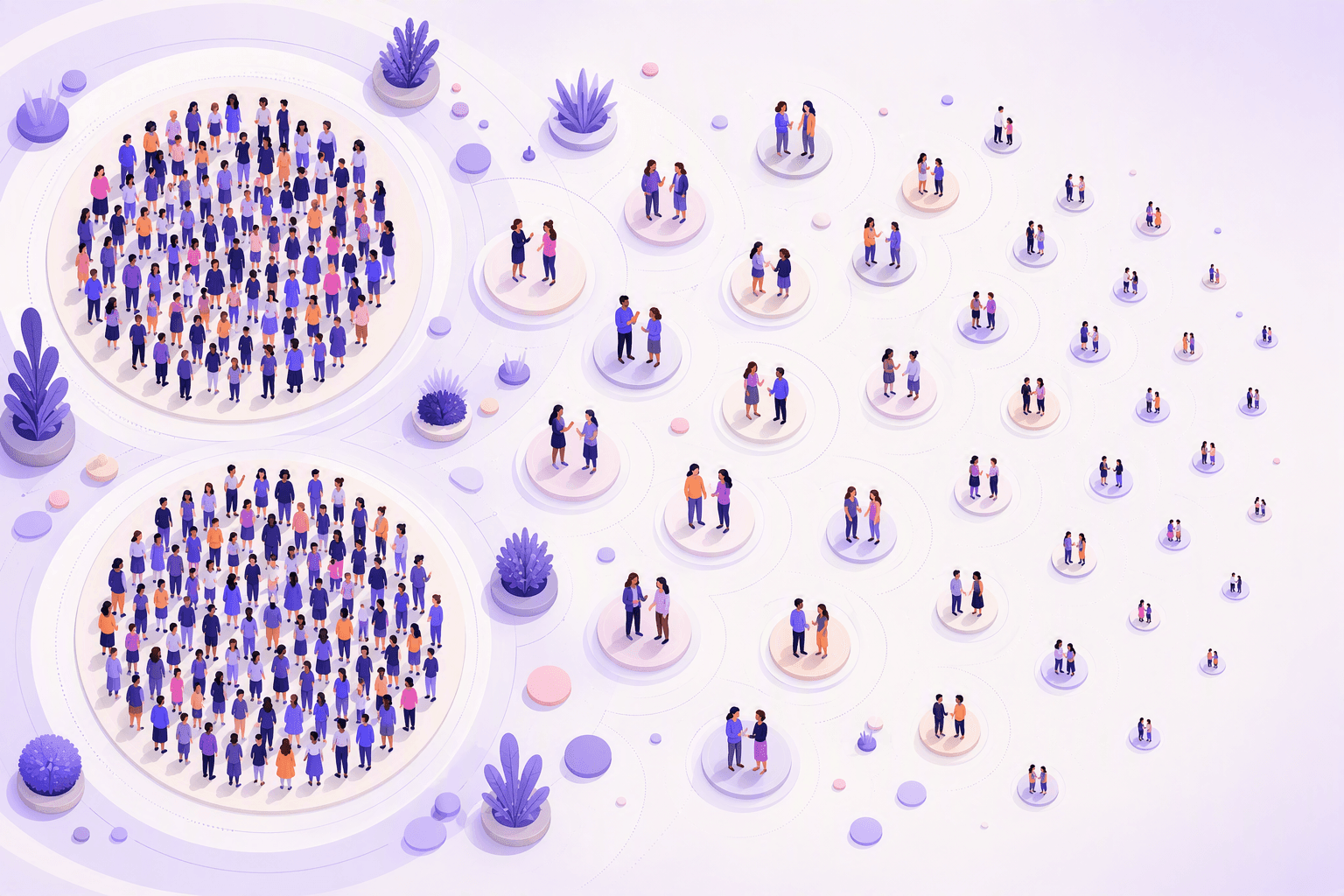
Ethnologue reports that half of the world’s living languages have fewer than 10,000 speakers. That means global linguistic diversity is carried by many small communities, not by the handful of global languages you see on airline signage.
This also explains why language shift can happen quickly. If a community has only a few thousand speakers and children stop learning the language at home, the change can be visible within one or two generations.
A small number of languages dominate global communication
Ethnologue estimates English has about 1.5 billion total speakers (native plus second-language). Mandarin Chinese is around 1.1 billion, and Hindi around 600 million (totals vary by methodology and census cycles).
This concentration shapes the internet, entertainment, and education markets. It also shapes what learners choose to study, which can reinforce the dominance of already-dominant languages.
If you are curious how global English works as a system (not just a school subject), see our English language overview.
Language diversity is not evenly spread across countries
A few countries contain an outsized share of the world’s languages. Papua New Guinea is the most famous example, with hundreds of languages in a relatively small population, reflecting long-term settlement patterns and rugged geography.
This matters culturally: multilingualism is not an exception in many places, it is the default. In such settings, "How many languages do you speak?" is not a flex, it is normal life.
Living languages vs extinct languages
Most counts you see online focus on living languages. That is because living languages have communities, intergenerational transmission patterns, and current speaker estimates.
Extinct languages are harder to count because:
- Some are known only from a few inscriptions
- Some were never documented
- Some are partially reconstructed from descendants
So when you hear "about 7,000," understand it as "about 7,000 living languages with enough evidence to classify."
What counts as a separate language in real life
Even if you accept mutual intelligibility as a guideline, daily life introduces complications.
Dialect continua: where the boundary is a choice
In a dialect continuum, each neighboring community understands the next, but distant ends may not understand each other. Many European examples are well-known, but similar continua exist worldwide.
In these cases, drawing a line is partly a practical decision. Education systems, media markets, and writing standards often force the issue.
Standard languages vs home varieties
Many people speak one variety at home and use a standardized variety in school or formal writing. This is common in Arabic-speaking contexts (local varieties plus Modern Standard Arabic), but it also happens in languages with strong standardization traditions.
This is one reason language learning can feel different from "learning to talk." You are often learning the standardized register first, then learning how people actually speak in daily life.
Wordy’s approach, learning through real clips, is designed for that gap. If you are working on everyday comprehension, browse the Wordy blog and compare it with drill-heavy approaches in our best language learning apps list.
Are new languages being created today?
Yes, but not usually in the way people imagine.
Creoles and new mixed varieties
New languages can emerge when communities with different languages need a stable shared system over generations. Creole formation is one pathway, where a contact language becomes a native language for children and expands in structure and vocabulary.
Sign languages
Sign languages are full human languages with their own grammars, not "signed versions" of spoken languages. New sign languages can emerge when deaf communities form schools and social networks, and when children acquire and regularize a shared system.
This is an important reminder: "language" is not the same as "writing," and it is not limited to speech.
Are languages disappearing?
Yes, and the evidence is strong across independent sources. UNESCO’s Atlas documents many languages as vulnerable, definitely endangered, severely endangered, or critically endangered, depending on intergenerational transmission and community vitality.
Ethnologue also tracks endangerment status and reports a large threatened share of living languages. The exact percentage depends on classification, but the direction is not debated: language shift is widespread.
🌍 A cultural insight that surprises many learners
In many multilingual societies, people do not label what they speak as "a language" the way outsiders do. They may name it as "our way of speaking," tied to clan, valley, or island, and switch codes fluidly. Counting languages can feel like counting identities, not just counting grammars.
Why this matters for English learners (and for everyone)
If your goal is to learn English, you might wonder why global language counts matter. They matter because they explain why English looks the way it does in the real world.
English is one language with many global norms
English is used as an official language in dozens of countries and as a working language in international business, science, and aviation. That scale produces variation: pronunciation, vocabulary, and politeness norms shift by region and community.
That is why learners often feel confused by slang, taboo words, and informal speech. It is not "bad English," it is English doing what global languages do.
If you want a practical map of informal usage, start with our English slang guide. If you also want to understand taboo vocabulary responsibly, see English swear words.
Numbers and months are a hidden cultural layer
Even basic vocabulary can carry cultural assumptions. Date formats, for example, differ across English-speaking regions, and that can cause real misunderstandings in travel, contracts, and scheduling.
If you want to tighten up these everyday essentials, review English numbers and English months, then pay attention to how they appear in real dialogue.
A practical way to think about language counts
Instead of treating "how many languages are there" as a trivia question, treat it as three different questions.
1) How many languages are documented as living?
Use Ethnologue’s living language count as your default reference point. It is widely used, regularly updated, and designed for cross-country comparison.
2) How many distinct varieties exist in human speech?
This number is higher than any database count, because variation is continuous and not all varieties are documented. Databases are maps, not the territory.
3) How many languages are socially recognized?
This number depends on education systems, media, and law. It can change quickly with policy shifts, even if speech patterns change slowly.
💡 How to cite the number correctly
If you are writing an essay, avoid claiming a single permanent total. Write: "Ethnologue (2024) lists 7,164 living languages, though counts vary by classification criteria." That phrasing is accurate and defensible.
What you can do with this knowledge as a learner
Language learning is easier when you stop expecting a single "correct" version of a language.
Train your ear on real variation
Movies and TV are useful because they include accents, registers, and social context. Research on authentic input consistently finds benefits for listening comprehension and vocabulary growth, especially when learners get repeated exposure with support.
If you are building listening skills, choose clips where you can replay one line many times, not just binge passively. That is the difference between entertainment and training.
Learn the social meaning, not just the dictionary meaning
A phrase can be grammatically correct and still socially wrong for the situation. This is especially true for greetings, requests, and humor.
Linguistic diversity is not only about different languages. It is also about different ways of being polite, direct, funny, or respectful inside the same language.
Conclusion: the number is real, but the edges are fuzzy
There are about 7,000 living languages, with Ethnologue’s 2024 count at 7,164, but the total changes because "language" is not a purely technical label. It is a mix of intelligibility, history, standardization, and identity.
Once you understand that, the question becomes more interesting: not just how many languages exist, but how humans keep creating, maintaining, and sometimes losing them. For more language-learning context and practical study methods, explore the Wordy blog and our best language learning apps comparison.
Frequently Asked Questions
How many languages are there in the world right now?
Why do different sources give different language counts?
What is the difference between a language and a dialect?
How many people speak the most spoken languages?
Are languages really disappearing, and how fast?
Sources & References
- Eberhard, D.M., Simons, G.F., & Fennig, C.D. (eds.). Ethnologue: Languages of the World, 27th ed., 2024
- UNESCO. Atlas of the World's Languages in Danger, ongoing database (accessed 2026)
- Hammarström, H., Forkel, R., & Haspelmath, M. (eds.). Glottolog, ongoing database (accessed 2026)
- Crystal, D. The Cambridge Encyclopedia of Language (3rd ed.), Cambridge University Press, 2010
Start learning with Wordy
Watch real movie clips and build your vocabulary as you go. Free to download.


