Quick Answer
Most learners reach practical conversational fluency in 6 to 18 months if they study 1 to 2 hours per day and get regular listening and speaking practice. True professional fluency usually takes 2 to 5+ years because vocabulary size, speed, and cultural pragmatics take longer than basic grammar. Your timeline depends mainly on total hours, language distance, and how much real input you get.
Fluency usually takes 6 to 18 months for everyday conversation if you study 1 to 2 hours per day and get real listening and speaking practice, but reaching high, work-ready fluency commonly takes 2 to 5+ years because speed, vocabulary depth, and cultural usage take longer than grammar. The most reliable predictor is total focused hours, then language distance, then the quality of input and feedback.
A useful way to think about fluency is: you are not chasing a finish line, you are building automaticity. That is why two learners can both “know” the same grammar but sound completely different in real conversation.
If you are learning English specifically, pair this guide with Best Movies to Learn English to make your listening hours count, and use English slang carefully so you do not learn the wrong register too early.
What “fluency” really means (and why it changes the timeline)
People use “fluent” to mean at least three different things. If you do not define it, your timeline will feel random.
Practical fluency (everyday life)
This is the “I can live my life” level. You can handle errands, small talk, and most predictable situations without translating in your head every sentence.
For many learners, this aligns with CEFR B1 to B2. The CEFR is widely used in Europe and beyond as a proficiency framework (Council of Europe, CEFR).
Professional fluency (work and study)
This is the “I can do my job” level. You can participate in meetings, write clear emails, and follow fast discussions, even when you miss details.
For many fields, this is B2 to C1, depending on how language-heavy the work is. A nurse, a software engineer, and a trial lawyer do not need the same vocabulary depth.
Native-like fluency (near-native speed and nuance)
This is where learners often get stuck emotionally. You can communicate well, but you still do not feel “native” because humor, cultural references, and accent reduction are long projects.
Linguist Diane Larsen-Freeman’s work on language as a dynamic system is helpful here: proficiency is not a single ladder, it develops unevenly across skills. You can be C1 in reading and B1 in speaking for a long time, and that is normal.
The three biggest drivers of how long fluency takes
If you only remember one section, make it this one. These variables explain most timelines.
Total hours, not months
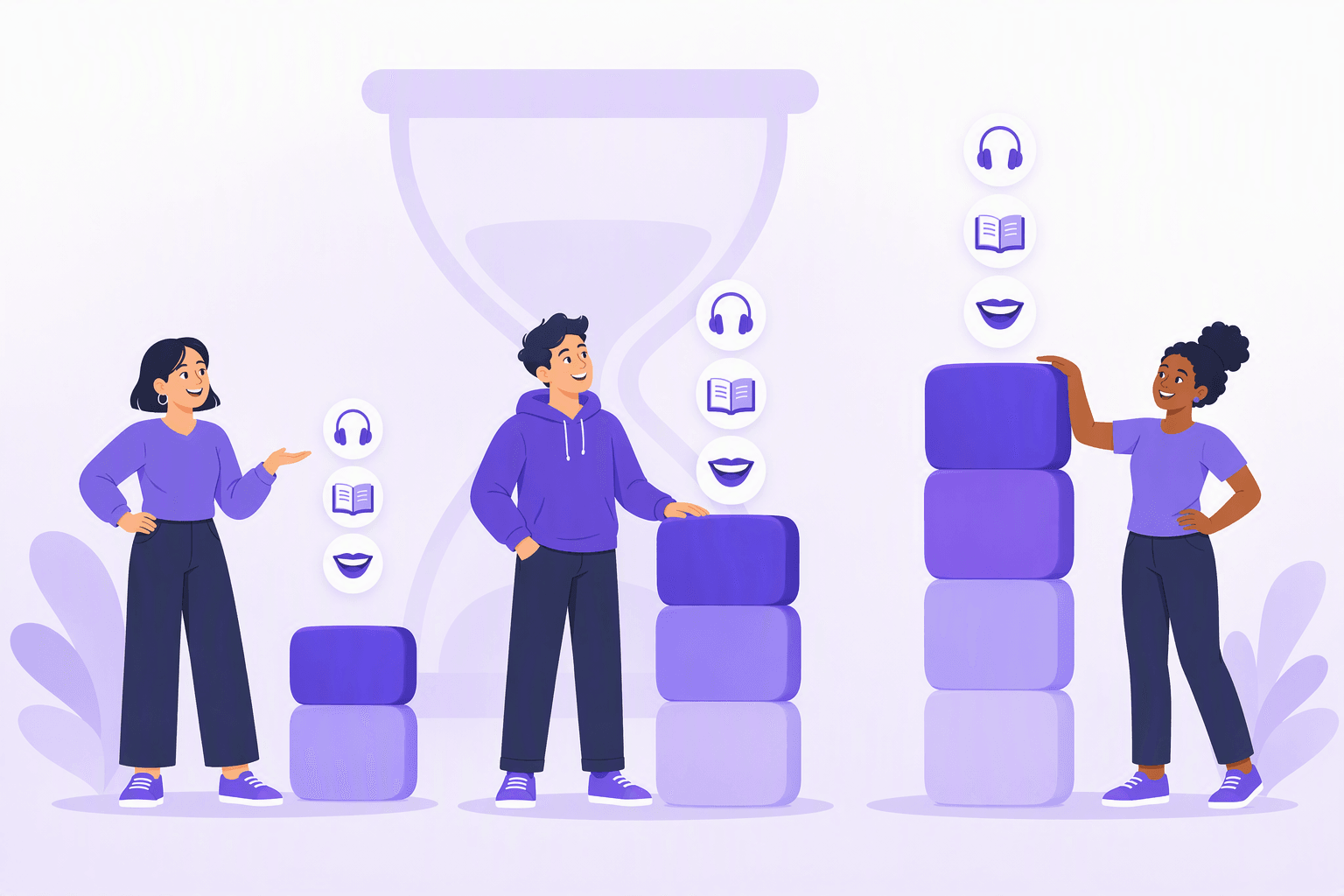
Time on the calendar matters less than hours of focused exposure and practice. One learner doing 30 minutes a day and another doing 3 hours a day are not on the same timeline, even if both say “I’ve been studying for a year.”
A simple conversion helps:
- 30 minutes/day is about 180 hours/year
- 60 minutes/day is about 365 hours/year
- 2 hours/day is about 730 hours/year
If you want a reality check, track hours for two weeks. Most people overestimate.
Language distance (how far the language is from what you know)
The Foreign Service Institute (FSI) groups languages by how long English-speaking diplomats typically need to reach professional working proficiency. It is not perfect, but it is a useful baseline (Foreign Service Institute, accessed 2026).
If your native language is not English, the “distance” changes. For example, Spanish speakers often find Italian faster than Japanese, while Korean speakers may find Japanese grammar patterns more familiar than English word order.
Input quality (real listening beats “clean” textbook audio)
Textbook audio is slow, scripted, and forgiving. Real speech is messy: reductions, interruptions, background noise, and cultural shortcuts.
Claire Kramsch’s work on language and culture is relevant: learners do not just acquire grammar, they acquire ways of meaning in context. That context mostly arrives through authentic input, not isolated sentences.
A realistic timeline by CEFR level (with hour ranges)
CEFR levels are not a stopwatch, but they give you a shared map. The ranges below assume consistent study with a mix of listening, reading, speaking, and vocabulary review.
A1 to A2: survival basics (roughly 60 to 200 hours)
You can introduce yourself, ask simple questions, and handle predictable needs. Your speech is slow, but you can be understood.
This stage feels fast because every new word is useful. It is also where many learners quit because they expect “fluency” too early.
B1: early conversation (roughly 200 to 400 hours)
You can talk about your life, opinions, and plans with simple language. You still miss a lot in fast speech, but you can keep going.
This is the level where “movies are too hard” becomes a common complaint. The fix is not to avoid movies, it is to use shorter clips with support, like the approach in Best Movies to Learn English.
B2: practical fluency (roughly 400 to 800 hours)
You can discuss familiar topics with fewer pauses. You can follow many TV scenes if the audio is clear and the topic is not specialized.
B2 is often the biggest psychological milestone. Many people call this “fluent,” and in daily life, that is fair.
C1: advanced fluency (roughly 800 to 1,200+ hours)
You can express nuance, follow complex arguments, and handle professional contexts. You still have gaps, but you can work around them smoothly.
At C1, your progress is less visible week to week. That is normal because improvements are in speed, precision, and style.
How long fluency takes in “easy” vs “hard” languages (for English speakers)
FSI categories are a practical shortcut for expectations. They are based on intensive training outcomes for English-speaking learners (Foreign Service Institute, accessed 2026).
Category I (often fastest): Spanish, French, Italian, Portuguese
Many learners can reach B1 in 6 to 9 months at 1 to 2 hours/day. B2 often takes closer to 12 to 18 months with consistent listening and speaking.
Spanish is also spoken across 20+ countries, which increases exposure opportunities. English itself is used as an official language in dozens of countries and is widely studied worldwide, which is why English learners can often find practice partners easily (Ethnologue, 27th edition, 2024).
Category II to III: German, Indonesian, Swahili (varies)
These can still be “fast,” but you may spend more time on morphology, word order, or unfamiliar sound patterns.
German learners often report that comprehension grows faster than production because word order and case marking slow down speaking. If you are learning German later, see German cases explained for why this happens.
Category IV to V (often slowest): Arabic, Mandarin, Japanese, Korean
These languages add multiple difficulty layers at once: new writing systems, different phonology, and different grammar patterns.
Japanese adds the extra load of kanji, which changes the timeline for reading. If you are curious about how the writing system affects “fluency,” start with Japanese alphabet and Kanji vs hiragana vs katakana.
The hidden reason “fluency” feels far away: vocabulary size
Grammar is learnable in chunks. Vocabulary is a long tail.
Research and teaching practice consistently show that advanced comprehension requires far more words than beginners expect, especially for movies, podcasts, and news. You can hold a conversation with a few thousand word families, but you need much more for effortless listening.
A practical approach is to build vocabulary around high-frequency language first. If English is your target, 100 most common English words is a better starting point than niche topics.
💡 A simple vocabulary rule that works
If you want faster fluency, stop collecting rare words. Spend most of your time on words you will hear again this week, and on phrases that glue sentences together: "I mean", "actually", "it depends", "the thing is".
The skill that separates “knows the language” from “sounds fluent”: automaticity
Fluency is not only knowledge, it is speed under pressure.
Psycholinguist Paul Nation’s work is often cited for vocabulary, but for fluency specifically, the key idea is repeated, meaningful practice until retrieval becomes fast. You can know a word and still not be able to pull it out quickly enough in conversation.
That is why repetition of the same content matters. Rewatching a scene you mostly understand is not “wasting time,” it is training speed.
What speeds up fluency the most (ranked)
Many study plans fail because they optimize for comfort, not results. These are the highest-impact levers.
1) Daily listening with material you can mostly follow
Aim for material where you understand roughly 70% to 90% with support. Too easy is boring, too hard is noise.
Movie and TV clips work well because you get emotion, context, and repetition of everyday phrases. If you are learning English, start with Best Movies to Learn English and pick one show to repeat, not ten shows to sample.
2) Speaking early, but with constraints
“Just talk” is not enough. Use constraints so you can repeat the same structures:
- Retell a short story in 60 seconds
- Describe your day using only past tense
- Answer the same five questions with new details each time
This builds fluency because you are rehearsing retrieval, not inventing new language every minute.
3) Feedback that targets one thing at a time
Correcting everything overwhelms you. Choose one focus for a week:
- Pronunciation of one sound
- Past tense endings
- Word order in questions
This aligns with what many applied linguists recommend: narrow attention produces measurable change.
4) Sleep and consistency (boring, but real)
Language learning is memory work. Sleep consolidates memory, and consistency reduces forgetting.
OECD reporting on education repeatedly shows that sustained time-on-task predicts outcomes across skills (OECD, accessed 2026). Language is not special in that sense.
What slows fluency down (and how to fix it)
Studying only “about” the language
Grammar explanations feel productive, but they do not train comprehension speed. You need hours of hearing the language.
Fix: for every 15 minutes of grammar, do 45 minutes of listening and reading that uses that grammar.
Waiting until you “feel ready” to speak
You will not feel ready. Speaking is a separate skill, and it stays weak if you avoid it.
Fix: start with low-stakes speaking, even if it is self-talk, shadowing, or short voice notes.
Learning slang too early
Slang is tempting because it feels like the “real” language. But it is also socially risky because it is tied to age, region, and relationship.
If English is your target, use English slang as recognition practice first. For strong language, read English swear words for cultural context so you do not copy movie dialogue into the wrong setting.
🌍 Fluency includes knowing what not to say
In many cultures, sounding fluent is partly about restraint. Native speakers often avoid extreme language in mixed company, even if they know it. Learners who copy the most emotionally intense lines from movies can sound socially off, not fluent.
Sample timelines (so you can estimate your own)
Below are realistic examples, assuming you are learning a language from scratch and you want B2-level everyday fluency.
Plan A: 30 minutes/day (about 180 hours/year)
- A2: around 6 to 12 months
- B1: around 12 to 24 months
- B2: often 3 to 5 years
This plan works if you are patient. It is also the plan most people actually follow.
Plan B: 60 to 90 minutes/day (about 365 to 550 hours/year)
- A2: around 3 to 6 months
- B1: around 6 to 12 months
- B2: around 12 to 24 months
This is the sweet spot for many adults with jobs. It is enough hours to keep momentum.
Plan C: 2+ hours/day plus speaking (700+ hours/year)
- A2: around 2 to 4 months
- B1: around 4 to 8 months
- B2: around 9 to 18 months
This is closer to an intensive program. It is also where burnout becomes a risk, so you need variety and rest.
⚠️ Do not copy someone else's timeline
If someone says they became fluent in 90 days, check what that means. Many mean they reached A2 or B1 in a narrow set of situations. That is still impressive, but it is not the same as handling fast group conversation, humor, and professional writing.
A practical “fluency plan” you can start this week
This is a simple structure that scales from beginner to advanced.
Step 1: Pick one main input source
Choose one show, podcast, or graded reader series. Repetition is the point.
If you are learning English, use one series from Best Movies to Learn English and stick with it for a month.
Step 2: Build a small, reusable phrase bank
Focus on phrases that appear everywhere:
- “What do you mean?”
- “It depends.”
- “I’m not sure.”
- “Can you say that again?”
If you want a low-friction way to practice numbers in real life, add number phrases early, like prices, dates, and times. See English numbers for the patterns that cause mistakes.
Step 3: Do one speaking task daily (5 to 15 minutes)
Rotate tasks:
- Shadow one short clip
- Retell the clip
- Answer three prompts about your day
- Have one short conversation
The goal is not perfect grammar, it is smoother retrieval.
Step 4: Review with spaced repetition, but keep it small
Spaced repetition works best when you review a manageable set. If your deck becomes huge, you stop.
A good rule is to cap new items per day and prioritize phrases over isolated words.
How to know you are becoming fluent (signs that matter)
You can paraphrase without panic
When you forget a word, you can explain it another way. This is a real fluency marker because it keeps conversation moving.
You understand the “glue” words
Words like “though,” “actually,” “anyway,” and “kind of” carry tone. When you start hearing them automatically, your comprehension jumps.
You can follow different accents better
At first, you understand one teacher. Later, you understand strangers. That shift is huge.
Ethnologue counts thousands of living languages worldwide, and even within one language there are many accents and dialects (Ethnologue, 27th edition, 2024). Fluency includes flexibility.
A realistic definition you can use
If you want a clean target, use this:
You are conversationally fluent when you can talk for 15 minutes with a patient native speaker about everyday topics, with only occasional searching, and you can understand most of their replies without needing them to repeat every sentence.
That is achievable for most learners. It just takes enough hours, the right kind of input, and steady speaking practice.
Using movies and TV without wasting time
Movies can either accelerate fluency or become background noise. The difference is how you watch.
Use short segments, not full films
A 30-second scene repeated five times teaches more than a two-hour movie you half-understand. You are training recognition speed.
Keep subtitles strategic
Start with subtitles in the target language if possible. Switch off subtitles for a second pass to test comprehension.
If English is your target, you can also use slang-heavy scenes as listening practice, but treat slang as recognition first. Cross-check with English slang so you learn tone, not just meaning.
Closing: the honest answer in one line
Fluency is mostly a math problem: total hours plus smart input, and the rest is patience.
If you want a structured way to turn entertainment into real listening practice, Wordy is built around short movie and TV clips with interactive subtitles and review, so your “watch time” becomes measurable study time.
Frequently Asked Questions
How many hours does it take to become fluent in a language?
Can I become fluent in 3 months?
Is 30 minutes a day enough to reach fluency?
What is the fastest way to become conversationally fluent?
Why do I understand a lot but still cannot speak fluently?
Sources & References
- Foreign Service Institute, Language Learning Difficulty for English Speakers (accessed 2026)
- Council of Europe, Common European Framework of Reference for Languages (CEFR) (accessed 2026)
- Ethnologue, 27th edition, 2024
- OECD, Education at a Glance (accessed 2026)
Start learning with Wordy
Watch real movie clips and build your vocabulary as you go. Free to download.


