Quick Answer
French is moderately easy for English speakers: the U.S. Foreign Service Institute places it in its easiest category, with roughly 600 to 750 classroom hours to reach professional working ability. Vocabulary is unusually familiar, but fast listening, nasal vowels, gender, and formal versus informal speech create real challenges.
French is not one of the hardest languages for an English speaker to learn. The U.S. Foreign Service Institute places French in Category I, its easiest group for English-speaking diplomats, estimating about 600 to 750 classroom hours for professional working proficiency. The main obstacles are not basic sentence order or vocabulary, but pronunciation, rapid listening, noun gender, verb forms, and the difference between formal written French and everyday speech.
French rewards consistency quickly. You can begin recognizing signs, menus, and familiar vocabulary early, then build listening ability through real dialogue. Start with useful phrases and a clear sound foundation, including how to say hello in French, rather than waiting until you know every grammar rule.
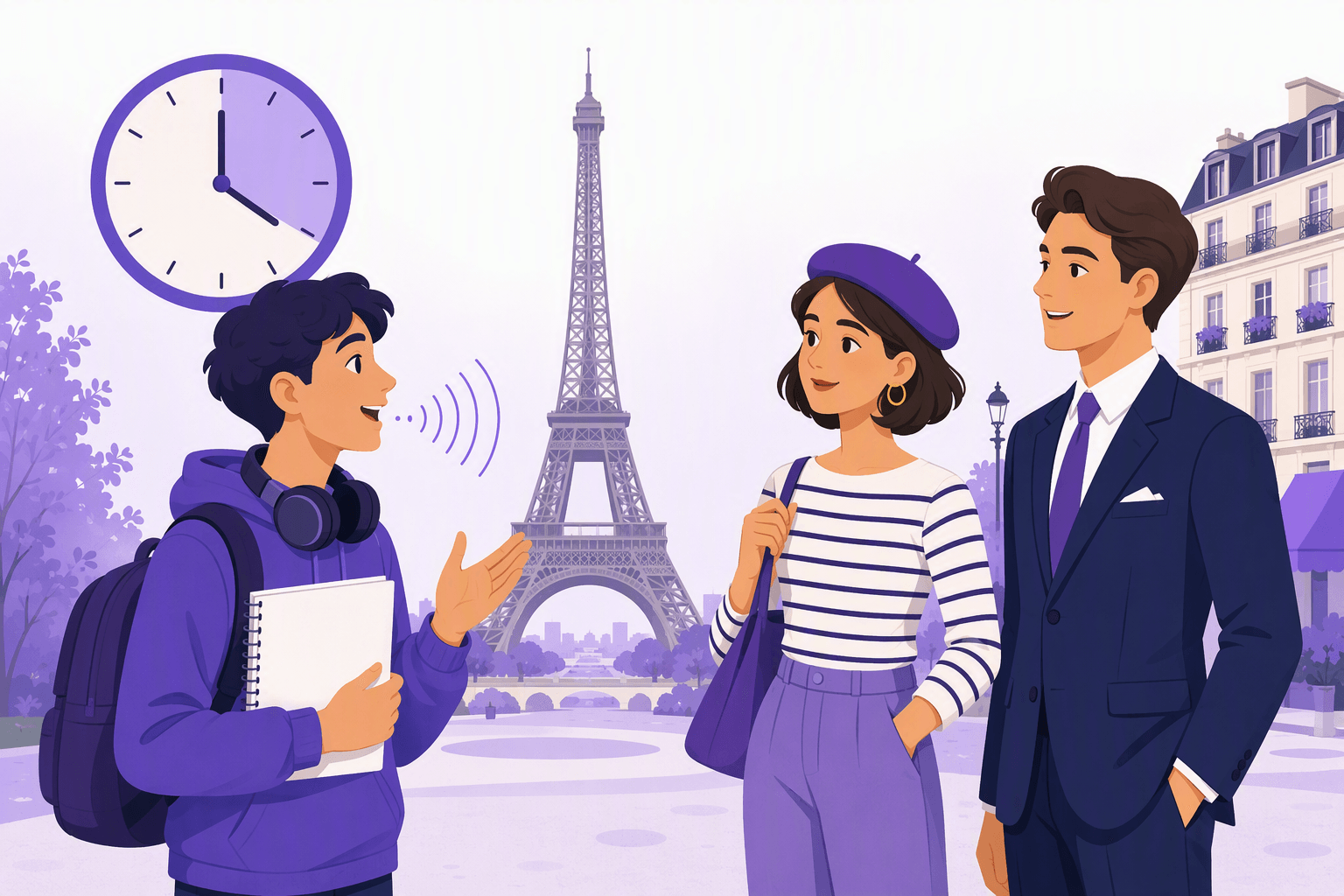
Why French Is Relatively Accessible for English Speakers
French and English are related through centuries of contact, especially after the Norman Conquest of England in 1066. Thousands of English words have French or Latin roots, which gives English speakers a substantial head start with reading vocabulary.
Words such as important /ɛ̃.pɔʁ.tɑ̃/, possible /pɔ.si.bl(ə)/, restaurant /ʁɛs.tɔ.ʁɑ̃/, nation /na.sjɔ̃/, and conversation /kɔ̃.vɛʁ.sa.sjɔ̃/ look and often mean something close to their English counterparts. This does not mean you can guess every word safely, but it makes early reading much less intimidating.
French also uses the same Roman alphabet as English. You will not need to learn a new writing system before you can read basic messages, unlike learners of Japanese, Korean, Arabic, or Russian.
The global reach of French adds another practical advantage. The Organisation internationale de la Francophonie reports more than 320 million French speakers worldwide, with French used across Europe, North America, the Caribbean, and much of Africa. That means learners have abundant films, news, music, podcasts, novels, and conversation partners.
💡 The realistic advantage
French may feel easy to read before it feels easy to understand. Treat reading familiarity as a starting point, then train your ear from the first week with short, repeatable audio.
What Makes French Difficult
The difficulty of French is concentrated in a few areas. If you practice those areas deliberately, the language becomes far less mysterious.
Pronunciation Is Not Fully Phonetic
French spelling preserves historical forms and grammatical information that speakers do not always pronounce. A final consonant in petit /pə.ti/ is usually silent, while the same letter may be heard in a related form such as petite /pə.tit/.
French also has nasal vowels, sounds produced with air resonating through the nose and mouth. In bon /bɔ̃/, vin /vɛ̃/, and sans /sɑ̃/, the final written consonant is not pronounced as a separate sound.
The French R in rue /ʁy/ and Paris /pa.ʁi/ is produced farther back in the mouth than the English R. It can take time to master, but perfect imitation is not required for clear communication.
Another feature is liaison /ljɛ.zɔ̃/, where a normally silent final consonant is pronounced before a following vowel sound. For example, les amis /le.z‿a.mi/ connects smoothly. Learners need to hear liaison often enough to recognize it, rather than trying to pronounce it everywhere.
For targeted sound work, use a French pronunciation guide alongside real audio. Isolated word drills help, but short full sentences teach rhythm and linking more effectively.
Spoken French Looks Different From Textbook French
A sentence can be grammatically correct on a worksheet and still sound formal or unusually careful in ordinary conversation. This gap is one reason learners sometimes understand written French better than a TV scene.
Formal negation often uses ne /nə/ plus pas /pɑ/. In casual speech, speakers frequently omit ne /nə/. The formal sentence Je ne sais pas /ʒə nə sɛ pa/ becomes Je sais pas /ʒə sɛ pa/ or J'sais pas /ʃɛ pa/.
Similarly, French speakers commonly use on /ɔ̃/ for “we” in conversation, even though learners first meet nous /nu/ in conjugation tables. You need to recognize both, because both are normal French.
This is not sloppy language. It is a predictable difference between register, situation, and medium. R. Hawkins and Richard Towell’s A Reference Grammar of Modern French treats these structural choices as central to understanding how contemporary French operates, not as optional slang.
Gender Requires Repetition
Every French noun has grammatical gender. A table is la table /la ta.bl(ə)/, while a book is le livre /lə li.vʁ/. The gender often affects articles, adjectives, and pronouns.
There are useful patterns, but no rule predicts every noun reliably. Learn each noun with its article from the beginning: not just livre /li.vʁ/, but un livre /œ̃ li.vʁ/ or le livre /lə li.vʁ/.
Agreement adds another layer. “A small house” is une petite maison /yn pə.tit mɛ.zɔ̃/, while “a small garden” is un petit jardin /œ̃ pə.ti ʒaʁ.dɛ̃/. This becomes automatic through repeated exposure, not by memorizing a giant list of endings.
Verb Forms Are Numerous, but Patterns Repeat
French verb conjugation includes endings that change with person, tense, and mood. The present tense of être /ɛtʁ/, meaning “to be,” is irregular: je suis /ʒə sɥi/, tu es /ty ɛ/, il est /il ɛ/, nous sommes /nu sɔm/.
That looks demanding, and some high-frequency verbs do require memorization. But French verb systems are highly patterned once you know the common groups and the most useful irregular verbs.
The subjonctif /syp.ʒɔ̃k.tif/, commonly called the subjunctive, is another point that worries learners. It expresses uncertainty, emotion, necessity, or evaluation in certain structures. You do not need to master every trigger at beginner level. First learn recurring phrases such as il faut que /il fo kə/ and je veux que /ʒə vø kə/ in meaningful sentences.
How Long Does French Take to Learn?
The answer depends on your target. Ordering lunch, following a slow podcast, studying at a French university, and working in a French-speaking office are different goals.
The Foreign Service Institute’s 600 to 750 hour estimate is for professional working ability, not native-like fluency. It also refers to intensive, guided study. A person studying five hours a week will take longer in calendar time than someone studying several hours daily.
| Goal | Typical focused study time | What you can realistically do |
|---|---|---|
| Basic survival French | 100 to 200 hours | Greet people, order food, ask directions, handle simple travel needs |
| Everyday conversation | 300 to 450 hours | Discuss routines, preferences, plans, familiar work, and personal experiences |
| Independent B1 to B2 use | 500 to 800 hours | Follow much everyday speech, travel independently, and express opinions with detail |
| Professional working ability | 600 to 750 intensive classroom hours | Operate effectively in many professional and social situations |
The CEFR framework is useful here because it describes what learners can do, rather than treating fluency as a vague finish line. At B1, you can generally manage familiar situations independently. At B2, you can interact with noticeably more spontaneity and follow more complex ideas.
Your Native Language Changes the Difficulty
For English speakers, French is generally easier than languages with very different grammar or writing systems. The FSI grouping reflects this relative accessibility.
Spanish, Italian, Portuguese, and Romanian speakers often find French vocabulary and grammar familiar because these languages share Latin roots. Their challenge may be French pronunciation and listening, especially the contrast between spelling and sound.
German speakers may find some vocabulary familiar through English and shared European linguistic history, but French gender and verb patterns still require focused work. Arabic, Mandarin, Japanese, and Korean speakers often face a larger distance in vocabulary, alphabet, and sentence structure, though individual motivation and study habits can outweigh broad language-distance predictions.
Do not treat an hour estimate as a verdict on your ability. Prior language learning experience, strong reading habits, access to conversation, and consistency make a major difference.
French Listening Is the Skill to Prioritize
Many French learners can complete grammar exercises but freeze when native speakers talk at normal speed. This is common because sound connections, reduced forms, and familiar words blend together.
Train listening with material that is only slightly above your level. Watch a 20 to 60 second scene, listen once for the general situation, then replay it with French subtitles. Notice what you missed, shadow one or two lines aloud, and revisit the clip the next day.
French films and series are especially useful because they teach social context, not just dictionary definitions. You hear how someone softens a request, shows impatience, speaks to a friend, or switches to politeness with a stranger. Our guide to the best movies to learn French can help you choose material that matches your level.
⚠️ Do not rely on subtitles alone
English subtitles can help you follow a plot, but they often summarize rather than translate every French word. Alternate between no subtitles, French subtitles, and brief checks against English so your ear continues to do the work.
Politeness Makes French Feel More Complex Than It Is
French has two major ways to say “you”: tu /ty/ for informal singular situations and vous /vu/ for formal singular or plural situations. Choosing correctly matters because it signals distance, respect, familiarity, or group address.
Use vous /vu/ with strangers, customers, older people when you are unsure, and in professional contexts. Use tu /ty/ with friends, many classmates, children, and people who have invited you to do so.
This can feel stressful, but the safest strategy is straightforward: begin with vous /vu/ when uncertain and follow the other person’s lead. Cultural linguist Claire Kramsch, in Language and Culture, emphasizes that language learning includes interpreting social meaning, not merely producing grammatically valid sentences.
Learn polite routines as complete units. Bonjour /bɔ̃.ʒuʁ/ before a question, s'il vous plaît /sil vu plɛ/ when requesting something, and merci /mɛʁ.si/ afterward make interactions smoother. French politeness is often less about elaborate wording than acknowledging the social opening of an exchange.
For a useful contrast between greetings and departures, see how to say goodbye in French.
French Around the World Is Not One Single Accent
French is spoken across more than two dozen countries and territories, so no learner needs to treat one Parisian accent as the only valid model. France, Belgium, Switzerland, Canada, Senegal, Côte d’Ivoire, Cameroon, and many other places have their own regional vocabulary, rhythm, and social conventions.
A beginner should first build a stable foundation in widely understood standard French. Then listen broadly. Québec French, for example, can sound strikingly different in vowel quality and casual vocabulary, while African French media may introduce local expressions and multilingual influences.
Henriette Walter’s work on the history and diversity of French shows why variation is not a defect or a barrier to “real” French. It is evidence of a language shaped by migration, contact, and local identity.
A Practical Plan to Make French Easier
A sustainable routine beats occasional long study sessions. Aim for daily contact with French, even if some sessions are only 20 minutes.
Weeks 1 to 4
Learn sound-spelling basics, greetings, numbers, common verbs, and survival phrases. Listen to short audio every day and repeat aloud before worrying about speed.
Weeks 5 to 8
Build high-frequency sentence patterns. Practice present tense, simple questions, negation, gender with common nouns, and descriptions of your routine. Read short graded texts and make short voice recordings.
Weeks 9 to 12
Add past events, opinions, plans, and real conversational fillers. Watch scenes with French subtitles, save useful expressions, and try speaking with a tutor, exchange partner, or voice tool at least once a week.
A phrase such as je t'aime /ʒə t‿ɛm/ is easy to memorize, but real confidence comes from understanding when it fits, how it sounds in context, and what someone might say in reply. For romantic language with cultural context, read how to say I love you in French.
The Honest Verdict
French is challenging enough to demand disciplined practice, but it is one of the most attainable major languages for English speakers. Familiar vocabulary and alphabet access make the early stage rewarding. Pronunciation, listening, gender, and social register make the intermediate stage demanding.
If you study consistently, speak before you feel ready, and spend regular time with natural audio, French becomes increasingly predictable. Build your grammar foundation, then use real clips and conversations to turn recognition into usable language.
Frequently Asked Questions
Is French harder than Spanish for English speakers?
How long does it take to become conversational in French?
What is the hardest part of learning French?
Can I learn French by watching French movies and TV shows?
Is French grammar very difficult?
Sources & References
- U.S. Department of State, Foreign Service Institute, Foreign Language Training, accessed 2026
- Organisation internationale de la Francophonie, La langue française dans le monde, 2022
- Ethnologue, 27th edition, 2024
- Council of Europe, Common European Framework of Reference for Languages: Companion Volume, 2020
- Hawkins and Towell, A Reference Grammar of Modern French, Routledge
Start learning with Wordy
Watch real movie clips and build your vocabulary as you go. Free to download.


