Quick Answer
Advanced German swear words are less about one 'bad word' and more about tone, compounds, and context. Germans often insult behavior (not identity) with words like 'Arschloch' and 'Wichser', intensify with 'verdammt' or 'scheiß-', and soften with humor or dialect. This guide explains what people actually say, how harsh it is, and what can get you in trouble.
German swear words get truly advanced when you understand how Germans actually deploy them: as targeted insults (often noun-based), as intensifiers (especially with scheiß-), and as tone markers that can flip from joking to hostile in one sentence. This guide explains what people really say in Germany, Austria, and Switzerland, how harsh it is, and which expressions are best avoided entirely.
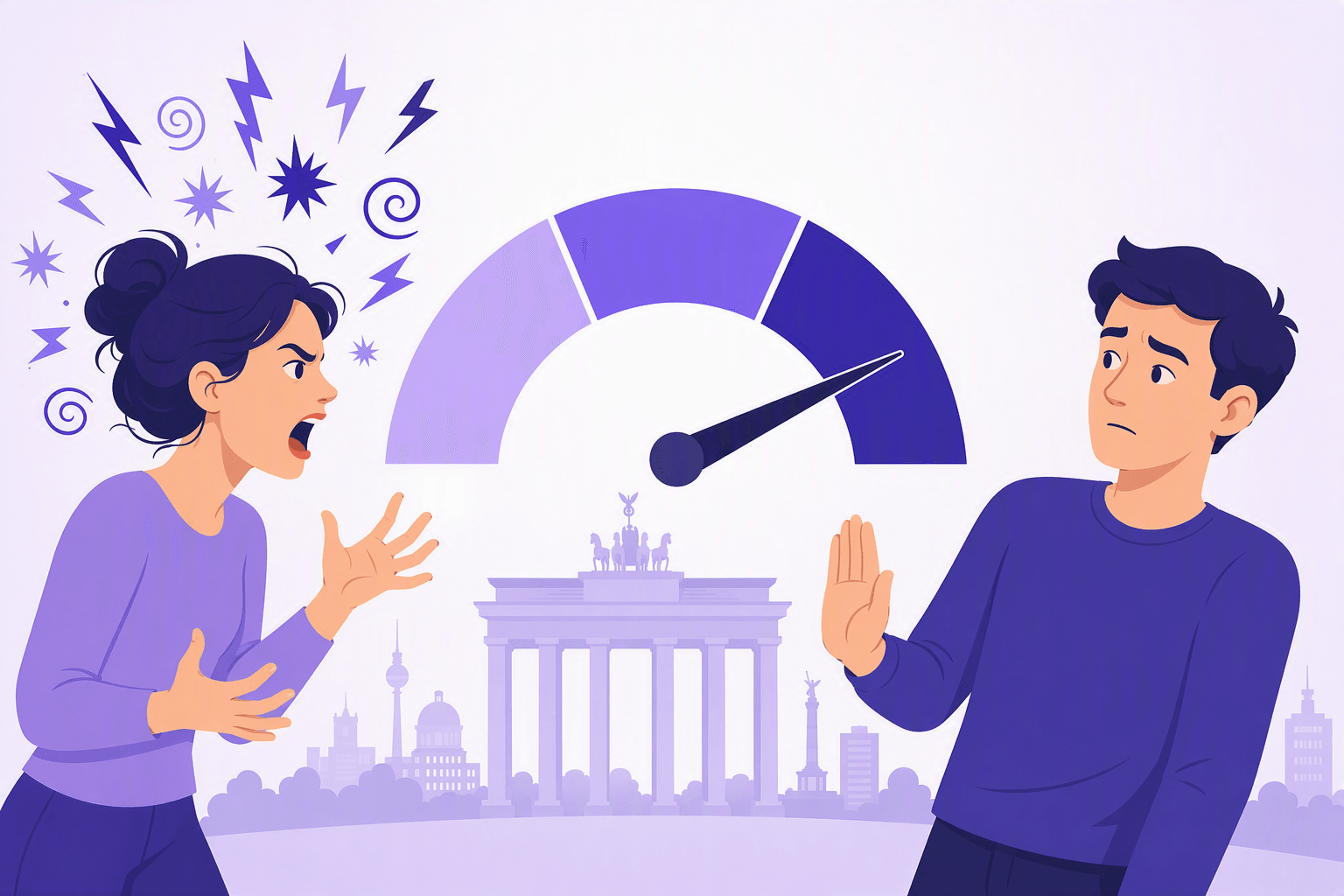
Severity Scale
Everyday expressions. May raise eyebrows in formal settings but generally acceptable among friends.
Clearly vulgar. Common in casual speech but inappropriate in professional or formal contexts.
Highly offensive. Can provoke strong reactions. Use with extreme caution or avoid entirely.
⚠️ Responsible use
Swearing is social language, not a vocabulary list to test on strangers. Many expressions below are insulting, and some can escalate quickly at work, in public, or online. Avoid slurs targeting identity entirely, and remember that direct insults can have legal consequences in Germany under insult law.
If you want a safer starting point first, read our baseline list of German swear words. For polite alternatives that keep you out of trouble, see how to say hello in German and how to say goodbye in German.
Why German swearing feels different (and why learners misjudge it)
German is spoken by tens of millions of people across Europe, and it is an official language in multiple countries. Ethnologue (27th edition, 2024) lists German as one of the world’s major languages by speaker population, which matters because norms vary across Germany, Austria, Switzerland, and border regions.
What learners often miss is structure. German insults are frequently nouns (Du bist ein X), and German is extremely productive with compounds. That productivity makes swearing feel creative, but it also makes it easy to accidentally sound much harsher than you intended.
Linguist Deborah Tannen’s work on conversational style is useful here: directness can be read as efficiency inside a culture, but as aggression outside it. In German, the line between blunt and rude is often drawn by context, pronouns (du vs Sie), and whether the insult is aimed at a person or at a situation.
Person vs situation: the key severity switch
A quick rule that works surprisingly well:
- Swearing about a situation is often tolerated: Scheiße! Mist! Verdammt!
- Swearing at a person escalates fast: Du Arschloch. Du Wichser.
Duden and DWDS usage examples show this split clearly in real citations, where interjections and evaluative adjectives are common, but direct address is the flashpoint.
The severity ladder Germans actually use
A lot of “German swear word lists” flatten everything into one bucket. In real life, Germans grade harshness by (1) target, (2) taboo domain, (3) creativity, and (4) delivery.
Mild: annoyance without attacking someone
These are the words you will hear from otherwise polite people when something goes wrong.
- Mist (MIST)
- Verdammt (fer-DAHMT)
- Scheiße (SHY-suh), often as an exclamation, not aimed at a person
Moderate: insulting, but common in arguments
These can be joking among friends, but risky with strangers.
- Idiot (ee-dee-OHT)
- Arsch (ARSH) as a label, not necessarily the full insult
- Spinner (SHPIN-ner), roughly “weirdo/crazy person” in tone
Strong: direct personal insult
These are the ones that can end friendships or start fights.
- Arschloch (ARSH-lokh)
- Wichser (VIKH-ser)
- Fotze (FOT-tsuh), extremely offensive, avoid
Extreme: slurs and dehumanizing language
Do not use these. Even “quoting” them can cause harm, and some contexts can create legal risk. This guide focuses on common profanity and insults, not identity-based hate speech.
🌍 A German cultural tell: precision insults
German insults often criticize competence or behavior: useless, unreliable, arrogant, dishonest. That can feel colder than English swearing, which often uses general profanity. The sting comes from being specific, not from being loud.
Advanced German swear words and insults (with real context)
Below are the expressions that show up in films, TV, football culture, gaming chat, and everyday arguments. Each entry includes pronunciation and how it lands socially.
Arschloch
/ARSH-lokh/
A very strong insult meaning 'asshole'. Directly attacking the person.
Used in heated conflict or aggressive joking between close friends. Very risky with strangers, coworkers, or in public.
“Du bist so ein Arschloch.”
You are such an asshole.
Common across Germany and Austria. In Switzerland, people may avoid it in mixed company, but it still exists.
Why it is “advanced”: the word is clear, but the grammar around it is where learners slip. So ein Arschloch is harsher than ein Arschloch, because so intensifies the judgment.
Wichser
/VIKH-ser/
A strong insult, literally tied to masturbation, used like 'jerk' but harsher.
Often used at someone who is acting smug, cruel, or deliberately annoying. Not a casual word for most workplaces.
“Was bist du denn für ein Wichser?”
What kind of asshole are you?
Heard widely in Germany. Tone can shift from joking to hostile quickly.
Duden treats it as vulgar, and in practice it is a big step up from Idiot.
Fotze
/FOT-tsuh/
An extremely offensive insult and a misogynistic term. Avoid.
Used to degrade. Even repeating it can be socially toxic. Do not use.
“Das war eine absolut widerliche Aussage.”
That was an absolutely disgusting thing to say.
If you hear it in media, treat it as a marker of a character being abusive, not as everyday vocabulary.
This is included for recognition, not production. If you are learning from gritty German shows, you will run into it.
Hurensohn
/HOO-ren-zohn/
A very strong insult meaning 'son of a prostitute'.
Common in aggressive environments (some street talk, online gaming, football rivalries). Not acceptable in normal conversation.
“Sag das nie wieder zu mir.”
Never say that to me again.
Heard across Germany. In Austria and Switzerland it exists, but social tolerance is low outside hostile contexts.
Why it matters: it is one of the most common “shock” insults learners hear online. It is also one of the fastest ways to escalate a situation.
Bastard
/BASS-tahrt/
A strong insult, often aimed at someone seen as cruel or unfair.
More common in media and dramatic speech than in polite daily life. Still insulting.
“Du verdammter Bastard.”
You damn bastard.
Feels slightly theatrical to some speakers, but still harsh when said directly.
The “scheiß-” system: how Germans intensify anything
One of the most German-feeling moves is turning scheiße into a prefix. Duden documents scheiß- as a vulgar intensifier, and DWDS examples show it attached to everyday nouns.
How it works
- scheiß + noun: scheiß Wetter (terrible weather)
- scheiß + job/object: scheiß Arbeit, scheiß Handy
- scheiß + person label: scheiß Typ (insulting)
Pronunciation: SHYSS (prefix) plus the noun.
💡 Safer alternative
If you want the rhythm without the vulgarity, use verdammt (fer-DAHMT) or blöd (BLURT) as a milder intensifier: verdammt kalt, blöde Idee.
When it crosses the line
Scheiß- aimed at objects is often tolerated. Scheiß- aimed at a person is a direct insult, and it can sound nastier than you expect because it frames the person as “garbage.”
“Du” vs “Sie”: the pronoun that changes the insult
German has a built-in politeness switch. Using du is intimate, whether friendly or hostile. Using Sie keeps distance, which can make an insult sound formal and cutting.
Compare:
- Du spinnst. (doo SHPINST), familiar, confrontational
- Spinnen Sie? (SHPIN-nen zee), cold, sarcastic, often workplace-coded
This is where Brown and Levinson’s politeness framework (in their work on face and face-threatening acts) maps well to German: insults are face attacks, and German gives you multiple “channels” to deliver them.
Region notes: Germany vs Austria vs Switzerland
German profanity travels, but local preferences matter.
Germany: directness plus compounds
Germany is where you will hear the widest range in mainstream media. Berlin speech in particular is famous for bluntness, but do not treat that as a national permission slip.
Austria: “Schmäh” and playful aggression
Austrian German often uses humor and teasing (Schmäh) as a social style. Strong insults still offend, but you may hear more playful grumbling and sarcastic phrasing.
Switzerland: dialect buffer, but not immunity
Swiss German dialects can soften the feel of certain words, and people may switch to Standard German for “serious” conflict. That switch itself is a social signal: when someone stops dialect and goes Standard, they may be escalating.
Swearing you will hear in movies and TV (and what it signals)
If you learn with clips, you will notice that writers use profanity as characterization.
- A character who says Mist and verdammt is often “normal angry.”
- A character who uses Arschloch as direct address is framed as aggressive.
- A character who uses extreme insults is often written as abusive or unstable.
This is one reason learning from authentic dialogue works well: you see who says what, to whom, and what happens next. For more on learning through real speech, start at the blog index and compare with structured basics like how to say I love you in German, where register matters just as much.
What to say instead: strong feelings without social damage
You do not need to swear to sound natural. You need the intonation and the idiomatic “shape” of German complaint.
High emotion, low insult
- Das ist echt nervig. (dahs ist ekht NEHR-vikh), “That’s really annoying.”
- Das geht mir auf die Nerven. (dahs gayt meer owf dee NEHR-ven), “That gets on my nerves.”
- Ich hab die Schnauze voll. (ikh hahb dee SHNOW-tsuh fohl), strong, but less obscene than many insults
Workplace-safe frustration
- Das ist ärgerlich. (dahs ist EHR-ger-likh), “That’s frustrating.”
- Das ist nicht in Ordnung. (dahs ist nikht in ORT-noong), “That’s not OK.”
- So war das nicht abgesprochen. (zoh vahr dahs nikht AHP-guh-shprokh-en), “That’s not what we agreed.”
These are the phrases that keep you sounding adult, not like a subtitled gangster.
Legal and social risk: “Beleidigung” is a real concept
Germany’s StGB §185 covers insult (Beleidigung). That does not mean every swear word leads to court, but it does mean direct personal insults can be more than “just words” if someone reports it.
Practical takeaway: avoid direct address insults in public, online under your real name, and in any situation with power imbalance (customer service, police, workplace conflict).
🌍 A common trap for learners
In English, “You’re an idiot” can be thrown around casually in some friend groups. In German, Du Idiot can feel more confrontational, especially with someone you do not know well. German often prefers describing the action instead: Das war idiotisch, which criticizes the choice, not the person.
How to learn profanity safely with clips (a method that works)
If you want to understand swearing without becoming the person who repeats it at the wrong time, use a three-step filter:
- Identify who says it and to whom.
- Note the consequence, does it get laughs, silence, or escalation?
- Build a “recognize only” list for extreme terms.
A spaced repetition tool can help you separate recognition from production. If you are already using flashcards, our Anki guide for language learning explains how to tag cards as “understand” vs “say.”
A compact “advanced” checklist (what to remember)
- Situation swears (Scheiße!, Mist!, Verdammt!) are far safer than person insults.
- scheiß- is a powerful intensifier, but it becomes aggressive when attached to people.
- Pronouns matter: du is direct, Sie can be icy and humiliating.
- Region and setting matter: what flies in a football crowd does not fly at work.
- If you are unsure, choose complaint phrases, not insults.
If you want the core list first, go to German swear words. Then come back here when you start hearing the “real” stuff in films and arguments.
Final note: learn it for comprehension, not performance
Advanced German profanity is mostly about social competence: knowing when a word is a harmless vent, and when it is a deliberate attack. If you can recognize the harsh terms, understand the tone, and respond with calmer German, you will sound more fluent than someone who only memorized the loudest words.
When you are ready to train your ear on real dialogue, Wordy’s clip-based practice is built for exactly this kind of register awareness: hearing what native speakers actually say, then choosing what you personally want to use.
Frequently Asked Questions
What are the strongest German swear words?
Is 'Scheiße' as strong as the English 'shit'?
Can you get fined for insulting someone in German?
What is the difference between 'du' insults and 'Sie' insults?
Do Germans swear more than other cultures?
Sources & References
- Duden, 'Scheiße' and related entries, accessed 2026
- DWDS (Digitales Wörterbuch der deutschen Sprache), usage examples for profanity terms, accessed 2026
- Institut für Deutsche Sprache (IDS), resources on German pragmatics and spoken language, accessed 2026
- Ethnologue, 27th edition, 2024
- Strafgesetzbuch (StGB) §185 Beleidigung, accessed 2026
Start learning with Wordy
Watch real movie clips and build your vocabulary as you go. Free to download.


