Quick Answer
French sentence structure usually follows subject, verb, object order, but pronouns, negation, adverbs, and questions change where words go. Learn the core patterns so you can build natural French sentences instead of translating English word for word.
French sentence structure usually follows subject + verb + object, as in Je regarde un film /ʒə ʁə.ɡaʁd œ̃ film/, meaning “I watch a film.” But French word order changes in predictable ways when you add negation, object pronouns, adverbs, questions, or two verbs together. Learn those positions, and you can build accurate sentences without translating English word by word.
French is used by an estimated 321 million speakers worldwide, according to the Organisation internationale de la Francophonie. It is an official language in 29 states and governments, so sentence patterns vary slightly across regions, but the core grammar explained here works in France, Belgium, Switzerland, Quebec, and much of Francophone Africa.
If you are starting with everyday speech, pair these grammar patterns with useful expressions from our guide to saying hello in French. Real greetings give you short, memorable models for how French words fit together.
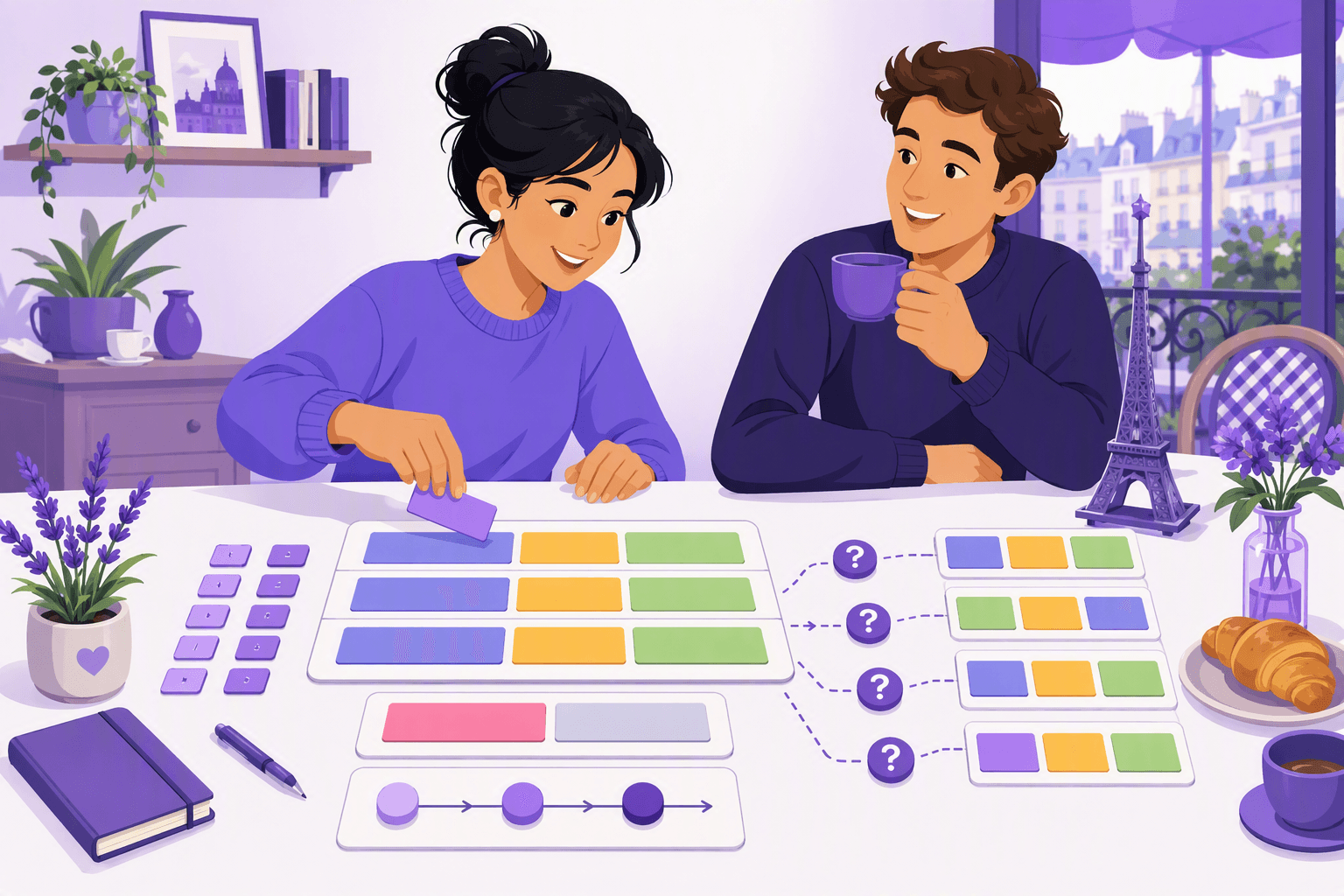
The basic French word order
The default order in a French statement is:
| Part of the sentence | Example |
|---|---|
| Subject | Je /ʒə/ |
| Verb | mange /mɑ̃ʒ/ |
| Object or complement | une pomme /yn pɔm/ |
Je mange une pomme. /ʒə mɑ̃ʒ yn pɔm/ means “I eat an apple.”
This is similar to English, but French uses subject pronouns much more consistently. English allows “Am going now” only in very informal notes or captions. French normally needs the subject: Je pars maintenant /ʒə paʁ mə̃.tə.nɑ̃/, “I am leaving now.”
| English | French sentence | IPA |
|---|---|---|
| She likes coffee. | Elle aime le café. | /ɛl ɛm lə ka.fe/ |
| We live in Paris. | Nous habitons à Paris. | /nu za.bi.tɔ̃ a pa.ʁi/ |
| They watch the series. | Ils regardent la série. | /il ʁə.ɡaʁd la se.ʁi/ |
| My friend speaks French. | Mon ami parle français. | /mɔ̃ na.mi paʁl fʁɑ̃.sɛ/ |
In spoken French, nous /nu/ is frequently replaced by on /ɔ̃/: On habite à Paris /ɔ̃ na.bit a pa.ʁi/. Grammatically, on takes a third-person singular verb, even when it means “we.”
Maurice Grevisse and André Goosse’s reference grammar Le Bon Usage treats this subject-verb relationship as a foundation of French clause structure. For learners, that means finding the conjugated verb first, then identifying who performs it.
Time, place, and manner
French has flexible word order for extra information, but a useful neutral pattern is:
Subject + verb + object + manner + place + time
Je travaille bien à la maison le matin. /ʒə tʁa.vaj bjɛ̃ a la mɛ.zɔ̃ lə ma.tɛ̃/ means “I work well at home in the morning.”
In real conversation, speakers move information to the start when it sets the scene or adds emphasis.
- Le matin, je travaille à la maison. /lə ma.tɛ̃ ʒə tʁa.vaj a la mɛ.zɔ̃/
- À Paris, les cafés ouvrent tôt. /a pa.ʁi le ka.fe zuvʁ to/
- Aujourd'hui, on reste ici. /o.ʒuʁ.dɥi ɔ̃ ʁɛst i.si/
Starting with a time or place phrase is extremely common in French. It does not require changing the subject and verb order, unlike formal inversion patterns in English such as “Here comes the bus.”
💡 A useful building rule
Build a short core sentence first: subject, verb, object. Add time, place, and manner afterward. This prevents a common learner mistake: trying to arrange every detail before choosing the main verb.
Adverbs and French word order
Short, common adverbs often go directly after the conjugated verb.
| English | French | IPA |
|---|---|---|
| I often read. | Je lis souvent. | /ʒə li su.vɑ̃/ |
| She speaks well. | Elle parle bien. | /ɛl paʁl bjɛ̃/ |
| We understand quickly. | Nous comprenons vite. | /nu kɔ̃.pʁə.nɔ̃ vit/ |
| He always arrives late. | Il arrive toujours en retard. | /il a.ʁiv tu.ʒuʁ ɑ̃ ʁə.taʁ/ |
With a compound past tense such as passé composé /pa.se kɔ̃.po.ze/, short adverbs usually go between the auxiliary and past participle.
J'ai bien compris. /ʒe bjɛ̃ kɔ̃.pʁi/ means “I understood well” or “I understood.”
Elle a beaucoup travaillé. /ɛl a bo.ku tʁa.va.je/ means “She worked a lot.”
Longer adverbial phrases frequently come after the past participle.
Nous avons parlé pendant deux heures. /nu za.vɔ̃ paʁ.le pɑ̃.dɑ̃ dø zœʁ/ means “We talked for two hours.”
Toujours
Toujours /tu.ʒuʁ/ is a useful example because position can affect the meaning. After a present-tense verb, it often means “always.”
Il arrive toujours en retard. /il a.ʁiv tu.ʒuʁ ɑ̃ ʁə.taʁ/ means “He always arrives late.”
With a negative, ne... toujours pas /nə tu.ʒuʁ pa/ means “still not.”
Il n'est toujours pas arrivé. /il nɛ tu.ʒuʁ pa za.ʁi.ve/ means “He still has not arrived.”
Object pronouns go before the verb
This is one of the largest differences between French and English. In English, the object generally follows the verb: “I see him.” In French, short object pronouns come before the conjugated verb.
Je le vois. /ʒə lə vwa/ means “I see him” or “I see it.”
Elle nous appelle. /ɛl nu za.pɛl/ means “She is calling us.”
| English | French | IPA |
|---|---|---|
| I know her. | Je la connais. | /ʒə la kɔ.nɛ/ |
| They invite us. | Ils nous invitent. | /il nu ზɛ̃.vit/ |
| We are waiting for you. | Nous t'attendons. | /nu ta.tɑ̃.dɔ̃/ |
| He gives me the book. | Il me donne le livre. | /il mə dɔn lə livʁ/ |
The third row above uses t' /t/ before a vowel sound. French shortens te /tə/ to t' before attendons /a.tɑ̃.dɔ̃/.
When two pronouns appear, French follows a set order:
| Position | Pronoun group |
|---|---|
| 1 | me, te, nous, vous /mə, tə, nu, vu/ |
| 2 | le, la, les /lə, la, le/ |
| 3 | lui, leur /lɥi, lœʁ/ |
| 4 | y /i/ |
| 5 | en /ɑ̃/ |
Je le lui donne. /ʒə lə lɥi dɔn/ means “I give it to him or her.”
This looks reversed to English speakers, but it is a fixed pattern. Read or hear it often enough, and it becomes a single grammatical unit rather than a five-part puzzle.
For a fuller explanation of everyday spoken structures, our French greetings guide is useful because common greetings contain pronouns, questions, and omitted words in their natural settings.
Negation surrounds the verb
Standard written French usually makes negation with ne /nə/ before the conjugated verb and another negative word after it.
Je ne parle pas anglais. /ʒə nə paʁl pa ɑ̃.ɡlɛ/ means “I do not speak English.”
| Meaning | French pattern | Example |
|---|---|---|
| not | ne... pas /nə pa/ | Je ne viens pas. /ʒə nə vjɛ̃ pa/ |
| never | ne... jamais /nə ʒa.mɛ/ | Il ne voyage jamais. /il nə vwa.jaʒ ʒa.mɛ/ |
| no longer | ne... plus /nə ply/ | Elle ne travaille plus ici. /ɛl nə tʁa.vaj ply i.si/ |
| nothing | ne... rien /nə ʁjɛ̃/ | Je ne vois rien. /ʒə nə vwa ʁjɛ̃/ |
| nobody | ne... personne /nə pɛʁ.sɔn/ | Je ne connais personne. /ʒə nə kɔ.nɛ pɛʁ.sɔn/ |
In informal speech, ne /nə/ is often dropped: Je sais pas /ʒə sɛ pa/ instead of Je ne sais pas /ʒə nə sɛ pa/. The Académie française supports the full form in careful writing, but recognizing the shortened spoken form is essential for films, series, and daily conversation.
With object pronouns, the pronoun stays between ne /nə/ and the verb.
Je ne le connais pas. /ʒə nə lə kɔ.nɛ pa/ means “I do not know him or it.”
With an infinitive, negation usually surrounds the infinitive.
Je préfère ne pas sortir. /ʒə pʁe.fɛʁ nə pa sɔʁ.tiʁ/ means “I prefer not to go out.”
Questions: three reliable structures
French offers three standard ways to ask a question. The best choice depends on formality, clarity, and region.
Intonation
Keep statement word order and raise your voice at the end.
Tu viens ? /ty vjɛ̃/ means “Are you coming?”
This is common with friends, family, classmates, and everyday dialogue. It is the question form you will hear most often in modern French speech.
Est-ce que
Put est-ce que /ɛs kə/ before a normal statement.
Est-ce que tu viens ? /ɛs kə ty vjɛ̃/ means “Are you coming?”
This is neutral, direct, and easy to produce. It is a strong default for learners because the subject stays before the verb.
Pourquoi est-ce que tu pars ? /puʁ.kwa ɛs kə ty paʁ/ means “Why are you leaving?”
Inversion
In formal writing and careful speech, place the subject pronoun after the verb, joined by a hyphen in writing.
Viens-tu ? /vjɛ̃ ty/ means “Are you coming?”
Aimez-vous ce film ? /e.me vu sə film/ means “Do you like this film?”
When a third-person verb ends in a vowel and the subject is il /il/, elle /ɛl/, or on /ɔ̃/, French often adds -t- /t/ for pronunciation.
A-t-il compris ? /a til kɔ̃.pʁi/ means “Has he understood?”
The t is not a separate word or a verb ending. It is a linking sound that prevents two vowels from colliding.
🌍 Formal French is not always distant
Inversion appears in news reports, public announcements, literary dialogue, surveys, and customer-facing language. It can sound polished, but it is not the default between friends. Choosing Est-ce que /ɛs kə/ or intonation usually sounds more natural in casual conversation.
Question words and their position
French question words often come first, especially in careful speech.
| English | French question | IPA |
|---|---|---|
| What are you doing? | Qu'est-ce que tu fais ? | /kɛs kə ty fɛ/ |
| Where do you live? | Où est-ce que tu habites ? | /u ɛs kə ty a.bit/ |
| Why is she late? | Pourquoi est-elle en retard ? | /puʁ.kwa ɛ tɛl ɑ̃ ʁə.taʁ/ |
| When are we leaving? | Quand est-ce qu'on part ? | /kɑ̃ ɛs kɔ̃ paʁ/ |
| How does it work? | Comment ça marche ? | /kɔ.mɑ̃ sa maʁʃ/ |
In casual speech, question words can remain at the end.
Tu habites où ? /ty a.bit u/ means “Where do you live?”
This structure is frequent in conversation, especially with où /u/, quand /kɑ̃/, comment /kɔ.mɑ̃/, and pourquoi /puʁ.kwa/. It is not incorrect, but it is less appropriate for formal writing or a carefully structured exam response.
Two verbs: where the second verb goes
French often puts a conjugated verb first and an infinitive second.
Je vais partir. /ʒə vɛ paʁ.tiʁ/ means “I am going to leave.”
Nous voulons manger. /nu vu.lɔ̃ mɑ̃.ʒe/ means “We want to eat.”
Elle peut venir. /ɛl pø və.niʁ/ means “She can come.”
Object pronouns go before the infinitive when they belong to that infinitive.
Je vais le voir. /ʒə vɛ lə vwaʁ/ means “I am going to see him or it.”
Not: Je le vais voir. The pronoun belongs with voir /vwaʁ/, the action of seeing, so it sits directly before that verb.
This point becomes easier with common modal verbs such as pouvoir /pu.vwaʁ/, vouloir /vu.lwaʁ/, and devoir /də.vwaʁ/. See them in context in a scene rather than as isolated charts, and the placement becomes much easier to hear.
Adjective position: noun first, usually
English usually places an adjective before a noun: “an interesting book.” French usually places it after.
Un livre intéressant /œ̃ livʁ ɛ̃.te.ʁɛ.sɑ̃/ means “an interesting book.”
Une ville moderne /yn vil mɔ.dɛʁn/ means “a modern city.”
Some frequent adjectives come before the noun, including petit /pə.ti/, grand /ɡʁɑ̃/, beau /bo/, jeune /ʒœn/, vieux /vjø/, bon /bɔ̃/, and mauvais /mo.vɛ/.
Une petite maison /yn pə.tit mɛ.zɔ̃/ means “a small house.”
Un bon restaurant /œ̃ bɔ̃ ʁɛs.to.ʁɑ̃/ means “a good restaurant.”
Position can change meaning. Un grand homme /œ̃ ɡʁɑ̃ t‿ɔm/ means “a great man,” often an important or admirable person. Un homme grand /œ̃ nɔm ɡʁɑ̃/ means “a tall man.”
The CNRTL dictionary is valuable for checking these meaning differences because it records usage, definitions, and historical senses rather than presenting adjective placement as a simplistic rule.
Common sentence structure mistakes
Translating English word by word
English: “I like very much this film.”
French: J'aime beaucoup ce film. /ʒɛm bo.ku sə film/
Put beaucoup /bo.ku/ after the verb, not before the object as English learners sometimes do.
Forgetting the subject pronoun
Incorrect: Suis fatigué.
Correct: Je suis fatigué. /ʒə sɥi fa.ti.ɡe/
French verb endings do not always make the subject obvious in speech, so pronouns are normally required.
Putting pronouns after the verb
Incorrect: Je vois le.
Correct: Je le vois. /ʒə lə vwa/
Use a full noun after the verb, but move a short object pronoun before it.
Using formal inversion everywhere
Correct but overly formal: Comment vas-tu ? /kɔ.mɑ̃ va ty/
Natural in many daily contexts: Ça va ? /sa va/ or Comment tu vas ? /kɔ.mɑ̃ ty va/
The goal is not to avoid formal French. It is to match the structure to the situation. Our guide to saying goodbye in French shows this clearly, since formal and casual farewells use different sentence lengths and levels of directness.
⚠️ Do not learn word order as a translation trick
French sentence structure works as a system. Instead of translating an English sentence one word at a time, identify the French subject, the conjugated verb, any object pronouns, and the extra information. Then place each element in its usual French position.
How to make French word order automatic
Start with short patterns you can reuse:
- Je veux... /ʒə vø/, “I want...”
- Je peux... /ʒə pø/, “I can...”
- Je ne sais pas. /ʒə nə sɛ pa/, “I do not know.”
- Est-ce que tu... ? /ɛs kə ty/, “Do you...?”
- Il y a... /il i a/, “There is” or “there are.”
- J'aime... /ʒɛm/, “I like...”
Then listen for those patterns in scenes, interviews, and conversations. Pause after a sentence and identify the conjugated verb, pronouns, and negative markers. This turns grammar from a written rule into something you recognize at normal speed.
Romantic phrases are especially useful for this because they often use pronouns and fixed word order. For example, Je t'aime /ʒə tɛm/, covered in our guide to saying I love you in French, demonstrates the core pronoun-before-verb pattern in just three syllables.
French sentence structure is systematic: put the subject before the conjugated verb, place object pronouns before that verb, surround it with negative words when needed, and use a clear question pattern for the setting. With repeated exposure to real dialogue, these positions stop feeling like rules and start sounding expected.
Frequently Asked Questions
What is the basic French sentence structure?
Does French use subject verb object word order?
Why do French adjectives sometimes come after the noun?
Where does ne pas go in a French sentence?
How do you form questions in French word order?
Sources & References
- Organisation internationale de la Francophonie, La langue française dans le monde, 2022
- Académie française, Dire, Ne pas dire, accessed 2026
- CNRTL, Trésor de la langue française informatisé, accessed 2026
- Maurice Grevisse and André Goosse, Le Bon Usage, De Boeck Supérieur
- John A. Hawkins, A Comparative Typology of English and German: Unifying the Contrasts, Routledge
Start learning with Wordy
Watch real movie clips and build your vocabulary as you go. Free to download.


