Quick Answer
French present tense (le présent) is used for what you do now, what you do regularly, general truths, and near-future plans with time words. Most verbs follow -er, -ir, or -re patterns, but a small set of high-frequency irregular verbs (être, avoir, aller, faire, venir, pouvoir, vouloir, devoir) carry a lot of everyday conversation.
French present tense (le présent) is the default tense for everyday French: you use it for what is happening now, what you do regularly, general truths, and even many near-future plans when you add a time phrase like demain or ce soir. If you can conjugate the three big groups (-er, -ir, -re) and a handful of irregular verbs, you can handle a large share of real conversations.
French is spoken by hundreds of millions of people worldwide. Ethnologue estimates about 321 million total French speakers (L1 plus L2) across many countries and regions (Ethnologue, 27th edition, 2024), and the Organisation internationale de la Francophonie tracks French as a global language used across multiple continents (OIF, La langue française dans le monde). That global spread matters because the present tense is stable across regions, but pronunciation and everyday subject choices (like using on for we) are especially noticeable in spoken French.

The core idea: French present tense is about "now" plus "normal"
In English, you often split meaning between "I work" (habit) and "I am working" (right now). French often uses the same present form for both, and the time phrase does the heavy lifting.
Compare:
- Je travaille. This can mean "I work" or "I am working."
- Je travaille en ce moment. This is clearly "I am working right now."
- Je travaille le lundi. This is clearly a habit.
If you want a fast refresher on how French sounds in real life, start with greetings, because they are packed with present-tense verbs like être and aller. See our guide to saying hello in French and how to say goodbye in French.
What le présent is used for (with real-life triggers)
1) Actions happening now
Use le présent with "right now" markers:
- maintenant (mahnt-NAHN)
- en ce moment (ahn suh moh-MAHN)
- tout de suite (too duh SWEET)
Example:
- Je t'appelle maintenant. (zhuh tah-PELL mahnt-NAHN)
"I'm calling you now."
2) Habits and routines
Frequency words point to routine:
- souvent (soo-VAHN)
- toujours (too-ZHOOR)
- parfois (par-FWAH)
Example:
- On mange souvent ici. (ohn MAHN-zhuh soo-VAHN ee-SEE)
"We often eat here."
3) General truths and facts
French uses the present for general statements:
- L'eau bout à 100 degrés. (loh boo ah sahn duh-GRAY)
"Water boils at 100 degrees."
4) Near future with time phrases
French commonly uses present tense for scheduled or imminent actions:
- Je pars demain. (zhuh pahr duh-MEH)
"I'm leaving tomorrow."
You will also hear the near-future construction aller + infinitive (je vais partir), but plain present is extremely common, especially with clear time words.
5) Narration and commentary (especially in media)
In sports commentary, recaps, and casual storytelling, French often uses present for vividness. This is one reason movie and TV clips are so useful: you hear le présent used for action, reaction, and quick judgments.
Before conjugation: the two rules that save you
Rule 1: The subject pronoun is not optional in speech
Because many endings are silent, French keeps the subject pronoun almost always:
- je (zhuh)
- tu (too)
- il/elle/on (eel, ell, ohn)
- nous (noo)
- vous (voo)
- ils/elles (eel, ell)
In writing, the endings matter more. In speech, the pronoun often carries the person information.
Rule 2: Learn verbs as "sound families"
French spelling can make conjugation look harder than it sounds. Many forms are pronounced the same even when written differently.
For example, parler (to speak):
- je parle, tu parles, il parle often sound like pahr-l (one main spoken shape)
This is why modern teaching approaches emphasize high-frequency chunks and listening. In applied linguistics, Paul Nation’s work on frequency and coverage is often cited for the idea that high-frequency items give the biggest payoff first (Nation, Learning Vocabulary in Another Language, Cambridge University Press). For verbs, that means mastering the most common present-tense patterns and irregulars early.
Group 1: -er verbs (the biggest group)
Most French verbs end in -er, and the present tense pattern is consistent.
Pattern: parler (pahr-LAY)
Stem: parl-
| je | tu | il/elle/on | nous | vous | ils/elles |
|---|---|---|---|---|---|
| parle | parles | parle | parlons | parlez | parlent |
Pronunciation tip: je parle, tu parles, il parle, ils parlent are usually pronounced the same in everyday speech.
Common -er verbs you will see everywhere:
- aimer (eh-MAY) to like, to love
- regarder (ruh-gahr-DAY) to watch
- écouter (ay-koo-TAY) to listen
- demander (duh-mahn-DAY) to ask
Spelling-change -er verbs (still regular, just adjusted)
Some -er verbs change spelling to keep pronunciation consistent.
-ger: manger (mahn-ZHAY)
Nous form adds an e:
- nous mangeons (noo mahn-ZHOHN)
-cer: commencer (koh-mahn-SAY)
Nous form uses ç:
- nous commençons (noo koh-mahn-SOHN)
-yer: payer (peh-YAY)
Often becomes i in many forms:
- je paie / je paye (zhuh peh) Both spellings exist, pronunciation is similar.
💡 A fast way to spot an -er verb
If the infinitive ends in -er and it is not aller, it is almost always a regular -er verb in the present tense. Put your effort into the irregulars first, because they appear constantly in real dialogue.
Group 2: -ir verbs (two common patterns)
Not all -ir verbs behave the same. There are two big patterns, and you should learn to recognize them.
The -issons pattern: finir (fee-NEER)
Stem: fin-
| je | tu | il/elle/on | nous | vous | ils/elles |
|---|---|---|---|---|---|
| finis | finis | finit | finissons | finissez | finissent |
A quick recognition trick: if you see nous finissons, you are in the -issons family.
Common verbs in this pattern:
- choisir (shwah-ZEER) to choose
- réussir (ray-oo-SEER) to succeed
- grandir (grahn-DEER) to grow up
The "no -iss" pattern: partir (pahr-TEER)
Stem changes slightly in plural forms for many of these verbs.
| je | tu | il/elle/on | nous | vous | ils/elles |
|---|---|---|---|---|---|
| pars | pars | part | partons | partez | partent |
Other common verbs in this family:
- sortir (sor-TEER) to go out
- dormir (dor-MEER) to sleep
- servir (sehr-VEER) to serve
Group 3: -re verbs (short, often silent endings)
Many -re verbs drop the final -re in the singular and add -ons, -ez, -ent in the plural.
Pattern: vendre (vahn-druh)
Stem: vend-
| je | tu | il/elle/on | nous | vous | ils/elles |
|---|---|---|---|---|---|
| vends | vends | vend | vendons | vendez | vendent |
Common -re verbs:
- attendre (ah-TAHN-druh) to wait
- répondre (ray-POHN-druh) to answer
- entendre (ahn-TAHN-druh) to hear
CNRTL is a reliable place to check conjugation tables and usage notes when you are unsure about a verb family (CNRTL, accessed 2026).
The irregular verbs that power everyday French
A small set of irregular verbs covers an outsized portion of real speech. If you learn these in the present tense, you unlock introductions, opinions, needs, plans, and polite requests.
être (EH-truh)
Pronunciation: je suis (zhuh SWEE), tu es (too EH), il est (eel EH)
| je | tu | il/elle/on | nous | vous | ils/elles |
|---|---|---|---|---|---|
| suis | es | est | sommes | êtes | sont |
You use être for identity, descriptions, and the most common structure in spoken French: c'est (SEH), meaning "it is" or "that is."
avoir (ah-VWAHR)
| je | tu | il/elle/on | nous | vous | ils/elles |
|---|---|---|---|---|---|
| ai | as | a | avons | avez | ont |
Avoir is also the helper verb for passé composé later, so it is a long-term investment.
aller (ah-LAY)
| je | tu | il/elle/on | nous | vous | ils/elles |
|---|---|---|---|---|---|
| vais | vas | va | allons | allez | vont |
Aller + infinitive is the near-future pattern:
- Je vais manger. (zhuh veh mahn-ZHAY) "I'm going to eat."
faire (FEHR)
| je | tu | il/elle/on | nous | vous | ils/elles |
|---|---|---|---|---|---|
| fais | fais | fait | faisons | faites | font |
You will hear:
- Ça fait... (sah FEH) "That makes..." or "It's been..." (time)
venir (vuh-NEER)
| je | tu | il/elle/on | nous | vous | ils/elles |
|---|---|---|---|---|---|
| viens | viens | vient | venons | venez | viennent |
Common in:
- Je viens de + infinitive (recent past): Je viens de rentrer. (zhuh vyahn duh rahn-TRAY)
pouvoir, vouloir, devoir (modal-style verbs)
These are essential for polite, natural speech.
- pouvoir (poo-VWAHR): je peux (zhuh puh), nous pouvons (noo poo-VOHN)
- vouloir (voo-LWAHR): je veux (zhuh vuh), nous voulons (noo voo-LOHN)
- devoir (duh-VWAHR): je dois (zhuh DWAH), nous devons (noo duh-VOHN)
If you want to sound natural, these verbs matter more than hundreds of low-frequency regular verbs.
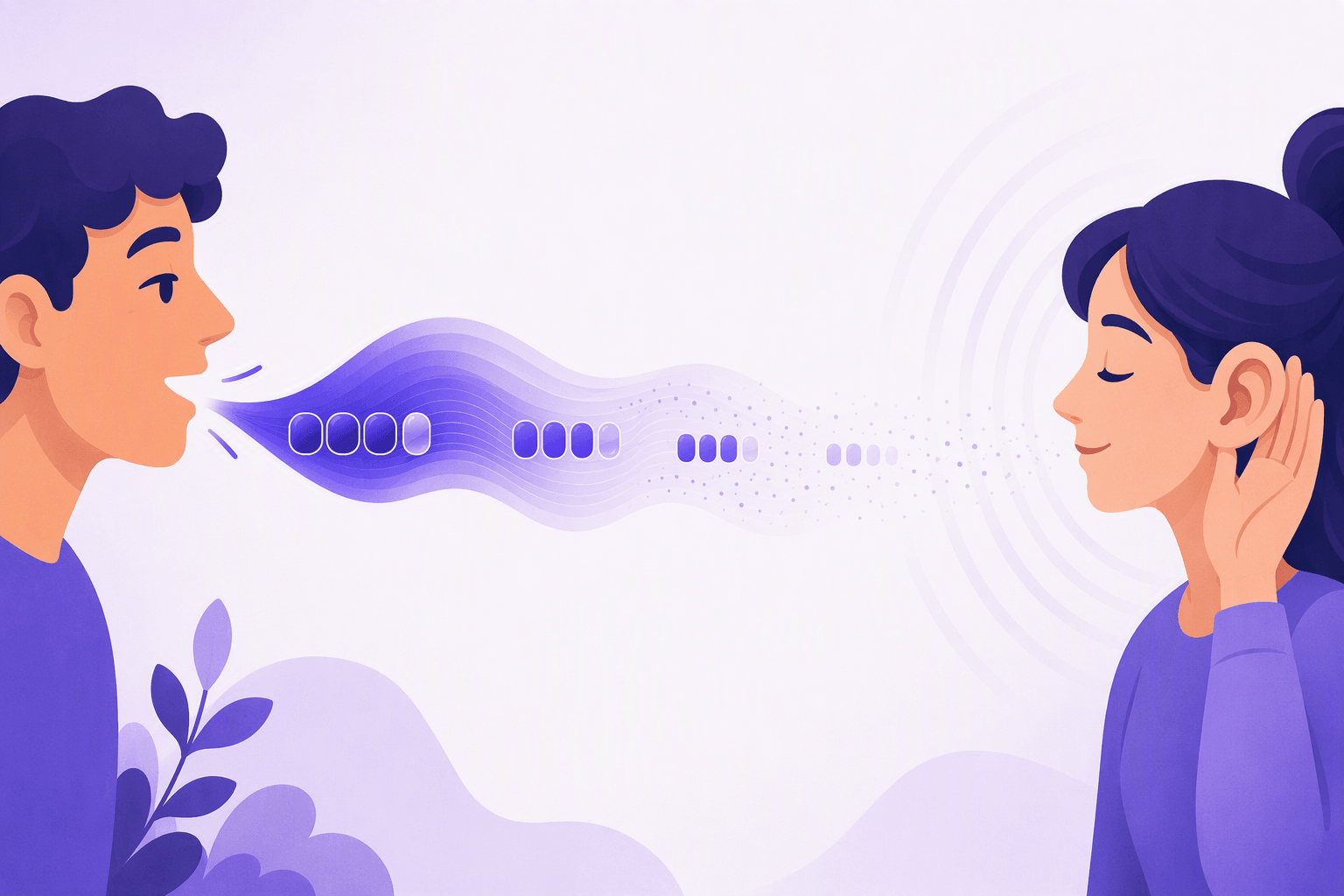
The spoken French reality: endings you see but do not hear
Many learners feel they "know" conjugation but cannot catch it in dialogue. That is normal, and it is partly structural.
Why it happens
- For many verbs, the written endings -e, -es, -ent are silent.
- Liaison and linking can hide word boundaries.
- The subject pronoun is often reduced (je becomes zhuh or even sh in fast speech).
David Crystal’s general point about rhythm and connected speech in language description applies well here: fluent speech is not a sequence of isolated words, it is a stream with reductions and predictable patterns (Crystal, The Cambridge Encyclopedia of the English Language, Cambridge University Press). For French, those reductions are strongly tied to silent endings and linking.
What to do instead of "listening harder"
Train your ear on high-frequency frames:
- je suis, c'est, il y a (eel ee AH)
- je vais + infinitive
- je peux, je veux, je dois
- on + verb (on est, on va, on fait)
Movie and TV clips help because you hear the same frames repeated with different vocabulary, which is how your brain starts predicting them.
Cultural note: why "on" is everywhere
In many classrooms, you learn nous first for we. In everyday spoken French, on often replaces nous, especially in casual settings:
- On va au cinéma. (ohn vah oh see-neh-MAH)
"We are going to the movies."
This is not slang, it is standard spoken usage. In more formal writing, nous is more common, and in formal speech (presentations, interviews) you will hear both.
🌍 A practical register tip
If you use nous in a casual conversation, you will still be understood, but it can sound slightly formal or schoolbook depending on the setting. If you use on with friends, you will sound more natural, and the verb stays third-person singular.
Common present-tense mistakes (and quick fixes)
Mixing up tu and vous
Tu is singular informal. Vous is plural or polite singular.
If you are unsure, default to vous. It is safer in customer service, first meetings, and professional contexts.
Translating English "I am + -ing" too literally
French does not need a special present continuous tense.
- I am eating.
Je mange. (zhuh MAHN-zhuh)
If you need emphasis:
- Je suis en train de manger. (zhuh SWEE ahn TRAYN duh mahn-ZHAY)
This is "I am in the middle of eating."
Forgetting that verbs follow the subject, not the person you mean
Learners sometimes say nous va because they are thinking "we go." The subject controls the form:
- nous allons
- on va
Overusing je in fast dialogue
Native speech often uses short replies:
- Pas vraiment. (pah vray-MAHN) not really
- J'sais pas. (zhay pah) I don't know (casual reduction of je ne sais pas)
⚠️ About casual reductions
Forms like j'sais pas are common in movies and everyday speech, but they are casual. Learn them for listening, and use the full form (je ne sais pas) in writing and formal situations.
Practice plan: learn le présent the way you will actually use it
Step 1: Memorize the eight power verbs
Spend a week cycling:
- être, avoir, aller, faire, venir, pouvoir, vouloir, devoir
Write five sentences per verb that you could say in real life.
Step 2: Add one regular verb per day, but keep the same frames
Example frames:
- Je + verb + souvent
- On + verb + ce soir
- Tu + verb + où
This keeps practice meaningful instead of mechanical.
Step 3: Use real dialogue, not invented textbook sentences
Short scenes force you to process speed, reductions, and turn-taking. If you like learning through set phrases, you will also see how present-tense verbs show up inside emotional lines like je t'aime. Our I love you in French guide is a good example of how a simple present form carries a lot of pragmatic weight.
Step 4: Check usage when you are unsure
For definitions and real usage notes, CNRTL is a strong reference (CNRTL, accessed 2026). For broader usage guidance and common pitfalls in contemporary French, the Académie française maintains practical notes in Dire, Ne pas dire (Académie française, accessed 2026).
Present tense in real French: mini examples you will hear a lot
C'est
Pronunciation: SEH
Meaning: "it is", "that is"
- C'est bon. (SEH bohn) It’s good.
- C'est pas grave. (SEH pah grahv) It’s not a big deal.
Il y a
Pronunciation: eel ee AH
Meaning: "there is/there are"
- Il y a un problème. (eel ee AH uhn proh-BLEHM)
Ça va
Pronunciation: sah VAH
Meaning: "it goes", used as "How’s it going?" and "I’m fine."
If you want the greeting context and natural replies, see how to say hello in French.
Je peux / je veux / je dois
These three cover ability, desire, and obligation. They are the backbone of polite requests and everyday decisions.
A quick note on taboo language and the present tense
You will hear present tense inside swearing and insults because it is immediate and direct. If you are learning from movies, you will run into lines like c'est nul or t'es sérieux. Knowing être in the present helps you understand tone without copying it.
If you want to recognize common expressions without accidentally using them in the wrong setting, read our guide to French swear words.
Bringing it together: the smallest set that gets you fluent-feeling fast
If your goal is to speak sooner, prioritize:
- être, avoir, aller, faire
- pouvoir, vouloir, devoir
- one clean regular -er verb (parler), one -ir (finir), one -re (vendre)
- on as spoken "we"
This set lets you describe yourself, ask for things, make plans, and react in conversation, which is what most learners actually need first.
When you are ready to hear le présent at native speed, practice with short, repeatable scenes and subtitles, then rewatch until the reductions feel normal. For more French learning paths, browse the Wordy blog and keep your practice anchored in real dialogue, not just charts.
Frequently Asked Questions
What is the French present tense used for?
Do French verbs always have to be conjugated?
Why do I not hear the verb ending in spoken French?
What are the most important irregular verbs in the present tense?
Is 'on' singular or plural for conjugation?
Sources & References
- Organisation internationale de la Francophonie, La langue française dans le monde
- Ethnologue, 27th edition, 2024
- CNRTL (Centre National de Ressources Textuelles et Lexicales), verb entries and conjugation tables, accessed 2026
- Académie française, Dire, Ne pas dire (usage notes on contemporary French), accessed 2026
Start learning with Wordy
Watch real movie clips and build your vocabulary as you go. Free to download.


